
Written Rule: 54.9 Percent Against 29.5
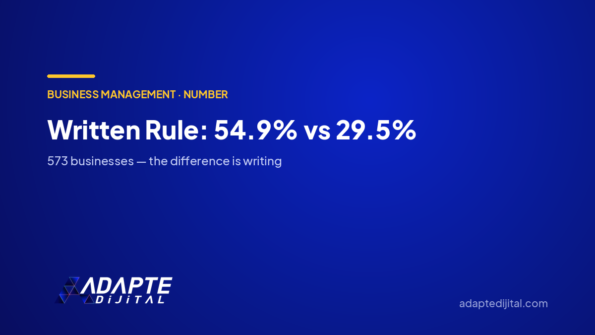
A business with a written rule replies nearly twice as fast as one without. A benchmark study of five hundred and seventy-three businesses put two figures side by side: 54.9 percent of those with a written response rule reply within fifteen minutes, against 29.5 percent of those without.
The difference is not ability. It is a written sentence, and the result of writing it down. Intent that stays spoken goes untracked. Writing it down changes the outcome by a considerable margin. The commitment becomes trackable and the team knows the target.
What the Number Says
BU BÖLÜMÜN ÖZETİ
- A written rule changes the outcome
- Most miss the target
- The sample is broad
Three findings.
A written rule changes the outcome
The gap between the two groups runs close to double. Businesses doing the same work reply at different speeds. What decides it is whether the commitment was written down. An unwritten promise goes untracked. What is not measured is not managed. Writing is the first step, and it takes ten minutes to complete, and the application starts the same day.
Most miss the target
The same study found three quarters of businesses missing the five-minute window. So replying quickly counts as an exception, and the opportunity sits right there. What most cannot do becomes a way to stand apart. Competition here stays thin. Three quarters of businesses miss the window entirely. Standing apart becomes straightforward when so few manage it.
The sample is broad
More than five hundred businesses were examined across different sectors. The finding carries weight for that reason. The sample was not kept narrow. Different sectors were covered. The result is not a coincidence.
What the Headline Misses
BU BÖLÜMÜN ÖZETİ
- The rule need not be complex
- Five minutes is not needed everywhere
- A rule alone is not enough
Three details.
The rule need not be complex
A written rule here can be a single sentence of commitment. Something like “enquiries get a reply the same day.” What shortens the time is clarity rather than complexity. The average delay meanwhile runs to two days.
Five minutes is not needed everywhere
That threshold matters where decisions get made fast. Long decision cycles carry no such urgency. Setting a period that suits your own work makes more sense than copying one. Your own decision cycle is what matters. Fast decisions carry more urgency. Longer decision cycles allow considerably more room.
A rule alone is not enough
Writing it is the first step. Applying it needs an owner. When the two come together the outcome changes. A rule on its own stays on paper. Someone has to carry it.
What a Business Should Do
BU BÖLÜMÜN ÖZETİ
- A ten-minute first decision
- First move: pick a realistic period
- Next move: measure adherence
Three steps.
A ten-minute first decision
How long, at most, before you reply to an enquiry? Choose a period and write it down. It takes ten minutes and needs no complex process.
First move: pick a realistic period
Writing a period you cannot hold serves nothing. Even same-day is a step forward for most businesses. The response system builds the structure that carries it.
Next move: measure adherence
In how many enquiries did you meet your own stated period? That ratio shows your real performance.
Replying quickly is not a talent. It is the result of a written rule.