

Return on website investment is a critical question that every business aiming for sustainable growth in the digital world must answer. The question, “What did we spend on the site, and what did we gain in return?” sounds simple; however, it’s almost impossible to give a reliable answer without knowing the right metrics. This guide is designed to make your digital investment measurable, traceable, and optimizeable.
📊 According to Google research, businesses that make data-driven decisions achieve 23% more growth compared to their competitors. However, the vast majority of SMEs in Türkiye never measure the real return on their website investment. Budget is based on estimation, decision-making on intuition.
In this guide, we will cover four key topics step-by-step, from the Return on Website Investment (ROI) formula to real-world industry examples, from success metrics to expectation management. Each section provides both the conceptual framework and immediately applicable tools. Because getting this calculation right is not just about finding a number — it’s the foundation of making smarter decisions.
1. ROI Formula: How to Calculate Return on Website Investment?
Do you know what your website is really bringing you — or are you guessing? The basis of the Website Return on Investment (ROI) calculation rests on the universal ROI formula: (Profit − Cost) ÷ Cost × 100. However, in the digital world, the concept of “profit” is not limited to direct sales; organic traffic, brand trust, cost per customer reduction, and operational efficiency are also part of the equation.
🧮 Limiting the ROI calculation to only e-commerce sales means ignoring the invisible returns. A blog post that ranks high in organic searches brings months of free traffic; a 24/7 contact form collects leads outside of working hours.
The return on digital investment (ROI) becomes much stronger when all these channels are taken into account. Therefore, the return on website investment should be calculated by summing both direct and indirect returns.1.1 Basic ROI Formula and Components
The first step in the calculation is to list all cost items completely. Website development costs, annual hosting and domain, maintenance, SEO work, and advertising budget — all of these fall under the cost side. On the revenue side, there are direct sales from the website, form requests, phone calls, and increased brand searches. The Return on Website Investment formula is based precisely on the difference between these two sides.
- Cost:construction + hosting + domain + maintenance + SEO + advertising — all must be entered completely
- Revenue:direct sales + form requests + phone calls + increased brand value
- Formula:(Total Revenue − Total Cost) ÷ Total Cost × 100 = ROI %
- Measurement period: At least 3 months of data required — perform monthly, quarterly and yearly comparisons
1.2 Distinction Between Direct and Indirect Returns
You have a mobile-friendly site — but have you ever considered the reduction in your customer service burden? The most common mistake in ROI calculation is only counting direct revenue. However, the indirect returns of a website are often greater than direct revenue: reduced customer service burden, shorter sales cycle, lower onboarding costs. To see the True Return on Website Investment, indirect returns must be taken into account. To see the true return, indirect returns must be taken into account. When the Return on Website Investment is calculated only by looking at sales figures, a significant part of the true picture remains invisible.
- Direct return: Sales, quotation forms, reservations coming from the web
- Indirect return: Reduced support calls, shorter sales cycle, lower customer acquisition costs
- Brand value: Increased organic search volume, social referrals, press releases
- Operational savings: Transitioning physical items such as paper catalogs, brochures, and faxes to digital
1.3 Extended ROI with Customer Lifetime Value (CLV)
Does a customer who comes through a website only buy once? To see the true extent of website ROI, it is essential to include customer lifetime value (CLV) in the equation. Formula: average order value × annual purchase frequency × customer lifetime. When this calculation is combined with CLV, a much stronger picture emerges than a one-time sales-focused calculation.
- CLV formula:Avg. Orders × Annual Purchases × Customer Lifecycle (years)
- Example:2,000 TL × 3 orders/year × 4 years = 24,000 TL CLV — the real value of each new customer
- Extended ROI:10 customers from the website × 24,000 TL CLV = 240,000 TL long-term return
- Cohort analysis:Compare the CLV of customers acquired in different periods
1.4 Digital Tools That Simplify ROI Calculation
So where will you find all this data? Google Analytics 4 shows where each visitor came from, how long they stayed on each page, and at which step they converted. This data allows you to reliably fill in the revenue side of the ROI formula. ROI calculation without tools is an estimate, while calculation with tools is the actual ROI.
- Google Analytics 4: traffic source, conversion tracking, goal completion — free
- Google Search Console: organic clicks, impressions, average Ranking — SEO is critical for Return on Website Investment
- Hotjar / Microsoft Clarity: Heatmap and logging — which domains are converting, which are missing?
- CRM integration: Track the conversion rate of leads from your website to sales
👉Let’s build your Return on Website Investment infrastructure → 
2. Example Calculation: Visualize ROI with Real-Life Scenarios 📐
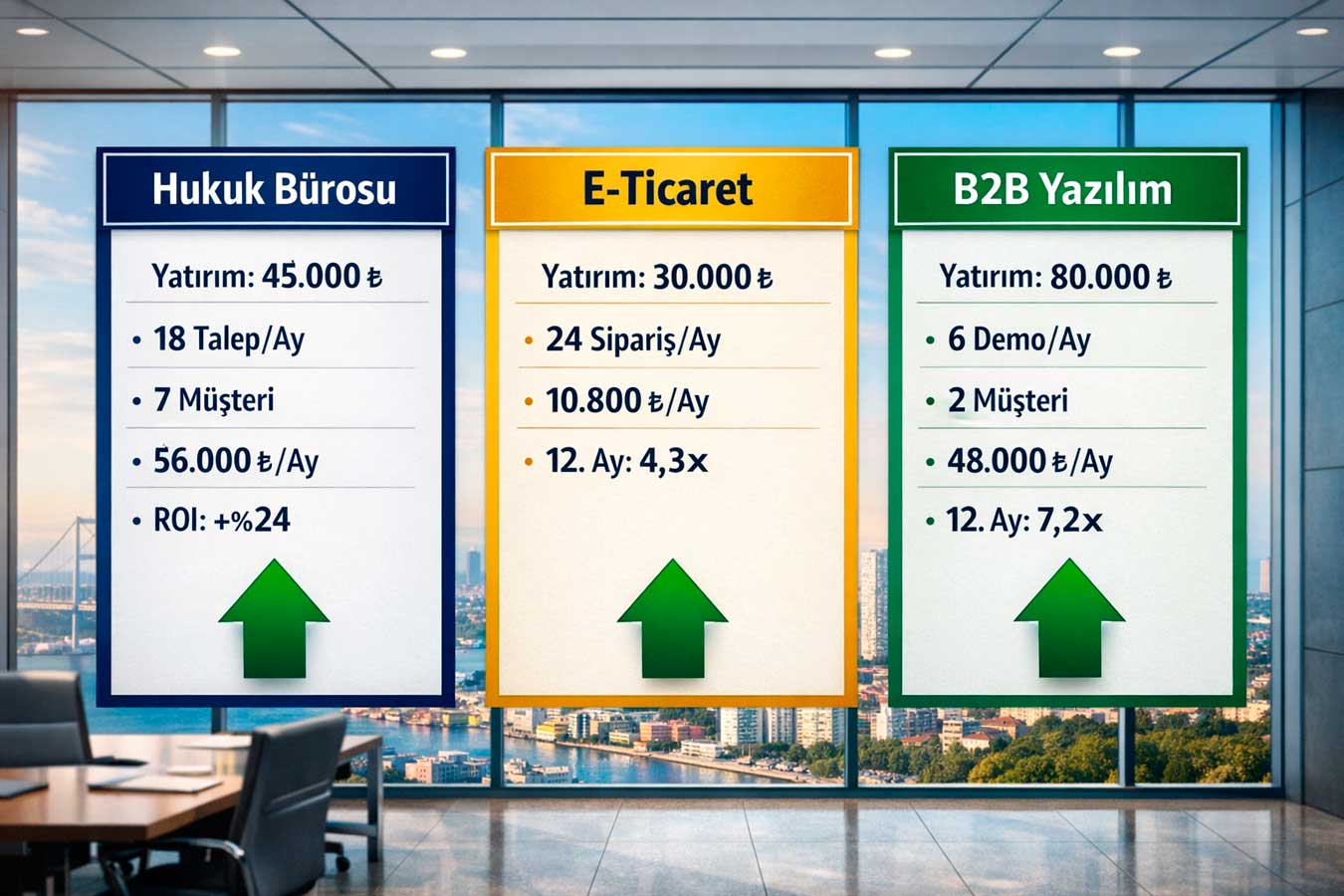
The formula is clear — but abstract numbers don’t make decisions. Making budget decisions without visualizing the Return on Website Investment means investing blindly. So, what does a realistic ROI table look like in your sector? The following three scenarios are typical models based on the realities of Turkish SMEs.
📐 We have taken examples from three different sectors: service, e-commerce, and B2B. In each sector, the cost structure, the Return on Website Investment, and customer value differ; therefore, the ROI table also changes. You can quickly calculate this ratio based on the scenario closest to your own sector.
2.2 E-Commerce Scenario: Handmade Product Brand
A brand selling handmade products establishes an e-commerce site with an investment of 30,000 TL. With 1,200 monthly visitors and a 2% conversion rate, it receives 24 orders/month. The average order value is 450 TL, and the CLV (Customer Lifecycle) is 2,700 TL. Monthly revenue: 24 × 450 = 10,800 TL. Monthly operating costs are 800 TL. The return on website investment becomes positive in the 3rd month; in the 12th month… Cumulative return reaches 4.3 times the investment.
- Investment: 30,000 TL — e-commerce setup + first year maintenance
- Monthly orders: 24 × 450 TL = 10,800 TL — monthly operating cost 800 TL
- 3rd month cumulative: 32,400 TL → positive ROI threshold exceeded
- 12-month cumulative: 129,600 TL → 4.3 times the investment
2.3 B2B Scenario: Software Company
A corporate software company is establishing a content-focused corporate website with an investment of 80,000 TL. Monthly 400 organic visitors, 1.5% conversion rate, 6 demo requests/month. Demo → customer conversion 33% = 2 new customers/month. Annual license value 24,000 TL. Monthly direct return: 2 × 24,000 = 48,000 TL. ROI in the 2nd month +20%; total return in the 12th month 7.2 times the investment.
- Investment: 80,000 TL — including content strategy + technical SEO
- Demo request → conversion: 6 × 33% = 2 customers × 24,000 TL = 48,000 TL/month
- ROI (2. (month): (96,000 − 80,000) ÷ 80,000 × 100 = 20% positive
- 12-month cumulative return: 576,000 TL → 7.2 times the investment
2.4 Channel Comparison: Website vs. Advertising vs. Fair
To contextualize website ROI, it is essential to compare it with other channels. With Google Ads, per customer The cost is 500–5,000 TL; when advertising stops, traffic instantly drops to zero. With an organic website, the cost per customer gradually decreases to 50–200 TL and continues to grow without advertising. This investment offers the highest Return on Website Investment of digital channels in the long term.
- Google Ads: 500–5,000 TL per customer — traffic instantly drops to zero when advertising stops
- Organic website: 50–200 TL per customer — decreases over time, no need to stop
- Social media organic: 200–800 TL per client — algorithm dependent, fragile
- Fair / event: 1,000–8,000 TL per client — geographically restricted, non-repeatable
👉 For ROI calculation specific to your sector → Free Consultation — Web Design Agency
3. Success Metrics: Which KPIs Drive ROI? 📈
Your website gets 10,000 visitors a month but no customers? Then the metric you’re measuring is wrong. Choosing the right metrics is the only way to avoid falling into the vanity metric trap. High traffic but zero conversions is far less valuable than low traffic but high conversions.
📈 Choosing the right KPIs shows you clearly where your budget is going and what’s working. Every metric measures something; but they don’t all carry equal weight. To see the True Return on Website Investment value, look for one that’s directly linked to your business goal. It is essential to first list the metrics, then measure them regularly.
3.1 Traffic Metrics: Quality, Not Quantity
Where is all this traffic coming from, and is the visitor really interested? Traffic quality, not traffic quantity, determines ROI. Analyzing traffic metrics by source — organic, paid, direct, social — reveals which channel is actually working. The most valuable resource for Return on Website Investment: organic traffic.
- Organic traffic: Free visitors from Google — a direct output of SEO investment
- Bounce rate: Below 40% is good; above 70% indicates page-audience mismatch
- Session duration: More than 2 minutes means interaction; short duration indicates content mismatch
- Page views/visits: 2+ visitors are browsing the site and are interested — a positive sign
3.2 Conversion Metrics: The Heart of ROI
Your visitor comes to your site — but what do they do next? Conversion metrics are the indicators that most directly affect this investment. Conversion isn’t just about sales; form completion, phone clicks, document downloads, and starting live chats also count as conversions. Every 1% increase in conversion rate is as valuable as doubling traffic.
- Overall conversion rate: industry average 1-4% — above is good, below is an optimization signal
- Page-based conversion: Which landing page generates the most forms? Duplicate that page
- Micro-conversion: Phone clicks, map clicks, document downloads — pre-purchase signals
- Conversion path: How many pages did the user visit before conversion? Optimizing this path is critical
3.3 SEO Metrics: The Compass of Organic Growth
Content that appears on the first page today brings free traffic for years — are you watching this? Organic search metrics show the long-term health of your digital return. Regularly monitoring organic click, impression, and average ranking data from Google Search Console proves that your SEO investment is progressing in the right direction.
- Organic click increase: 5%+ monthly growth is an indicator of healthy SEO progress
- Keyword ranking: Are target keywords in the top 3, top 10, or on the first page?
- Domain Authority (DA): Monthly tracking with Moz or Ahrefs — a reflection of backlink quality
- Core Web Vitals: LCP, FID, CLS — Google’s speed and usability score, rankingdirectly affects
3.4 Customer Acquisition Cost (CAC): Compare Channels to Their True Value
Have you ever calculated which channel brings you the cheapest customer? Formula: Total Marketing + Cost of Sales ÷ Number of New Customers Acquired. As the website’s organic channel strengthens, CAC continues to decrease. While CAC follows a stable or rising curve in advertising-dependent businesses, websites with a strong organic infrastructure eventually become the channel with the lowest CAC. This decline is the strongest evidence for the return on Website Investment growth.
- CAC formula: Total Marketing Cost ÷ Number of New Customers
- CAC target: Should be at most 1/3 of CLV — if CLV is 24,000 TL, CAC max 8,000 TL
- Channel-based CAC: organic, advertising, social, referral — en Which channel brings in the cheap customer?
- CAC trend: Does monthly CAC decrease as organic traffic increases? Is this decrease evidence of increased ROI?
👉 Set up the metrics correctly → Professional Web Design and Analytics Setup
4. Expectation Management: When and How Does ROI Come? ⏱️
“We had the site built, but no customers have come” — the first question that comes to mind when you hear this sentence is: how much time has passed? This return is not instantaneous, it is a cumulative process. Many business owners operate with unrealistic time expectations. Organic SEO requires a 6–12 month horizon; content marketing should be evaluated from an annual perspective.
⏱️ The ROI timeline varies depending on the industry, competition, and content investment. General rule: paid channels provide quick but temporary returns; organic channels provide slow but permanent and growing returns.
To maximize this return, combining short-term advertising with a long-term organic strategy is the smartest approach.4.1 ROI Timeline: What to Expect Month by Month?
The first 3 months after the website goes live is the technical indexing and content accumulation period. Google recognizes the site, indexes the pages, but organic traffic is still low. The first organic visitors arrive in months 4–6, and if conversion tracking is set up, the first data is collected. Months 7–12 is the compound growth period: a little more traffic, a little more conversions each month.
ROI starts to materialize during this period.- 0–3 months: technical indexing, basic SEO, content publishing — low traffic, patience required
- 3–6 months: first organic positions, first conversions — optimistic but cautious
- 6–12 months Month: Compound growth begins, CAC decreases, ROI turns positive.
- After 12 months: Organic traffic and Return on Website Investment grow exponentially — the most productive period
4.2 ROI Time by Sector: Different Expectations, Different Strategies
If your competitor appears on Google in 3 months, why are you waiting 12 months? Or is this normal in your sector? In the low-competition local service sector, organic visibility can be achieved in 3-4 months. In trust-based sectors like law and accounting, a 6-9 month timeframe is more realistic. However, in competitive e-commerce, a perspective of 12 months or more is necessary. Creating a sector-specific timeline for this return keeps expectations realistic.
- Local services (plumbing, cleaning): 2–4 months — low competition, fast organic visibility
- Professional services (legal, accounting): 6–9 months — trust building takes time
- E-commerce (moderate competition): 6–12 months — product pages + blog combination required
- B2B / Software: 9–18 months — decision cycle is long, content depth is critical
5 Strategies to Accelerate ROI
What can you do to get faster results? This return is not programmed to wait; it can be accelerated with the right moves. Increasing the speed of content production, bridging organic growth with Google Ads, creating conversion-focused landing pages, and integrating email marketing are among the top priorities. While each strategy contributes on its own, the impact is multiplied when applied in combination.
- Content acceleration: 4 blog posts per month instead of 2 — organic growth rate doubles
- Google Ads bridge: Initiate conversions with paid traffic until organic growth is complete
- CRO work: Increasing conversion rate from 1% to 2% = as valuable as doubling traffic
- Email integration: Add the visitor to the list — increases repeat visits and purchase rates
- Local SEO: Google Business Profile integration yields results much faster than national competition
4.4 ROI Tracking Routine: Monthly, Quarterly, Yearly
You cannot manage what you do not measure. The Return on Website Investment (CAC) isn’t just a number calculated once and forgotten; it’s an indicator that is regularly monitored and interpreted. The monthly report examines key traffic, conversion, and CAC values. The quarterly report provides a trend analysis: what’s growing, what’s declining, and why? Finally, the annual report involves strategic decisions: budget increase, channel change, or a new content focus? Without this rhythm, ROI data remains a raw number.
- Monthly monitoring: organic traffic, conversion rate, CAC, top-5 landing pages — 30 minutes is enough
- Quarterly analysis: trends, competitor comparison, content performance — strategy revision
- Annual review: budget decision, channel mix update, new goal setting
- Dashboard: Automatic report with Google Looker Studio — see a summary in 5 minutes every morning
👉 Let’s set up your Website Investment Return tracking system together → Web Design Institution — Contact

📊 Website Investment Return by Sector — Comparison Table
The table below compares the key parameters that determine the Website Investment Return value in different sectors. Figures are based on Turkish SME averages:
| Sector | Average Investment | ROI Threshold | Monthly Potential | 12 Month ROI |
| Local Service | 15,000–30,000 TL | 2–3 months | 8,000–20,000 TL | 300–500% |
| Professional Service | 30,000–60,000 TL | 3–6 months | 20,000–60,000 TL | 200–400% |
| E-Commerce (Medium) | 30,000–80,000 TL | 3–6 months | 10,000–50,000 TL | 150–350% |
| B2B / Software | 60,000–150,000 TL | 4–8 months | 40,000–120,000000 TL | 200–500% |
| Corporate / National | 80,000–200,000 TL | 6–12 months | 80,000–300,000 TL | 150–400% |
🧠Summary Box: 5 Critical Takeaways from This Article
- The formula is universal, the application is specific: ROI = (Revenue − Cost) ÷ Cost × 100 — it’s important not to limit revenue to direct sales only
- CLV conversion power: Return on website investment is exponentially increased when customer lifetime value is taken into account
- Metric quality trumps quantity: 0 conversions with 10,000 visitors is far less valuable than 20 conversions with 800 visitors
- Timeline must be realistic: Organic SEO It requires a 6-12 month horizon — impatient budget decisions are the biggest ROI killer.
- You can’t know unless you measure it: ROI estimate without tools; Google Analytics 4 and Search Console installation is mandatory.
❓ Frequently Asked Questions
When does the return on website investment begin?
Depending on the sector and competition, the first organic conversions start to be seen within 3-6 months. With Google Ads, this period can be reduced to a few weeks; But the real return on investment comes from the organic channel.
Which tools should I use to measure ROI?
Set up conversion goals in Google Analytics 4. Define each form submission, phone click, and sale as a goal.
Track organic clicks with Search Console and customer conversion rate with CRM.Is ROI calculation different for small businesses?
The formula is the same; the scale is different.
For small businesses, local SEO and Google Business Profile integration are the most effective levers for accelerating return on investment. Local searches yield results much earlier than national competition.How does website ROI compare to advertising ROI?
The return on advertising website investment is instant but temporary. When advertising stops, traffic drops to zero. The return on organic website investment is slow but permanent; Even if investment stops, traffic and conversions continue for months.
What should I do to increase my conversion rate?
Conversion rate optimization (CRO) provides the fastest impact. Increasing the conversion rate from 1% to 2% is as valuable as doubling your advertising budget. Increasing content production speed and adding email integration multiplies the long-term return.
🚀 Result: Start Measuring Your Website Investment Return Today
The return on website investment can be measured, tracked, and optimized with the right tools and the right metrics. Understanding the ROI formula, visualizing the calculation with real-world industry examples, tracking the right KPIs, and managing realistic expectations — these four steps take your digital investment from a blind budget to data-driven growth.
As a web design company, we offer transparent pricing, technical SEO compliance, and analytical infrastructure setup in a single package. We not only build your website, but we also set up a system that allows you to measure the return on your website investment. Request a free consultation today; Let’s calculate your ROI potential together.
👉 Calculate your Return on Investment potential for your Website → Website Design Prices — Web Design Agency
📋 About This Content:
This article was prepared by Adapted Digital for business owners, entrepreneurs, and marketing managers who want to measure the return on their website investment and manage their digital budget wisely.
📹 Video Content Recommendation:To explore website ROI and digital strategy with visual explanations, we recommend watching our video titled Adapte Dijital · Web and Digital Marketing Agency.
🌐 Professional Website Service:For a corporate website focused on Return on Website Investment, visit webtasarimkurumu.com.tr. As a web design company, we carry out corporate projects with analytics setup, technical SEO and conversion optimization.
🔗 Related Article:For website cost items, check out our guide titled Website Costs: A Guide with Real Figures.