

A website for the service sector is a lawyer’s shop window, a doctor’s appointment book, and a consultant’s reference book — all in one. Businesses selling services expect a different kind of website than those selling products: visitors are buying not the product, but the person and trust. This guide explains how service websites should be designed in four critical areas, from lawyers and accountants to doctors and business consultants.
🏢 In Türkiye, 54% of service sector SMEs either don’t have a website or haven’t updated it in the last two years (TESK, 2025). Yet, 87% of potential customers (BrightLocal, 2024) conduct online research before contacting a service company.
How did you choose your lawyer, doctor, or consultant? Most likely, you received a recommendation or researched them online. But can your website provide this trust in the first 8 seconds? For the service sector, trust factors on a website shape the visitor’s “Should I contact this firm?” decision in seconds.
🏆 According to Stanford Web Credibility Lab’s 2024 research, 75% of users evaluate a firm’s credibility by looking at its website.
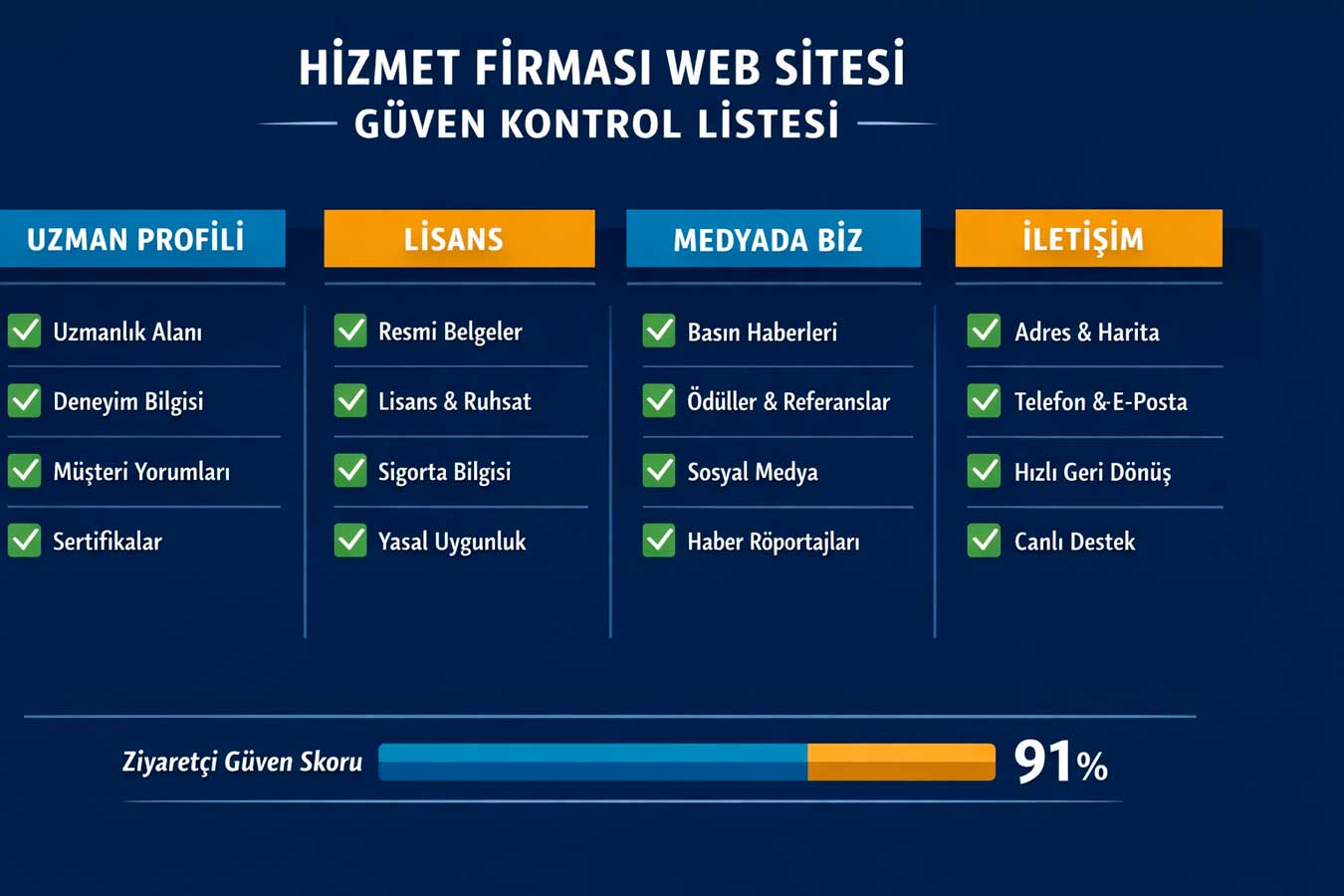
1.1 Expert Profile and Team Page
Who is the client hiring — the firm or the person behind it? In the service sector, the answer is mostly the latter. If a law firm doesn’t list the lawyers’ areas of expertise, court experience, and educational background on its page, the client looks for another firm. For a financial advisor: the chamber they belong to, their areas of expertise, and how many years of experience — these are the answers to the first questions. For the service sector, the team page on the website is among the most read sections.
🔑 Critical content:Photo · Title · Area of expertise · Years of experience · Certificates · LinkedIn
- Professional photo:natural, smiling, simple background — confidence immediately increases
- Area of expertise:clear definition such as “Tax law” or “Orthopedics” — ambiguity is missing
- Experience and education: university, certificates, professional organizations you are a member of
- Examples of success: concrete figures such as “200+ case experience” or “500+ patients”
1.2 License, Certificate and Membership Section
When a doctor enters the room, you see their diploma. It’s possible to create the same effect on a website. Making medical association membership, bar association registration number, Capital Markets Board license, and certified public accountant license visible and downloadable creates instant trust in the visitor. First-time customers, in particular, want to confirm legal authorization before receiving the service. For the service sector, the license section on the website is the strongest brick of the trust wall.
🔑 Critical documents:Professional chamber membership · License number · Insurance policy · ISO certificate
- Bar association / chamber registration number:clickable verification link — instant confirmation possibility
- Professional responsible personPublic health insurance: The existence of a policy makes the customer feel secure.
- International certifications: International certificates such as CPA, CFA, PMP increase confidence.
- Associations of which we are members: TÜRMOB, TBB, TTB logos — a corporate trust signal.
1.3 Media Coverage and Press Section
If a tax consultant comments on CNN Türk or a lawyer gives an interview to Hürriyet, this visibility creates a trust multiplier. The “We in the Media” section is the fastest content format to elevate a service firm to an authority position. For a doctor: the health programs they participate in, the columns written about them, and podcast interviews create social proof. For the service sector, media visibility on the website is key to transitioning from an ordinary firm to an expert authority.
- Media logos: NTV, Bloomberg HT, Hürriyet — logos provide visual credibility
- Interview links: publication link + summary excerpt + publication date
- Podcast and video: direct listening/watching with embedded player possibility
- Speaker history: conference and event participations — proof of expertise
1.4 Contact Information and Physical Address
Phone number, address and opening hours — how easy is it to find these on the website? According to KoMarketing’s 2024 research, 68% of users leave a site immediately if they cannot find contact information. For firms that offer face-to-face services, such as lawyers and doctors, having an address and map helps the customer overcome the last hurdle. Contact information for the service sector website should be visible on every page — in the footer, header, and contact page.
🔑 Critical elements:Phone · Address + Map · Opening hours · WhatsApp button · Email
- Clickable phone:One-touch call on mobile — directly increases conversion
- Embed Google Maps:Office location + directions — clinic and requirements for the office
- WhatsApp button: 89% penetration in Türkiye — the fastest communication channel
- Working hours: Monday–Friday, weekend status — expectation management
👉 Let’s design a trust-focused service website → Corporate Web Design Service
2. Online Appointment: Customers Should Be Able to Book Appointments 24/7 📅
Your customer wants to book an appointment at 11 PM. The phone is off, the form is empty, the email is unanswered. Are they waiting until morning, or are they booking an appointment through your competitor’s online system? For the service industry, an online appointment system on the website is the only way to avoid losing customers outside of business hours.
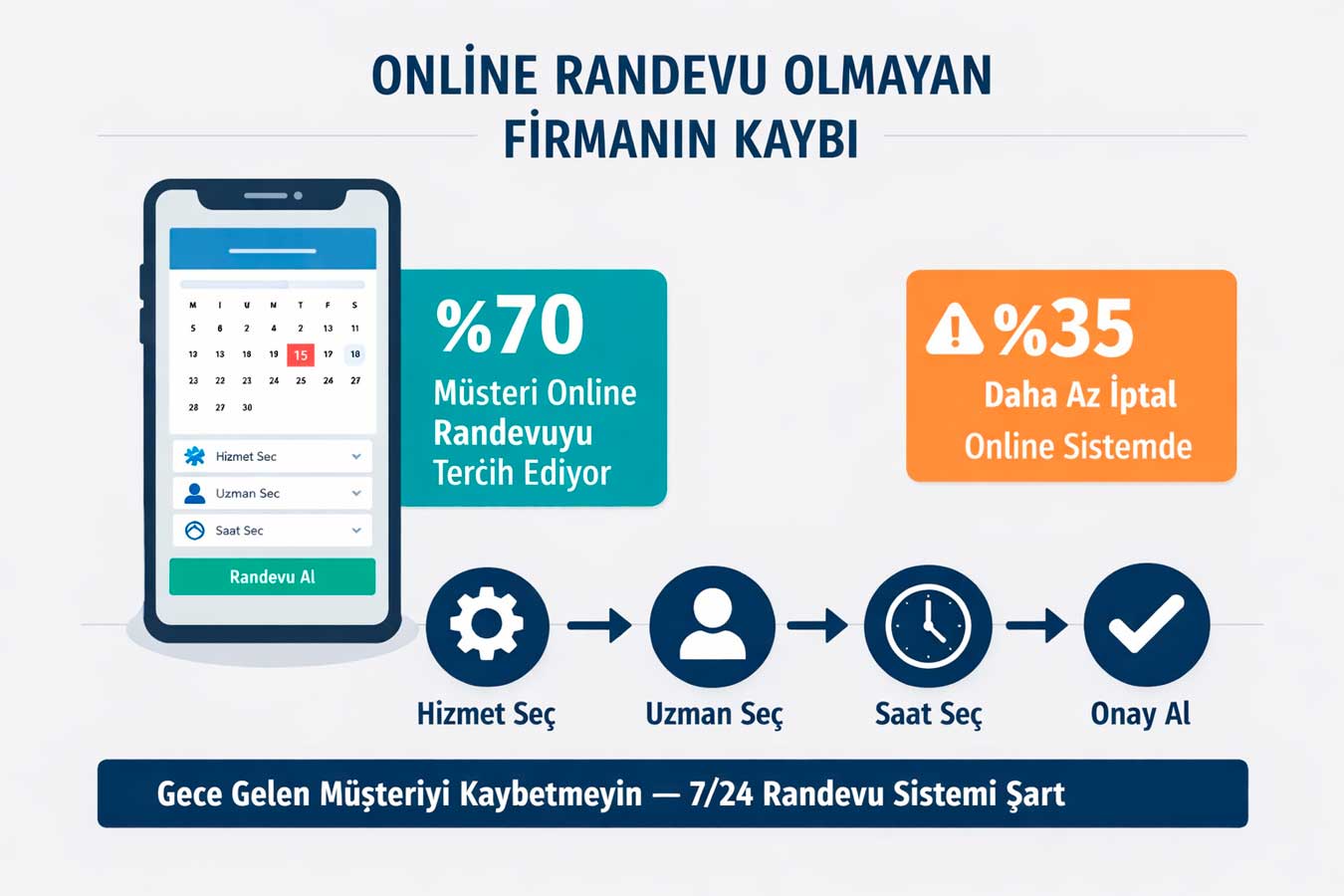
📅 According to Accenture’s 2024 healthcare and service survey, 70% of customers prefer companies that offer online appointments to those that don’t.
The same study shows that online appointments are cancelled 35% less than phone appointments. For the service sector, the website’s role is…The online appointment system both increases customer satisfaction and improves operational efficiency. Seeing available slots speeds up the customer’s decision to book an appointment. For example, for a dentist: available hours are shown with color codes on the calendar, the customer selects the desired day and receives automatic confirmation. Compared to manual appointment management, phone traffic drops by 60%, and the assistant can focus on other tasks. Calendar integration is an operational revolution for every service company, from clinics to law firms. For the service sector, the website’s appointment calendar acts as a bridge connecting the customer from initial contact to booking.- Real-time availability: Automatically closes occupied slots — double booking is prevented
- Google/Outlook integration: Automatically updates the specialist calendar
- Buffer duration: Automatic spacing between appointments — preparation time is preserved
- Mobile-friendly calendar: Easily book appointments from your phone — the most used channel
2.2 Automatic Reminder and Confirmation System on the Website for the Service Sector
An appointment was made, but did the customer forget? Cancellation rates in the health and legal sectors can reach up to 30%. Automatic SMS or email reminders reduce this rate by half. An example for a psychologist’s clinic: automatic reminders are sent 24 hours and 2 hours before the appointment; those who want to cancel do so by clicking the link — zero assistant intervention. Automatic reminders improve both customer experience and calendar utilization.
- SMS reminder: Automatic message 24 hours + 2 hours in advance — open rate 98%
- Email confirmation: Location, time, expert information + add to calendar button
- Cancel/postpone link: One-click cancellation — resets assistant traffic
- Waiting list: Automatic notification to the first person on the list when cancelled
2.3 Service and Expert Selection on the Website for the Service Sector
Before scheduling an appointment, the client wants to choose which service and from which expert. For an accounting firm: corporate tax consulting, individual tax return, or social security consulting — step-by-step selection. Then, which consultant is available, how much does it cost, and how long does the session last. This workflow balances both customer expectations and expert workload.
- Service category: main service → sub-service — selection in 2 steps
- Expert profile: short biography + rating score before calendar opens
- Session duration and fee: transparent pricing — appointment without surprises
- Prepayment option: Secure reservation with credit card — reduces cancellation rate
2.4 Privacy and GDPR Compliant Form on the website for the service sector
The appointment form collects personal data: name, phone, email and sometimes health status. Under GDPR, the collection of this data requires explicit consent. Especially in sensitive sectors such as health and law, privacy assurance affects the customer’s decision to fill out the form or not. The privacy policy and consent checkbox are the legal framework of digital security. On the website for the service sector;
- KVKK (Personal Data Protection Law) information text: Concise and understandable — “Your personal data is safe” below the form
- Explicit consent:Required checkbox — Collecting data without consent is a legal violation
- SSL + secure form: HTTPS encryption — form data protected
- Data retention period: The retention period should be specified — transparency increases trust
👉 Let’s create an online appointment system → Professional Web Design Service
3. Service Details: “What Do You Do?” Answer the Question Clearly 📋
Can someone visiting your website for the first time understand what you do in 10 seconds? Most service sites say “we offer quality service”; but the customer is looking for an answer to the question “what can you do for my problem?”. For the service sector, service pages on the website should answer this question in the visitor’s mind in a concrete and clear way.
📋 According to Nielsen Norman Group’s 2024 research, visitors spend an average of only 10–20 seconds on service sites, and they spend most of this time looking for an answer to the question “is this right for me?”. Well-structured service detail pages quickly convey the right message and motivate visitors to take action.
3.1 Service Page Structure: Problem-Solution-Result Format
Consider an employment law attorney. Under the heading “Employment Law Consulting,” there is only a list of services item by item. However, the client wants to read: “Has an employee compensation lawsuit been filed? We manage the court process on your behalf and bring you to the solution in the shortest way possible.” The Problem-Solution-Result format transforms the service page into a sales pitch. This format is the most effective structure that directly increases the conversion rate. Website for the service sector;
- Problem description: Clearly and recognizably describe the customer’s situation
- Solution description: Which service do you offer, and how — step by step
- Conclusion and benefit: “What do you ultimately achieve?” — concrete and measurable
- CTA: “Get a Free Consultation” or “Schedule an Appointment” — take action now
3.2 Pricing Transparency
Should service prices be on the website? In law, healthcare, and consulting, the answer to this question varies depending on the sector. But one thing is certain: if the customer can’t find any price hint, they move on to another site.
Information such as “First consultation free”, “Package prices starting from X TL” or “Free preliminary assessment” (price anchor) keeps the customer on the page and encourages them to fill out the form. This is especially true for the service sector website.- Package services: Net price in standard packages — comparison made easier
- Starting price: “From X TL” — expectation management and qualified customer filter
- Free initial consultation: The most powerful conversion hook for lawyers, consultants and coaches
- Quote form: “Get a personalized offer” — offers value when collecting customer information
3.3 Frequently Asked Questions (FAQ) Section on the website for the service sector
The customer wants answers to their questions before scheduling an appointment. “How long does the first session last?”, “Do I need to bring my documents with me?”, “Is online consultation possible?” A site that doesn’t answer these questions forces the customer to call — and every call is a potential loss. FAQs for an accounting firm: “Is e-transformation mandatory?”, “How is the bookkeeping fee calculated?”, “When can I reach your consultant?” A well-designed FAQ section neutralizes customer objections before they even fill out the form. Website for the service sector;
- 8–10 most frequently asked questions: real questions compiled from customer interviews
- Accordion format: collapse — keeps page length under control
- Schema markup: FAQ schema with featured snippet on Google — increased traffic
- CTA integration: “Contact us for more questions” link under each answer
3.4 Service Process and Timeline on the website for the service sector
The client wonders “how does the process work?”. For a tax consultancy firm, the process is: “1. Free preliminary consultation → 2. Document collection → 3. Analysis → 4. Declaration preparation → 5. Approval → 6. Submission.” This visual process map ensures the customer knows what to expect and eliminates anxiety about uncertainty. Uncertainty is the biggest obstacle to purchasing services. Website for the service sector;
- Step-by-step process: icon + short description — visual flow makes reading easier
- Timeframe: Expectation management such as “Average 3 business days”
- Customer task: what the customer needs to do at each step — increases engagement
- Progress tracking: Process tracking via online portal — not a luxury, but an expectation
👉 Let’s set up your service pages → Website Design Prices
4. Customer Reviews on Websites for the Service Sector: Social Proof Drives Purchases ⭐
When choosing a new lawyer, doctor, or consultant, where do you first look? Most likely, reviews. Social proof is far more decisive in the purchasing decision than price and service description. The customer reviews section on websites for the service sector is the most powerful tool for converting a stranger into a customer.
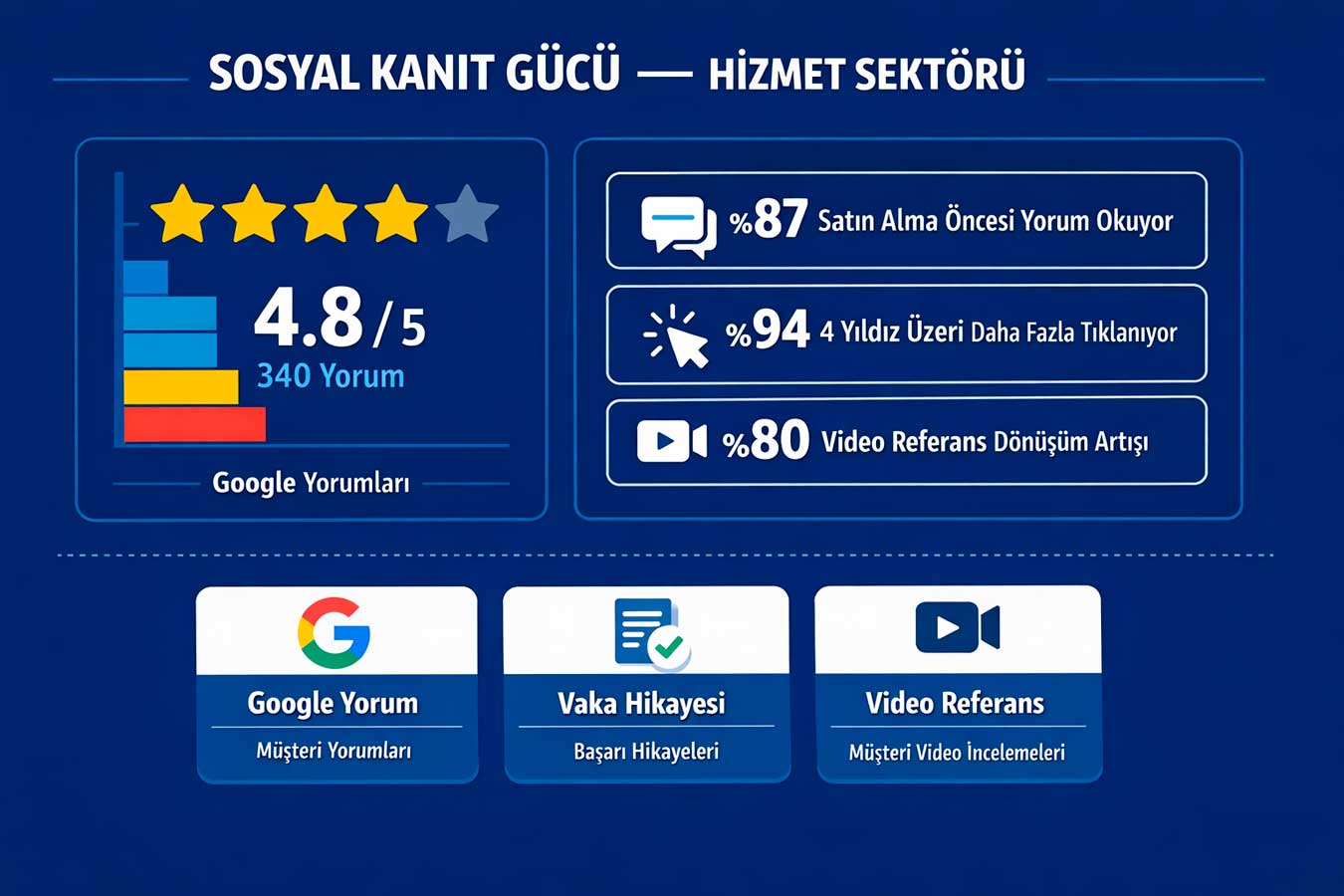
⭐ According to BrightLocal’s 2025 local service survey, 87% of consumers read online reviews before contacting a service company.
4.1 Google Review Integration
Google star ratings appear in search results — this alone means increased traffic. A Google review widget integrated into your website gives visitors the assurance of independent source. For a dental clinic: 4.8 stars and 340 reviews on Google are much more convincing than a competitor’s 3.9 stars. Comments should be displayed on the site, and to receive comments you should use the active strategyteji should be implemented. Website for the service sector;
- Google review widget:real-time updated live review feed
- Review acquisition strategy:post-service SMS with Google review link — conversion simple
- Review response:respond to every review — Google visibility and trust increase
- Star rating visibility: Schema markup for displaying stars in search results
4.2 Case-Based Client Stories
A numerical success story is far more powerful than a general comment. For example, for a business consultant: “We grew the company by 40% in 3 years, increasing the team from 12 to 35.” Or for a tax lawyer: “We eliminated a client’s 2.3 million TL tax penalty.” These stories evoke a feeling in the client that “they can do it for me too”. Case studies are the most persuasive content format.
- Customer profile: sector, company size, problem encountered — recognizable scenario
- Solution applied: which service, which process — technical reliability
- Measurable result: percentage increase, savings, time reduction — tangible impact
- Customer quote: with name + title + company — much more powerful than anonymous comment
4.3 Video References and Audio Testimonials
Text commentary is powerful; but a 60-second video narrated by the customer in their own voice is ten times more persuasive. For a consulting firm: 3 customers from different sectors speak for 1 minute each, listed on the website. According to Wyzowl’s 2024 research, pages with video references have a conversion rate 80% higher. The cost of filming is low, and the persuasive power is very high. Website for the service sector;
- Short format: 60–90 seconds — suitable for attention span, full message
- Subtitles: Required for silent viewers — 85% silent viewing on mobile
- Customer diversity: Different sectors and profiles — every visitor sees someone like themselves
- Thumbnail design: smiley face + headline text — increases click-through rate
4.4 Review Collection and Management Strategy
Reviews don’t come automatically — a systematic process is needed. Review requests sent within 24-48 hours of service completion yield the highest conversion rate. Negative reviews should be responded to instead of closed — a professional response can turn a negative review into a signal of trust. Review management is the digital reflection of service quality.
- Post-service SMS/email: Review request within 24 hours — highest conversion window
- QR code: Review QR at office exit — instant and easy
- Response to negative review: Apology + solution suggestion — public opinion management
- Periodic analysis: monthly review report — feedback for service quality
👉 Let’s establish your review and trust strategy → Web Design Institution — Contact
📊 Service Sector Website: Section-Based Priority Table
Summary of the four main sections:
| Section | Key Content | Priority | Target Customer | Contribution |
| Trust Elements | Expert profile · License · Media · Communication | 🔴 Critical | New visitor | Building initial trust |
| Online Appointment | Calendar · Reminder · Form · GDPR | 🔴 Critical | Decision-making | Conversion |
| Service Details | Page structure · Price · FAQ · Process | 🔴 Critical | Research | Expectation management |
| Customer Reviews | Google · Case · Video · Strategy | 🟠 Important | Undecided visitor | Breaking the last objection |
🧠 Summary Box: 5 Critical Takeaways From This Article
5 critical points:
- Trust is built or lost in 8 seconds: Expert profile, license, and contact information should be visible on the first screen
- Online appointments attract customers: A 24/7 system is essential to capture customers who apply at night — 70% of customers prefer it
- Service page should answer questions: The Problem-Solution-Result format prompts visitors to take action in 10 seconds
- Buy social proof It matters: 87% of customers read reviews; 4+ stars get 94% more clicks
- Video testimonials are the most powerful format:60-second customer videos increase conversion by 80% (Wyzowl, 2024)
❓ Frequently Asked Questions
How long does it take to build a website for the service industry?
Depending on content preparation, it varies between 4–8 weeks. The time is significantly shorter if expert photos, service descriptions, and customer reviews are already provided.
Is additional software required for the online appointment system?
It can be installed on most modern websites with an integrated appointment plugin.
Ready-made systems like Calendly and Doctolib, or custom site development — are chosen according to need.Don’t the customer reviews look fake?
Google and authorized platform reviews are verifiable, therefore they are reliable.
Reviews presented with name + photo + Google profile are much more persuasive than anonymous text.Should I display prices on the site?
Showing a price range or starting price instead of a fixed price attracts qualified customers.
The phrase “First consultation free” is the most powerful conversion hook.Is a single-page site sufficient?
No. Creating separate pages for each service is critical for both SEO and user experience.
“Tax consultancy” and “Social Security consultancy” should be on separate pages, not the same page.🚀 Result: Take Trust to the Digital World, Win the Customer
A website for the service sector is the digital reflection of your expertise and your 24/7 sales representative. From trust elements to online appointments, from service details to customer reviews, the four sections covered in this guide encompass the entire cycle that converts a visitor into a customer. To get ahead in digital competition, you don’t need a big budget, you need the right structure.
As Web Design Agency, we offer a trust-focused design, online appointment system, and review management infrastructure tailored to the service sector, from law firms to private clinics, from financial consulting to management consulting, all in one package. Your customer is looking for you; make it easier for them to find you.
👉 For free consultation → Web Design Agency
📋 About This Content:
This article was prepared by Adapte Digital for lawyers, doctors, financial advisors, consultants, and other professional service firms operating in the service sector.
📹 Video Suggestion: Adapte Dijital · Web and Digital Marketing Agency
🌐 Professional Website: webtasarimkurumu.com.tr
🔗 Related Article: How Should a Website for the Manufacturing Sector Be?