
Medical Supply Shop Licences and Permits: Step by Step
Standard workplace documents are not enough here. Every business selling medical devices must obtain a sales centre authorisation certificate from the provincial health directorate, register with the Product Tracking System (ÜTS) and appoint a responsible manager.
Those three items separate medical supply from other retail branches, and they set the pace. Below: how long each step takes, where it gets stuck and the order to follow.
Step 1: Settle the responsible manager question
A responsible manager is compulsory in medical device sales centres and must meet defined training conditions. If the owner meets them, the owner can hold the post; if not, the appointment comes from outside.
Common mistake: leaving this item until last. Finding the right person and completing the paperwork takes time, and waiting with premises taken and rent running is the most expensive scenario.
Duration: days if the person is ready, weeks if you have to search. Needed: training and appointment documents.
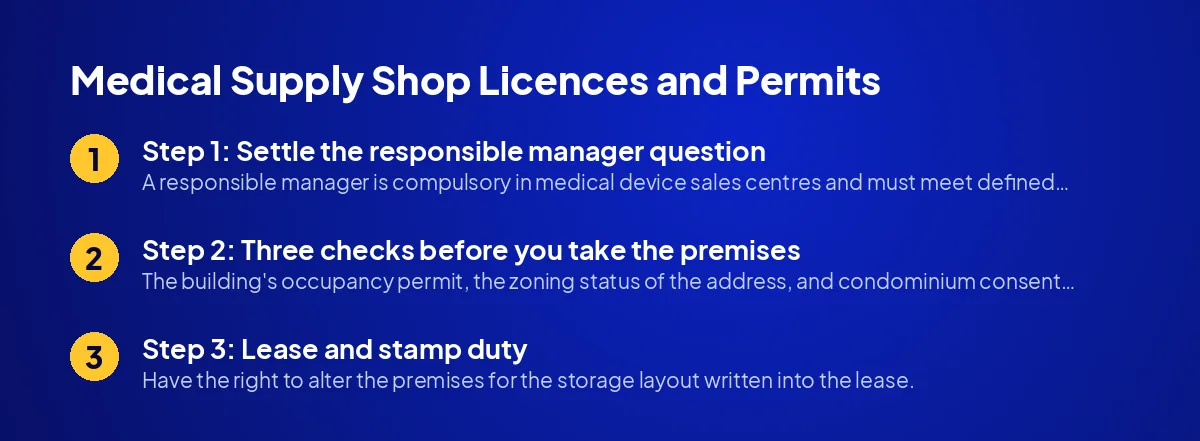
Step 2: Three checks before you take the premises
The building’s occupancy permit, the zoning status of the address, and condominium consent if the building is residential. Medical supply adds one more: the sales centre must meet the premises conditions.
Storage space, products kept safe from heat and damp, and a clear division between sales and storage are expected. When viewing premises, look less at floor area and more at whether that division can be built.
Duration: 1-3 days. Needed: zoning enquiry, occupancy permit, premises plan.
Step 3: Lease and stamp duty
Have the right to alter the premises for the storage layout written into the lease. A medical supply shop needs shelving and a separate storage section, and neither can be built without permission.
Duration: 1 day. Needed: lease, stamp duty payment.
Step 4: Commencement notice and tax certificate
The notice is filed through your accountant or the interactive tax office, a site visit follows, and the certificate is issued. A company structure is more common here; corporate customers and the tender side may require it.
Duration: 3-7 days, longer if you are incorporating. Needed: lease, identity documents, accountant.
Step 5: Chamber registration
A company registers with the trade chamber, a sole trader with the tradesmen’s chamber. The step is quick and it feeds the ones that follow.
Duration: 1-3 days. Needed: tax certificate, identity documents, company papers.
Step 6: Applying for the sales centre authorisation certificate
This is the real step. The application goes to the provincial health directorate, which assesses the premises, the responsible manager and the staff. Without this certificate no medical device may be sold.
Common mistake: taking the municipal licence and starting to sell. That licence permits the premises to open; the document permitting medical device sales is separate.
Duration: weeks, including assessment and the site inspection. Needed: premises plan, responsible manager paperwork, staff documents.
Step 7: Product Tracking System registration
Traceability of medical devices runs through the Product Tracking System (ÜTS). You register as a sales centre and report the movements of everything you buy and sell there.
This is the most skipped and most inspected side of the business. A product that does not appear in the system cannot be sold, even if it sits on your shelf.
Duration: days to register, longer to learn how it works. Needed: authorisation and an electronic signature.
Step 8: Municipal licence and opening
The workplace opening and operating licence comes from the municipality. If you employ staff, the social security workplace declaration is filed before the first employee starts.
Duration: 1-3 weeks if the file is complete. Needed: all the documents above.
Sales staff need documents too
Staff selling medical devices are expected to have been trained in the field. Assume from the start that everyone working in the shop will be assessed on this basis.
What to do in practice
Ask about this document when you recruit; if it is missing, plan the training around the start date. At inspection everyone working that day is examined, not only the responsible manager.
Which products fall within scope?
The definition of a medical device is broad, and most of what these shops sell falls inside it. Blood pressure monitors, glucose meters, orthopaedic supports, patient beds, wheelchairs and respiratory devices are a few examples.
Products that look outside scope but need care
Shelves may also carry products that are not medical devices: cosmetics, food supplements, baby products. Each is governed by its own rules and brings separate obligations.
When you plan your shelves, mark the rules each product group falls under. One shelf may sit under three different sets.
Checklist
Before taking the premises: who the responsible manager will be, occupancy permit, zoning status, whether the required division can be built.
After the lease: stamp duty, commencement notice, tax certificate, chamber registration, staff documents.
Before selling: sales centre authorisation certificate, Product Tracking System registration, municipal licence.
At opening: social security declaration, licence and tax certificate displayed, a map of the rules by product group, supplier file.
For the order authority by authority see the business licence roadmap, and for capital and cost bands our medical and health sector page. For the dental side see our dental supply depot article.
The three steps that delay openings most
BU BÖLÜMÜN ÖZETİ
- 1. Suitability of the premises
- 2. Appointing the responsible manager
- 3. Completing the system registration
- The behaviour that shortens the timetable
Timetables usually slip in the same three places. Knowing them in advance pulls the opening forward by weeks.
1. Suitability of the premises
Whether the occupancy permit covers commercial use is often discovered late. Check the title deed and permit position before signing; unsuitable premises block the file at its first stage.
2. Appointing the responsible manager
The authorisation application cannot be completed without one. Searching for that person on the day of application stretches the timetable; run the appointment in parallel with the premises decision.
3. Completing the system registration
Product Tracking System registration is not a task for after the certificate arrives; the business needs it to function. Until it is complete no product movement can be reported, and the gap shows at the first inspection.
The behaviour that shortens the timetable
Running these three steps in parallel rather than in sequence shortens the opening noticeably. Talking to a candidate responsible manager while the premises negotiation continues, and gathering what the system registration needs, wins back the lost weeks.
The location decision sets the customer profile
Where the shop opens decides which customers you see. A hospital district and a residential neighbourhood build two different businesses.
Near a hospital demand is heavy but one-off: the companion, the discharged patient, the urgent need. Turnover moves fast and the relationship is short. In a neighbourhood demand comes slowly but repeats; the regular user and their family become steady customers.
The second model takes longer to build but stands more firmly. With limited capital, starting in a neighbourhood and building a reputation is less risky than holding on in a high-rent hospital district.
In Short
- Standard workplace documents are not enough; the authorisation certificate, system registration and a responsible manager are compulsory
- Settle the responsible manager first; it is the item that sets the pace
- The municipal licence opens the premises; the document permitting medical device sales is separate
- Storage and separation conditions apply to the premises; these matter more than floor area
- Sales staff are also expected to be trained in the field
- A product that does not appear in the system cannot be sold, even if it is on your shelf
- If cosmetics and food supplements share the shelf, each follows its own rules
- Running premises, manager and system registration in parallel pulls the opening forward by weeks
- A hospital district gives fast but one-off demand; a neighbourhood gives slow but repeating demand
For a neighbouring branch see our medical distribution article.
Quick Glossary
Sales centre authorisation certificate: the document from the provincial health directorate permitting medical device sales. Responsible manager: the person accountable for compliance at the sales centre. Product Tracking System (ÜTS): the official system providing traceability for medical devices. Traceability: a record of where a product came from and where it went.
Next Step
Let’s draw up your document list and timetable together: consultation request form.
Frequently Asked Questions
Updated: September 2026
Sık Sorulan Sorular
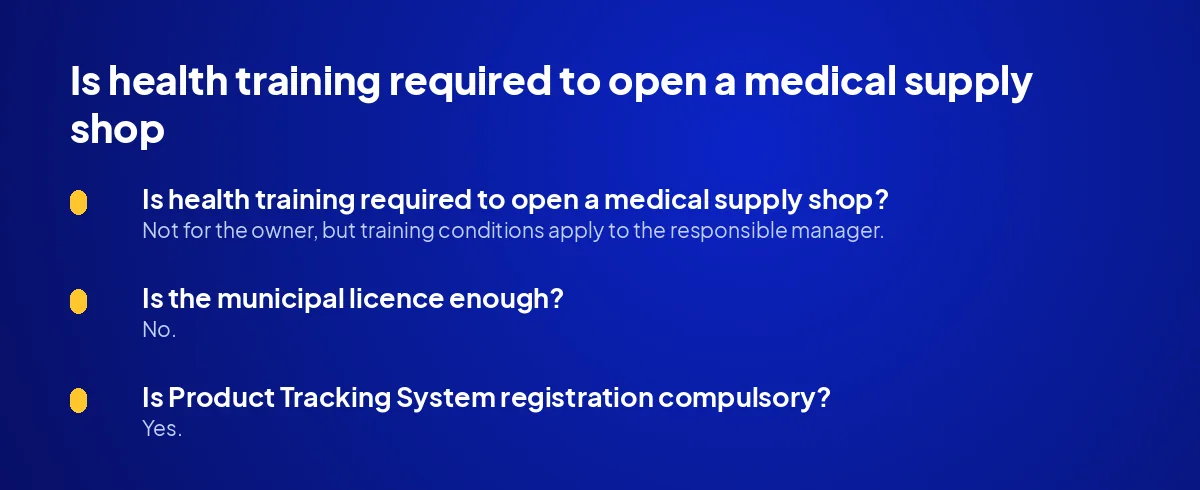
Not for the owner, but training conditions apply to the responsible manager. If the owner does not meet them, the appointment comes from outside.
No. It permits the premises to open; medical device sales need a separate certificate from the provincial health directorate.
Yes. Traceability runs through this system and sales centres must report movements.
They are expected to have been trained in the field, and at inspection everyone working that day is assessed.
You can, but cosmetics follow their own rules, with separate notification and labelling duties.
Less a single figure than meeting the storage and separation conditions. Prepare the premises plan before applying.
Six to eight weeks if the responsible manager is ready. Without that item the timing becomes unpredictable.
A company structure is more common in medical supply; corporate customers and the tender side usually require it.
There are restrictions on distance selling and the position differs by product group; check the rules product by product before deciding.