
What Is the Difference Between Selling Orthopaedic Products and Making Them to Measure?

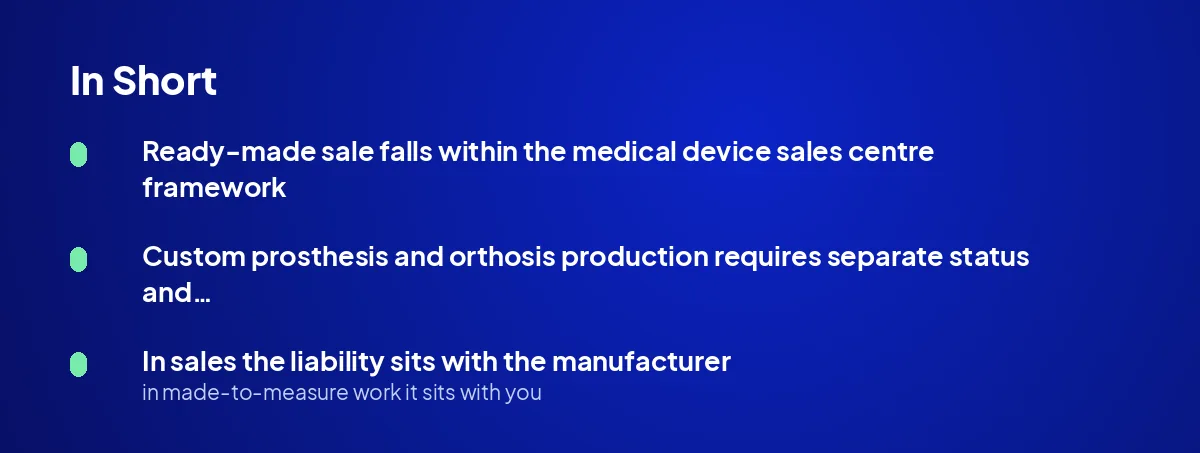
Selling ready-made orthopaedic products falls within the medical device sales centre framework: a sales centre authorisation certificate, Product Tracking System (ÜTS) registration and a responsible manager are enough. If you produce custom prostheses or orthoses the work changes entirely; that is a separate field requiring application centre status.
Perhaps you did not know this: selling supports and producing custom orthoses in the same shop is not a business that runs on a single document. The two activities are subject to different authorisations, and this distinction is where newcomers most often go wrong.
Two activities, two statuses
In ready-made sales you sell a product as it is; whoever made it carries the responsibility. In made-to-measure production you build the product to the patient’s measurements, which makes you the producer.
The comparison
| Criterion | Ready-made sales | Made to measure |
|---|---|---|
| Status | Medical device sales centre | Application centre |
| Authorised person | Responsible manager | Practitioner trained in the field |
| Premises | Sales and storage sections | Production and measuring areas as well |
| Product liability | With the manufacturer | With you |
| Set-up time | Weeks | Months |
| Start-up cost | Weighted to stock | Stock plus production equipment |
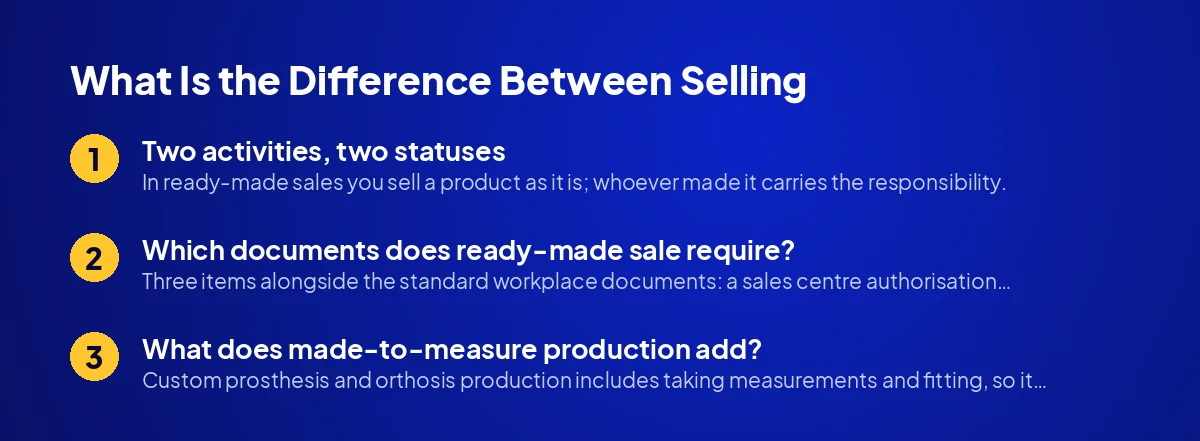
Which documents does ready-made sale require?
Three items alongside the standard workplace documents: a sales centre authorisation certificate from the provincial health directorate, Product Tracking System registration and a responsible manager appointment. Sales staff are also expected to be trained in the field.
Supports, knee braces, wrist braces, orthopaedic insoles and neck collars produced ready-made are all sold within this framework.
What does made-to-measure production add?
Custom prosthesis and orthosis production includes taking measurements and fitting, so it falls under a separate set of rules. What is looked for here is that the person doing the work is trained in the field and that the premises have sections suitable for production and fitting.
Which route should you take?
Ready-made sale is set up quickly, capital sits in stock and the process is measured in weeks. The margin is limited because the product is comparable.
Made-to-measure production is slow to set up and demands equipment and competence; in return the product cannot be compared and the margin is noticeably wider. A sustainable flow of patients can be built through clinician referral.
The mixed model
Running both together is possible, but the conditions of each status must be met separately. Carrying out made-to-measure production on a sales centre certificate counts at inspection as activity outside scope.
Referral and sales on prescription
A large share of orthopaedic products is bought on a clinician’s report and within reimbursement cover. That shapes the commercial side of the business directly.
The reimbursement side
If you will work with reimbursement bodies, a separate contract and record-keeping routine comes into play. Learn the conditions of that routine directly from the relevant body; they vary by product group and status.
Care in sales without a report
Sales without a report do happen, but advising on the condition in which a product should be used can amount to practising medicine. Present the product; do not set the indication.
Measuring and fitting decide the quality of the work
Even in ready-made sales, the right size and the right product matter. A support or knee brace in the wrong size does not work and may even cause discomfort; the customer remembers you rather than the product.
A routine that works
- Know the product’s size chart and take the measurement yourself
- Offer a fitting; do not ask for a decision with the product still boxed
- Give brief written information on how long and how to use it
- State your exchange conditions from the outset
Hygiene and exchange
Exchange policy needs care for products that touch the body. Returning a used item creates a hygiene problem, so getting the fitting stage right is better than dealing with exchanges afterwards.
Now you know this
Selling ready-made orthopaedic products and producing custom ones are two separate trades requiring two separate authorisations. Settle which status you will hold before you decide; even when taking premises, that decision changes your layout.
For the general licence order see the business licence roadmap, for the retail side our medical supply shop article, and for capital bands our medical sector page.
As the range widens the document picture changes
Orthopaedic products is a broad heading and not every group inside it sits in the same frame. Keep track of that distinction as you grow the portfolio.
| Group | Typical position |
|---|---|
| Ready-made supports, knee and wrist braces | Usually standard sale |
| Insoles, ready-made | Usually standard sale |
| Products made to individual measurement | Additional obligations may arise |
| Prosthesis and orthosis fitting | Separate competence and staffing condition |
The third and fourth rows need attention: preparing a product to individual measurement is not the same as selling a ready-made one. If you are considering that side, obtain the conditions in writing from the relevant authority.
The order for growing the portfolio
Starting with ready-made products, learning the customer and the lines that move, then crossing to the custom side is a manageable order. Going the other way means taking on both the staffing and the paperwork before the volume exists.
The referral channel carries half the sales
People buying orthopaedic products rarely arrive on their own decision; they come on the referral of a clinician or a physiotherapist.
So familiarity with nearby health institutions is the most important customer channel in this branch. Clinicians prefer a place that explains the right product properly and follows up when needed.
The way to build that channel is not promotion but quality of work: a clinician who hears good things from a referred patient keeps referring. One patient given the wrong product closes the channel.
In Short
- Ready-made sale falls within the medical device sales centre framework
- Custom prosthesis and orthosis production requires separate status and competence
- In sales the liability sits with the manufacturer; in made-to-measure work it sits with you
- The mixed model is possible, but each status must be satisfied separately
- In contract manufacturing, liability touches you if the product carries your name
- A large share of products is bought on a clinician’s report and within reimbursement cover
- Present the product; do not set the indication, that is the clinician’s work
- Preparing a product to individual measurement is not in the same frame as ready-made sale
- A product in the wrong size is useless; get the fitting stage right
- The main customer channel here is clinician and physiotherapist referral
For a neighbouring branch see our physiotherapy centre article.
Quick Glossary
Orthosis: an external support product that supports or corrects part of the body. Prosthesis: an artificial part replacing the function of a missing limb. Application centre: a centre carrying out custom production and fitting, requiring separate authorisation. Indication: the medical determination of the condition in which a product is to be used.
Next Step
Let’s decide together which status you should proceed under: consultation request form.
Frequently Asked Questions
Updated: September 2026
Sık Sorulan Sorular
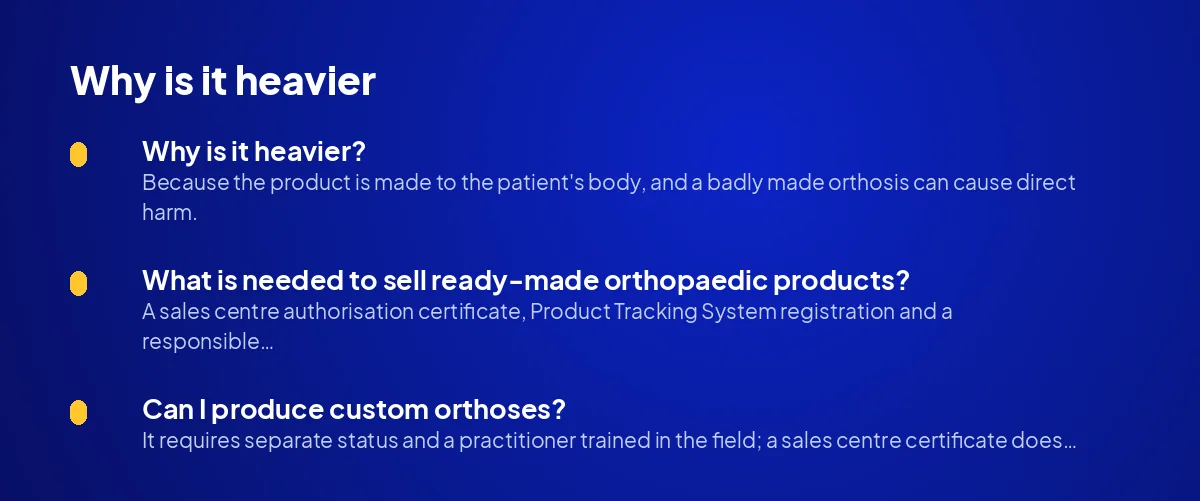
Because the product is made to the patient’s body, and a badly made orthosis can cause direct harm. The rules therefore look at both the practitioner’s competence and the suitability of the premises.
Let me add this: some in the field say “I take the measurements and have it made” and move to contract manufacturing. If the product reaches the patient under your name, the chain of responsibility touches you; make clear in the contract who does what.
A sales centre authorisation certificate, Product Tracking System registration and a responsible manager appointment.
It requires separate status and a practitioner trained in the field; a sales centre certificate does not cover it.
It is possible, but the conditions of each status must be met separately.
If the product reaches the patient under your name, the chain of responsibility touches you; make it clear in the contract.
A separate contract and record-keeping routine is required; learn the conditions directly from the relevant body.
You can present the product, but determining the condition it is used for is the clinician’s work.
No. Made-to-measure work also requires production and measuring areas.
The margin is noticeably wider in made-to-measure work because the product cannot be compared; the set-up is heavier.
Weeks for ready-made sales, months for made-to-measure production.