
Laboratory Supplies: Documents and the Cold Chain Record
In a business selling laboratory supplies the document list is built on the medical device sales centre framework: a sales centre authorisation certificate, registration in the Product Tracking System (ÜTS) and a responsible manager. What sets this branch apart is something else: storage conditions have to be proven by records.
With businesses working in this branch we set up the following method: a storage and dispatch file kept by product group. Below we explain how that arrangement is built and why it earns its place at inspection.
Why do storage conditions matter so much here?
Because a large share of laboratory supplies must be held within a defined temperature range. A reagent or a test kit that leaves that range counts as spoiled, and the test result obtained from it becomes unreliable.
The issue here, in other words, is not only damage to the product; it is the result of the test run with it. That is why inspectors look at this heading in particular.
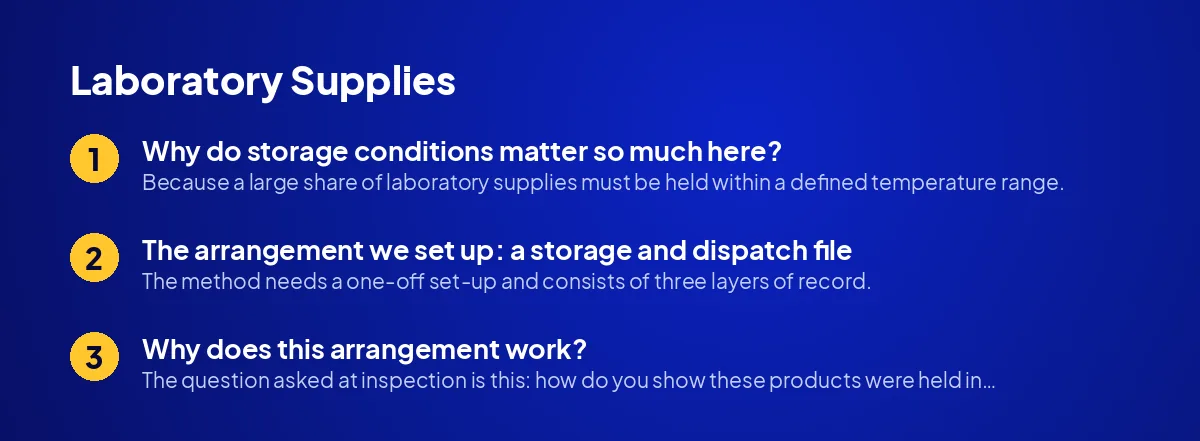
The arrangement we set up: a storage and dispatch file
BU BÖLÜMÜN ÖZETİ
- 1. Warehouse temperature record
- 2. Storage details by product group
- 3. Dispatch record
The method needs a one-off set-up and consists of three layers of record.
1. Warehouse temperature record
The temperature of the cabinet or room holding products that need cold storage is logged regularly. That log must be continuous and open to review after the fact. A temperature monitoring device is the basic investment here.
2. Storage details by product group
For each product group the storage range, the shelf life and the in-use period after opening are filed. That information comes from the product’s own documentation; ask your supplier for it.
3. Dispatch record
When a product needing the cold chain is dispatched, the conditions it travelled under are recorded. If refrigerated transport is used, that goes into the record too.
Why does this arrangement work?
The question asked at inspection is this: how do you show these products were held in suitable conditions? With the file ready, the answer is given by producing the temperature logs.
Without the file the answer stays verbal, and a verbal answer is not enough under this heading. The set-up cost is limited to a monitoring device and an orderly file; the benefit shows at the first inspection.
The customer asks the same question
Laboratories, in their own accreditation and quality audits, may ask about their suppliers’ storage conditions. So this file is not only for your own inspection; it helps you win customers.
What you will be asked as a supplier
- How is the product stored, and is there a temperature log?
- How is the cold chain protected in transit?
- Are batch numbers and shelf life tracked?
- How does a recall work if something goes wrong?
A supplier with ready answers to those four becomes a candidate for corporate laboratory work. A supplier without them is left competing on price.
Product groups and the regulatory split
Laboratory supplies is a broad definition, and not every group inside it falls under the same rules.
| Group | Typical framework | Watch for |
|---|---|---|
| Test kits and diagnostic products | Medical device scope | System registration and traceability |
| Consumables | Varies by product group | Check each group separately |
| Chemicals and reagents | Chemicals rules may also apply | A safety data sheet is expected |
| Instruments | Medical device scope | Sales centre authorisation |
The third row is the one most often missed: for certain chemicals, holding a safety data sheet and meeting storage conditions apply separately.
The method in summary
In this branch the licence and the authorisation certificate are the known part of the work. What sets you apart is being able to show that what you sell was stored and carried in suitable conditions. The three-layer file makes that something you can set up in a day.
For the general licence order see the business licence roadmap, for the distribution side our medical distribution article, and for capital bands our medical sector page.
If you move into sample transport
Some laboratory suppliers move into sample transport over time. That is a separate business with its own rules; it does not run within the same framework as supply sales.
The test for the decision
This service lifts customer loyalty noticeably; when a laboratory takes both its supplies and its transport from one place, the relationship strengthens. But do not take the obligations lightly; do not move into this side without learning the conditions from the relevant authority.
Shelf life management is this branch’s profit line
Much of what a laboratory supplier sells carries an expiry date. That makes stock management a matter of profit directly.
The arrangement that works
- Enter the expiry date of every batch in the record
- Apply first in, first out in practice, not just on paper
- Move anything below a set remaining period onto a warning list
- Push the products on that warning list out to sale first
The third and fourth items make the difference: noticing a product before its date runs out gives you the chance to sell it, even at a discount, and recover the capital.
Set your order quantities accordingly
A large order brings the unit price down but raises the shelf life risk. In this branch the right question is not “how do I buy cheapest” but “how much can I sell before the date runs out”.
Different customer types want different sales arrangements
The buyer of laboratory supplies is not one type, and each group works to a different sales rhythm.
Private laboratories decide quickly and look at price and delivery time. The hospital and public side runs through tenders and specifications; the process is long but the volume is steady. University and research units buy small quantities of specialist products; there, being able to find the item matters more than the price.
That third group is a field most suppliers pass over: the supplier who can bring in a hard-to-find reagent becomes that unit’s standing address. Looking for that gap at the outset is more productive than competing on price.
In Short
- The document framework is built on the medical device sales centre rules
- What sets this branch apart is proving storage conditions by records
- A reagent that leaves its temperature range makes the test result unreliable
- Three layers: warehouse temperature log, product group storage details, dispatch record
- A verbal answer is not enough under this heading at inspection
- Laboratories ask about their suppliers’ conditions in their own audits
- For chemicals, a safety data sheet and storage conditions apply separately
- A supplier with ready answers is a candidate for corporate work; one without competes on price
- Sample transport is a separate business; do not move into it without learning the conditions
- Shelf life management is a direct profit line in this branch
- A supplier who can find the hard-to-get product is not left competing on price
For a neighbouring branch see our hospital textiles article as well.
Quick Glossary
Cold chain: holding a product within its temperature range from manufacturer to user. Reagent: a substance used in laboratory tests that produces a chemical reaction. Safety data sheet: the document setting out a chemical’s risks and handling conditions. Shelf life: the period a product remains usable under suitable conditions.
Next Step
Let’s set up your storage and dispatch file together: consultation request form.
Frequently Asked Questions
Updated: September 2026
Sık Sorulan Sorular
Carrying biological samples is subject to specific rules on packaging and temperature. There are requirements for the transport container, secondary packaging, leak resistance and labelling.
A defined procedure is also expected for any incident during transport. Staff need to be trained in it.
A product past its shelf life cannot be sold and is destroyed. The capital tied up in it is lost outright. Laboratories also tend to refuse any product with less than a certain remaining shelf life; the product can still be formally valid and yet become unsellable.
A sales centre authorisation certificate, Product Tracking System registration and a responsible manager; further conditions may arise by product group.
For products needing cold storage you are expected to be able to show the storage condition; a log is the only way to do that.
By refrigerated transport and suitable packaging; the method used goes into the dispatch record.
Chemicals rules may also come into play; holding a safety data sheet and meeting storage conditions then apply.
A storage log, a cold chain method, batch and shelf life tracking, and a recall arrangement.
With a monitoring device and an orderly file it is a day’s work; the benefit shows at the first inspection.
It is taken out of the sales area, held in a separate section and recorded on destruction.
Products intended for diagnosis are assessed within that scope; system registration and traceability are required.
Yes. Laboratory supplies is a broad definition and the groups can fall under different rules.