
Locksmith Licences and the Notification Calendar

In locksmithing the difficulty of the file comes from sequence, not the number of documents. Two tracks run together: the municipality’s licensing track, and the notification and record routine on the police side. Knowing which week each comes into play is the one thing that pulls the opening forward.
Below we set the process out week by week. The calendar is not a firm promise; it slides with how quickly the paperwork comes together and with the district’s workload. The sequence itself does not change from province to province.
Why the calendar decides matters in this trade
Because some steps depend on other people’s timetables. The mastership certificate follows the examination season, registration on the police side follows the appointment system, and the licence moves with the site inspection.
Those three steps can be run in parallel. Run in sequence, the same work takes twice as long. The calendar below shows how the parallel arrangement is built.
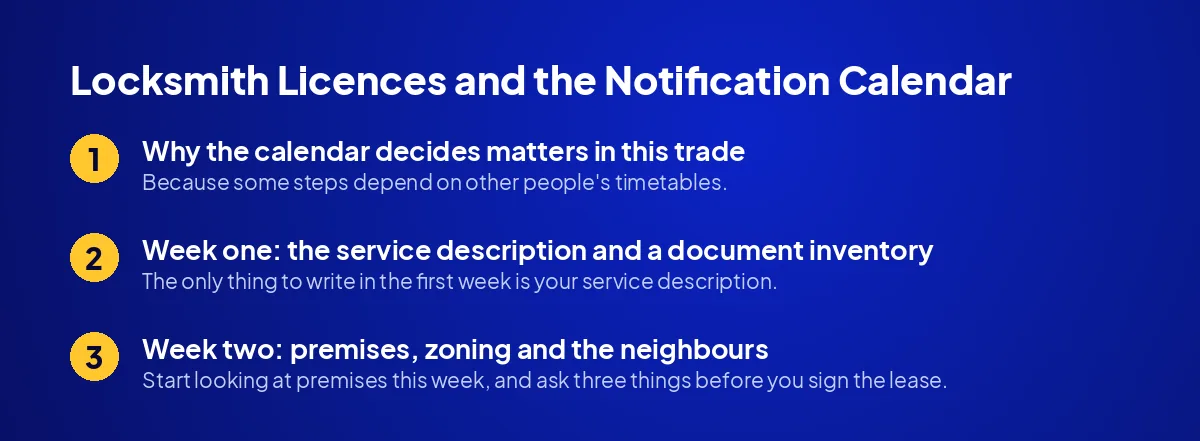
Week one: the service description and a document inventory
The only thing to write in the first week is your service description. Will you do key cutting and lock sales alone, or will you offer a door opening service as well?
That distinction shapes the whole file. A business offering door opening carries out work that is sensitive from a security standpoint, and the record routine comes forward for that reason. In the same week, count what you hold: identity papers, proof of residence, any vocational certificates and the criminal record document.
Week two: premises, zoning and the neighbours
Start looking at premises this week, and ask three things before you sign the lease.
- Is there an occupancy permit and is the shop fit for commercial use
- Does the zoning status of the address cover this activity
- Will the noise of the key cutting machine disturb the floor above
The third item looks small, but it is the complaint heard most often in locksmith’s shops. Thinking from the outset about which wall the machine goes against heads off the report that comes later.

Week three: the tax office and chamber registration
Once the premises are settled the commencement notice is given, an inspection follows and the tax certificate is issued. Those setting up alone then register with the tradesmen’s chamber, those forming a company with the trade chamber.
This week runs mechanically. What matters is not putting it on hold; the input for the next two applications comes out of it.
Week four: the mastership certificate track
Locksmithing is one of the branches where vocational competence is asked about. Here the mastership certificate and the vocational qualification certificate (MYK) work as two separate tracks; which one is asked of you can shift with your description of activity and with district practice.
Having worked in a shop for years does not amount to an authority visible in the paperwork. If you hold no certificate, learn the examination and application timetable this week, because that timetable does not run to your plan. Have the district municipality confirm in writing which document will be sought.
Where the police notification sits in the calendar
The police side is a heading of its own in this trade. In businesses offering a door opening service, notification, an identity record and a job record routine come into play. The reach and the form of the practice can differ at province and district level.
The right move is this: go to the district police directorate before the licence application and ask what is expected for your own activity. Rather than settling the matter outright, have the conditions confirmed in writing by the district police directorate and by the municipality. Leaving this step to the fifth week can put the licence file on hold.
Week five: the licence application
Once the paperwork is gathered, the application for the workplace opening and operating licence goes to the district municipality. A locksmith’s shop is generally examined as a point of sale and service assessed within the sanitary establishment frame.
If turning, grinding or metalworking will be done in the shop, however, the assessment can change. Write your description of activity so that it carries that detail, and ask your district about the class.
Week six: site inspection and opening
After the application the municipality’s team comes to see the address. The headings looked at on that visit are where the extinguisher sits, the state of the signage, whether the shop matches the declared activity, and the records for the staff.
Have the bench and the machines set up in the arrangement you declared before the inspection. A machine that moves afterwards means a second visit.
The calendar as a table
| Week | Work done | Institution |
|---|---|---|
| 1 | Service description and document inventory | Your own preparation |
| 2 | Premises, zoning and occupancy checks | Municipal zoning unit |
| 3 | Commencement notice, tax certificate, chamber registration | Tax office and chamber |
| 4 | Mastership and qualification certificate application | Vocational training side |
| 4 | Notification meeting on the police side | District police directorate |
| 5 | Licence application and delivery of the file | District municipality |
| 6 | Site inspection and issue of the licence | District municipality |
| 6 | Social security declaration if you have staff | Social security institution |
The weeks in the table show an average flow and carry no promise of a closed timetable. Running the two rows in week four together is the move that shortens the calendar most.
The first month after opening
What has to be built once the licence is out is the record routine. In door opening work, the most valuable document is the book showing how the job went onto the record.
- Writing the date, the time and the address for every door opening job
- Entering the identity details of the person requesting the service
- Noting the statement, and any document, that they live at the address
- Tying the job to a receipt or an invoice
- Keeping the record on the footing that it may be asked about later
Learn the reach of that record and how long it must be kept from the police directorate for your own district. Keeping the book from day one is far easier than going back three months later to fill it in.
Three things that break the calendar
- Going into the application without the certificate. If the mastership side is missing, the file stays tied to the examination timetable and the weeks stretch
- Leaving the police meeting until after the licence; running the two tracks in sequence doubles the time
- Writing the description of activity narrowly and adding services later; when the description changes, the file is updated
Do not trust the figures circulating in the trade for the items payable during the application; the municipality’s own tariff applies and it changes annually. Where each authority comes in is mapped in the business licence roadmap, while capital and running-cost ranges are gathered on our home and building sector page. If you are thinking of setting an ironmongery shelf beside the counter, see our hardware shop article; if you are planning something larger, our DIY store article.
In Short
- In this trade the municipal track and the police track run together
- The service description is written in week one; it shapes the whole file
- A door opening service brings the record routine forward
- The noise of the key machine is the complaint heading heard most often
- Mastership and vocational qualification certificates are two separate tracks
- The examination timetable does not run to your plan, so apply early
- The police meeting happens before the licence application
- Ask the district police directorate in writing how far notification reaches
- If metalworking will be done in the shop, the class assessment can change
- Machines are set up in the declared arrangement before the site inspection
- The items payable follow the municipal tariff and change annually
Quick Glossary
Sanitary establishment: the class of workplace held to carry no heavy effect into its surroundings, weighted towards sales and service. Job record book: the routine in which a service given is entered with its date, address and the details of the person requesting it. Vocational qualification certificate: the output of the national system in which competence in a trade is measured by examination and certified. Site inspection: the visit on which the municipality’s team sees the address and checks it against the declaration.
Next Step
Let’s draw up your week-by-week calendar for your own district: consultation request form.
Frequently Asked Questions
Updated: September 2026
Sık Sorulan Sorular
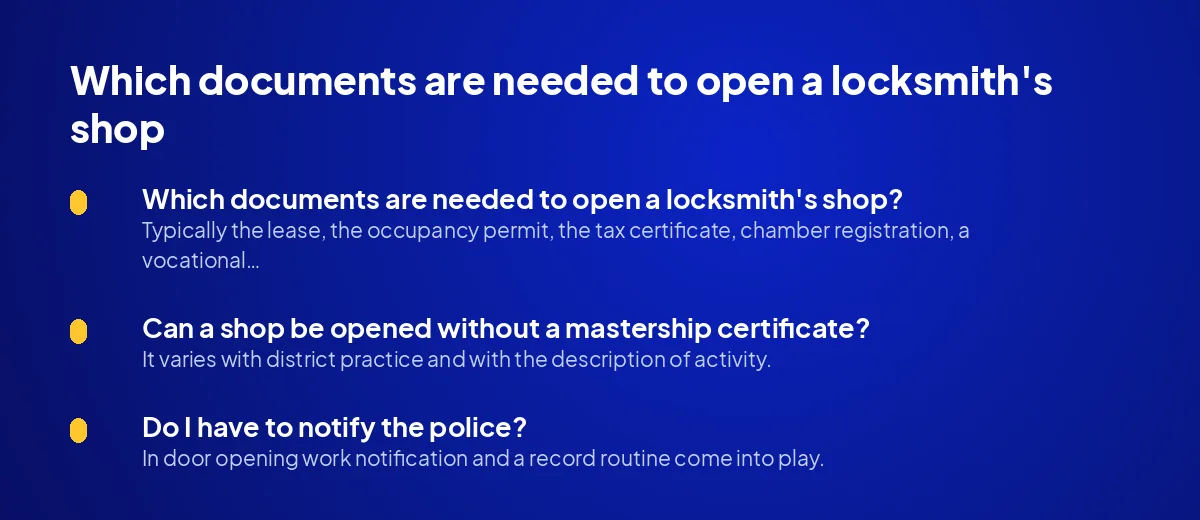
Typically the lease, the occupancy permit, the tax certificate, chamber registration, a vocational competence document and the workplace opening and operating licence.
It varies with district practice and with the description of activity. Have the municipality confirm in writing which document will be sought.
In door opening work notification and a record routine come into play. Confirm the reach with the district police directorate and the municipality.
The date, the time, the address, the identity details of the person requesting it and their statement that they live there. Remember to keep the record.
Before the licence application. Running the two tracks in parallel shortens the calendar markedly.
A complaint can come from the floor above because of the noise. Plan where the machine goes during the rent negotiation.
No single amount can be given. The district’s tariff applies and the tariff is updated during the year.
You can, but your description of activity widens and your licence file is updated to match.
About six weeks if the documents are ready. If the mastership side is missing, the time stays tied to the examination timetable.