
Opening a Costume Jewellery Shop: The Three Most Misunderstood Conditions
Most people opening a costume jewellery shop carry what is written about the jewellery trade into their own file. They then set about a preparation they never needed, and skip the heading that will actually be put to them.
This article takes up three mistaken beliefs in turn, showing why each is wrong, what stands in its place, and exactly where the boundary lies.
What costume jewellery sells and what it does not
Costume jewellery is ornamental jewellery containing neither precious metal nor precious stone. Brass, steel, alloy, glass, resin, beads, leather and plated items all sit inside that definition.
The one thing that steps outside the definition is the metal in the item. Once a product contains gold, silver or platinum, the same shelf is no longer assessed the same way; the business’s identity changes in that moment too.
The first mistake: that jewellery trade documents are required
This is the commonest belief. The would-be shopkeeper writes preparations peculiar to the precious metal trade into their own list, and shoulders a needless burden before trading has begun.
Yet because costume jewellery sells goods containing no precious metal, it is not assessed within the scope of those rules. This is not an exemption but a difference of definition: the goods sold are not what the rules are about.
The second mistake: that a hallmark is looked for
A hallmark shows the purity of precious metal in an article. A costume jewellery item has no purity to show, so there is no mark to look for.
Against that, plated items raise a different sensitivity. Selling an item as gold-plated and selling it as gold differ in the accuracy of the commercial description, and the consumer must not be misled.
The third mistake: that the precious metal duties apply
Customer identification and transaction records attaching to precious metal trading concern, as the name says, businesses that trade in precious metal.
Costume jewellery does not fall within that definition. But matters change once a silver or stone-set item joins the shelf. Before that passage, take confirmation from the legislation as it stands and from your accountant; thresholds and procedure are set and renewed under the rules of MASAK, Türkiye’s financial crimes investigation board.
The three mistakes in one table
The table shows which heading replaces each misunderstood condition. It is not a ruling but a map for preparation.
| The misunderstood condition | Why it is wrong | The heading to look at instead |
|---|---|---|
| Preparation peculiar to the precious metal trade | The goods sold are not precious metal | A general retail licence file |
| Hallmark | There is no degree of purity to show | Writing the product description correctly |
| Precious metal duties | The activity is not within that definition | Fresh assessment if silver joins the shelf |
| A high security standard | Goods value sits in a different band | What the insurer expects |
| A special trade certificate | No work is carried out when only selling | The competence heading if a service is added |
The last two lines carry a warning. Clear the mistaken beliefs away and it is assumed nothing is left; yet the real heading is only now arriving.
What is actually asked for
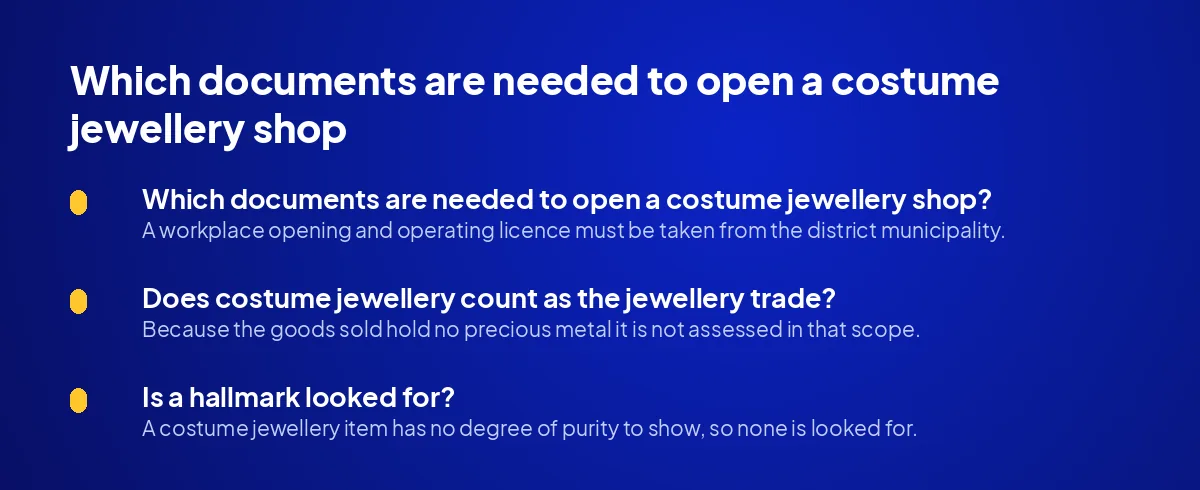
The workplace opening and operating licence comes from the district municipality, and costume jewellery is a retail business typically assessed towards a sanitary establishment. The file holds the following; the last word sits on the municipality’s own form.
- Application form and declaration
- Lease agreement or title deed
- Occupancy permit and information on the zoning status
- Tax certificate and chamber registration document
- Identity document and photograph
- Condominium consent in a residential building
- A fire brigade report according to the premises and the activity
- Social security workplace notification if staff will be employed
The list is not closed; the final answer lies in the questions on the municipality’s form. Some districts add papers of their own.
The real heading: product safety and metal content
What truly carries weight here is not the name of a set of rules but the product. In alloys that touch the skin, metal content is a matter of consumer safety, and the last link in the chain of responsibility is the seller.
Ask the supplier for an invoice by product group, a declaration of conformity where one exists, and the importer’s details on imported goods. When a question comes, the answer is who the item came from and on what paper.
A separate care with children’s items
With jewellery and hair accessories for children, two headings come forward: whether small parts can come away, and the material content.
If you enter this product group, choose suppliers on their paperwork, not on price. Trouble here touches the whole window.
If an ear piercing service is added
Ear piercing looks like a natural extension of the trade. It is in fact an operation that breaks the skin, and it takes the shop out of a selling arrangement.
If you are considering it, declare the scope in writing to the district municipality and, where needed, the district health directorate, and ask for the assessment in writing. Complete that step before the instrument reaches the counter.
Where the boundary lies if a silver shelf opens
Many costume jewellery shops open a silver shelf in time. That can be the right move for the trade, but for the file it is a passage.
With the silver shelf, the headings on the precious metal side come into play. Put your record-keeping in place before the passage; for the detail, see our silver shop article.
Labels, prices and consumer information
The first places an inspection looks are not the large headings. The order runs almost always as follows.
- Is the price label standing where the customer can see it
- Is the product description true, and is a plated item written up as plated
- Is the till and document routine in place
- Are the return and exchange terms made known to the customer
All four are settled in an afternoon. Left unsettled, the report drawn up against you follows you for months.
How expectations are set on the fee side
Items such as the licence fee and the signboard tax shift with the municipality’s own schedule and are set again every year. Do not write a figure quoted for another district into your own reckoning.
Learn that year’s schedule from the revenue department before the file is opened. The margin and capital bands are laid out on our jewellery and accessories sector page.
A plan for moving up a branch
Costume jewellery is the lowest-capital door into this trade. Set up properly, the customer base it builds finances the move up a branch.
For the general order of the authorities look at the business licence roadmap, and if selling moves onto the internet read our online jewellery sales article. Take the decision by the demand at the window, not by the signboard.
In Short
- Costume jewellery is ornamental jewellery with no precious metal or stone in it
- Because the goods sold are not what those rules are about, it falls outside them
- This is not an exemption but a difference in the product definition
- With no degree of purity to show, no hallmark is looked for
- Describing a plated item as plated protects the consumer
- The precious metal duties do not cover the selling of costume jewellery
- Once silver or stone-set goods reach the shelf the position is assessed again
- The real heading is product safety and the metal that touches the skin
- With children’s items, small parts and material content come forward
- An ear piercing service takes the shop outside a selling arrangement
- Fee items shift with the municipal schedule and are renewed every year
Quick Glossary
Costume jewellery: the group of jewellery made from alloys and ornamental materials, holding no precious metal or stone. Plated item: an article whose body is of another material and whose surface carries a thin layer of metal. Product safety: the arrangement requiring goods placed on the market to be of a quality that will not harm the consumer. Declaration of conformity: the paper by which a maker or importer states that an item complies with the relevant technical regulation.
Next Step
Let us build your product group and your supplier file together: consultation request form.
Frequently Asked Questions
Updated: September 2026
Sık Sorulan Sorular
A workplace opening and operating licence must be taken from the district municipality. The file proceeds as an ordinary retail file.
Because the goods sold hold no precious metal it is not assessed in that scope. Confirm your exact position with the district municipality in writing.
A costume jewellery item has no degree of purity to show, so none is looked for. Describing a plated item correctly is still required.
So long as you remain outside the definition of precious metal trading, that heading does not arise. Reassess the position if silver joins the shelf.
State plainly on the label and at the sale that it is plated. Presenting the item as gold misleads the consumer.
An invoice by product group, a declaration of conformity where one exists, and the importer’s details on imported goods.
That small parts do not come away, and the content of the material. In this group choose the supplier on their paperwork.
Because it is an operation that breaks the skin, the scope must be declared in writing to the municipality and, where needed, to the district health directorate.
The record and customer identification headings on the precious metal side come into play. Put your arrangement in place before the passage.
Source: Ministry of Trade — Product Safety and Technical Regulations