
Documents Needed for Jewellery Wholesale: A Nine-Step Set-Up
Jewellery wholesale builds a different file from retail. A warehouse in place of a window, a dealer in place of a customer, steady despatches in place of a single sale. The document list reflects that: the centre of gravity shifts from the licence towards supply, record-keeping and despatch.
Below we divide the set-up into nine steps. Each step’s output is the next one’s input, so the order matters. If a dealer network is in mind, you will also see from step seven how responsibility shifts.
Step 1: Settle your product group and your material
The first decision, the one shaping the whole file, is the material. Costume jewellery, silver and gold-bearing groups are not assessed in the same frame.
Sell goods containing precious metal and the fineness, hallmark and customer identification lines come into effect. Sell costume jewellery alone and they do not, but product safety and labelling come forward. For a mixed portfolio, account for both from the outset.
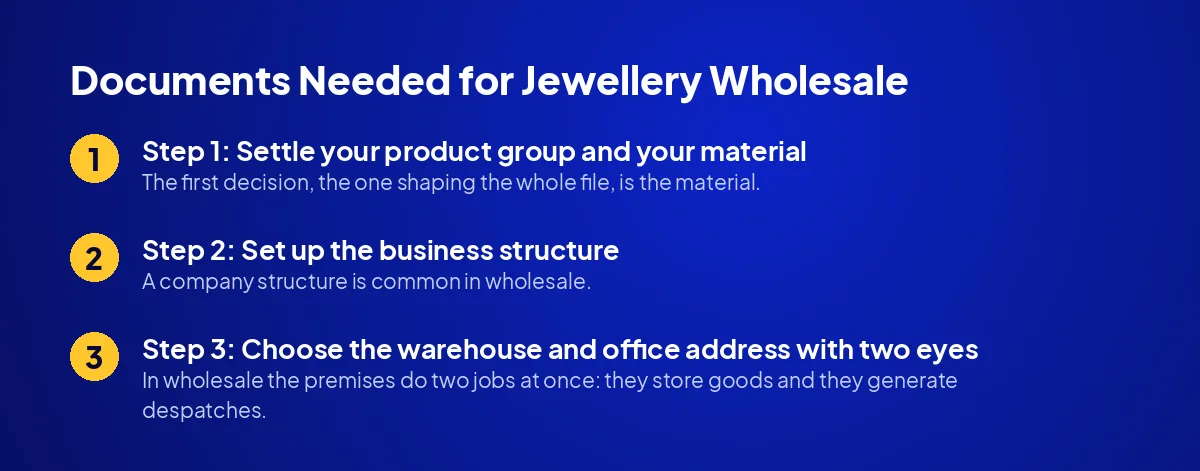
Step 2: Set up the business structure
A company structure is common in wholesale. Where a business signs dealer agreements, invoices corporate customers and exports, a limited company usually works more comfortably than a sole tradership.
After formation come the tax certificate and chamber registration. The step runs mechanically, but it feeds every later application, so it should not be put off.
Step 3: Choose the warehouse and office address with two eyes
In wholesale the premises do two jobs at once: they store goods and they generate despatches. Those two needs ask for different things.
- A frontage a vehicle can reach for loading and unloading
- A locked, separate and recorded section for valuable goods
- A separate working bench area for counting and packing
- Zoning status at the address suitable for warehouse and office use
- Cameras with sufficient retention and an entry control arrangement
The fourth item is most often skipped. An address suitable for retail may not suit warehouse activity; ask about zoning status with your description of activity.
Step 4: Open the municipal file
The workplace opening and operating licence is taken from the district municipality. Warehouse and office activity carries no noise or waste, so it is typically assessed within the sanitary establishment frame.
If you will assemble, solder or plate on the premises, that can change. Put your planned operations in writing and ask the district municipality for the classification in writing; never start refurbishment on the strength of something said verbally.
Step 5: Build the supply and record arrangement
A wholesaler’s commercial identity shows in the stock record. When that record is not kept, the problem surfaces not in a sale but in an inspection or a dealer’s objection.
- Recording every consignment at intake with the supplier, date and invoice details
- Writing the fineness into the record for goods containing precious metal
- Using product codes in the same form on both the intake and the outgoing record
- Tying the counting cycle to a written arrangement
- Keeping returns and exchange records separately
The third item asks most effort of a wholesaler. The same product entered under a different code means no count holds at month end.
Step 6: Read the fineness, hallmark and customer identification line
For a wholesaler selling goods containing precious metal this step cannot be skipped. On fineness and hallmarking, the legislation relating to the Turkish State Mint is decisive; confirm with the Mint and the relevant institution how a product is hallmarked and which conditions are sought.
Alongside sit customer identification and suspicious transaction reporting obligations. Their thresholds and reporting procedure are set and updated under the legislation. Volumes are high in wholesale, so describe your manner of selling and ask your accountant for a written assessment.
Step 7: Tie your despatch and carriage arrangements to documents
This is the most tangible item separating a wholesaler from a retailer. The goods are constantly on the road, and the record of goods on the road stays with you.
| Item | What it provides | Watch for |
|---|---|---|
| Despatch note arrangement | The record of goods leaving | Complete on every despatch |
| Carrier agreement | The definition of responsibility in transit | Have the value limit written in |
| Goods-in-transit insurance | Cover for damage and loss on the road | Read against the type of product |
| Signed delivery record | Who the goods were handed to | Is the dealer’s employee authorised |
| Packing standard | Reduction of the risk of damage | Weight and label consistency |
The fourth row carries a quiet risk. If it is not in writing whether the person taking delivery on the dealer’s side was authorised, no foundation remains in a dispute over loss.
Step 8: How does responsibility shift once a dealer network is built?
A dealer network grows the business and widens responsibility with it. A product that is not in your window begins to be sold in your name.
- A written definition of which product group the dealer sells, and where
- Limits on the use of the brand and its imagery set out in the agreement
- An obligation that fineness and product information are passed on correctly by the dealer
- Determination of where the returns, defective goods and warranty processes begin
- Periodic comparison of dealer stock against the records
The third item is the most critical. A dealer passing on product information wrongly brings the consumer’s objection to your door, so it is safer for the wholesaler to prepare the information sheet.
Step 9: Staff, insurance and opening
You will be taking on employees on the warehouse and packing side. The social security workplace declaration is given before the first employee; safety training and a record of personal protective equipment are also expected.
Set two policies beside them: stock insurance for the business and goods-in-transit insurance for despatches. The risk begins inside the warehouse and ends at the dealer’s door; read line by line whether the policies cover the ground between.
Summary of the set-up order
| Step | Output |
|---|---|
| 1-2 | Product group decision and a formed business |
| 3-4 | A suitable address and an opened licence file |
| 5-6 | A working stock record and a read obligation line |
| 7 | Despatch and carriage arrangements tied to documents |
| 8 | A dealer relationship set on an agreement |
| 9 | Staff records, policies and the start of trading |
We give no figure for charge and signage items; the schedule differs from one municipality to the next and is renewed at the turn of the year. Ask your district’s revenue directorate for current amounts. Plan the order of institutions from the business licence roadmap, and the capital load of the warehouse and stock side from our jewellery and accessories sector page. If your own production is planned, our jewellery design studio article carries this set-up on; if the digital channel is too, our online jewellery sales article does.
In Short
- In wholesale the centre of gravity is supply, record-keeping and despatch rather than the licence
- The first decision shaping the whole file is the product material
- On goods containing precious metal the fineness, hallmark and customer identification lines come into effect
- An address suitable for retail may not be suitable for warehouse activity
- Assembly or plating on the premises can change the establishment assessment
- The same product code at intake and despatch is the one condition of a count that holds
- Obligation thresholds and reporting procedure are set and updated under the legislation
- The despatch note, the carrier agreement and the delivery signature work together
- The authority of the person taking delivery on the dealer’s side must be in writing
- The wholesaler preparing the product information sheet reduces objections arising from dealers
- Stock and transit policies should cover the ground between the warehouse and the dealer’s door
Quick Glossary
Despatch note: the document showing goods leaving the business and where they have been sent. Dealer agreement: the commercial agreement governing the sale of a product on defined terms. Goods-in-transit insurance: the policy covering the risk of damage and loss while goods are being carried. Product information sheet: the document setting out a product’s material, fineness and care details together.
Next Step
Let us adapt the nine steps to your own product group and tie them to a calendar: consultation request form.
Frequently Asked Questions
Updated: September 2026
Sık Sorulan Sorular
The formation papers, tax certificate, chamber registration and workplace opening and operating licence are the usual set, with stock and despatch records beside them.
They do not. On goods containing precious metal the fineness, hallmark and customer identification lines come into effect; in costume jewellery, labelling and product safety come to the front.
A file is opened for every address where activity is carried on. Ask about zoning status with a description covering warehouse and office use.
It can, but in a business with dealer agreements and a corporate sales plan a company structure usually works more comfortably.
On fineness and hallmarking, the legislation relating to the Turkish State Mint is decisive; confirm the conditions for your product group with the institution.
This obligation exists in the precious metals field. Thresholds and procedure are set under the legislation; ask your accountant for a written assessment.
It is determined by the frame set by the carrier agreement and the signed delivery record. Where both are missing, no foundation remains in a dispute.
A consumer objection can reach the wholesaler. That is why the wholesaler preparing the information sheet is the safer arrangement.
Six to ten weeks if the address and the papers are ready. Drawing up the dealer agreements asks for a separate calendar outside that period.
Source: MASAK, Türkiye’s financial crimes investigation board — Guidance for Obliged Parties