
Setting Up a Removals Company: Which Paper From Which Authority?
In removals the file does not close at one door. In a retail shop the process largely begins and ends at the municipality; here four separate links are joined, each pointing to a different authority.
Below we open the four links in turn. The aim is not a closed list of papers but to settle which question goes to whom. One heading alone changes the file here: how many vehicles you take to the road with.
How the four links are joined
Setting up a removals firm runs across four interlocking areas: legal personality and tax, the address and the premises, transport authority, and the vehicle and staff side.
When one link is left short the others are left idle. Firms that build the fleet and leave the transport authority side to the end also pay the standing cost of waiting vehicles.
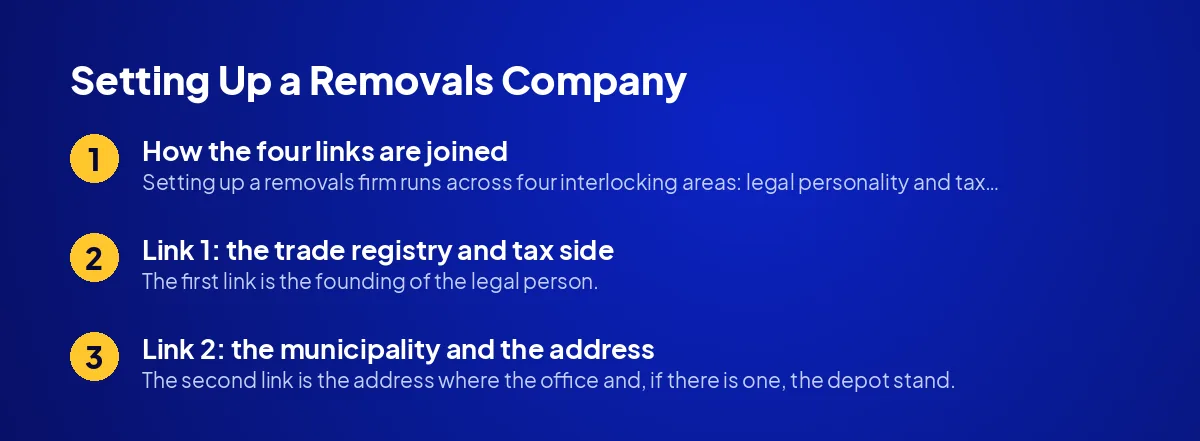
Link 1: the trade registry and tax side
The first link is the founding of the legal person. For a company, registry entry and chamber registration; for a sole trader, the tax office notice and chamber entry, complete this link.
In this branch a company structure is often less a preference than a need. Work becomes easier when corporate clients, the insurance side and the transport authority application all run through a legal person.
Link 2: the municipality and the address
The second link is the address where the office and, if there is one, the depot stand. For that address the workplace opening and operating licence is issued by the licensing unit of the district municipality.
On an office-only arrangement the business leans towards a sanitary establishment. Once parking, loading and storage come to the same address the assessment can change; ask the licensing unit for the class decision in writing.
Link 3: the transport authority side
The third link is this branch’s own particular door. Carrying commercial goods by road is an activity governed by the Ministry of Transport and Infrastructure, and the question of an authorisation certificate arises here.
The authorisation certificate comes in more than one type, and which of them concerns you varies with the scope of your activity. Types and conditions are revised; so confirm the one your own work needs in writing with the regional directorate concerned.
Link 4: vehicles, drivers and social security
The fourth link covers the side that goes out on the road. The licensing, inspection and insurance position of the vehicles, and the licence class and vocational qualification of the drivers, gather in this link.
If you employ staff, the social security file and the occupational health and safety service are set up before the first person. In haulage, loading and unloading is the stage that produces the most accidents; do not treat this heading as a formality.
The four-link table of authorities
The table below shows at which door each heading is to be raised. Practice shifts from one province to the next.
| Link | Authority concerned | When it comes in |
|---|---|---|
| Legal personality and tax | Trade registry and tax office | At the very start |
| Chamber registration | Trade chamber or tradesmen’s chamber | After registration |
| Address and workplace licence | District municipality | Once the address is settled |
| Transport authority | Regional directorate of the Ministry of Transport and Infrastructure | Before investing in vehicles |
| Vehicles and insurance | Traffic registration and the insurer | With the vehicle purchase |
| Drivers and staff | Social security and the safety service | Before the first recruitment |
Do not read the table as a settled ruling. A heading appearing in your file does not mean it is compulsory for every firm.
Where the number of vehicles changes the certificate
This is the point most often missed. On the transport authority side, which certificate comes into play depends on the size of the fleet as much as on the nature of the activity.
A firm beginning with one vehicle and a fleet of five may not be assessed in the same application frame. We give no figures for which threshold opens which type; those values are matters of regulation and they change. Before building your fleet, tell the regional directorate the number of vehicles you plan and ask its view in writing.
The divide between local, intercity and international
Where the carriage runs from and to settles the frame directly. Carriage within a city, carriage between provinces and carriage crossing the border answer to separate arrangements.
The international side is the heaviest frame and wants preparation of its own. Decide at the outset which band you will build your model in; changing band afterwards means a fresh application process.
The difference between house removals and part-load haulage
House removals is a model working face to face with the customer, taking in packing and assembly as well. Part-load and commercial goods haulage is a business-to-business model where the consignment papers carry the weight.
Both can use the same vehicle, but not the same operation. Insurance, liability and pricing logic are separate; if you sell both, build two processes.
What happens if storage is added
Once you begin holding a customer’s goods for a period, the business ceases to be only a carrier. The depot address becomes subject to its own licence assessment.
At a depot, fire safety, the evacuation arrangement and the insurance side move to the front. Before selling a storage service, check whether the depot carries those three headings.
Four written confirmations to ask for before applying
- From the regional directorate: which type of authorisation certificate your scope requires
- From the district municipality: in which class this address and this activity are assessed
- From the insurer: which policy the goods carried and the liability require
- From your accountant: sole trader or company, and which suits at which threshold
Four written answers wipe out most of the month-long delays here. Buying vehicles on spoken information is the costliest mistake in the work.
Fees and charges are two separate items
The licence fee, the signboard tax and official application charges are not fixed. Municipal items depend on each municipality’s own tariff, while the charges on the ministry side sit under their own arrangement and are revised yearly.
So do not write a figure you have heard into a budget line; ask the district revenue department and the regional directorate separately for the amounts in force. Capital and margin bands sit on our business services sector page.
Putting the set-up in the right order
The right order is this: legal personality, address, the transport authority’s view, then vehicles. Reverse it and the vehicles wait while the loan instalments keep running.
For the general order of the authorities see the business licence roadmap; to compare the branch model our courier branch article, and to see another staff-heavy permit regime our private security company article.
In Short
- In removals the file runs in four links, each pointing to its own authority
- The first link is legal personality, registration and tax
- The second is the address and the licence issued by the district municipality
- The third is the authority question on the Ministry of Transport side
- The type of authorisation certificate varies with the scope of your activity
- Confirm the type and its conditions in writing with the regional directorate
- The number of vehicles you plan affects which frame you fall into
- Local, interprovincial and international carriage answer to separate arrangements
- House removals and part-load haulage are not the same operation
- If storage is added, the depot address has its own assessment
- The right order: legal personality, address, authority view, vehicles last
- Fees and charges are revised yearly; ask the two authorities separately
Quick Glossary
Authorisation certificate: the paper, governed by ministry regulation, showing within what scope road haulage may be carried on. Regional directorate: the provincial body dealt with on transport applications. Part-load: the form of carriage in which one customer does not fill the load and several consignments are combined. Consignment document: the commercial paper showing whose the goods carried are and where they are going.
Next Step
Let us write out your scope of carriage and vehicle plan and work out what to ask at which door: consultation request form.
Frequently Asked Questions
Updated: September 2026
Sık Sorulan Sorular
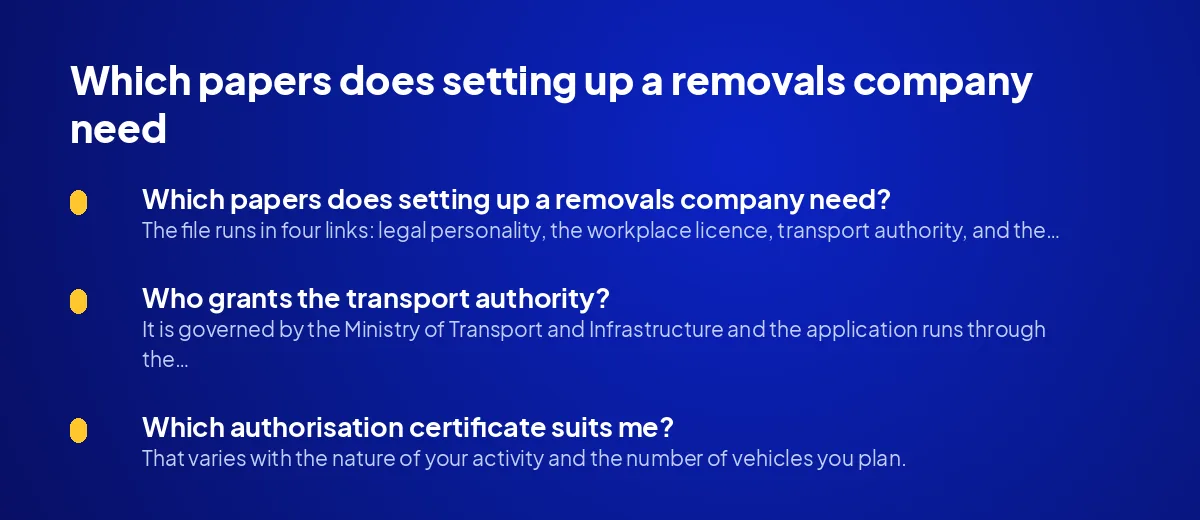
The file runs in four links: legal personality, the workplace licence, transport authority, and the vehicle and staff side. Each link’s paper is asked of its own authority.
It is governed by the Ministry of Transport and Infrastructure and the application runs through the regional directorate. Learn the type suited to your scope there, in writing.
That varies with the nature of your activity and the number of vehicles you plan. Since types and conditions are revised, you need confirmation from the regional directorate.
There are models that can be started that way. Because fleet size affects which frame you fall into, declare your plan before applying.
You cannot. The municipal licence settles the address and premises side; transport authority is a separate door.
The zoning status and the condominium side decide. The question grows heavier if vehicle parking and load handling come to the same address.
The licence class and the vocational qualification side come up. Ask the regional directorate for written information about your own team.
The depot address is subject to its own licence assessment. Fire safety and the evacuation arrangement move to the front at that address.
The road can be reached within a few months if the authority side is solved at the front. Left to the end, that link keeps the vehicles waiting and the time lengthens.
Source: Ministry of Transport and Infrastructure — Road Transport Regulations