
New flower shop, no customers? The 6 parts of a botanical studio’s trust threshold
When a new flower shop has no customers, the reason is usually trust rather than the flowers. Flowers are often bought for someone else, and the person paying cannot see the bouquet before it is delivered. So before ordering, a selective client looks for answers to six questions: can I see your work, were others happy, is the price range clear, is the delivery time firm, can I reach you, and is there a serious brand behind this.
When one goes unanswered, the client glances at the window and moves on. A newly opened botanical design studio has few reviews, little past work and an unknown name. The fix is not more advertising but completing the six parts in order. In a 2026 US local consumer survey, 47 percent of respondents said they won’t use a business with fewer than 20 reviews; the first months are preparation for that threshold.
Why is the Yeşilköy studio’s window full and its order book empty?
Let’s say you open a botanical design studio on a street near the station in Yeşilköy, on the Bakırköy side of Istanbul. There is a dried-flower arch in the window. At weekends many walk past, few come in, and phone orders reach one or two a day. The problem is not your product but the information the client holds at the moment of decision.
What does a client buying flowers for someone else weigh up?
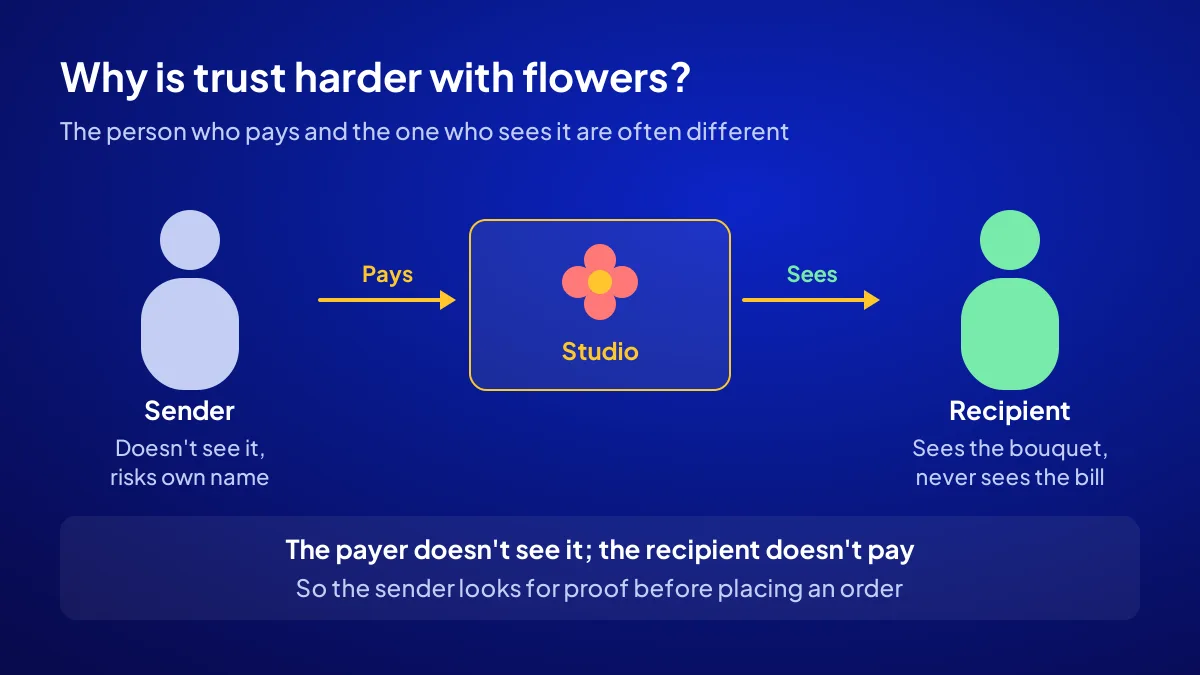
In a flower order, the person who pays and the person who sees the flowers are often different people. Someone in Mavişehir sending a bouquet to their mother in Ankara puts their own name on the line without ever seeing the bouquet. So the trust threshold is higher than for a café or a hair salon: the client entrusts you with their own reputation.
An unseen product needs visible proof
If the sender cannot see the bouquet, show them proof: photos of real work in the same price band, a photo of the finished bouquet before delivery, a notification at delivery time. These small steps stand in for social proof. We explain what the client is really buying with that proof in what flower studio clients really buy.
Corporate orders are even more cautious
A manager ordering weekly flowers for a reception or hotel lobby asks about invoices, regularity and a backup plan. Show them a written delivery schedule before the first order.
Why do reviews carry so much weight?
Because a new studio has little other proof. BrightLocal’s 2026 Local Consumer Review Survey is based on 1,002 adults in the US. It is not Turkish data, but it shows the direction of behaviour: reviews get read, and both count and freshness matter. The table sets four findings next to what they mean for a newly opened flower studio.
| Finding (BrightLocal 2026) | Share | What it means for a new studio |
|---|---|---|
| Read reviews for local businesses | 97% | Have a review plan before the profile goes live |
| Won’t use a business with fewer than 20 reviews | 47% | First goal: 20 genuine reviews |
| Look for reviews written in the last three months | 74% | A new studio’s reviews are fresh; that is an advantage |
| Only use businesses rated 4.5 stars or higher | 31% | Reply calmly and quickly to every negative review |
Opening with zero reviews is nothing to be ashamed of
Every studio starts at zero; buying reviews or having friends write them is the mistake. Using reviews whose purchase cannot be verified in your promotion also falls foul of the advertising rule in force in Turkey since 1 August 2026.
Freshness works in your favour
If clients look at the last three months, a rival’s old reviews shine less. Ask for reviews with a polite card in early orders.
What are the 6 parts of the trust threshold?
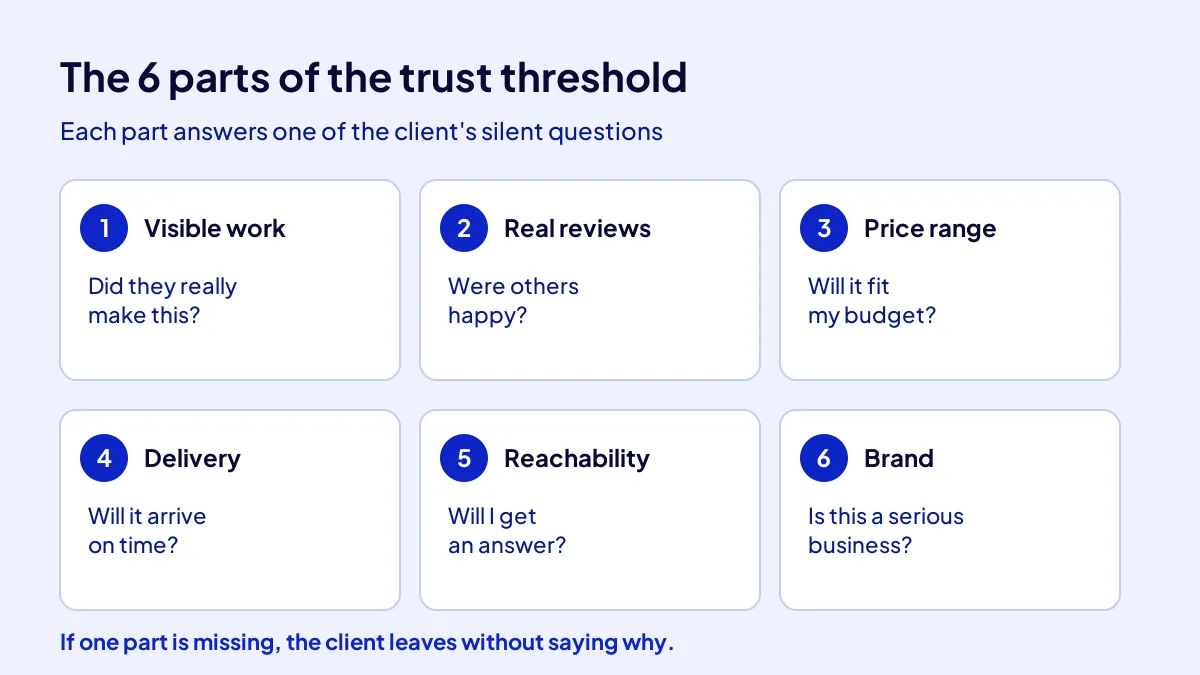
The six parts are answers to the client’s silent questions: visible work, genuine reviews, price range, delivery promise, reachability and brand consistency. When one is missing, the client walks away without saying why. The table gives one opening-week task for each.
| Part | The client’s silent question | Task for week one |
|---|---|---|
| 1. Visible work | “Did they really make this?” | 12 photos of real work, the same on profile and site |
| 2. Genuine reviews | “Were others happy?” | A review request card in early orders |
| 3. Price range | “Will it fit my budget?” | Three tiers of starting prices |
| 4. Delivery promise | “Will it arrive on time?” | Area and time window in writing |
| 5. Reachability | “Will I get an answer?” | Reply within the same hour during opening hours |
| 6. Brand consistency | “Is this a serious business?” | Same name, logo, packaging and domain |
Why does hiding prices backfire with selective clients?
Premium clients fear uncertainty, not high prices. “DM for prices” feels like an invitation to haggle, and most never write. Three tiers of starting prices tell clients both the budget and the studio’s level. We dig into the roots of this behaviour in why do they only ask about price.
Three tiers are enough
Write a “from…” price for a seasonal bouquet, a signature bouquet and event design, based on your own costs.
A ready answer to the price question
Answer a price enquiry with two options and a photo of each. Keep that template ready, even on quiet days when you are twiddling your thumbs.
Which part do you fix first?
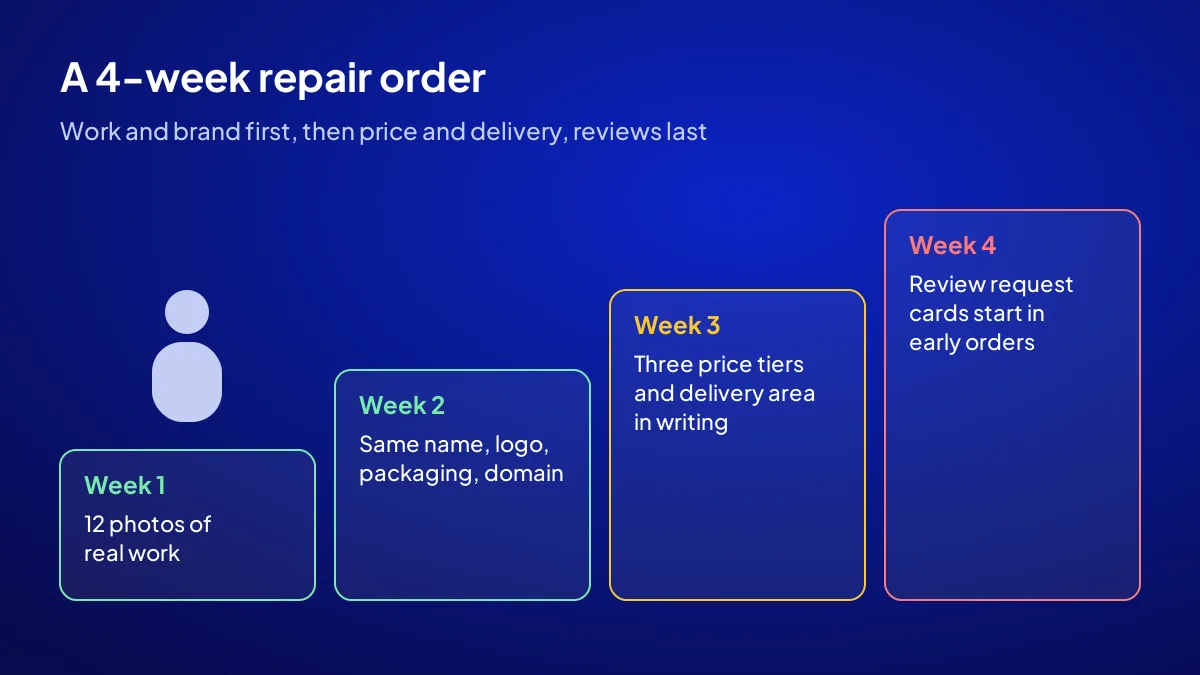
Follow the client’s decision path: first visible work and brand consistency, then price and delivery, reviews last. Reviews come later, once the first two parts are in place. Brand consistency takes longest, because the name, logo, packaging, domain and site all need to speak the same language.
Building the brand in one place
The Build Your Digital Brand campaign covers positioning and brand voice, a TÜRKPATENT preliminary search (not a legal opinion), three directions for logo, colour and typeface, a domain with one year of hosting, a six-page brand site and 108 articles. The domain is registered in your name. TRY 36,000 + VAT at a fixed price, 12 brand places and a deadline of 1 November 2026. Details are on the campaign page.
The full plan
The studio’s full promotion plan is in the new flower and botanical design studio promotion guide, and the order of the first three months in the first 90 days plan. One principle: a selective client does not send flowers from a place they do not trust, so make trust visible first.
Quick Summary
- When a new studio gets no customers, the reason is usually trust.
- The person paying and the person receiving are different, so the threshold is high.
- In BrightLocal 2026, 47 percent of respondents won’t use a business with under 20 reviews.
- Six parts: visible work, reviews, price range, delivery, reachability, brand.
- Instead of hiding prices, show three tiers of starting prices.
- Repair order: work and brand first, then price and delivery, reviews last.
Short Glossary
Trust threshold: A trust threshold is the concept used to describe the set of questions a client wants answered before placing an order.
Social proof: Social proof is the element used to reassure a new client by showing other people’s experience, such as reviews, photos or references.
Starting price: A starting price is the price information used to show the lowest amount in a product tier so clients can weigh their budget.
Next Step
To build your studio’s name, identity and website in one voice, apply for the Build Your Digital Brand campaign. For the 10% coupon, just mention the code when you apply or in your meeting.
Frequently Asked Questions
Source: BrightLocal — Local Consumer Review Survey 2026
Sık Sorulan Sorular
“Lovely, but how much?” If there is no price, walking in to ask feels like entering a negotiation. A selective client usually does not ask; they keep walking.
That evening they type the studio’s name into Google. They find two reviews, five photos and a profile with no opening hours. The order goes to the florist they already know. It looks as if the till isn’t ringing, but the decision is being made on a screen you never see.
Instagram carries two of the parts; the rest get scattered. Prices, delivery area and how to order belong on one page. The list of those pages is in a flower studio’s website pages.
Usually because of trust. Flowers are often bought for someone else, so the client decides without seeing the bouquet. If they cannot see your work, reviews, price range, delivery promise, reachability and brand consistency, they give the order to a business they already know.
Do not buy reviews or have friends write them. Ask genuine customers for a review with a polite card in your early orders. Because clients look at recent reviews, a new studio’s fresh reviews gain weight over time.
The domain is registered in the client’s name. One year of hosting is included; the second-year hosting renewal is the client’s responsibility. The package is TRY 36,000 + VAT at a fixed price; with 20 percent VAT it comes to TRY 43,200, but check the current rate on your invoice.
Updated: October 2026