
Boutique Google Business Profile: the right category and 6 fields for vintage shops
A boutique Google Business Profile is the record that decides how your shop is described on Maps and in search. The field that does the most work is the category. Google asks you to describe what your business is, not what it has. For anyone opening a niche boutique, a vintage store or an antique shop, that single rule sets up half of the profile.
The other half is six fields: business name, primary category, address and signage, opening hours, opening date, and photos with a description. Get them right and a selective shopper in Beşiktaş who types “vintage” sees you on the right shelf. Get them wrong and nobody walks through the door.
Most people miss this: why a category is not a keyword
BU BÖLÜMÜN ÖZETİ
- A category is like the name on a doorbell
- What a business has versus what it is
- Fewer categories say more
Google’s guidelines say plainly that categories should not be used as a keyword tool. There is a lesser-known detail too: when you pick the most specific category, Google adds the broader ones in the background on its own. A shop that chooses an antiques category does not need to hunt for a generic “store” category as well.
A category is like the name on a doorbell
Write five names on one doorbell and the courier finds the building but not the door. One correct name brings the right customer to the right door.
What a business has versus what it is
Say you offer coffee in your vintage boutique in Kadıköy. That does not make the shop a café. The category reflects what the business is, not the machine in the corner.
Fewer categories say more
Google recommends choosing as few categories as possible to describe your core business. Extra categories rarely help; they blur the profile.
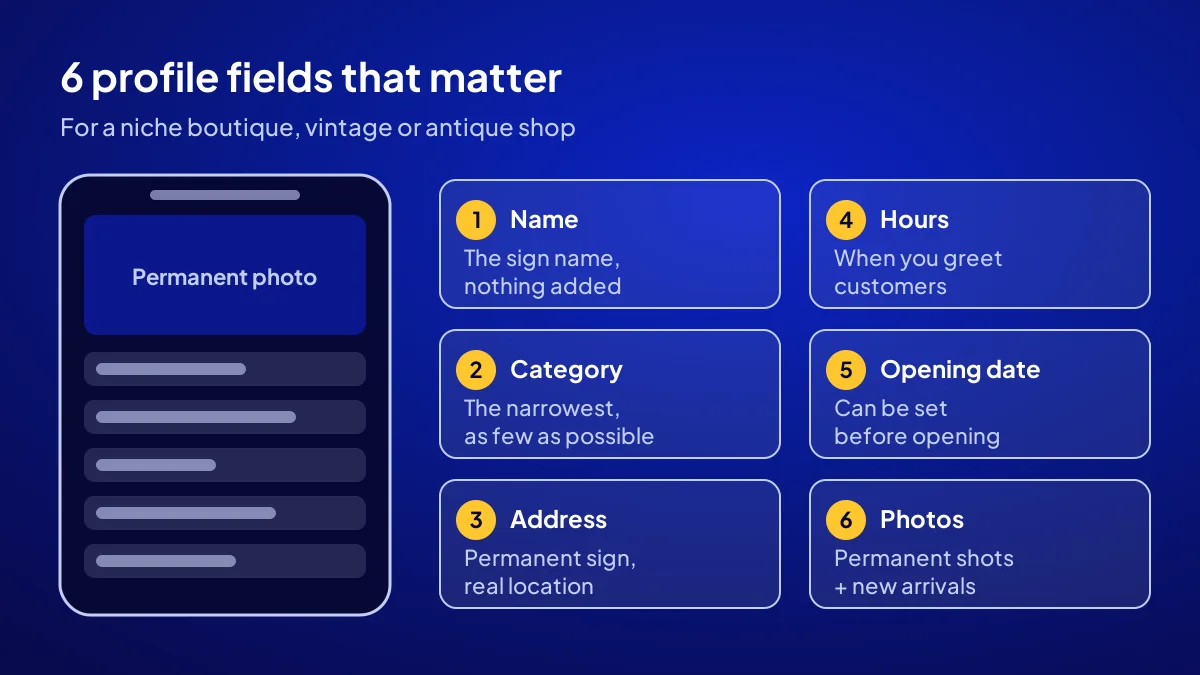
Which category should a boutique, vintage or antique shop start with?
The primary category describes the work that brings in most of your takings. If most sales are period furniture and objects, go in the antiques direction. If most are period clothing, go vintage clothing. If you sell curated new design pieces, go boutique. Type “antique”, “vintage” or “boutique” into the category box and pick the narrowest match from the list.
| What the shop mainly does | Primary category direction | When to add a secondary | Avoid |
|---|---|---|---|
| Period furniture, objects, paintings | Antiques | If you run a real restoration workshop | Museum, exhibition hall |
| Period clothing, bags, accessories | Vintage clothing | If accessories are a separate section | Fashion designer (unless you design) |
| Curated new design products | Boutique | If home decor is a separate section | Wholesaler, manufacturer |
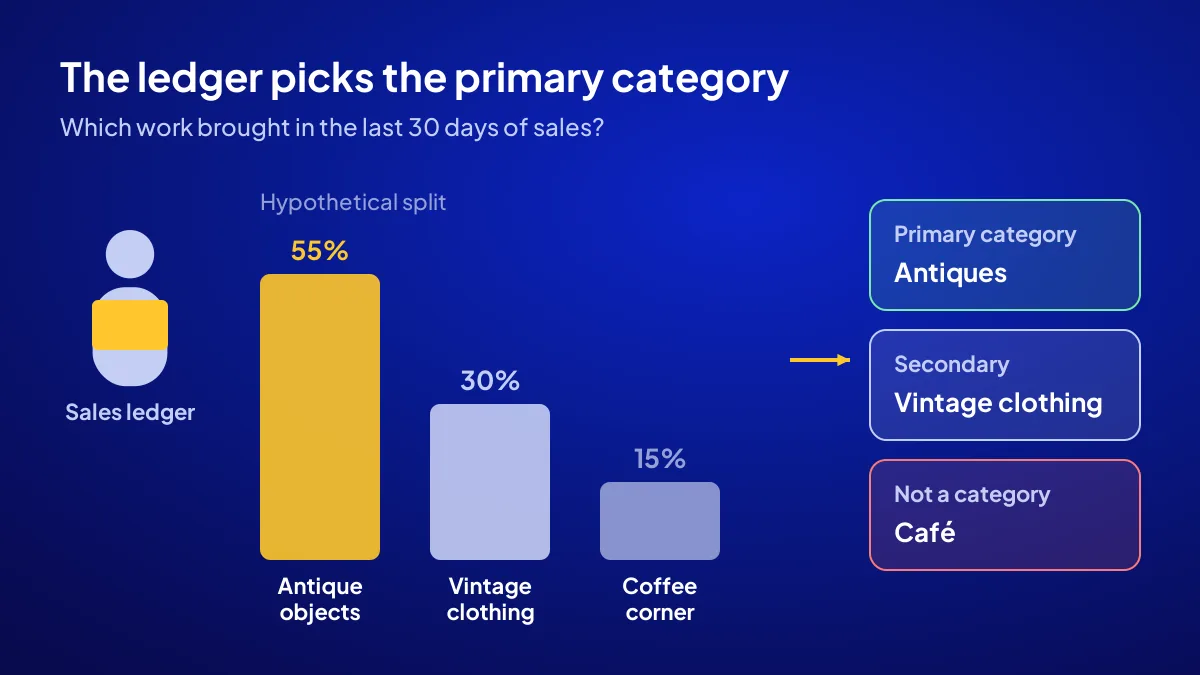
| Mixed: vintage, antiques and a drink | Whatever brings most sales | Few, and only for work you really do | Café (unless seating is the main business) |
The mixed shop’s dilemma
Say you sell vintage jackets and antique mirrors in Moda. Open the ledger and look at the last 30 days. Whichever brings most of the revenue is the primary category; the other becomes a secondary.
When to review the category
Review the category once, after the first month’s sales. How you show up in your district once the profile is live is covered in visibility in affluent districts.
Why adding your district or “vintage” to the name backfires
Google treats marketing taglines, location details, phone numbers, opening hours and words written entirely in capitals as against the rules when added to a business name. The name is whatever is on your sign and invoices. “Nostalgia Vintage Antiques Beşiktaş” breaks the rule and looks amateurish to a selective customer.
The sign name is the profile name
When the sign, invoices, Instagram and profile carry the same name, Google and customers both see one business.
“Best”, “only”, “original”
“Istanbul’s oldest antique dealer” cannot be part of the name, and in the description it needs documents. Selective customers look for proof.
How to fill in address, signage and hours
BU BÖLÜMÜN ÖZETİ
- The appointment-only showroom
- The seasonal shop in Çeşme
- The phone field
Google wants a profile created for a real location in the real world, and it expects businesses shown on Google to have permanent signage. A virtual office that does not receive customers does not qualify. In the hours field you enter the regular hours in which you greet customers at the door.
The appointment-only showroom
Picture an appointment-only antique showroom in Sarıyer. With permanent signage and customers received on site, the address makes sense. Enter the real hours in which you give appointments and explain the booking routine in the description.
The seasonal shop in Çeşme
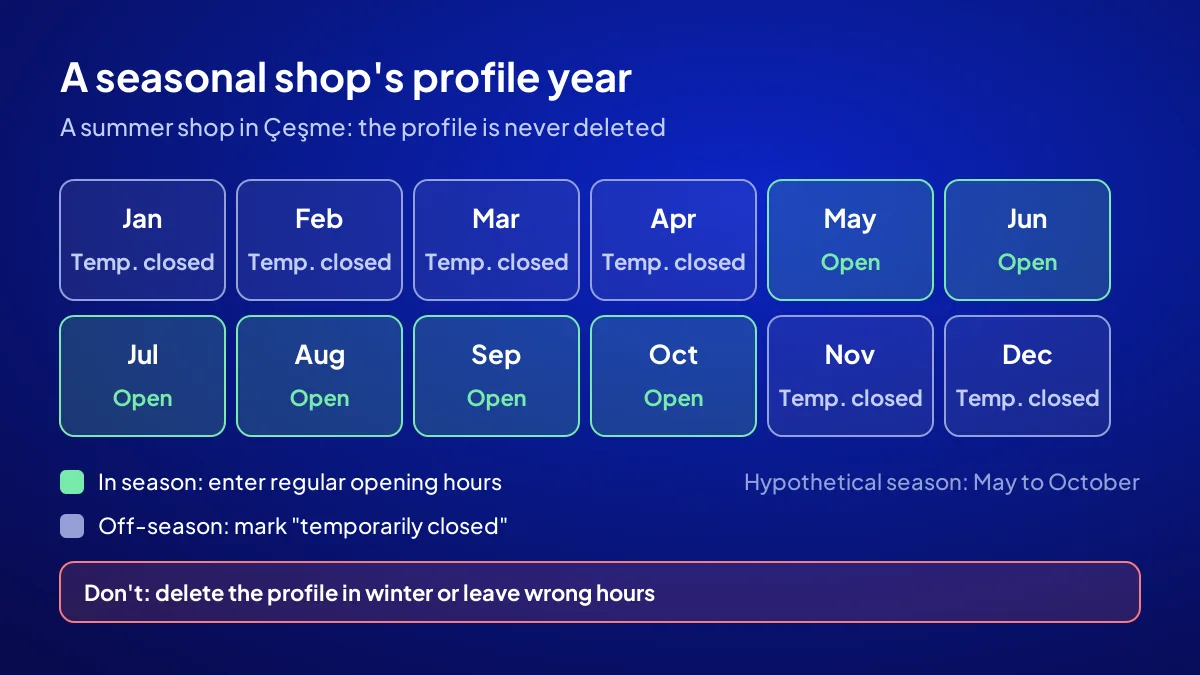
Google’s rule for seasonal businesses is clear: enter regular hours for the season you are open and mark the profile “temporarily closed” off-season. Do not delete it. Even while the shop sits empty in winter, the profile keeps its history for the summer.
The phone field
Where possible, use the shop’s local number rather than a call centre.
What do the opening date, photos and description change?
BU BÖLÜMÜN ÖZETİ
- Opening date
- The one-of-a-kind photo problem
- Description: state your selection criteria
These three fields are the profile’s shop window. The opening date shows the difference between “not open yet” and “just opened”. Photos are the first thing a selective customer weighs. The description says what the shop chooses and what it leaves out.
Opening date
If you have not raised the shutter yet, you can enter a future opening date. See adding an opening date on Google.
The one-of-a-kind photo problem
The piece you photograph today may be sold tomorrow. Post two kinds of photos: permanent shots of the shop, the window, the entrance and you, plus regular updates of new arrivals.
Description: state your selection criteria
Say in two or three sentences which periods, origins and conditions you pick. “We have everything” turns a niche shop into an ordinary one.
Which claims should an antique shop keep out of its profile?
Trading antiques and items that may count as cultural property is subject to separate rules. Under Turkey’s Law No. 2863 on the Protection of Cultural and Natural Property, a trading permit may be required for this business. Before you open the profile, ask your local museum directorate or the Ministry of Culture and Tourism about the current requirement.
Documents come before descriptions
Use words like “period piece”, “original” or “appraised” only when you hold the paperwork. Without it, describe the condition and estimated period honestly.
Who sets up the profile, and how long does it take?
You can open the profile yourself in an evening. Verification depends on Google and can take a few days. The Start a Business Online campaign sets it up together with a website, tracking and WhatsApp Business at a fixed price. The shop’s overall promotion plan sits in the new boutique promotion guide.
Price and places
TRY 36,000 + VAT, paid upfront at a fixed price; with 20 percent VAT that is TRY 43,200, so check the current rate on the invoice. There is a 10 percent coupon; just mention the code when you apply. Places are limited to 12 businesses and the last application day is 1 November 2026. Details are on the campaign page.
Now you know
The category is the shop’s identity, the name is the sign name, and a seasonal shop is never deleted. The first three months after setup are in the first 90 days plan, and the steps to the first customer are in finding clients for a new boutique.
Quick Summary
- The category says what the business is, not what it has.
- Choose the narrowest category; Google adds the broader ones itself.
- The name is the sign name; no district, “vintage” or all caps.
- A seasonal shop is marked “temporarily closed” off-season.
- Antique claims and the word “original” need documents.
- Verification depends on Google and can take a few days.
Short Glossary
Primary category: The primary category is the profile field used to tell Google the main business in a single line.
Temporarily closed: Temporarily closed is the status used to show that a seasonal or briefly closed business is shut without deleting its profile.
Profile verification: Profile verification is the step used to prove to Google that the business really is at that address and belongs to that person.
Next Step
To set up the profile together with a website, tracking and WhatsApp Business, apply for the Start a Business Online campaign. After you apply, a name and plan proposal follows and the setup schedule is given in writing.
Frequently Asked Questions
Source: Google Business Profile Help — Guidelines for representing your business on Google
Sık Sorulan Sorular
Google Business Profile, a website with 6 main and 12 sub-pages, 108 articles across 6 keyword groups, 3 social media accounts, GA4 and Search Console tracking, WhatsApp Business, structured data and the AI-SEO Diagnosis Card. The domain is registered in your name.
Google recommends as few categories as possible to describe the core business. The primary category reflects the work that brings most sales; a secondary is added only for separate work you really do. When you pick the most specific category, Google adds the broader ones itself.
No. Under Google’s rules a seasonal business enters regular hours for the season it is open and marks the profile “temporarily closed” off-season.
Profile setup is included, but verification depends on Google and can take a few days. The package is TRY 36,000 + VAT, paid upfront at a fixed price; the setup schedule is given in writing after you apply.
Updated: October 2026