
Dry cleaner website: the 9 pages a premium workshop needs and a launch checklist
A dry cleaner website for a premium workshop has 9 pages: home, services and prices, tailoring and alterations, special garments, pickup and delivery area, workshop and method, frequently asked questions, contact and booking, and a privacy notice under Turkey’s data protection law (KVKK). Each page closes one question a selective client has. Leave one out and the question goes to a competitor.
Below, each page is a step: what to write, roughly how long it takes, what you need in hand. At the end you will find the structured data setup and a 9-point checklist to tick before launch. The site is the counter that keeps working in Kadıköy or Mavişehir while your shutters are down.
Which 9 pages belong on a dry cleaner website?
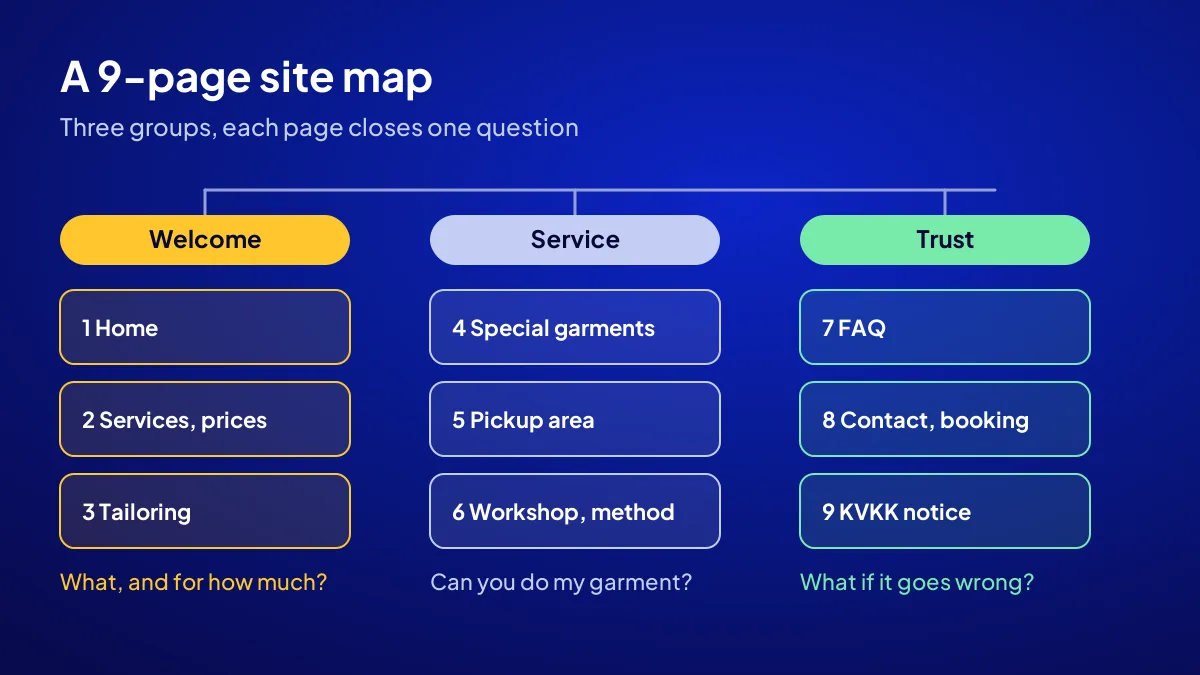
The nine pages fall into three groups: pages that welcome, pages that explain the service, and pages that close the trust gap. Each group answers one kind of question a client has, as the table below shows. That is why the order matters.
| Group | Pages | Question it closes |
|---|---|---|
| Welcome | 1. Home · 2. Services and prices · 3. Tailoring and alterations | What do you do, for how much? |
| Service | 4. Special garments · 5. Pickup and delivery area · 6. Workshop and method | Can you handle my garment, how does it reach you? |
| Trust | 7. FAQ · 8. Contact and booking · 9. KVKK privacy notice and cookies | What if something goes wrong, what about my data? |
Why one page is not enough
A one-page site works for the first week, but it cannot carry the special-garment and delivery questions.
The build process
We explained the general flow of design, content and launch in how a website is built; here we cover only the pages specific to a dry cleaner.
What should the welcome pages show at first glance?
BU BÖLÜMÜN ÖZETİ
- Step 1. Home page
- Step 2. Services and price list
- Step 3. Tailoring and alterations
The first three pages tell a client three things in five seconds: what you do, what it costs and whether you also take on tailoring. A premium client does not call before seeing the price and the turnaround time. These three pages are where a visitor turns into someone at your counter.
Step 1. Home page
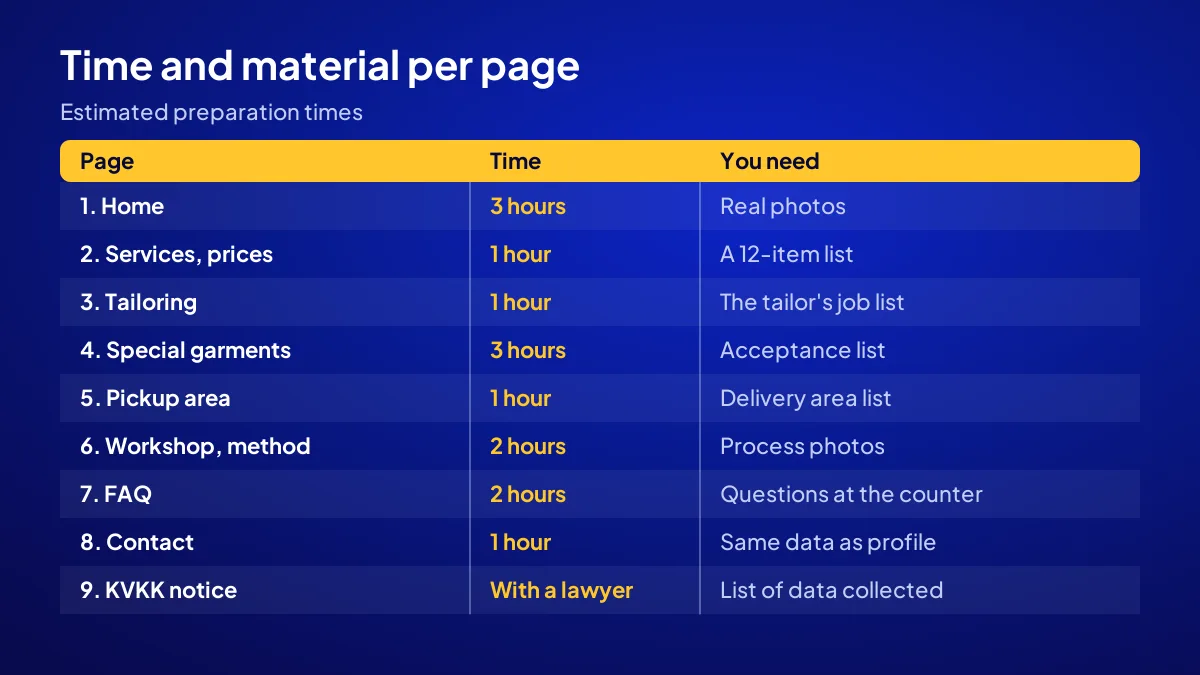
A one-line promise, the turnaround time, the address and two buttons: “Call” and “WhatsApp”. Estimated time: 2 hours of writing, 1 hour of photos. You need: real photos of the storefront, the counter and finished garments on the rail.
Step 2. Services and price list
Prices and turnaround for the 12 most common items in one table. Estimated time: 1 hour. You need: the current price list and standard turnaround.
Step 3. Tailoring and alterations
List jobs such as hems, waists, sleeve length and zip replacement, with how long each takes. Estimated time: 1 hour. You need: the tailor’s job list and how fittings work.
How do service pages answer “can you handle my garment”?
BU BÖLÜMÜN ÖZETİ
- Step 4. Special garments
- Step 5. Pickup and delivery area
- Step 6. Workshop and method
A selective client looks for the name of their own garment, not a general cleaning promise. The owner of a wedding dress, a cashmere coat or a leather jacket wants to see how you handle that piece. The pickup and workshop pages close the “how does it get there, where is it processed” question.
Step 4. Special garments
A short section each for wedding and evening dresses, leather, suede, silk and cashmere. State clearly what you accept and what you do not. Estimated time: 3 hours. You need: the workshop’s acceptance list and care-label notes.
Step 5. Pickup and delivery area
Which districts, which days, which time slots, free or paid. Estimated time: 1 hour. You need: the delivery area list, which must match the service areas on your Google profile.
Step 6. Workshop and method
The garment’s journey from drop-off to collection: label check, stain pre-treatment, cleaning, pressing, quality check, packing. Do not write “eco-friendly” or “organic” claims you cannot prove. Estimated time: 2 hours. You need: process photos.
Common mistake: Putting stock photos on service pages. A premium client sees the same photo on another site and trust breaks on the first click. A real workshop photo taken on a phone beats a flawless stock image.
Which questions do the trust pages close?
BU BÖLÜMÜN ÖZETİ
- Step 7. Frequently asked questions
- Step 8. Contact and booking
- Step 9. KVKK privacy notice and cookies
Trust pages answer the questions clients hesitate to ask: what happens if a garment is damaged, how many days it takes, what happens to the address and phone number I give you. If the site does not answer them, the client either asks or gives up. A selective client usually gives up.
Step 7. Frequently asked questions
At least 6 questions: what happens with damage or loss, how long uncollected items are kept, whether there is express service, how payment works, what if a button comes off, whether items without a care label are accepted. Estimated time: 2 hours. You need: the questions you hear most at the counter.
Step 8. Contact and booking
Address, map, hours, phone, WhatsApp and a pickup request form. Name, address and phone must match your Google profile letter for letter. Estimated time: 1 hour.
Step 9. KVKK privacy notice and cookies
If your pickup form collects name, address and phone, Turkey’s Personal Data Protection Law No. 6698 (KVKK) requires a privacy notice. Have a lawyer check the text against how you actually work. You need: a list of what data you collect and why.
What does structured data tell Google?
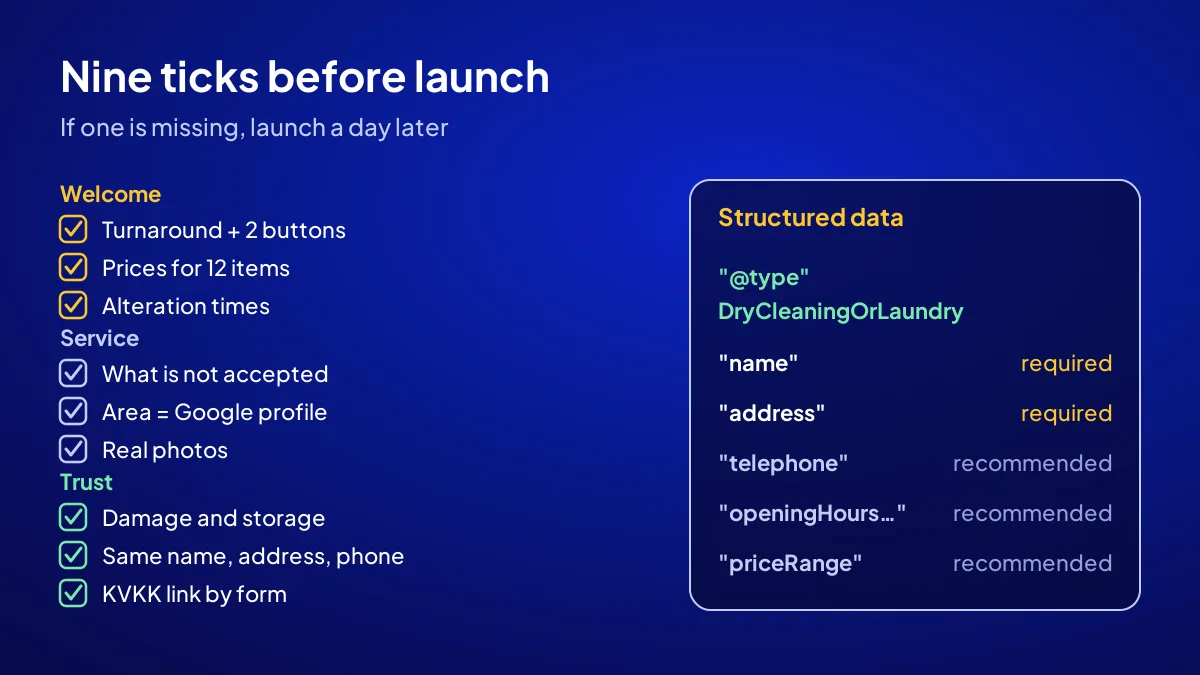
Structured data repeats the information on the page in a label Google can read. The Schema.org vocabulary has a dedicated type for this business: DryCleaningOrLaundry, a subtype of local business for dry cleaners and laundries. According to Google’s local business documentation, name and address are required, while phone, URL, location, opening hours and price range are recommended.
| Field | Status | What a dry cleaner puts in |
|---|---|---|
| @type | Type | DryCleaningOrLaundry |
| name | Required | The name on the sign |
| address | Required | Full address, same as the profile |
| telephone | Recommended | The counter phone |
| openingHoursSpecification | Recommended | Opening and closing, day by day |
| priceRange | Recommended | Relative price range |
Why the site and Instagram do different jobs
Instagram shows the window, the site answers the questions. We covered that difference in is Instagram enough, and what the client is really buying in what dry cleaning clients really buy.
Can the whole site be set up in one go?
Yes. In the Build Your Digital Brand campaign the domain is registered in your name, a 1-year server and a 6-page brand site are set up, structured data is added, and 108 AI SEO-ready articles are written across 6 keyword groups. TRY 36,000 + VAT at a fixed price, with a 10 percent coupon; just mention the code when you apply. There are 12 brand places, and the deadline is 1 November 2026.
The full framework
The site’s place in the promotion plan is in the new dry cleaner promotion guide, its order in the first three months in the first 90 days plan. The full campaign scope is on the campaign page.
Which 9 points do you tick before launch?
BU BÖLÜMÜN ÖZETİ
- Welcome pages
- Service pages
- Trust pages
Before the site goes live, tick the 9 points below one by one. If one is missing, delay launch by a day. The list is the short version of the 9 steps above, in the same three groups. Check each item on a phone as well.
Welcome pages
- The home page shows turnaround time and two contact buttons.
- The price list has the 12 most common items and turnaround.
- Tailoring and alteration jobs are listed with their times.
Service pages
- Special garments state what is and is not accepted.
- The pickup area matches the Google profile.
- The workshop page has real photos and no unproven claims.
Trust pages
- The FAQ answers damage and storage period.
- Name, address and phone match on every page and the profile.
- The KVKK privacy notice is linked next to the form.
Quick Summary
- A premium dry cleaner site has 9 pages in three groups: welcome, service, trust.
- Price and turnaround appear on the first two pages.
- Special-garment pages also say what is not accepted.
- The pickup area matches the service area on the Google profile.
- Structured data type is DryCleaningOrLaundry; name and address are required.
- If there is a form, there is a KVKK privacy notice.
Short Glossary
Structured data: Structured data is the code used to mark up business information on a page with standard labels that search engines can read.
DryCleaningOrLaundry: DryCleaningOrLaundry is the local business subtype used in the Schema.org vocabulary to describe dry cleaning and laundry businesses.
Privacy notice: A privacy notice is the text used by a business that collects personal data to explain which data it processes, why and how.
Next Step
If you want the domain in your name and your site and 108 articles set up in one go, apply for the Build Your Digital Brand campaign. Fill in the form and mention your coupon code when you apply.
Frequently Asked Questions
Source: Google Search Central — Local Business (LocalBusiness) structured data
Sık Sorulan Sorular
Structured data is added to the site’s code once and updated when the address or hours change. Hand this table to whoever manages the site.
The 6-page brand site in the campaign carries the core of this list. Which heading becomes its own page and which becomes a section within a page is settled together during consulting. Special-garment care questions are a natural topic for the 108 articles.
For a premium workshop, 9 pages: home, services and prices, tailoring and alterations, special garments, pickup and delivery area, workshop and method, FAQ, contact and booking, and a KVKK privacy notice. Each page closes one of the client’s questions.
Schema.org has a DryCleaningOrLaundry type, a subtype of local business. According to Google’s local business documentation, name and address are required, while phone, hours and price range are recommended.
The domain is registered in the client’s name. The campaign includes a 1-year server, a 6-page brand site and 108 AI SEO-ready articles; server renewal from the second year is the client’s. The price is TRY 36,000 + VAT, paid upfront; at 20 percent VAT that is TRY 43,200, but check the current rate on the invoice.
Updated: October 2026