
Sinan Asılyazıcı weighs self-checkout against staffed tills, which suits your store?
Sinan Asılyazıcı compares staffed tills with self-checkout, the till where customers scan and pay for their items themselves, on cost, space and risk (Perakende.org, 12 October 2026). According to Asılyazıcı, self-checkout saves on labour and floor space. The same system creates new control needs around shrinkage, checkout promotions and age-restricted sales.
For a store owner, this means the till is not an equipment purchase but a profitability decision. The column gives no data on how widespread self-checkout is in Türkiye, what it costs or how much stock goes missing; its only figure is 2009, the year the author gives for the first installation. So for grocery, clothing and electronics stores in Türkiye in autumn 2026, each business should decide with its own till data.
On what grounds does Sinan Asılyazıcı weigh self-checkout against staffed tills?
On profitability. According to Asılyazıcı, retail is an expensive business that should not be done on the cheap, so the till decision cannot rest on payback alone. Alongside ROI and GMROI, profitability, average basket value, sales per employee and sales per square metre are what decide it. This is an opinion column, not a data report; the pros and cons are the author’s assessment.
What does self-checkout gain a store, and what does it put at risk?
According to Asılyazıcı, the gains are fewer cashiers and lower labour cost, less floor space, often no queue, and relief for staffed tills at peak times. The risks are the need for extra theft controls, harder checkout promotions, weaker control over age-restricted sales and reluctance among some customers. Shrinkage sits underneath all of it: if losses rise, the savings vanish.
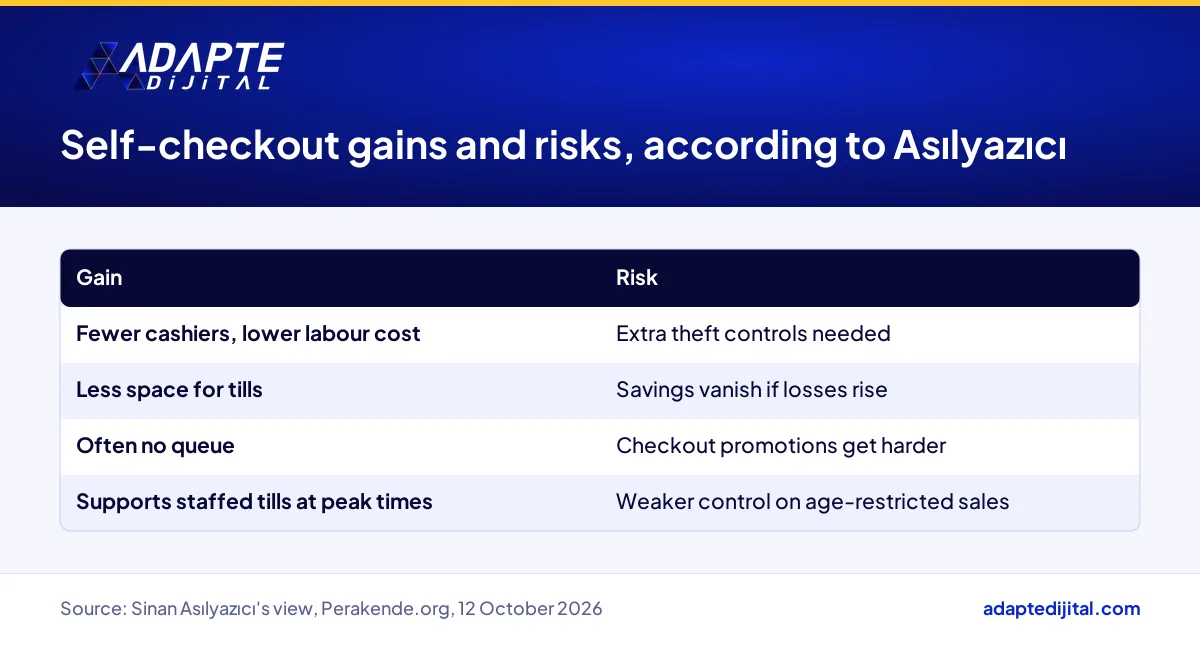
Self-checkout or a staffed till for your store: which measures decide it?
Your own till data. The measures Asılyazıcı lists, profitability, average basket value, sales per employee and sales per square metre, form the columns of your decision table. Self-checkout makes sense in a store with small baskets, sharp peak hours and loss control in place. Staffed tills come first where baskets are large, customers want advice or age-restricted sales carry weight.
| Feature | Business benefit | Condition |
|---|---|---|
| Customers scan their own items | Lower labour cost | Loss control must be in place |
| Smaller till footprint | Room for shelving and displays | Freed space must turn into sales |
| Extra payment points | Shorter queues at peak times | Baskets should be small |
| Cameras, item verification, weight checks | Limits shrinkage | Needs extra investment |
| Staffed till | Promotions, age checks, conversation | Staff cost continues |
What does self-checkout change in promotions, customer data and payments?
Screens, apps and loyalty schemes take over from checkout promotions. When no cashier is there to suggest a product, the payment screen, a mobile coupon or a personalised offer does the job. That only works if customer and basket data sit in one place and the payment setup is linked to that data.
Which retailers does the self-checkout decision affect, and how?
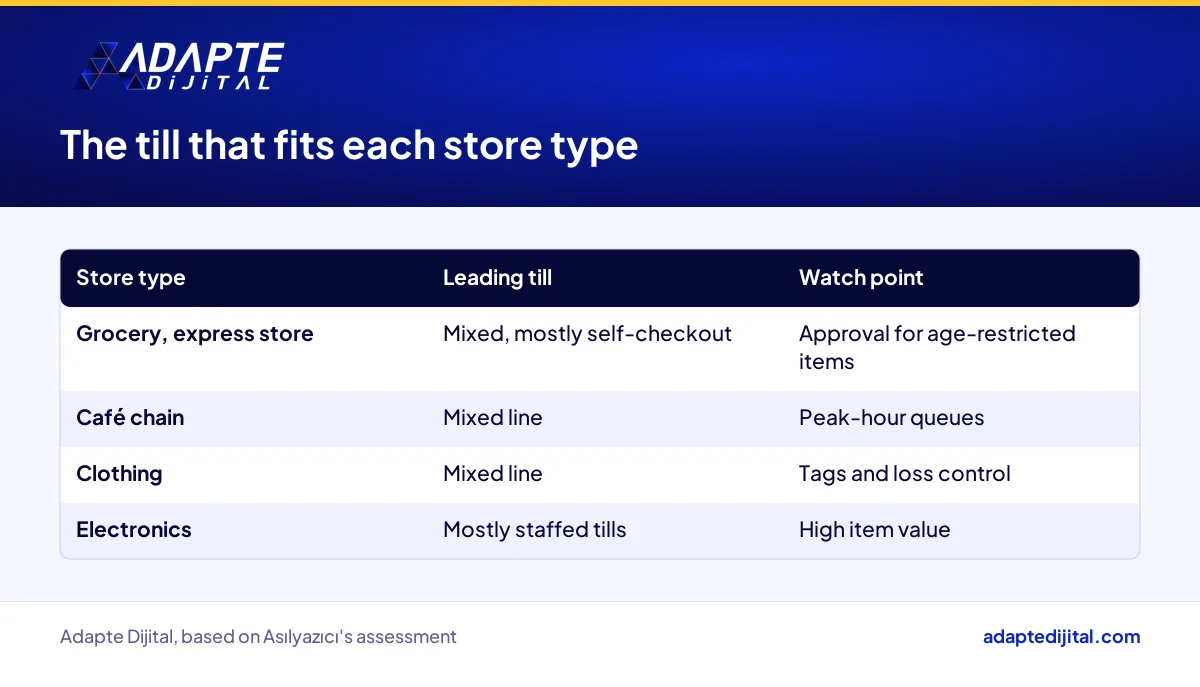
Stores with small baskets and sharp peaks are closest to the gains: grocery stores, city-centre express stores and café chains. Stores that sell high-value or age-restricted products, or whose customers want advice, carry more of the risk. Suppliers of cameras, security and payment systems are affected indirectly.
What should a store owner do this week about the self-checkout decision?
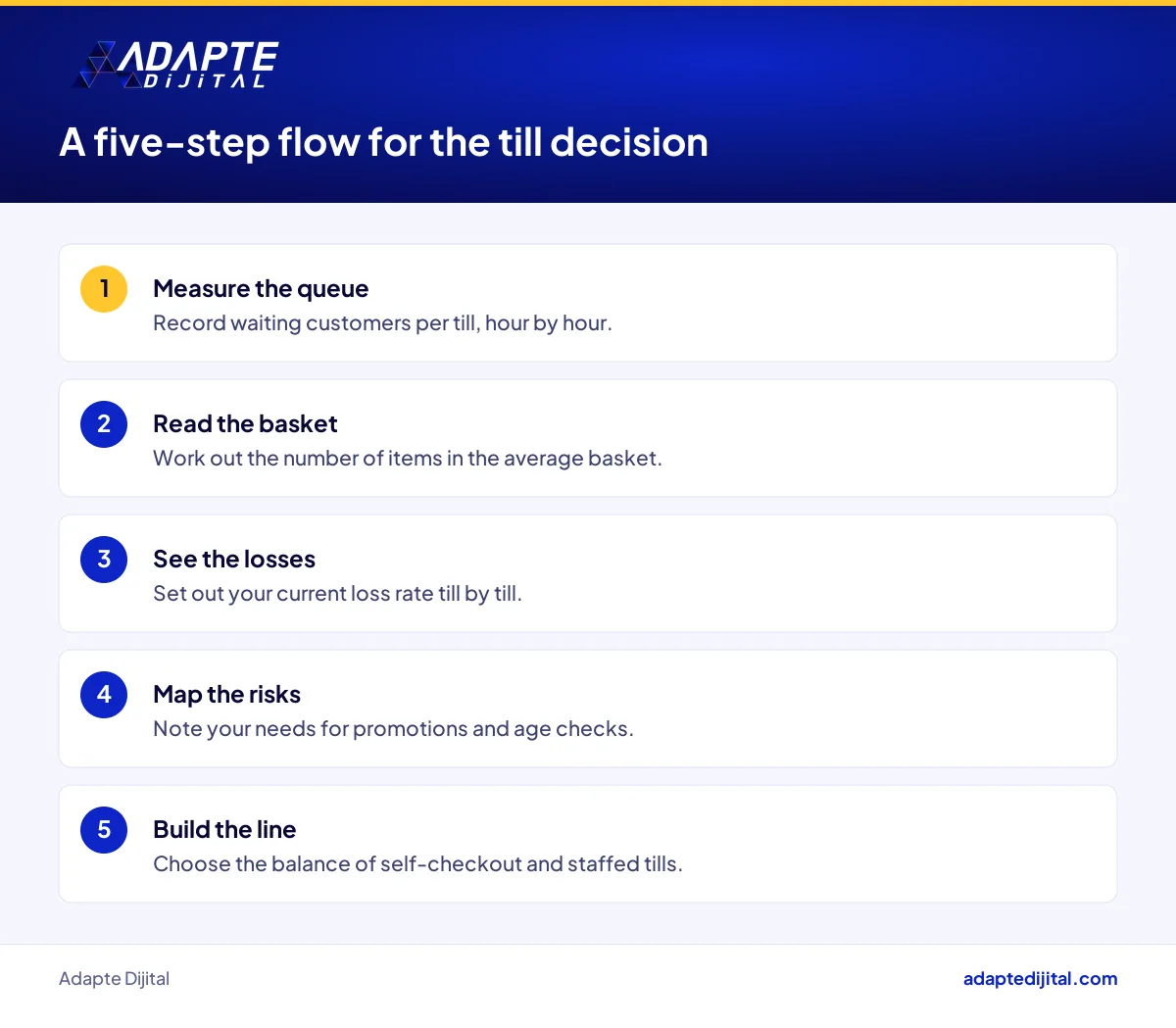
Start by collecting three numbers: the queue at each till hour by hour, the number of items in an average basket and your current loss rate. These three show whether self-checkout will save money in your store or open a new gap. Asking for quotes before you have them leaves the decision to the vendor’s sales pitch.
Quick Summary
- Sinan Asılyazıcı compares staffed tills and self-checkout through the lens of profitability (Perakende.org, 12 October 2026).
- According to Asılyazıcı, self-checkout saves labour and space and eases the load on staffed tills at peak times.
- According to Asılyazıcı, rising shrinkage can wipe out the savings, and promotions and age checks get harder.
- According to Asılyazıcı, Türkiye’s first self-checkout opened in 2009 at Migros in Ataşehir, a claim not independently confirmed.
- The desk recommends deciding for the whole checkout line, using queue, basket and loss data.
Short Glossary
- Self-checkout (SCO)
- Self-checkout is the term used for a cashierless till where customers scan and pay for their own items.
- GMROI
- GMROI is the retail measure used to show how much gross profit each unit of money invested in stock generates.
- Loss rate
- Loss rate is the measure used to express stolen, damaged or unscanned goods as a share of sales.
Frequently Asked Questions
Next Step
If you would like to review your checkout line with your own queue, basket and loss data, fill in the Consult Your Expert form and we will look at your store’s till layout in the first call. Our retail page, where we interpret the retail agenda for you, gathers the other stories.
Sources: Perakende.org, Sinan Asılyazıcı, “Bir müşteri, iki kasa” (One customer, two tills), 12 October 2026 · Yeni Şafak, 15 February 2026 · ESM Magazine, Global Market Insights forecast, December 2020 · Republic of Türkiye Ministry of Trade, Law No. 6585 page (linked in the text)
Updated: October 2026
Sık Sorulan Sorular
Self-checkout, or SCO, is a till where customers scan their own items and pay without a cashier. At a staffed till, an employee does that work. The difference is not only who scans, but who holds control.
According to Asılyazıcı, the first self-checkout in Türkiye went into use in 2009 at a store of the supermarket chain Migros in Ataşehir, Istanbul. This is the author’s statement and has not been confirmed by the company. According to the Turkish daily Yeni Şafak (15 February 2026), the clothing retailer LC Waikiki is also preparing to use cashierless technology in its stores in Türkiye.
Asılyazıcı notes that in the Netherlands and France, chat-focused “bla bla tills” serve some customers. The example is a reminder that a till is not only a payment point. Some customers want speed, others want a few words, and the same store can serve both.
From labour and space. According to Asılyazıcı, self-checkout needs fewer cashiers and less room. If the space freed from the checkout line goes to shelving or displays, your sales-per-square-metre sums change as well.
Shrinkage means stock that is stolen or leaves the store unscanned. According to Asılyazıcı, this risk calls for extra safeguards such as AI-assisted cameras, item verification and weight checks. If the loss rate climbs, the money saved on labour leaks out as missing stock.
Impulse items at the checkout and the promotion a cashier reminds you about drop out when customers scan for themselves. Products with an age limit still need someone to approve the sale. Asılyazıcı lists both among the drawbacks of self-checkout.
According to Asılyazıcı, some customers keep their distance from paying on their own. Push that customer to a cashierless till and they may leave the basket and walk out the door. For them, the staffed till remains part of the service.
ROI shows how fast an investment pays for itself; GMROI shows the gross profit generated by money tied up in stock. According to Asılyazıcı, neither is enough on its own for the till decision. Profitability and average basket value belong in the table too.
ESL, or electronic shelf labels, are small digital screens on the shelf that update prices remotely. Asılyazıcı sees a parallel between ESL and self-checkout, but he notes himself that he has no firm data on it. Read the comparison as a prompt to ask how each investment shifts work around your store.
The picture Asılyazıcı paints points that way. At peak times, self-checkout eases the load on staffed tills, while staffed tills serve customers who want promotions, age checks or a chat. The desk’s recommendation is to decide for the whole checkout line, not one till at a time.
One suggestion on the payment screen that fits the basket, a coupon loaded in the app before the customer reaches the till, or a discount on the receipt for the next visit. That way the promotional product gathering dust on the shelf still reaches the customer without a cashier.
Which till customers choose, at what hour and with what basket size can guide the number of tills and the shift rota. The same data feeds ad targeting and the loyalty scheme. Read at SKU level, it also shows which product’s promotion should move from the checkout to the screen.
At a cashierless till, payment happens entirely between the customer and the machine; if the system stutters, the queue comes back. We cover that question in depth in our piece on who should manage a store’s payment setup.
Baskets with few items, quick visits and busy lunchtime or evening peaks match the queue advantage Asılyazıcı describes. In these stores, staffed tills do not close; their load gets lighter.
In electronics, high item value raises the stakes of shrinkage; in clothing, security tags and fitting-room routines do the same. According to Yeni Şafak, LC Waikiki’s preparations show that cashierless technology is on the agenda in clothing as well. The report gives no figures and no named source.
Suppliers of cameras, item verification and weight checks, plus payment and software firms. We look at security technology beyond the store in our piece on the Securitas Alarm and Drivee crash detection partnership. A Global Market Insights forecast published in December 2020 expected the self-checkout market to reach about USD 6 billion by 2026; this is an old projection, not an outcome.
For each till, record transactions per hour and the number of customers waiting in line. If the tills are not turning over, the problem may lie in layout or shift planning, not in the number of tills.
Ask how cameras, item verification and weight checks work, and pin down who approves sales of age-restricted products. In Türkiye, store operations fall under Law No. 6585 on the Regulation of Retail Trade (Ministry of Trade page). Verify with the official source; this is not legal or financial advice.
A till decision changes software, staff planning and store layout at the same time. Planning that kind of shift from start to finish is what our digital transformation management service does.
It is worth considering if baskets are small, queues build at set hours and you can put loss control in place. Without those conditions, the savings can turn into missing stock, so decide with your own till data.
Asılyazıcı’s assessment does not point that way. Promotions, age checks and customers who prefer not to pay on their own still call for a staffed till.
That is not known. Asılyazıcı’s column gives no data on adoption or loss rates in Türkiye; its only date is the first installation in 2009, according to the author.