
Starting a Business with Agents, Year 3: Small Teams and the Rise of the Solo Founder
The three-year horizon of starting a business with agents describes a period in which a small team with agents may do work that once took much larger teams. The question over this horizon is not “how big can we grow?” but “what size do we want to stay?” 🌱
This page is the seventh step in the agent business horizon series. It covers what may change in three years, how the small-team model can work, where people stay, the mistakes possible over this horizon and what is rising. Every conclusion on a distant horizon is a forecast and is marked as one.
What may change in three years?
BU BÖLÜMÜN ÖZETİ
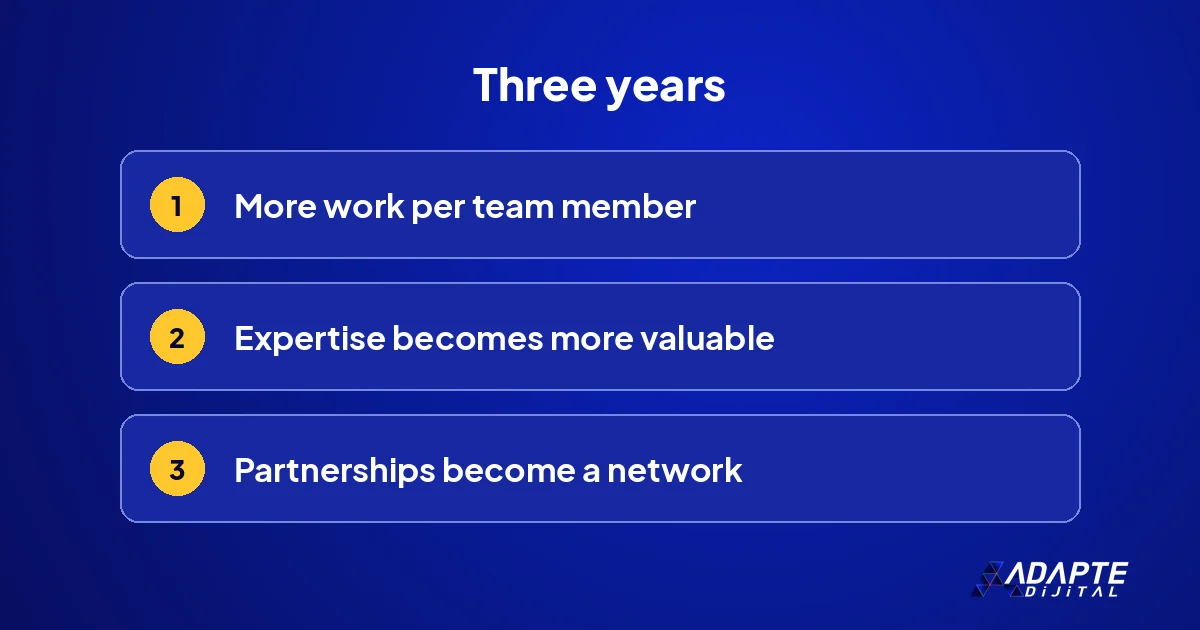
- More work per team member
- Expertise becomes more valuable
- Partnerships become a network
Three years is the time in which a business leaves its founding period and chooses its own way of growing. Three changes look particularly likely for an agent-run business.
More work per team member
As agents carry preparation, correspondence and record-keeping, it may become possible to serve more customers with the same number of people. This means growth is no longer measured by hiring alone. Customer numbers can rise while the team stays small, which keeps both the management load and fixed costs in check over the years. 📈
Expertise becomes more valuable
As routine work passes to agents, what makes a business different becomes the expertise of its owner and team. Time spent on expertise is the best use of the time agents save. Over a three-year horizon, successful businesses may be the ones that spend that time on the product, service quality and customer relationships, and the records will show it.
Partnerships become a network
Instead of doing everything in-house, small teams can build a standing network of collaboration with accountants, lawyers, designers and suppliers. Agents make coordinating this network easier; meeting notes, follow-up lists and document flow stay in order. Liability and data rules are written down for every link in the network. 🕸️
How does the small-team model work?
BU BÖLÜMÜN ÖZETİ
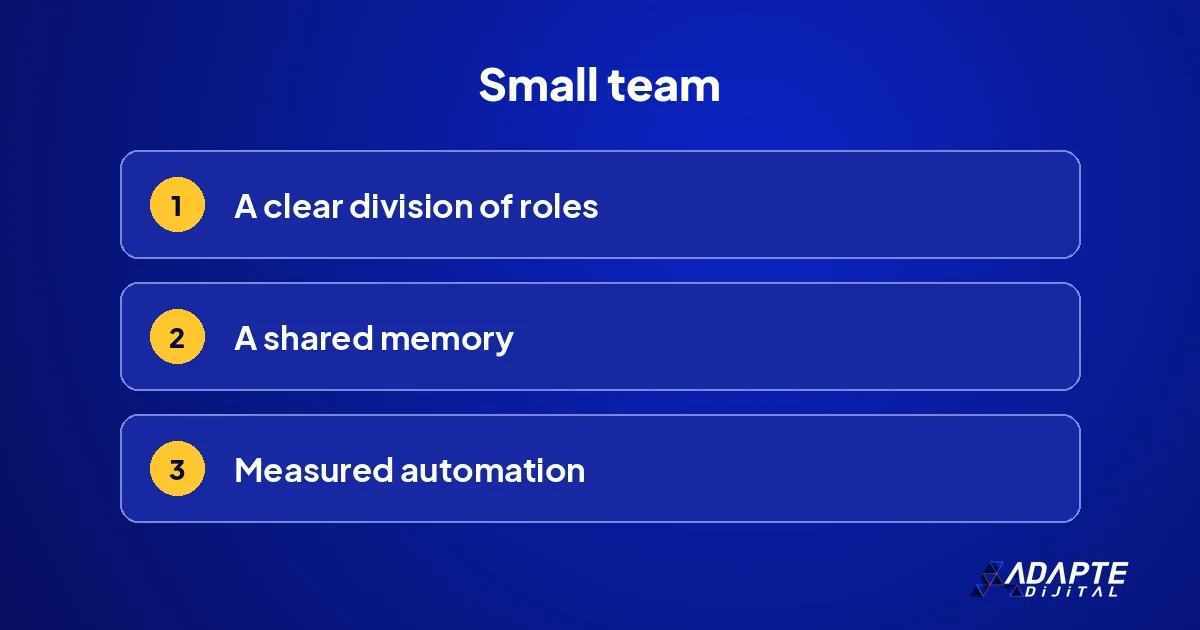
- A clear division of roles
- A shared memory
- Measured automation
The small-team model is a few people running a large operation together with agents. It rests on three foundations.
A clear division of roles
What each person and each agent job does, whom it reports to and which decisions it makes are written down clearly. Ambiguity costs more in a small team than in a large one, because each person carries more than one job. How to map the agent side is covered in the agent team org chart. The map is reviewed every quarter. 🗺️
A shared memory
Rules, customer notes, decisions and lessons are gathered in one shared knowledge base. A shared memory protects the business’s knowledge even as people change. Agents draw on this memory, and people look at it first when starting a new job. How a small business can gain an edge with AI is covered in the small business AI advantage.
Measured automation
Rather than automating everything, the business automates the jobs whose gains are proven by the records. Measured automation lets a small team grow without losing control. Before a new agent job is added, its checking load is calculated; a job that exceeds the team’s approval capacity brings risk, not growth. ⚖️
Where do people stay?
BU BÖLÜMÜN ÖZETİ
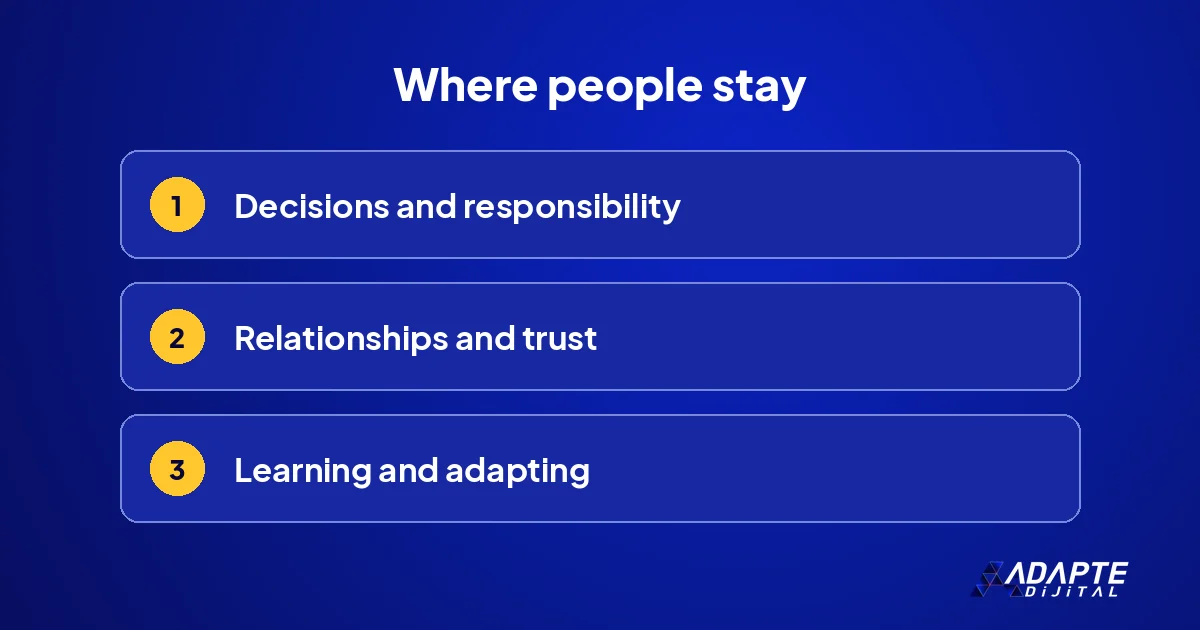
- Decisions and responsibility
- Relationships and trust
- Learning and adapting
However far agents develop, some roles stay with people. Over a three-year horizon these roles may become even clearer.
Decisions and responsibility
Decisions on pricing, hiring, partnerships and legal matters stay with people, and people are responsible for their outcomes. An agent is not a person that carries responsibility on its own; every output an agent prepares and the business uses is the business’s responsibility. This is one of the principles that will not change in three years either. 🔑
Relationships and trust
The trust built with customers, suppliers and the team is a business’s longest-lasting asset. Trust is built through consistent behaviour and personal contact. Agents can prepare and speed up that contact, but the relationship itself is carried and protected by people. At critical moments, the customer finds a person on the other side.
Learning and adapting
Noticing changing customer needs, developing a new service idea and rewriting the rules are human work. An agent applies a written rule; a person writes the rule. Over a three-year horizon, the team’s speed of learning may be one of the main factors that decide a business’s competitive strength. 📚
Which mistakes are possible over this horizon?
BU BÖLÜMÜN ÖZETİ
- Uncontrolled growth
- Depending on one person
- Mistaking agents for the team
Mistakes over a three-year horizon usually come from the eagerness to grow and from neglecting the arrangement.
Uncontrolled growth
Growth made easier by agents can damage the customer experience if approval and quality do not grow at the same pace. The pace of growth is limited by the team’s checking capacity. If the records show the correction rate rising, the arrangement is strengthened before new customers or new jobs are added. ⚠️
Depending on one person
In a small team, concentrating all knowledge and authority in one person stops the work when that person is unreachable. Authority and knowledge are backed up in at least two people; in a one-person business, rules and access details are kept securely and documented. The backup is tested once a year.
Mistaking agents for the team
Putting agent jobs in place of the human team leads to neglect of work that needs relationships, creativity and responsibility. Agents are the team’s tools, not the team itself. In the three-year plan, human roles and their development are written down in as much detail as the agent jobs, and reread every year. 👥
What is rising over this time frame?
BU BÖLÜMÜN ÖZETİ
- Today: the solo-founder share has risen clearly
- Forecast: the measure of growth changes
- Forecast and log
Over a three-year horizon, the share of the solo-founder and small-team model is rising. The first item is today’s status; the next two are forecasts.
Today: the solo-founder share has risen clearly
According to Carta’s December 2025 report on solo founders, the share of US startups on its platform founded by a single person rose from 23.7% in 2019 to 36.3% in the first half of 2025. The data covers US companies; there is no comparable measurement for Türkiye. The trend points to a stronger small-team model. 📅
Forecast: the measure of growth changes
Forecast: within three years, the measure of growth in small businesses will shift from headcount towards service quality per customer and value created per person. Businesses that keep records will be able to see this change in their own data.
Forecast and log
Forecast: within three years, the most valuable investment of small teams working with agents will be a shared knowledge base and written rules. Update log. 12 November 2026: first publication. The forecasts on this page are re-read when they fall due; a forecast that turns out wrong is not deleted but corrected here. The next step in this series is starting a business with agents: year 6.
How does Adapte Digital look at the three-year horizon?
BU BÖLÜMÜN ÖZETİ
- A single delivery package
- Today’s step
- Where to start
We prepare for the three-year horizon by choosing the shape of growth together: a division of roles, a shared memory and a measured automation arrangement are set up and delivered to you.
A single delivery package
Adapte Digital does not charge a monthly management fee. Work starts with a single delivery package whose scope is written down in advance: 36,000 TRY + VAT. If the work grows, the new need is defined as a separate add-on package, priced by what will be delivered rather than by the hours spent. 📦
Today’s step
Today’s version of the three-year direction is a clear task map and a shared knowledge base. How to carry these choices into a written plan is covered in how to write a business plan.
Where to start
Which packages are open, and at what price, is shown on our campaign pages, item by item. 🧭
If you see a business opportunity here, we wrote a separate article on agent-run content site portfolios.
Quick Summary
- Over a three-year horizon, a small team with agents can run a large operation.
- The small-team model rests on a clear division of roles, a shared memory and measured automation.
- Decisions, relationships and learning stay with people.
- Uncontrolled growth and depending on one person are this horizon’s mistakes.
- Conclusions on a distant horizon are forecasts and are re-read in the update log.
Short Glossary
- Small-team model
- A way of working in which a few people run a large operation together with agents.
- Shared memory
- A shared knowledge base holding rules, decisions and customer notes.
- Measured automation
- Automating only the jobs whose gains are proven by the records.
Frequently Asked Questions
Next Step
Draw the task map of your team and your agent jobs; mark any knowledge or authority that depends on a single person. Our campaign pages list the delivery packages that cover this work.
Sources: Carta — Solo Founders Report 2025 · Carta — 2026 Founder Ownership Report
Updated: November 2026
Sık Sorulan Sorular
It can, but it needs a clear division of roles, a shared knowledge base and a pace of growth that fits the team’s approval capacity.
According to Carta’s US data, the share of startups founded by a single person rose from 23.7% in 2019 to 36.3% in the first half of 2025. There is no comparable data for Türkiye.
Decisions, customer relationships, responsibility and writing the rules. Agents prepare for this work.