
What Is a Token in AI? The Invisible Unit That Grows the Bill
A token is the small piece of text a language model uses when it reads and writes. It can be a word, a syllable or a single punctuation mark. An AI bill is charged in tokens, not in words. 🔤
This article explains tokens not as an engineer would but as the person who pays the invoice: which tokens make up the bill, which are expensive, and which setting brings the amount down? The scenario file is fiction. It does not describe a real company; it is written to show how the risk works.
Scenario file: why does the same question produce two different bills?
Picture two businesses. Both answer customer questions with AI and both receive the same number of questions a day. At the end of the month one bill is several times the other.
The first business
On each question the first business sends the model only the question and a short note about the relevant product. It has capped the length of the answer. For simple questions it uses a small model. Each call carries just enough text for the job. Its bill moves along a predictable line. 📉
The second business
On each question the second business sends the model its whole product catalogue, its returns policy and the entire conversation of the day. Answer length is unrestricted and the largest model is selected. The customer receives the same answer. The text processed behind it is dozens of times larger.
What exactly is a token?
Models do not process text letter by letter or word by word. They split it into frequently occurring pieces, and each piece is a token.
A piece, not a word
According to OpenAI’s help documentation, one token is roughly four characters of English, and a hundred tokens are roughly seventy-five words. Short, common words take a single token; long words are split into several pieces. The ratio changes with the language. Providers offer their own counting tools, and the most accurate count comes from those.
The context window
Every model has an upper limit on the number of tokens it can read at once; this is called the context window. The larger the window, the more documents you can give the model. But a large window does not mean you have to fill it. Every token you make it read is charged.
Which tokens make up the bill?
BU BÖLÜMÜN ÖZETİ
- Input tokens
- Output tokens
- Cache and tool tokens
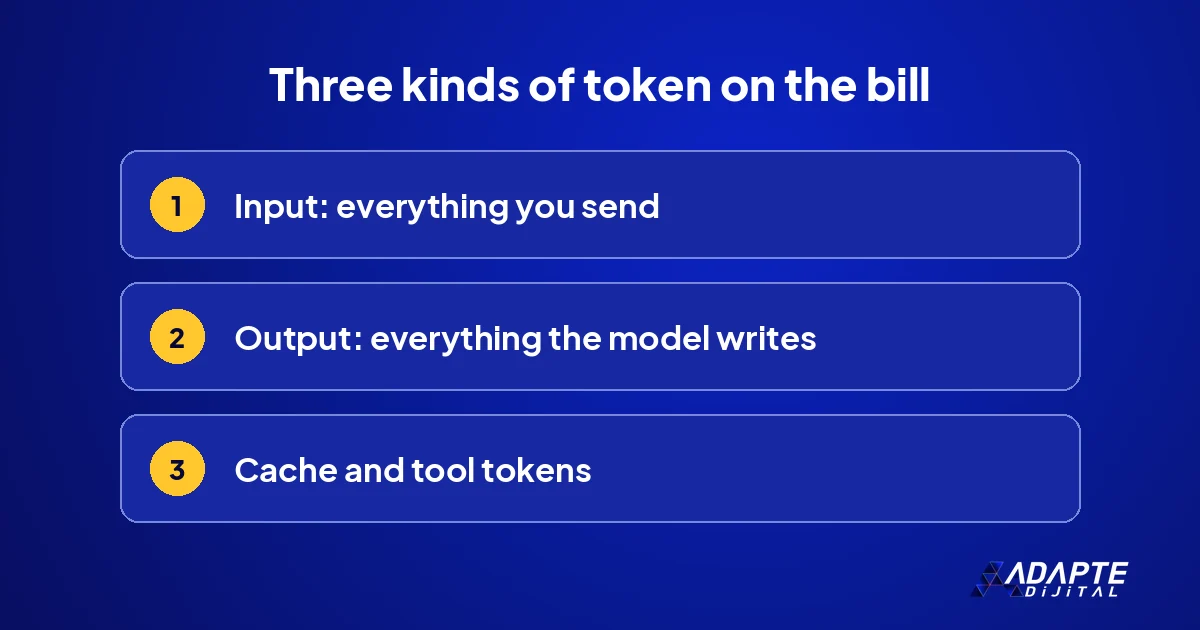
There is not one kind of token on the invoice. There are at least three, and they are priced differently.
Input tokens
Everything you send to the model is input: the question, the instructions, attached documents and the earlier messages of the conversation. As a chat gets longer, all the earlier messages are sent again with every new message. The last message of a long conversation costs far more than the first. This is often the line that grows the bill most. 📥
Output tokens
Everything the model writes is output. In providers’ price tables, an output token is generally more expensive than an input token. For some models in Anthropic’s price table, the output price is five times the input price. That is why a needlessly long answer costs more than a needlessly long question. Capping answer length is the quickest saving.
Cache and tool tokens
If you send the same instructions or document again and again, caching can be used. According to Anthropic’s documentation, a token read from the cache is charged at one tenth of the normal input price, while the first write costs a little more. An agent’s tool calls and the results that come back from tools are tokens too. In a business that runs agents, much of the bill can come from this unseen back-and-forth, which we look at in token waste in agent systems. 🔁
How is the cost worked out?
BU BÖLÜMÜN ÖZETİ
- The cost formula
- The average misleads
- Cost per job
The cost of a single call is a simple sum. The hard part is multiplying that sum correctly up to monthly usage.
The cost formula
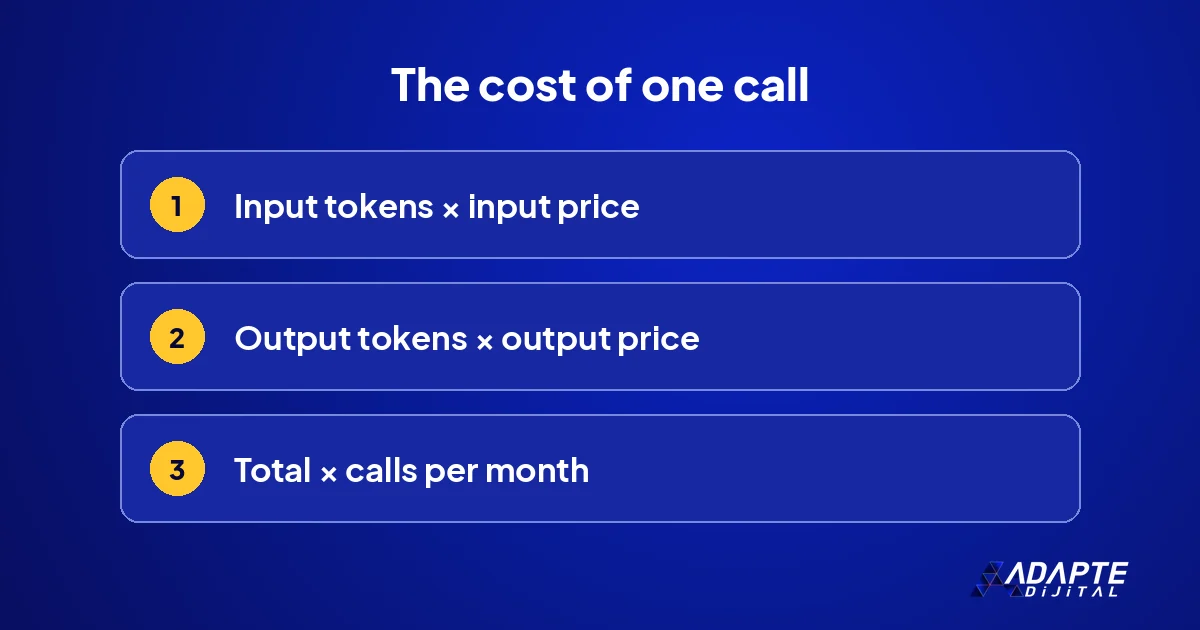
The cost of one call is: (input tokens × input price) + (output tokens × output price). The monthly cost is that amount multiplied by the number of calls in a month. Prices are quoted per million tokens and sit on the provider’s pricing page. Take the figure from there; prices you see in articles may be out of date.
The average misleads
Most calls are cheap; a small number of expensive calls grow the bill. Questions with a long document attached, conversations that run on and agent tasks sit far above the average. So looking at the average cost per call is not enough. List the hundred most expensive calls; the leak is usually there. 🔍
Cost per job
For a business the meaningful unit is not the token but the job: a customer question answered, a product description written, an invoice processed. Divide token cost by the number of jobs and you get cost per job. If that number is falling the system is getting more efficient; if it is rising, something has changed. We cover the budget side in how to audit an AI budget.
What shrinks the bill?
BU BÖLÜMÜN ÖZETİ
- The right model for the right job
- Caching and batch processing
- Five questions asked in an audit
Most of the saving comes not from using less but from doing the same job with fewer tokens.
The right model for the right job
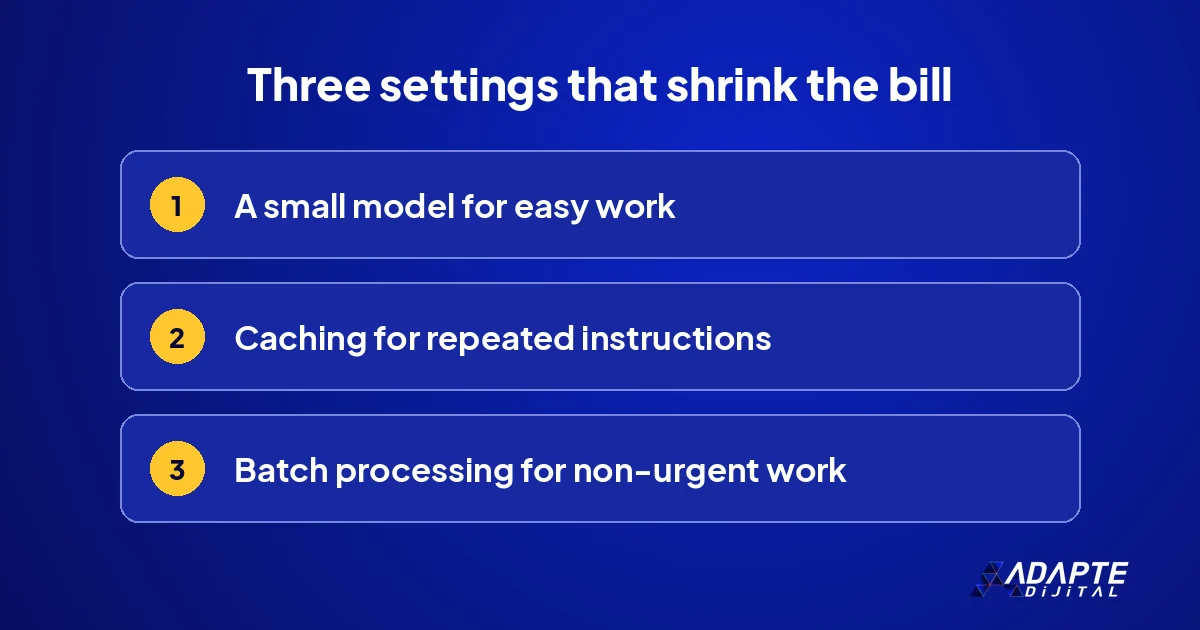
Not every job needs the largest model. Work such as classification, short summaries and simple answers can be done with a small model, and the price gap is wide. Routing hard work to a large model and easy work to a small one lowers the bill noticeably by itself. You cannot know which work is easy without measuring. ⚖️
Caching and batch processing
Caching is used for repeated instructions, and batch processing for work that is not urgent. According to Anthropic’s documentation, batch processing is charged at half the standard price and can be combined with the caching discount. Reports that run overnight and bulk content jobs suit this route. Any job that does not need an instant answer is a candidate for a discount.
Five questions asked in an audit
One: who opens the usage dashboard, and how often? Two: are input and output tokens tracked separately? Three: is there a cap on answer length? Four: are repeated instructions cached? Five: is cost per job known? Forecast: token prices will keep falling, but usage will rise faster, so the total bill will grow in most businesses. Update log. 18 November 2026: first publication. Forecasts on this page are re-read when they fall due; one that proves wrong is corrected here, not deleted. The sums for agents are in how to calculate AI agent costs, and the longer trend is in where AI bills are heading.
How does Adapte Digital review token spending?
BU BÖLÜMÜN ÖZETİ
- A single delivery package
- The table that comes out
- Where to start
In the bill file we start from the dashboard: the usage export is taken, the most expensive calls are separated and cost per job is worked out.
A single delivery package
Adapte Digital does not charge a monthly management fee. Work starts with a single delivery package whose scope is written down in advance: 36,000 TRY + VAT. If the work grows, the new need is defined as a separate add-on package, priced by what will be delivered rather than by the hours spent. 📦
The table that comes out
For each flow the table shows the model, average input and output, calls per month and cost per job, so that the most expensive flow is visible at a glance.
Where to start
The written scope of each package, with current pricing and capacity, is on our campaign pages. 🧭
Quick Summary
- A token is the unit a model uses to process and bill text.
- Languages with long inflected words, such as Turkish, can use more tokens for the same meaning.
- Input, output and cache tokens are priced differently; output is generally the most expensive.
- The cost of one call: input × input price + output × output price.
- A small model, caching and batch processing are three settings that lower the bill.
Short Glossary
- Context window
- The context window is the largest number of tokens a model can read at one time.
- Caching
- Caching is a feature that lets repeated instructions and documents be read at a lower price.
- Batch processing
- Batch processing is a way of running non-urgent requests together at a discounted price.
Frequently Asked Questions
Next Step
Open your provider dashboard and look at the ten most expensive calls of last month. When you find out why they were expensive, you will have found your first saving.
Sources: OpenAI Help Center — What are tokens and how to count them? · Claude Docs — Pricing · Claude Docs — Prompt caching
Updated: November 2026
Sık Sorulan Sorular
Because both businesses see the same thing on screen: a question and an answer. The token count is not shown in the interface; it is written in the provider’s usage dashboard. The second business has never opened that dashboard. A unit you cannot see is a unit you do not manage. 🙈
Turkish is an agglutinative language; one word can carry several suffixes. A model often splits those long words into more than one piece. As a result, a Turkish text with the same meaning can use more tokens than its English version. The same applies to other languages with long compound or inflected words. Measure the exact ratio with your own text; do not rely on a general multiplier. 🌍
Yes, but they are not billed to you one by one. A subscription is a fixed fee with a usage limit. A token bill appears with sites and automations that run on a model key.
In your provider’s usage dashboard. It lists input and output tokens separately for each call. Most providers also offer a tool for counting a text in advance.
Not by itself. The real load is usually not the question but the instructions, documents and conversation history sent along with it.