
Agent Commerce, Month 1: What Should a Store Do Before Agent Checkout Reaches Türkiye?

The first month of agent commerce is for reading your store’s product data through an agent’s eyes and closing the most visible gaps. Agent checkout has not opened in Türkiye yet, so this month is not a race but a quiet period of preparation. Instead of a large software project, small but correct fixes are made. 🗓️
This page is the first step in the agent commerce horizon series. It covers what is realistic in the first month, which data to tackle first, a four-week task list, common mistakes and what is rising over this time frame. Forecasts are marked as forecasts.
What is realistic in the first month?
BU BÖLÜMÜN ÖZETİ
- Focus: best sellers
- Visibility, not checkout
- One owner
A month is not enough to rewrite the whole catalogue, but it is enough to fix the data of your best-selling products and decide the order of the months that follow.
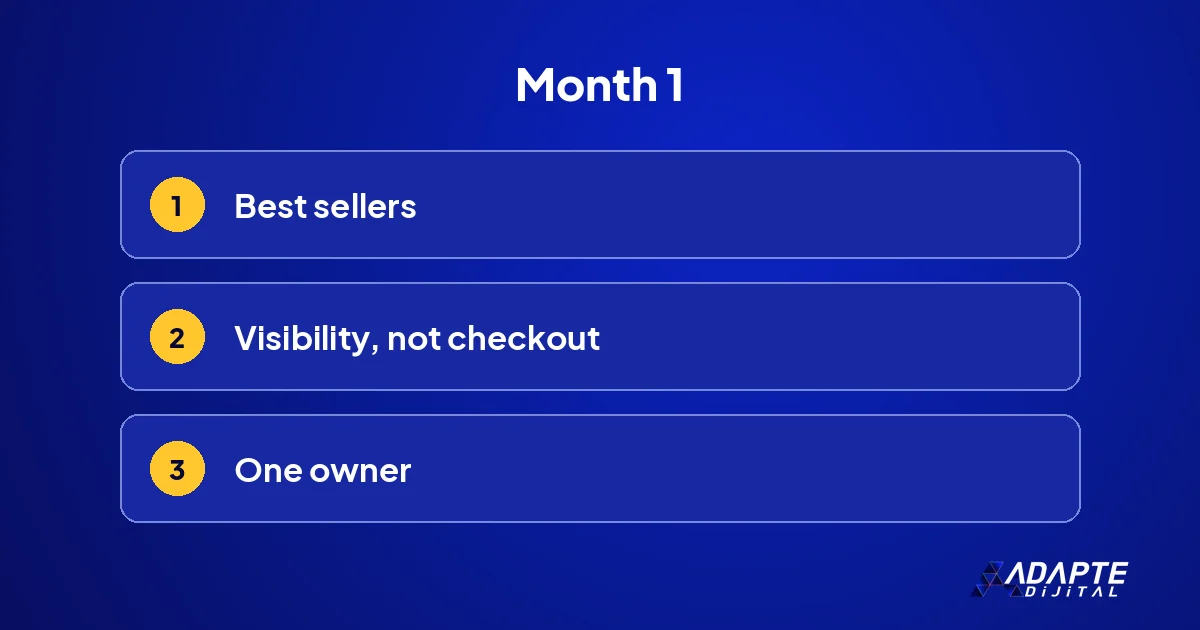
Focus: best sellers
Trying to fix the entire catalogue at once is the most common trap of the first month. Starting with the twenty or fifty products that bring in most of the revenue gives quick results and builds a method. A routine that works for one product group can later be rolled out to the whole catalogue. The chosen products go into a spreadsheet, and the missing fields are marked for each one, so the gaps are visible at a glance rather than buried in product pages. 📋
Visibility, not checkout
There is no agent checkout in Türkiye yet, but agents already read store data when they recommend products. So the goal for the first month is not a buy button but being read correctly and recommended. A product an agent recommends still brings the customer to the store’s own checkout page. Preparation done for visibility will also pay off when checkout opens, because the same fields are needed in both cases.
One owner
In most stores, product data is an area nobody fully owns: the catalogue team writes one thing, the agency another and the marketplace integration a third. By the end of the first month, the data should have a single owner. Data with a clear owner stays consistent. This person keeps the fix list and change notes, and checks that the rules are followed when new products are created. Without an owner, fixes made this month quietly decay. 🔑
Which data comes first?
BU BÖLÜMÜN ÖZETİ
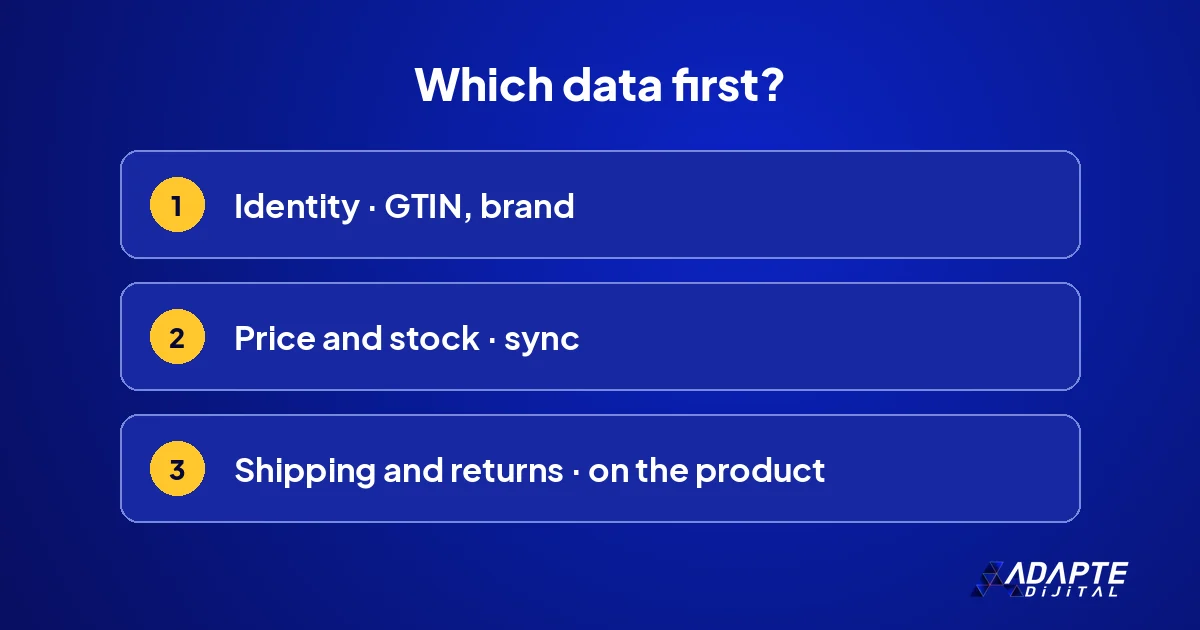
- Product identity
- Price and stock
- Shipping and returns
Not all fields carry the same weight. The three groups below decide whether an agent will include the store in a comparison at all.
Product identity
The GTIN (the barcode number), the brand and the manufacturer part number let an agent match a product with the same item in other stores. A product without an identifier cannot enter a price comparison. For handmade or custom products without a barcode, saying so explicitly is better than leaving the field empty. The basics of product data are covered in how to prepare product data; the same rules apply here, only with an agent as the reader.
Price and stock
A feed price that matches the page is the agent’s first sign of trust. If a campaign price is updated on the page but stays old in the feed, the agent sees two different prices. A sold-out product that shows as in stock turns a recommendation into a complaint. In the first month, check how often synchronisation runs and write it down, because that frequency decides how far the data can drift during a busy day. 💳
Shipping and returns
Delivery time, shipping cost and return conditions are the source of the agent’s answers to questions such as “will it arrive tomorrow?” or “can I return it if I don’t like it?”. If this information sits only in a policy text on a separate page, the agent may not be able to link it to the product. Shipping and return information attached to the product record is the most rewarding fix of the first month, and often the cheapest.
A four-week task list
BU BÖLÜMÜN ÖZETİ
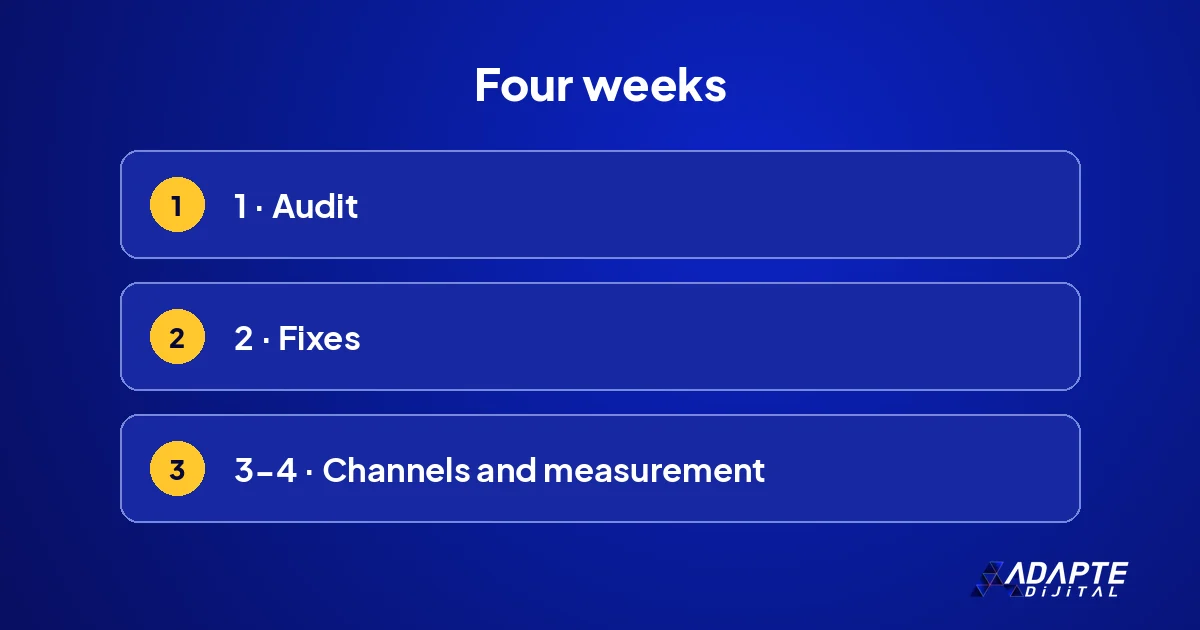
- Week 1: audit
- Week 2: fixes
- Weeks 3 and 4: channels and measurement
The order below is enough for a small store. Each week uses the output of the week before.
Week 1: audit
The data of the selected products is gathered in one table: title, identifier, category, price, stock, shipping and returns. Missing or contradictory fields are marked in each row. Putting the page, the feed and the marketplace record side by side makes contradictions visible immediately. The output of the audit is a fix list in order of priority, with the products that bring in the most revenue at the top. 🔍
Week 2: fixes
The gaps at the top of the list are closed: identifier fields, shipping and return information, and title and category structure. Descriptions are rewritten to answer questions: size, material, compatibility and use. Every change is recorded with a short note, so it is possible to trace later which fix had an effect. Notes also help when an integration overwrites a field and you need to know what it said before.
Weeks 3 and 4: channels and measurement
The corrected data is carried into the Merchant Center feed and the site’s structured data, and feed errors are checked. In the same weeks, a tracking setup is created in analytics to separate visits coming from assistants. At the end of week four, a short status note is written; it becomes input for the three-month plan. The note lists what was fixed, what is still open and what the first numbers show. 🛠️
Which mistakes happen in the first month?
BU BÖLÜMÜN ÖZETİ
- Installing a plugin and calling it done
- Writing descriptions like ads
- Not seeing agent traffic
First-month mistakes usually come from haste or wrong expectations. Knowing three of them in advance keeps the month from being wasted.
Installing a plugin and calling it done
The WordPress plugin directory has plugins that say they set up UCP or ACP endpoints. Opening an endpoint is useless if the data behind it is not in order. A protocol is a door; the data is the load that passes through it. Unofficial plugins should also be tried in a staging environment before going on a live store, since a broken checkout endpoint can do more harm than having none at all. 🚪
Writing descriptions like ads
Adjectives such as “unique”, “amazing” and “the best” carry no information for an agent. An agent looks for size, material, warranty and compatibility. A description that answers questions serves both the agent and the customer. Stripping out adjectives makes descriptions shorter but stronger, and the space they free up is filled with concrete facts the customer would otherwise have to ask about.
Not seeing agent traffic
Some visits from assistants appear in analytics as direct traffic or as some other referral. A channel that is not tracked from the first month cannot be measured retroactively. A simple start is to collect referring assistant domains in a separate channel group. Store reports can then be read with that group in mind; how to read them is covered in reading WooCommerce reports. Measurement comes first; decisions follow. 📊
What is rising over this time frame?
BU BÖLÜMÜN ÖZETİ
- Today: the US holiday season
- Forecast: data quality becomes decisive
- Forecast and log
Most of what will happen over a one-month horizon has already begun. The first item is today’s status; the next two are forecasts.
Today: the US holiday season
In October 2026, the UCP integration hub in Merchant Center began rolling out gradually to US merchants, who can choose capabilities such as identity linking, cart transfer and checkout. This year’s holiday season will be the first large-scale test of agent shopping in the United States. For a store in Türkiye, it is a chance to learn from someone else’s experience before facing the same questions at home. 📅
Forecast: data quality becomes decisive
Forecast: in the coming weeks, early experience from agent-assisted shopping will show that missing product identifiers and inconsistent stock are among the leading reasons products are passed over. Stores that start fixing their data in the first month will carry a lighter workload when checkout opens in Türkiye.
Forecast and log
Forecast: stores that fix their best sellers in the first month will roll the same method out to the whole catalogue with less effort in the months that follow. Update log. 12 November 2026: first publication. The forecasts on this page are re-read when they fall due; a forecast that turns out wrong is not deleted but corrected here. The next step in this series is agent commerce at 3 months.
How does the first month work with Adapte Digital?
BU BÖLÜMÜN ÖZETİ
- A single delivery package
- What is delivered
- Where to start
We do the first month’s work as a delivered job: product data is audited, a fix list and a measurement setup are prepared and handed over to you.
A single delivery package
Adapte Digital does not charge a monthly management fee. Work starts with a single delivery package whose scope is written down in advance: 36,000 TRY + VAT. If the work grows, the new need is defined as a separate add-on package, priced by what will be delivered rather than by the hours spent. 📦
What is delivered
The output is a data table for your priority products, an ordered fix list and a tracking proposal for agent traffic. The fields we check are described in the product data agents read.
Where to start
Which packages are open, and at what price, is shown on our campaign pages, item by item. 🧭
Quick Summary
- The first month is for reading product data through an agent’s eyes and making quick fixes.
- Start with best sellers rather than the whole catalogue.
- Priority data: product identity, price and stock, shipping and returns.
- Installing a plugin achieves nothing on its own if the data is not in order.
- Forecasts are re-read in the update log.
Short Glossary
- GTIN
- A product’s globally recognised identification number; the number printed on the barcode.
- Synchronisation
- Updating price and stock simultaneously across the site, the feed and marketplace records.
- Channel group
- A grouping in analytics that reports visits from similar sources together.
Frequently Asked Questions
Next Step
This week, list your twenty best-selling products in a spreadsheet and mark whether each has a GTIN, a delivery time and return conditions filled in. Our campaign pages list the delivery packages that cover this work.
Sources: Search Engine Land — Google rolls out Merchant Center UCP integration hub in the U.S. · WooCommerce — From found to bought: Getting your store ready to sell through AI
Updated: November 2026
Sık Sorulan Sorular
Auditing the data of your best sellers. Other steps stay weak until the identity, price, stock, shipping and return fields are complete.
Fix the data first. WooCommerce’s official support is still listed as coming soon; third-party plugins should only be considered after testing in a staging environment.
You can start by collecting referrals from assistant domains in a separate channel group in analytics. This first step does not show everything, but it makes the trend visible.