
Why Do AI Projects Go Over Budget? The Quiet Reasons the Bill Grows
AI projects usually come out cheap in a pilot and expensive in production. The pilot runs with ten users; the invoice arrives with a thousand. What breaks the budget is not the price of the model but the lines left out of the sum. 📊
This article lists those lines. First comes a fictional scenario, then the research, then the total cost formula. The scenario file is fiction. It does not describe a real company; it is written to show how the risk works.
Scenario file: how does a successful pilot turn into an expensive project?
BU BÖLÜMÜN ÖZETİ
- The pilot month
- Going live
- Month six
Picture an insurance agency. An AI assistant that answers customer questions is being trialled, and the trial goes very well.
The pilot month
Five employees use the assistant for a month. The answers are correct, the team is pleased and the bill is negligible. Management decides to open the assistant to all customers. The budget is written by multiplying the pilot month’s bill by headcount. The sum is simple, and it is wrong. 🧪
Going live
The assistant is placed on the website. Customers ask differently from employees: longer, messier, more often. The assistant needs to connect to the policy system, and that connection becomes a separate piece of software work. An employee is assigned to monitor the accuracy of the answers. None of this was in the pilot budget.
Month six
By month six, spending is several times the written budget. The assistant works and customers are satisfied. But management can no longer ask one thing: is this money paying its way? The measure of success was never written down. The project is neither a success nor a failure; it is simply expensive. 💸
What does the research say?
BU BÖLÜMÜN ÖZETİ
- Gartner’s forecast
- Hype and reality
- The advice
Budget overrun is not a problem of individual companies but a shared one across the sector. Analysts say so plainly.
Gartner’s forecast
In June 2025, Gartner predicted that more than 40 per cent of agentic AI projects would be cancelled by the end of 2027. It gave three reasons: escalating costs, unclear business value and inadequate risk controls. The first of the three is cost. This is a forecast, not a measured result, but its direction is clear. 📉
Hype and reality
In the same statement a Gartner analyst says that most current projects are early-stage experiments driven largely by hype. She notes that this can hide the real cost and complexity of deploying agents at scale. The firm also points out that some vendors rebrand older products as agents. It is not always clear even what is being bought.
The advice
Gartner’s advice is plain: at this early stage, agentic AI should be pursued only where it delivers clear value or return. It adds that connecting agents to existing systems can be technically complex and can require costly modifications. So the largest line is often not the model but everything around the model. 🧩
What are the quiet reasons for overruns?
BU BÖLÜMÜN ÖZETİ
- The volume gap
- The lines you do not see
- Scope creep
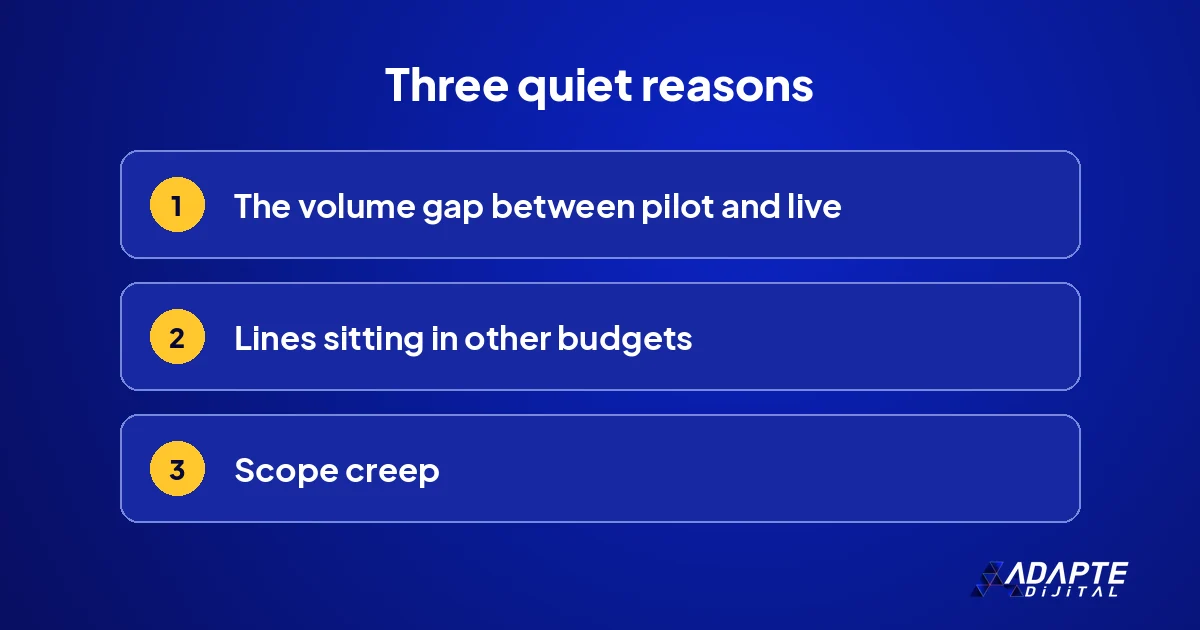
Three reasons appear in almost every project. None of them shows itself during the pilot.
The volume gap
A pilot is run with few people and with goodwill. In production the number of users rises, questions lengthen and conversations continue. Usage does not grow in a straight line, because each longer conversation carries the earlier messages along with every new one. Ten times the users means more than ten times the bill. The same effect inside agents is described in token waste in agent systems. 📈
The lines you do not see
The model bill is the visible line. The invisible ones are: connecting to systems, preparing data, monitoring answers, fixing errors and training the team. These are often paid from other budgets under other names. The project looks cheap because half its cost is written on other lines.
Scope creep
Once the assistant works, everyone wants one more thing from it: let it answer this too, look at that system as well, speak this language. Each addition is small and sensible. Six months later the project does twice the work of the project that was approved. The budget was written for the first scope. 🧱
How is the cost worked out?
BU BÖLÜMÜN ÖZETİ
- The cost formula
- Measuring the pilot properly
- The return
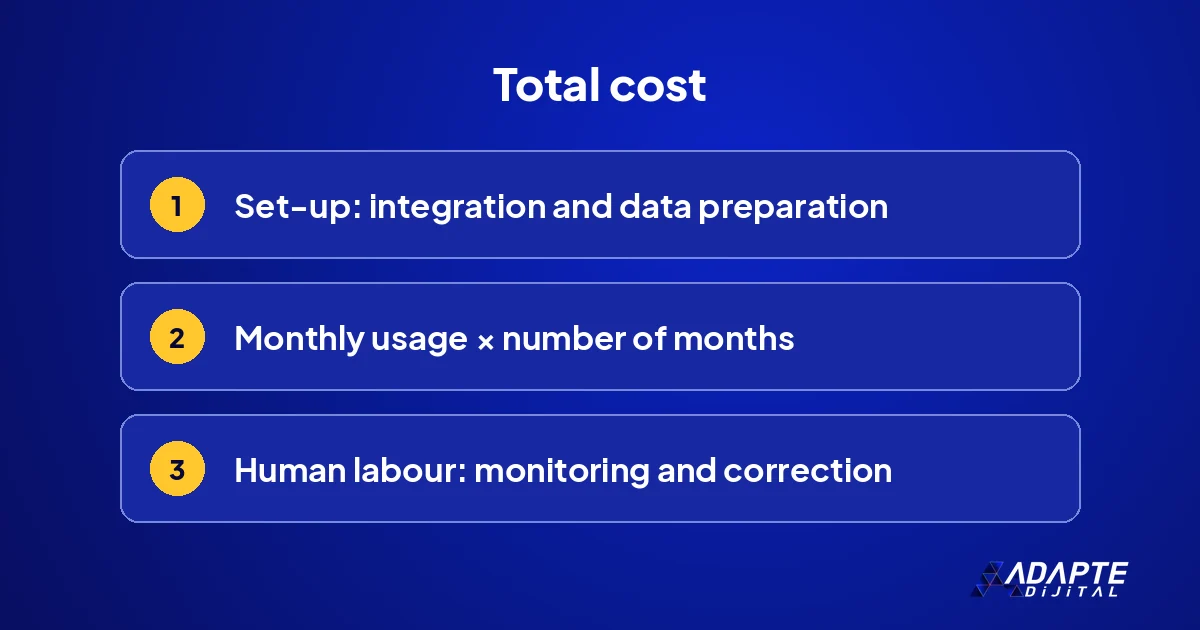
A sound budget costs the whole life of the project, not the model bill.
The cost formula
The formula is: total cost = set-up + (monthly usage × number of months) + human labour. Set-up includes integration and data preparation. Monthly usage is calculated on real production volume. Human labour is the hours given to monitoring and correction. The third line is the one most often forgotten. 🧮
Measuring the pilot properly
A pilot should answer not only ‘does it work’ but also ‘at what cost does it work’. Measure cost per job during the pilot and multiply it by the expected number of jobs in production. Then double that figure before you look at it, because a real user costs more than a pilot user. The method is in how to audit an AI budget.
The return
What will stand against the cost should be written down at the start: hours saved, fewer complaints, more sales. Without a measure a project never fails, but it never succeeds either. It merely continues. A project that continues unmeasured is the most expensive kind in a budget. The general cost picture is in what AI costs in a business.
How is an overrun prevented?
BU BÖLÜMÜN ÖZETİ
- Start small, grow by measuring
- A threshold and a stop rule
- Five questions asked in an audit
Prevention is not shrinking the project; it is giving the project a limit and a measure.
Start small, grow by measuring
Choose one job, take it live and measure it for three months. Do not move to a second job until cost per job and the return are clear. This route looks slow, but it is faster than a large project that gets cancelled. Every new scope is added with its own budget and its own measure. 🪜
A threshold and a stop rule
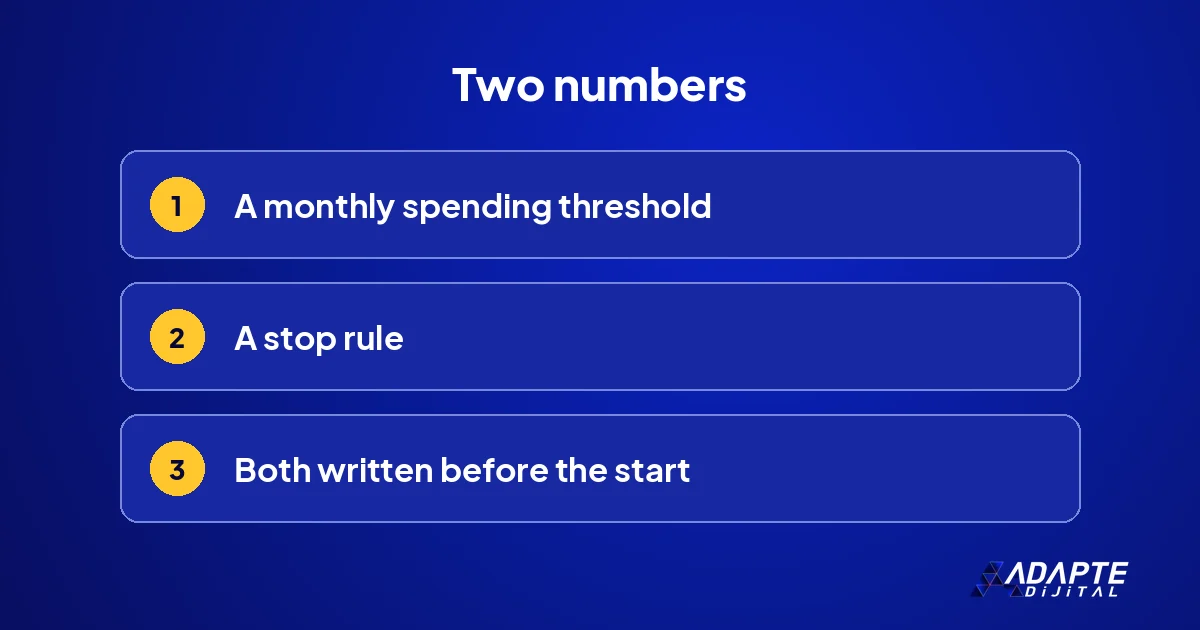
Write two numbers into the project: a monthly spending threshold and a stop rule. If the threshold is passed, the project is reviewed. The stop rule says which missing result will close the project. Writing this rule before the project starts is easy; once it has started, nobody wants to propose closing it.
Five questions asked in an audit
One: was the budget calculated from the pilot bill or from production volume? Two: are integration and monitoring labour in the budget? Three: is the measure of success written down? Four: is there a monthly threshold and a stop rule? Five: when was the scope last widened, and with whose approval? Forecast: most cancelled projects will be cancelled on budget grounds, not technical ones. Update log. 18 November 2026: first publication. Forecasts on this page are re-read when they fall due; one that proves wrong is corrected here, not deleted. The longer price trend is in where AI bills are heading.
How does Adapte Digital review a project budget?
BU BÖLÜMÜN ÖZETİ
- A single delivery package
- What comes out
- Where to start
In the bill file we also open projects that are under way: the written budget and actual spending are put side by side and the gap is explained line by line.
A single delivery package
Adapte Digital does not charge a monthly management fee. Work starts with a single delivery package whose scope is written down in advance: 36,000 TRY + VAT. If the work grows, the new need is defined as a separate add-on package, priced by what will be delivered rather than by the hours spent. 📦
What comes out
For each project we write a total cost table, the missing measures and the thresholds we recommend, so that the next budget starts from real figures.
Where to start
The written scope of each package, with current pricing and capacity, is on our campaign pages. 🧭
Quick Summary
- A pilot does not show the cost of live use.
- Gartner predicts that more than 40 per cent of agentic AI projects will be cancelled by the end of 2027.
- The quiet reasons: the volume gap, invisible lines and scope creep.
- Total cost: set-up + monthly usage × months + human labour.
- A monthly threshold and a stop rule are written before the project starts.
Short Glossary
- Proof of concept
- A proof of concept is a small-scale trial run to show whether an idea works.
- Scope creep
- Scope creep is the unnoticed widening of a project’s approved limits through small additions.
- Stop rule
- A stop rule is a condition set in advance that says which missing result will close a project.
Frequently Asked Questions
Next Step
If you have an AI project under way, write two numbers today: a monthly spending threshold and a stop rule. If you cannot write both, the project has not yet been budgeted.
Sources: Gartner — Over 40% of Agentic AI Projects Will Be Canceled by End of 2027 · FinOps Foundation — FinOps for AI Overview · Claude Docs — Pricing
Updated: November 2026
Sık Sorulan Sorular
No. Falling prices lower unit cost, but usage and scope grow faster. Most of the overrun does not come from the model bill anyway; it comes from the lines around it.
Measure cost per job in the pilot, multiply it by the number of jobs in production, and add integration and human labour on top. Leave a margin for uncertainty.
No. A project stopped by its measure is a project that protected the budget. Failure is a project that cannot be stopped because it has no measure.