
Füsun Özdemir urges investing in people as much as tech, how should a team prepare for AI?
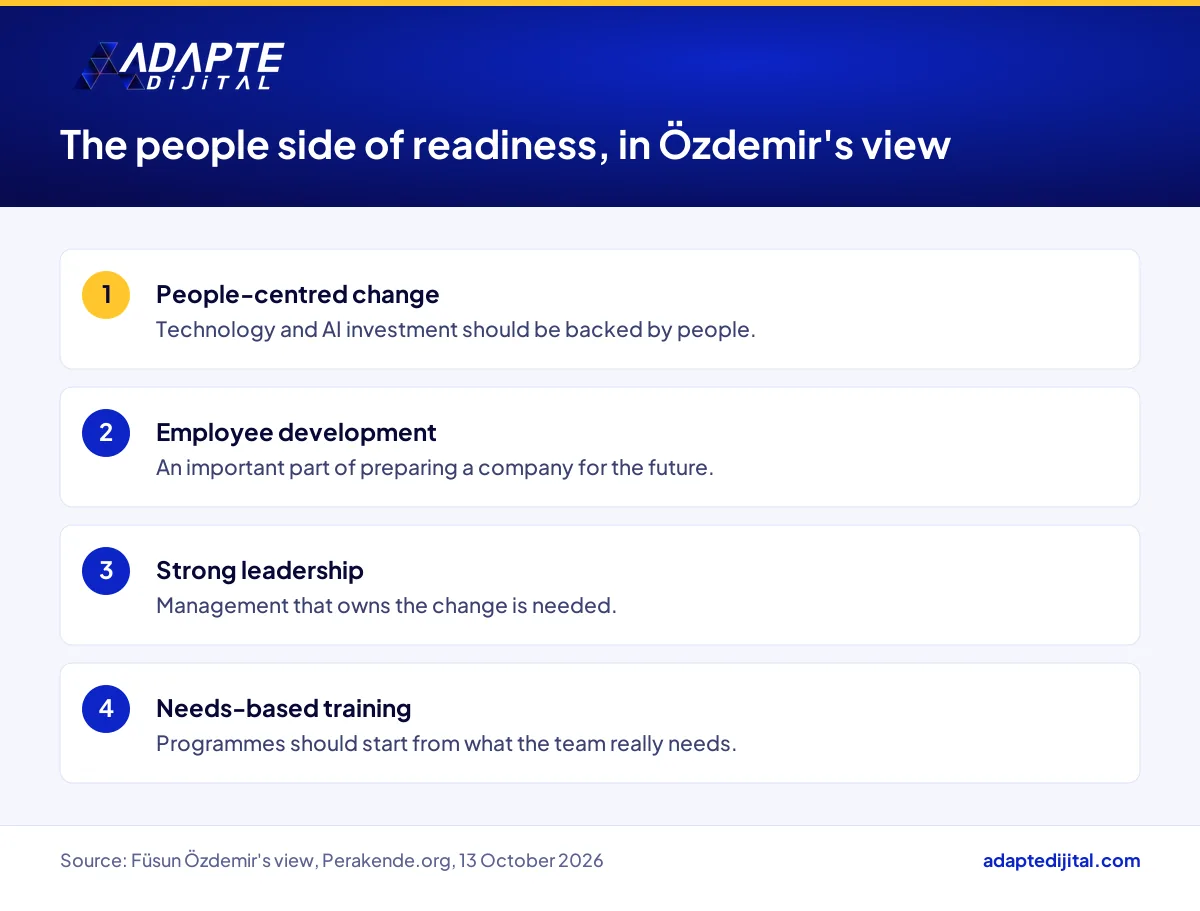
Füsun Özdemir, founder of FSN Danışmanlık & Akademi, argues that investment in technology and artificial intelligence needs to be backed by a people-centred transformation (Perakende.org, 13 October 2026). In Özdemir’s view, employee development, strong leadership and needs-based training programmes are what prepare a company for the future. Her comments come from a video interview tagged Vizyon 100 on Perakende.org, a Turkish retail news site.
If you are buying an AI tool for the till, stockroom or customer service, plan the team’s readiness on the same budget sheet. The page text gives no figures, company examples or programme names; everything said is Özdemir’s opinion. For Turkish stores and small businesses in autumn 2026, the question is whether your team will actually use the tool.
What does Füsun Özdemir say about the role of people in AI investment?
According to Özdemir, technology and AI investment should be supported by a people-centred transformation. She highlights three elements that prepare a company for the future: employee development, strong leadership and needs-based training programmes. The page text contains no numerical data and no example company. Read it as a consultancy founder’s direction, not a measurement.
What does Özdemir’s view mean for a retailer investing in AI?
Here is what it means for you: the work starts, not ends, on the day you buy an AI tool. A system for stock forecasting, price labels or customer messages works only as well as the person running it. Without a ready team, old habits win and the investment stays on paper. The fact box below separates goals from measured outcomes.
| Area | Goal (Özdemir’s view) | Outcome (measured on the page) |
|---|---|---|
| Technology investment | Should be backed by people-centred change | No data |
| Employee development | Important for future readiness | No data |
| Leadership | Strong leadership is needed | No example company |
| Training | Needs-based programmes | No programme name or result |
How is the view of AI in Türkiye changing, according to Ipsos data?
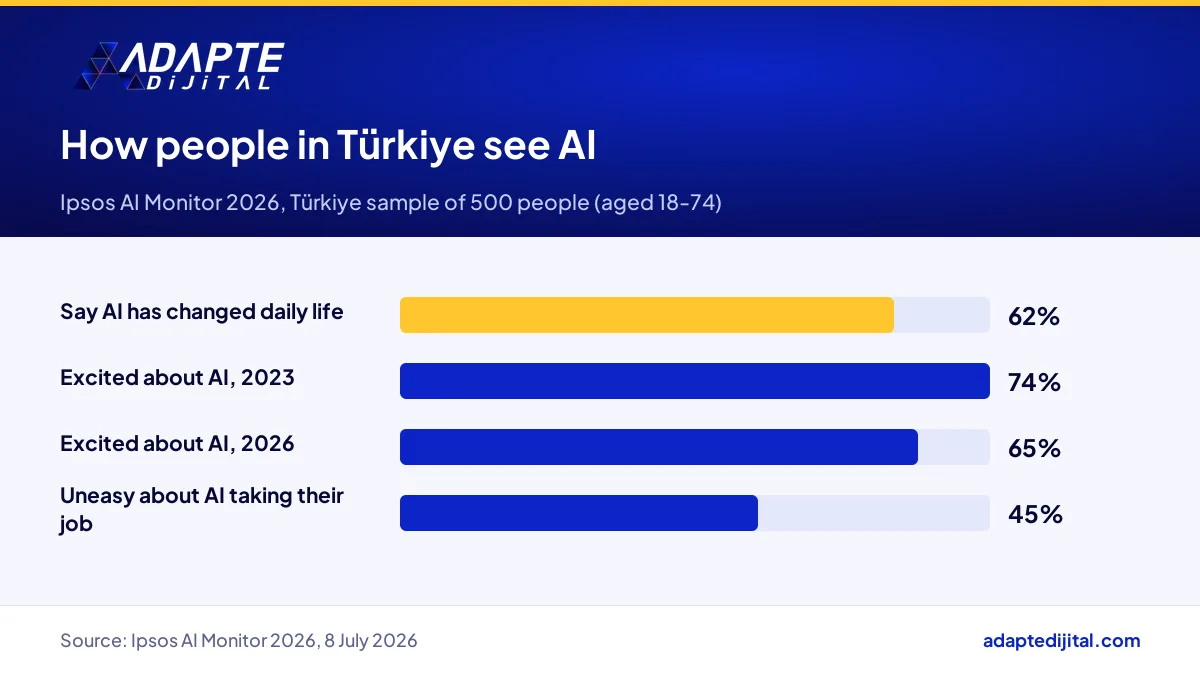
People in Türkiye are both used to AI and wary of it. According to the Ipsos AI Monitor 2026, 62% of people in Türkiye say AI has changed their daily life over the past three to five years, 8 points above the average across countries. The share who feel excited about AI fell from 74% in 2023 to 65%. And 45% are uneasy about AI taking over their job.
What do AI tools expect from the team on web, search and marketplaces?
They expect checking more than creating. Tools that write product descriptions, update marketplace listings, answer reviews or draft ad copy deliver output fast. If nobody checks that output, a wrong price, a wrong size or off-brand language goes live. The team’s job is to keep data clean and give final approval.
Which businesses does the focus on people in AI affect, and how?
It matters most for multi-branch retailers with high staff turnover, because every new hire has to learn the tool from scratch. In a single-store business, the owner can learn the tool and pass it on, so the job falls on one person. Training providers and consultancies sit on the side where demand grows indirectly.
How should a business owner prepare the team for AI this week?
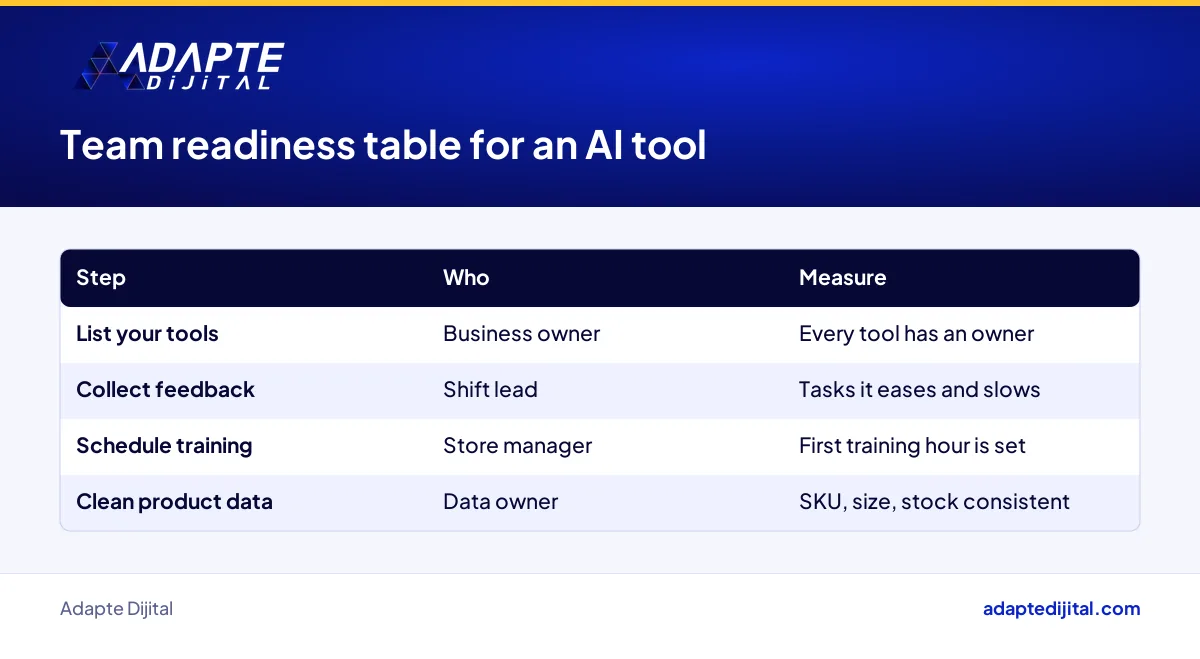
You can do three things this week: name an owner for each AI tool, write on one page what the tool will change, and put the first training hour in the calendar. None needs a large budget, and together they give a concrete start to the three elements Özdemir lists.
Leadership starts with the store manager
The store manager or shift lead should be the first person to use the tool, because a team does not take seriously a system its manager never opens. Choosing tools and planning the team together is part of our AI consultancy work.
Quick Summary
- According to Füsun Özdemir, AI investment should be backed by a people-centred transformation (Perakende.org, 13 October 2026).
- Özdemir highlights employee development, strong leadership and needs-based training, and the page gives no numerical data.
- According to the Ipsos AI Monitor 2026, 62% of people in Türkiye say AI has changed their daily life.
- In the same survey, 45% are uneasy about AI taking over their job (Ipsos, 8 July 2026).
- The desk recommends one owner, one training hour and a separate budget line for every tool.
Short Glossary
- People-centred transformation
- People-centred transformation is the approach used to plan a technology investment together with employees’ skills and ways of working.
- Needs-based training
- Needs-based training is the method used to build a programme from the concrete problems a team meets on the job rather than from general topics.
- Staff turnover
- Staff turnover is the measure used to express how many employees leave in a given period relative to total headcount.
Frequently Asked Questions
Next Step
If you would like to assess how ready your team is for AI tools, fill in the Consult Your Expert form and we will draft a first plan from your tool list and team structure. Our retail page, where we interpret the retail agenda for you, gathers the other stories.
Sources: Perakende.org, “Füsun Özdemir: Geleceğe yön veren kurumlar, teknolojiye ve insan potansiyeline yatırım yapanlar olacak”, 13 October 2026 · Ipsos Türkiye, AI Monitor 2026, 8 July 2026 (linked in the text)
Updated: October 2026
Sık Sorulan Sorular
The conversation runs as a video interview on Perakende.org under the Vizyon 100 tag. The page does not explain what the series covers. It gives no founding year or sector detail for FSN Danışmanlık & Akademi.
In Özdemir’s words, the future will be shaped by companies that invest “in people’s development as much as in technology” (our translation). The weight of the sentence sits in “as much as”. It does not push technology aside; it adds a second line next to it.
Because the page reports no measured result. Test the question against your own numbers: staff turnover, how fast a new hire gets up to speed and the error count at the till.
Füsun Özdemir, Perakende.org, 13 October 2026. The second column shows her view; the third shows whether the page reports a measured result. This is not investment advice.
The jobs with direct customer contact: the till, the returns desk, the order line and the shop-floor help point. When an AI suggestion turns out wrong, the employee still makes the final call. We look at the balance between technology and people at the till in our piece on self-checkout versus staffed tills.
Next to the software licence, add lines for training hours, a trial period and one named owner. The desk’s recommendation is to keep these as separate items. Otherwise training is the first line cut when money gets tight.
The survey covers 23,532 adults in 32 countries, interviewed between 20 March and 3 April 2026. The Türkiye sample is 500 people aged 18 to 74, and the results came out on 8 July 2026. It describes the adult population, not employees.
The 45% figure describes the general population, but it can surface in a store too. When a new system arrives and nobody answers the question “is this replacing me?”, staff find reasons not to use it. Özdemir’s people-centred focus lands right here.
Novelty alone is not enough. What wins an employee over is a tool that makes their day easier in concrete ways: fewer stock-count errors, faster order entry, fewer repeated customer questions.
Search engines and marketplaces recognise your product from the data you enter. If SKU codes, sizes, colours and stock levels are messy, AI multiplies the mess. A single owner for product data comes before any training.
Map-listing hours, review replies and store photos can be managed with automated tools. The tool can write the reply, but the team fixes the complaint in the store. Answer a review without solving the problem, and the customer walks back out the door.
Automated bidding and targeting spend money on the wrong audience when tracking is set up badly. At least one person on the team needs to read conversion tracking, average basket value and campaign return.
Grocery, café and store chains that add training and leadership lines to the technology budget can bed a tool in faster. Once the team adopts it, look for movement in sales per employee and sales per square metre.
Clothing and shoe stores find it hard to make time to teach new staff the system in peak season. Training gets postponed and the season closes before anyone uses the tool.
The focus on leadership also raises the question of who digital change should report to. Our take on Çilek’s appointment of a technology group head opens a different window on this.
Write every piece of software used at the till, in the stockroom, on social media and in customer service into one table. On each row, add who uses it and when they were last trained. The empty cells show your priorities.
Ask staff two questions: where does the tool make your work easier, and where does it slow you down? The answers are the raw material for needs-based training.
Not necessarily a large one. What you really need is time set aside for training and one person who owns the tool.
No. The interview text on Perakende.org names no software, programme or company example, and the views are general in nature.
Write down clearly which tasks the tool will take on and which tasks your staff will spend their time on instead. According to the Ipsos AI Monitor 2026, 45% of people in Türkiye share this worry, and staying silent does not reduce it.