
Online Spare Parts Sales: Documents and the Compatibility Arrangement
In a business selling spare parts online the document list is built from known items: the commencement notice and tax certificate, chamber registration, a workplace opening and operating licence for the warehouse address, and the information and record duties on the electronic commerce side. The difference here is something else: showing by record which vehicle your part actually fits.
With businesses working in this branch we set up the following system: a parts compatibility and returns file. It has four layers of record and moves the returns rate directly. Below we explain how it is built and why it works.
Why compatibility is the breaking point in this branch
In spare parts the main reason for a return is not a faulty product but one that does not fit. The customer believes they bought the right part, goes to have it fitted, and it will not seat.
From that moment two costs arise at once: the carriage and returns process, and the customer’s confidence. No second order comes for the same model. Compatibility is therefore not a customer service topic but the foundation of the business.
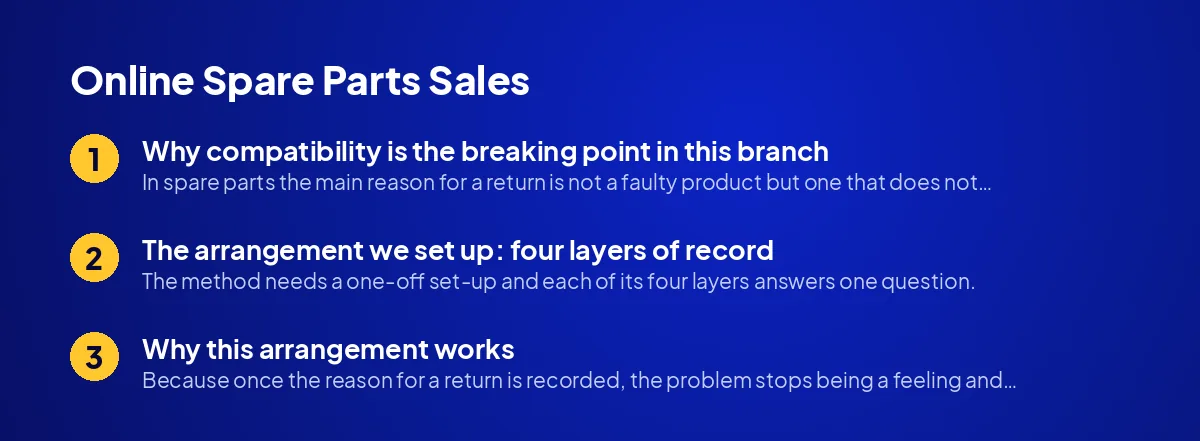
The arrangement we set up: four layers of record
BU BÖLÜMÜN ÖZETİ
- 1. The part identity record
- 2. The vehicle matching record
- 3. The product page declaration record
- 4. The returns and post-fitting record
The method needs a one-off set-up and each of its four layers answers one question.
1. The part identity record
For every part the manufacturer’s number, the equivalent numbers and any reference codes are held on one line. Without it, the same part inevitably ends up listed twice under two names.
2. The vehicle matching record
The make, model, production year range, engine code and body type the part fits are recorded. The critical detail is not the range but the change inside it; a mid-cycle update to the same model can alter the part.
3. The product page declaration record
Which compatibility information went onto the product page, on what date and on which source, is recorded. In a dispute, that record is what you stand on.
4. The returns and post-fitting record
The reason for every return is entered: did not fit, wrong order, arrived damaged, customer changed their mind. The proportions between those four show which section of your catalogue has the problem.
Why this arrangement works
Because once the reason for a return is recorded, the problem stops being a feeling and turns into data. The brand group, model range and part type the mismatches cluster around become visible.
The result we see is this: a large share of returns comes from a small section of the catalogue. Once that section is corrected, the returns rate falls noticeably without the rest of the catalogue being touched.
The paperwork: which framework applies to online selling
| Heading | From where | Note |
|---|---|---|
| Commencement notice and tax certificate | Tax office | The activity code must be chosen correctly |
| Chamber registration | Tradesmen’s or trade chamber | According to the business structure |
| Workplace licence for the warehouse | District municipality | Varies with the address and the activity |
| Electronic commerce disclosures | Yours, published on the site | Have the scope confirmed by the Ministry of Trade |
| Distance selling arrangement | Yours, the contract and the process | Pre-contract information and confirmation steps |
| Invoice and delivery note arrangement | Yours | Together with the dispatch and sales record |
This table is a frame for getting ready, not a closed list. How far the electronic commerce and consumer duties reach into your business is something to have confirmed in writing by the relevant authority.
The warehouse side is skipped in most files
In online businesses the heading most often skipped is the licensing position of the place where the goods sit. The selling happens online, but the part waits at a physical address.
Whether that address suits the activity, its zoning status and its fitness for storage are separate matters. For businesses starting from a home address, the heading arrives as soon as volume grows. Have your warehouse address confirmed in writing by the district municipality.
Distance selling and informing the customer about returns
In a distance sale the consumer is expected to be informed beforehand, with the conditions of the right of withdrawal set out plainly. In spare parts this heading carries one extra detail.
A part that has been fitted may be assessed differently from one never opened. Rather than settling that question outright, put your process in writing and have the scope confirmed by the Ministry of Trade. The information you give the customer and the process you run must be the same.
The post-fitting layer of the returns file
The most valuable part of the fourth layer is the returns arriving after an attempt at fitting. Three things need recording.
- The details of the customer’s vehicle: model, year, engine code
- The point at which the part did not fit: dimension, mounting, connector
- What the product page declared for that vehicle
Set those three side by side and the error shows itself: in the catalogue, in the customer’s choice, or in a mid-cycle change to the vehicle.
Selling on a marketplace against selling on your own site
The duties attaching to the two channels do not fully overlap, and that split is worth seeing early.
On a marketplace the platform’s own rules and disclosures come into play, while the accuracy of the product information stays with the seller. On your own site the disclosure, the contract and the whole returns process depend on the arrangement you build. If you run both channels, make the compatibility record their shared source.
Product safety and the supplier record
The source of the part you sell must be visible in your own hands. When a question comes in, the answer is who you bought it from and what document came with it.
For every supplier the invoice, the batch details and any documents belonging to the product are filed. Before drawing firm conclusions on product safety and consumer legislation, learn the scope for your product group from the Ministry of Trade.
The order in which the method is applied
- Deduplicate your catalogue against the part identity record
- Write the vehicle matching information by points of change rather than by year range
- Tie product page declarations to a record with their date and source
- Start gathering the reason for returns under four headings today
- A month later, correct the section where returns cluster
The fifth item is where the method repays you: the first four are set-up, the fifth is gain.
The method in summary
In this branch the paperwork is the known part of the work. What sets you apart is showing by record which vehicle your part fits, and turning the reason for a return into data. A four-layer file makes both of those something you can set up inside a week.
For the order in which the authorities come see the business licence roadmap, and for capital ranges and cost lines our automotive sector page. If you are considering a physical shop as well, see our auto spare parts shop article; if you will add an accessories line, our car accessories shop article.
In Short
- In this branch the main reason for a return is not a fault but a part that does not fit
- Four layers of record: part identity, vehicle matching, page declaration, reason for return
- The part identity record stops the same part being listed under two names
- A year range is not enough; the mid-cycle change inside that range decides
- The moment the reason for a return is recorded, the problem becomes data
- Returns usually cluster in a small section of the catalogue
- The licensing position of the address where goods sit is the heading most often skipped
- In distance selling the information given and the process run must match
- The duties of the marketplace channel and your own site do not overlap
- The supplier file is the only answer to a question raised about a product
- Confirm the electronic commerce and consumer scope with the relevant authority
Quick Glossary
Equivalent part: a product from another manufacturer usable in place of the original part. Engine code: the code identifying a vehicle’s engine, decisive in matching compatibility. Distance selling: a sale formed through remote communication, without the parties meeting in person. Right of withdrawal: the consumer’s right to step back from a purchase within set conditions.
Next Step
Let’s set up your compatibility and returns file together: consultation request form.
Frequently Asked Questions
Updated: September 2026
Sık Sorulan Sorular
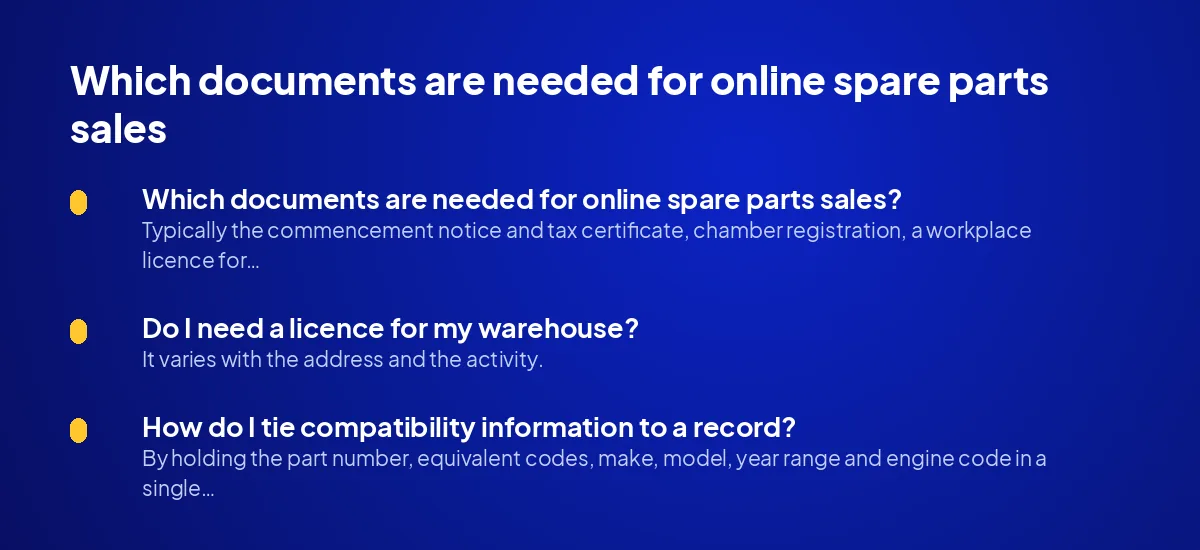
Typically the commencement notice and tax certificate, chamber registration, a workplace licence for the warehouse address and the disclosures on the electronic commerce side.
It varies with the address and the activity. Have the position of your warehouse address confirmed in writing by the district municipality.
By holding the part number, equivalent codes, make, model, year range and engine code in a single record.
Rather than settling this heading outright, put your process in writing and have the scope confirmed by the Ministry of Trade.
Once the reason is recorded, it becomes visible which make and model range the mismatches cluster around.
The set-up side lightens, but the accuracy of the product information stays with the seller. Use one shared record across both channels.
The invoice, the batch details and any documents belonging to the product. That file is the answer to a question raised later.
The compatible vehicle information and the source it rests on. Tie the declaration to a record with its date.
A week’s work, depending on the size of the catalogue; the return shows in the first month’s returns rate.