
Why are branded products more expensive? Same product, two prices and 6 reasons
Why are branded products more expensive? The short answer: the customer is not only buying the product, but the promise behind it. A name they recognise, the same quality every time, and someone to turn to if something goes wrong. That promise lowers the risk of the purchase, and customers pay for lower risk.
The gap rarely comes from the fabric or the jar. It comes from the name, the look, the voice and the trail online: invisible layers on top of the product. Below is one product at two prices, then the six reasons behind the gap.
How does the same product sell at two prices?
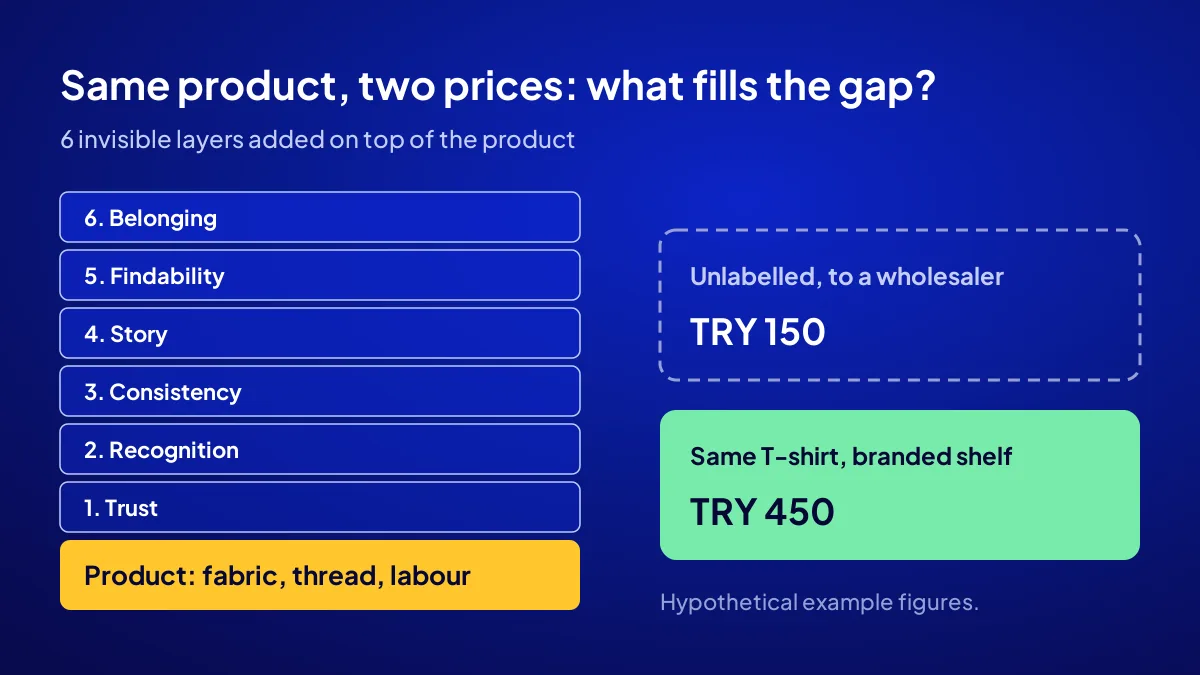
Say you run a T-shirt workshop in Bağcılar, Istanbul, and sell your shirts unlabelled to a wholesaler. The same cut and fabric ends up on another shelf under a brand’s label at a much higher price. The shirt and the work are the same. What changes is the customer’s trust in that label and the fact that they recognise it.
A table with hypothetical numbers
Say you sell each one to the wholesaler for TRY 150, and on the branded shelf it sells for TRY 450. Part of the TRY 300 gap is rent and distribution; part is the value the name carries. Your sector’s figures will differ.
What exactly is the customer paying the gap for?
The customer pays the gap for six things: trust, ease of recognition, consistency, story, findability and belonging. What these six share is that each one reduces uncertainty in the customer’s mind. As uncertainty drops, the room for haggling narrows and the price question moves to second place.
- Trust: knowing there is someone to turn to if something goes wrong.
- Recognition: not having to think twice on the shelf or in search.
- Consistency: expecting the same quality every time.
- Story: knowing where and who the product comes from.
- Findability: seeing it appear online when typing the name.
- Belonging: feeling in the right place while using it.
How much of a product’s value comes from things you cannot see?
According to a 2017 study by the World Intellectual Property Organization, intangible capital accounted, on average, for 30.4 percent of the total value of manufactured goods sold worldwide between 2000 and 2014. That capital includes branding, design and technology. Roughly one in every three lira of value comes from things you cannot hold.
Why do unbranded sellers always face the price question?
Because price is the only thing the customer can compare. Without a name, story or trail online, only the number on the tag differs. The cheapest wins, and the margin melts a little more with every haggle. We explain why this loop does not break in why do they only ask about price.
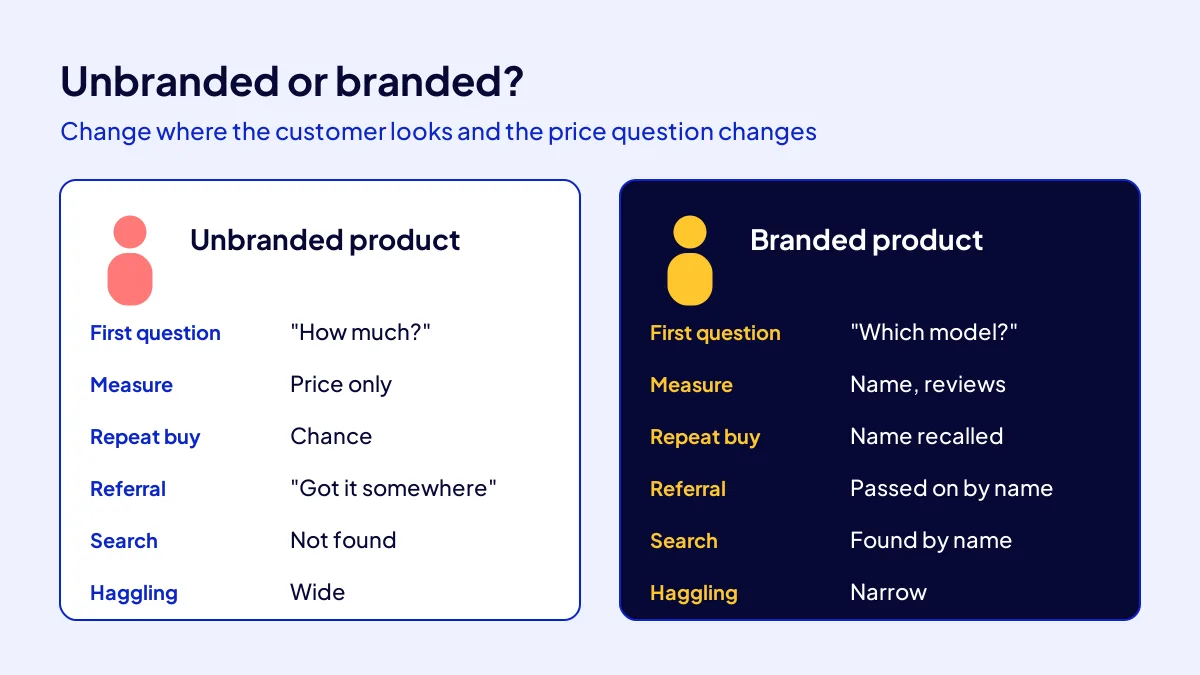
| Where the customer looks | Unbranded product | Branded product |
|---|---|---|
| First question | “How much?” | “Which models do you have?” |
| Basis for comparison | Price only | Name, reviews, look, price |
| Repeat purchase | Down to chance | Because they remember the name |
| Recommendation | “I got it somewhere” | Passed on by name |
| Online search | Cannot be found | Found by name |
| Room for haggling | Wide | Narrow |
When does a brand not justify a higher price?
When the promise is not kept. A nice name and a smart label carry the price gap once if the product falls short, but not twice. A brand does not raise prices on its own; it makes the product’s ongoing promise visible. That is why nobody can guarantee “brand it and your price goes up by this much”, and Adapte does not either.
Where does a small business start building the gap?
BU BÖLÜMÜN ÖZETİ
- Step one: write down what you promise and to whom
- Step two: fix the name and the look
- Step three: open an address online
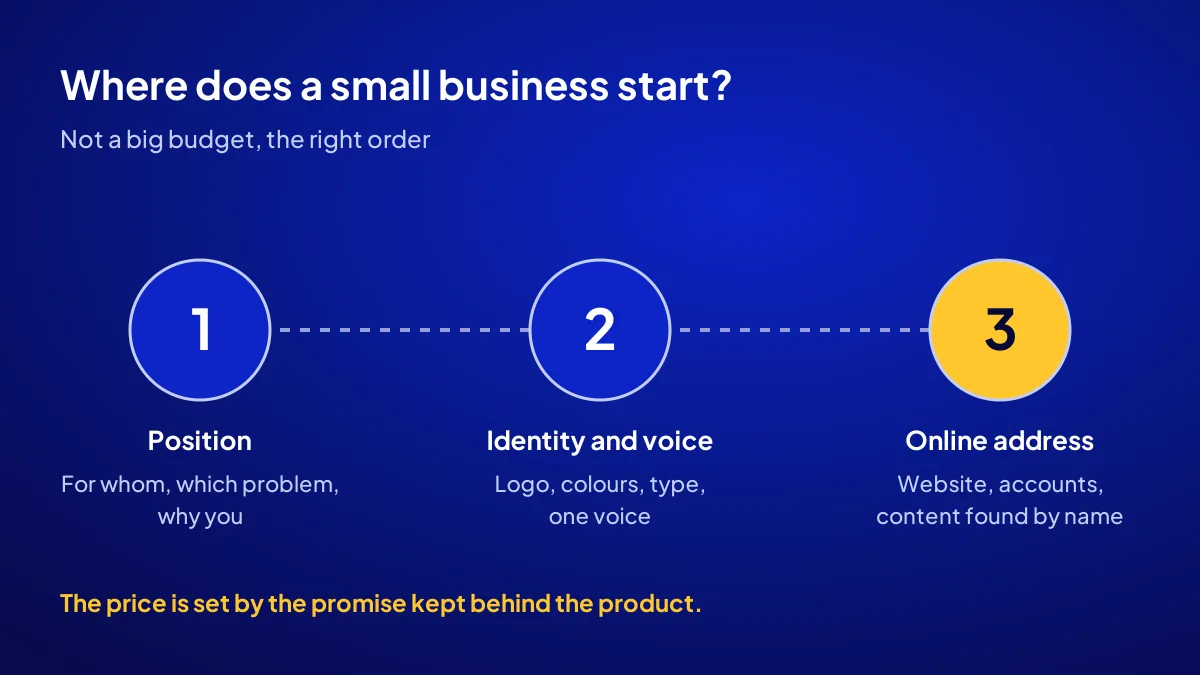
The order runs from small to large: name and position first, then look and voice, then an online address and content where people find you. It starts not with a big ad budget, but with a consistent identity and a trail that shows up when people search the name. Read how small brands take share from big ones in the rise of small brands toward 2027.
Step one: write down what you promise and to whom
A three-sentence answer to “for whom, which problem, why us”. That is positioning, and the price stands on it.
Step two: fix the name and the look
Logo, colours, typeface and voice are set once and used everywhere. Recognition takes repetition.
Step three: open an address online
A website, social media and content that appears when the name is searched. What customers find tells half the price story.
What is included in the Build Your Digital Brand campaign?
All three steps are in the package. Brand consultancy (positioning, target audience, brand voice), a TÜRKPATENT preliminary search and availability check, a digital identity with three directions presented and one finalised, a 6-page brand website with a domain and 1 year of hosting, and 108 AI SEO-ready articles across 6 keyword groups. On top come a brand guideline, a social media kit, a digital business card, structured data and a handover video.
Price and terms
TRY 36,000 + VAT, fixed and paid upfront; TRY 43,200 at the general 20 percent rate, so check the current rate on your invoice. The domain is registered in your name, and the second-year hosting renewal is yours. Packaging, labels and trademark filing are separate add-on offers. See our guide to building a digital brand.
Places and applying
There are 12 brand places, and the last day is 1 November 2026. If you have the 10 percent coupon, just mention the code when you apply. You can fill in the form on the Build Your Digital Brand campaign page. One principle to remember: the price is set not by the product, but by the promise kept behind it.
Quick Summary
- With a branded product, the customer buys a promise along with the product.
- Trust, recognition, consistency, story, findability and belonging carry the gap.
- Per WIPO, intangible capital averaged 30.4 percent of manufactured goods’ value.
- For an unbranded product, price is the only measure; margin melts in haggling.
- A brand does not rescue a weak product; it makes a solid one’s promise visible.
- The order: position, identity and voice, online address.
Short Glossary
Intangible capital: Intangible capital is the term used to group non-physical sources of value such as branding, design and technology.
Positioning: Positioning is the framework used to define for whom, for which problem and why a brand should be chosen.
Margin: Margin is the ratio used to express the difference between selling price and cost.
Next Step
If you want to make the promise behind your product visible, start with positioning. Apply to the Build Your Digital Brand campaign and take the first step with consultancy.
Frequently Asked Questions
Source: WIPO — New study on the value of intangible capital in manufactured goods (2017)
Sık Sorulan Sorular
You think in cost: fabric, thread, labour. The customer thinks in outcome: will it suit me, will it survive the wash. The price forms between the two.
Trust. For first-time buyers, risk costs most. Paying for an unknown product is like buying a pig in a poke; a brand lets them see what is in the bag first.
Customers now check the name, reviews and website first. A product with no trail online carries a second question mark.
The same study shows the share rising from 27.8 percent in 2000 to 31.9 percent in 2007, then holding stable.
The study also looks at the coffee market and notes that brand reputation and image help firms set their offer apart from rivals in all coffee segments. The coffee in the cup may be similar; the name on the cup separates the prices.
It signals the customer has no other measure. A name, a look and a consistent voice give them one.
In repeat purchases and referrals. A product whose name is remembered sells a second time; a nameless one has to find a new buyer every time. As traders say, one customer brings ten, but only if they can say your name.
It spreads the weakness faster, because a bad review travels with the name. The product must be solid first.
A different logo on every package and a different tone in every post make customers ask, “Is this the same company?” The document that fixes the look is covered in what is a brand guideline.
Brand consultancy, a TÜRKPATENT preliminary search and availability check, a digital identity with 3 directions, a 6-page website with domain and 1 year of hosting, 108 AI SEO-ready articles, a brand guideline, a social media kit, a digital business card, structured data and a handover video. The price is TRY 36,000 + VAT.
No, there is no such guarantee. A brand makes the trust and consistency your product delivers visible. The price gap is carried by the promise the product keeps.
No. Packaging and label design are a separate add-on offer. The package covers digital identity, website, content and guideline.
Updated: October 2026