
Private Security Company Licences and Permits: What Is the Authority?
In private security most entrepreneurs set out thinking it is one line of work. In fact the field holds authorities that stand apart from one another, and which of them you hold settles directly what you may sell.
The two most often confused are the security company and the security training institution. Both sit in the same sector, both answer to the same legislation, and they do quite different work. Below we open that distinction and show at which door the file runs.
How many separate authorities the field holds
Private security holds three distinct activity headings: the company providing protection and security services, the training institution that prepares security officers, and the body operating an alarm monitoring centre.
All three look to the same legislative frame, yet the permit for each is separate. Holding one gives no right to do another; for that reason your business model has to be chosen at the very start.
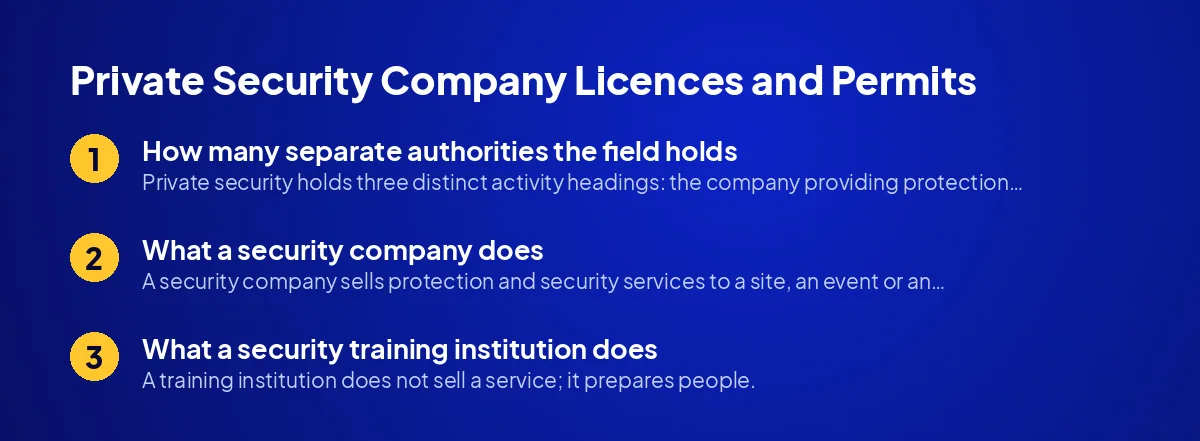
What a security company does
A security company sells protection and security services to a site, an event or an institution. It posts its own staff there, sets the shift pattern and carries the responsibility for the service.
The key element in this model is people. Turnover grows with headcount and risk grows at the same pace, so managing the workforce stands at the centre of the business.
What a security training institution does
A training institution does not sell a service; it prepares people. It gives those who wish to become security officers the training the legislation prescribes and readies them for the examination process.
The key elements here are the premises and the teaching staff. Classroom arrangements, a practice area and the body of instructors become decisive on this side.

The line that divides them
The line is very clear: one puts the service into the field, the other prepares the people who go into the field. Selling security services as a company, you may not give training; operating as a training institution, you may not place officers at a site.
Some entrepreneurs want to hold both authorities. In that case each heading is assessed separately; do not assume that one application opens two doors.
The notion of the operating permit
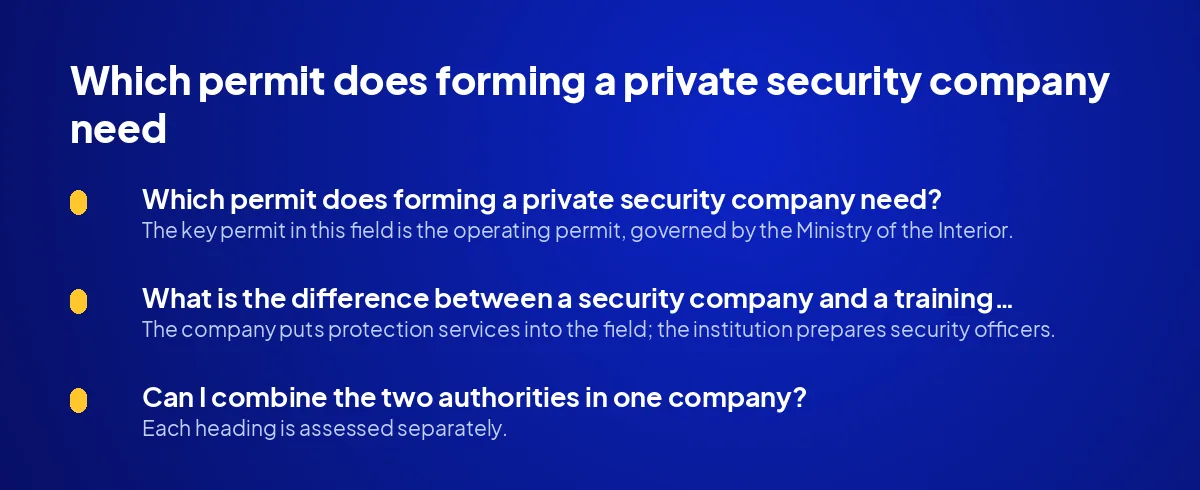
The key notion in this field is the operating permit. Companies formed to provide private security services are governed by the Ministry of the Interior, and activity begins with the granting of that permit.
The conditions of the permit, the qualities required of founders and managers and the manner of application are set in legislation, and that arrangement is revised over time. Confirm the exact conditions in writing with the provincial police directorate, not from the internet.
Which authority decides what
The table below shows which heading is settled at which door. Application varies between provinces.
| Heading | Authority concerned | When to ask |
|---|---|---|
| Company formation and registration | Trade registry and tax office | At the very start |
| Operating permit | Ministry of the Interior, through the provincial police directorate | Before the decision to form |
| Qualities of founders and managers | Provincial police directorate | Before the shareholding is settled |
| Staff identity card arrangement | Provincial police directorate | Before the first posting |
| Office address and workplace licence | District municipality | Once the address is settled |
| Personnel file and occupational safety | Social security and the safety service | Before the first recruitment |
Do not read the table as a settled ruling. Every line here waits to be verified in writing by the competent unit on your own application.
The founder and manager side
In this field who forms the company and who runs it is a direct subject of the permit process. The qualities looked for in founders and managers are prescribed in legislation.
Ask about this heading before the shareholding is settled. Registering the company and then falling foul of the manager requirement is the commonest cause of a return in this branch.
The staff side: the identity card arrangement
Every private security officer on duty in the field has an identity card arrangement of their own. That card is the paper showing the officer is authorised, and it is the precondition of posting.
Learn from the provincial police directorate how the card arrangement runs and what procedure governs its renewal. Putting an uncarded person into the field puts both the contract and the permit at risk.
The alarm monitoring centre is the third heading
Installing alarm systems and running a monitoring centre is the field’s third activity. It calls for technical infrastructure, an uninterrupted monitoring arrangement and an organisation able to respond.
That heading is subject to its own permit assessment. If you plan to sell protection and alarm monitoring together, ask about each side separately.
The office, the address and the licence
For the company’s office address the workplace opening and operating licence is taken from the district municipality. On an office arrangement the business is typically assessed towards a sanitary establishment.
Check three headings before taking the premises: does the occupancy permit suit commercial use, does the zoning status allow this activity, and can condominium consent be had if the building is residential.
Four questions to settle before applying
- Which activity you will sell: protection services, training or alarm monitoring
- Who meets the qualities looked for in founders and managers
- How the current application procedure for the operating permit runs
- How the staff identity card and posting arrangement will be set up
Put the four questions to the provincial police directorate in writing. Forming a company here on spoken information is the mistake most troublesome to put right afterwards.
How to ask about permit charges and fees
On the municipal side the licence fee and the signboard tax follow the council’s own tariff and are reviewed annually. Application and permit charges on the interior ministry side belong to a separate arrangement.
Ask about the two items separately: the schedule in force from the municipality’s revenue department, the permit-side charges from the provincial police directorate. We have worked out the cost and margin structure of a staff-heavy model on our business services sector page.
Notions not to be confused
Three notions are often mixed up here: the operating permit, the workplace opening and operating licence, and the private security officer identity card. The first is the company’s authority to do this work, the second is the address permission for the office, the third is the paper of the person in the field.
Not one of the three replaces another. To see the general order of the authorities go to the business licence roadmap; to compare another staff-intensive service model our cleaning company article, and to see a branch running on a separate authority our removals company article.
In Short
- Private security holds three distinct activity headings
- The company puts the service into the field; the institution prepares the people
- Holding one authority gives no right to carry on another
- The key notion is the operating permit, governed by the interior ministry
- Conditions are revised; ask the provincial police directorate in writing
- The qualities of founders and managers are a subject of the permit process
- Ask about the manager heading before the shareholding is settled
- Every officer in the field has an identity card arrangement of their own
- An alarm monitoring centre is subject to its own permit assessment
- The licence for the office address comes from the district municipality
- Operating permit, workplace licence and identity card are not interchangeable
- Fees and permit charges are asked of the two authorities separately
Quick Glossary
Operating permit: the permission, governed by the Ministry of the Interior, showing that a company may provide private security services. Security training institution: the body giving those who wish to become private security officers the training the legislation prescribes. Private security officer identity card: the personal paper showing that someone who will serve in the field is authorised. Alarm monitoring centre: the body watching alarm signals without interruption and directing the response.
Next Step
Let us settle which work you will sell under which authority, and in what order to apply: consultation request form.
Frequently Asked Questions
Updated: September 2026
Sık Sorulan Sorular
The key permit in this field is the operating permit, governed by the Ministry of the Interior. Learn the application procedure from the provincial police directorate in writing.
The company puts protection services into the field; the institution prepares security officers. Their authorities and permits are separate.
Each heading is assessed separately. Do not assume that a single application opens two doors.
The qualities are prescribed in legislation and revised over time. Obtain confirmation from the provincial police directorate before settling your shareholding.
Requirements of that kind are governed by the Ministry of the Interior and can change. Ask about the position in force, in writing, before you apply.
Anyone serving in the field has a private security officer identity card arrangement. Do not post a person who holds no card.
It is. The address side is settled with the workplace opening and operating licence issued by the district municipality.
An alarm monitoring centre is a third heading subject to its own permit assessment. If you will sell both services, ask about each separately.
A few months if the founder and manager side suits from the outset. Should a correction be needed on that heading, the timetable lengthens markedly.