
Judydoll enters Turkey via 300 Gratis stores, how does a new beauty brand win shelf space?
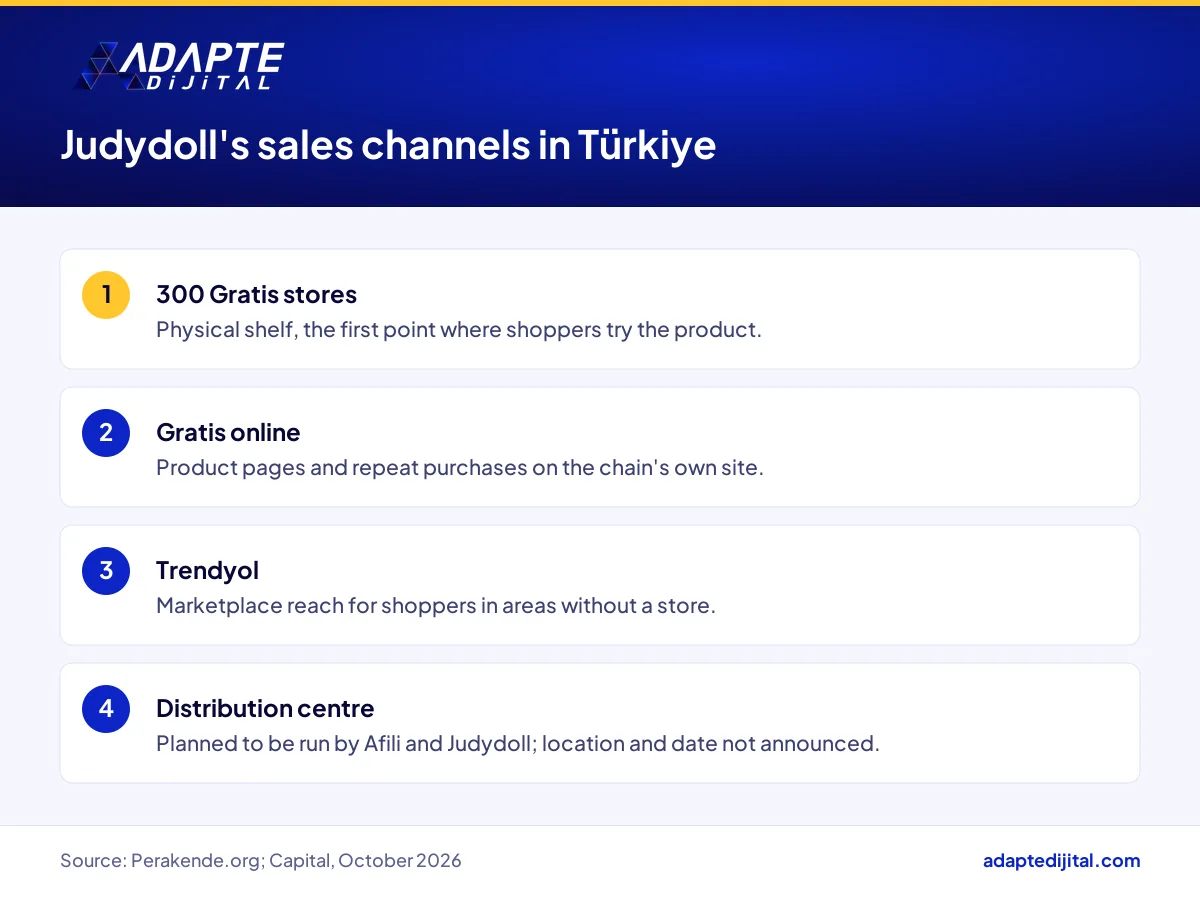
Judydoll, the make-up brand of Shanghai-based Joy Group, is entering Türkiye through a partnership with Afili Brands and selling in 300 Gratis stores, on Gratis’s own online store and on Trendyol (Perakende.org, 14 October 2026). (Gratis is a Turkish cosmetics chain; Trendyol is a Turkish marketplace.) A distribution centre run jointly by Afili and Judydoll is also planned in Türkiye; its location and date have not been announced.
Here is what it means for you: a new brand is not knocking on store doors one by one. It becomes visible through one partner, one chain and one marketplace at once. If you run a beauty brand, an independent cosmetics shop or a marketplace store, this model changes both your rivals’ speed and your own bargaining power.
Through which channels is Judydoll entering Türkiye, and what is Afili Brands’ role?
Through three channels: 300 Gratis stores, Gratis’s online store and Trendyol (Perakende.org; Capital). Afili Brands is the brand’s partner for the Turkish entry. According to the reports, Afili and Judydoll plan to run a distribution centre together. The sources say nothing more about Afili’s role or its other brands.
Why does Judydoll start with a single chain and one marketplace?
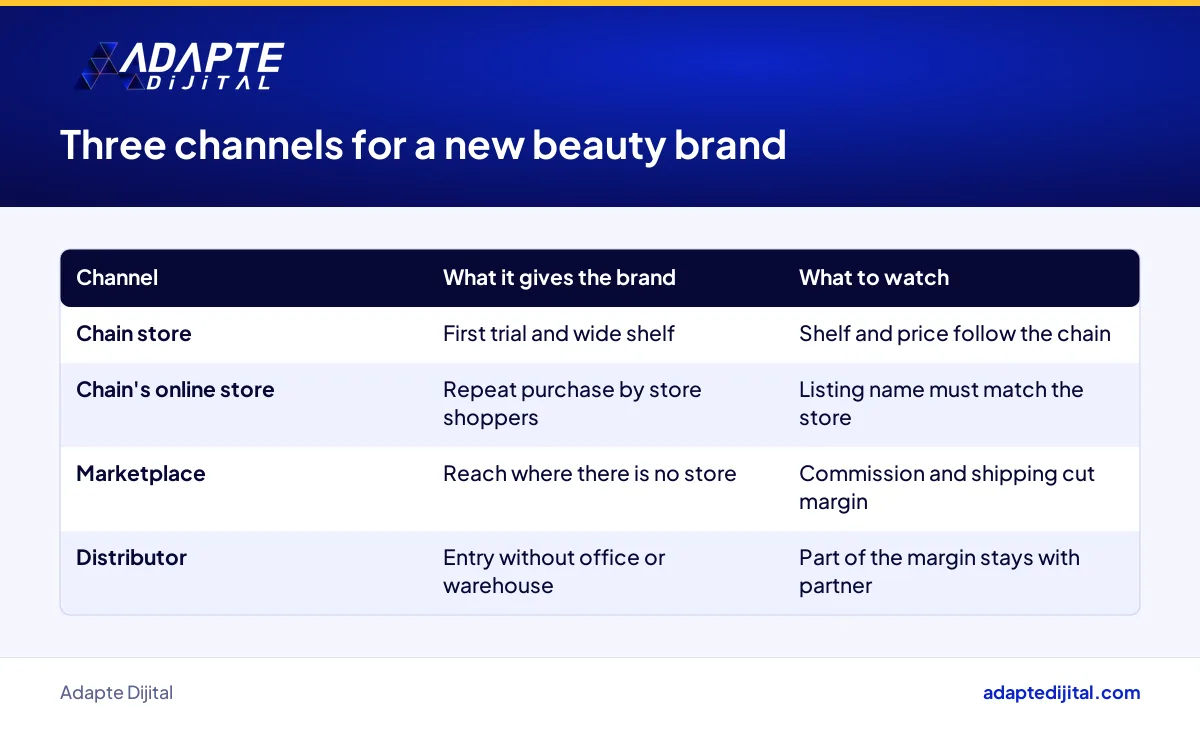
The brand has not given its reasons; our reading as a desk is this. The model gives a new brand the shortest route to wide shelf space and search visibility. One chain is faster than hundreds of independent shops, and a marketplace reaches towns without a store. The price is that shelf and pricing decisions follow the chain’s rules.
How does Judydoll’s entry affect cosmetics shops and beauty brands in Türkiye?
The winners are the chain and the marketplace, which gain traffic from a new name. The ones under pressure are local and imported colour cosmetics brands competing for the same shelf. Neighbourhood cosmetics shops feel it indirectly, when shoppers ask for the brand there. This is the picture in Turkish beauty retail in autumn 2026.
How does a new beauty brand like Judydoll become visible in online search?
Through product pages, reviews and the right search words. Shoppers rarely search for a new brand by name; they type a need such as “matte primer”. If the Gratis online and Trendyol pages miss that search, 300 stores of shelf space will not become online sales.
How should Afili Brands’ 5 percent market share target and its market data be read?
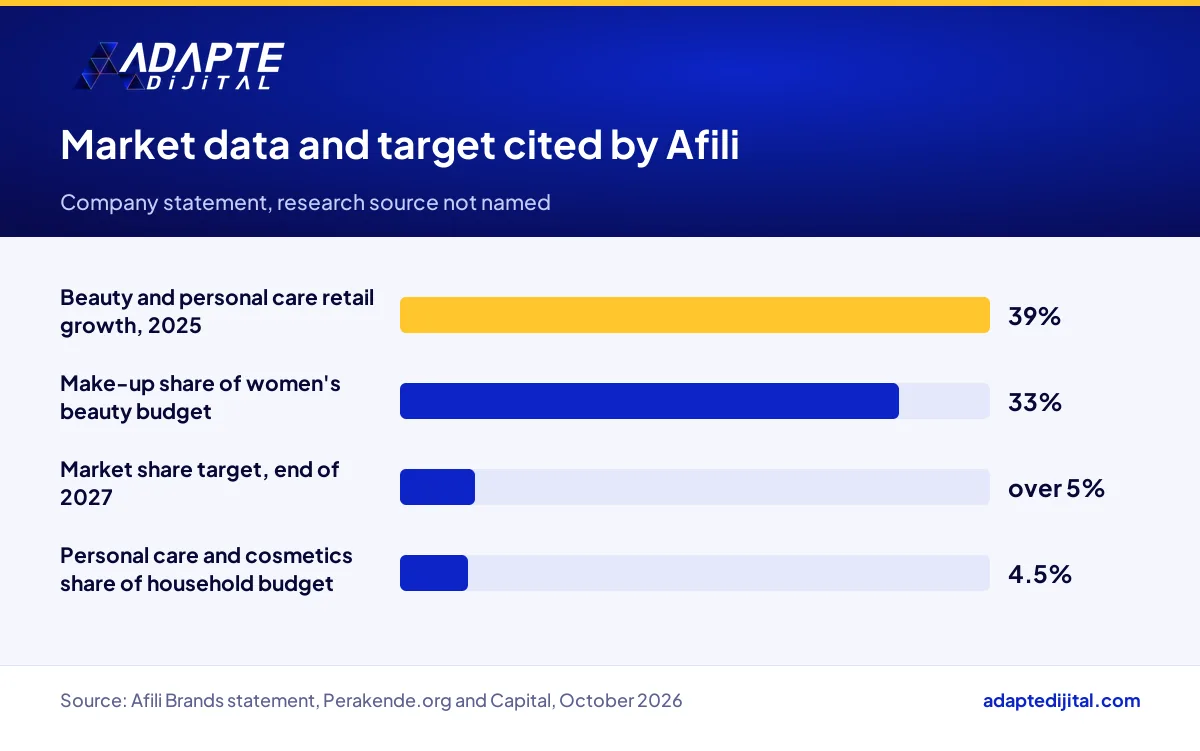
As a target, not a result. Afili aims for a market share above 5 percent by the end of 2027 and a place among the market’s top five brands within three years (Perakende.org; Capital). Capital describes this market as colour cosmetics, while Perakende.org simply says “the market”. Until that is clear, the target cannot be compared.
What should a beauty brand or shop owner do this week after Judydoll’s entry?
This week, put your sales channels into one table: chain, marketplace and your own website. For each, write the last three months’ units sold, unit profit and channel cost. Then check that your five best-selling SKUs appear under the same name and with the same photo in every channel. This table is your leverage in any negotiation.
Quick Summary
- Judydoll is entering Türkiye with Afili Brands through 300 Gratis stores, Gratis online and Trendyol (Perakende.org, 14 October 2026).
- Judydoll is the make-up brand of Joy Group, founded in 2016 and based in Shanghai (Para Dergi).
- A distribution centre run by Afili and Judydoll is planned in Türkiye; location and date were not announced.
- Afili’s target is a market share above 5 percent by the end of 2027 (Perakende.org; Capital).
- The research source behind the 39 percent sector growth cited by Afili was not named.
Short Glossary
- Distributor
- Distributor is the name used for a company that imports a brand’s products and supplies them to chains and other sales channels.
- Shelf share
- Shelf share is the retail term used to describe the space a brand takes up within a category’s total shelf area in a store.
- SKU
- SKU is the stock code used to track each product variant, including shade and size, separately in inventory.
Frequently Asked Questions
Next Step
Let’s balance your brand’s chain, marketplace and own-site channels together; fill in the consult your expert form.
Sources: Perakende.org, report on Judydoll and Afili Brands, 14 October 2026 · Capital, 15 October 2026 · Para Dergi, 14 October 2026 · Gratis, Judydoll product page (linked in the text)
Updated: October 2026
Sık Sorulan Sorular
Joy Group is a cosmetics group based in Shanghai and founded in 2016 (Para Dergi). According to the company, the group’s 2025 retail sales passed 730 million dollars, and Judydoll’s global retail sales passed 430 million dollars. Also according to the company, the brand has ranked first by sales volume in Asia’s make-up category for three years.
Yes, Judydoll product pages are live on the Gratis site. The Judydoll matte primer page on Gratis, for example, shows the brand and its country of origin. That page is a listing, not an announcement, and store-level stock is not reported in the sources.
A brand with a local warehouse does not wait weeks for stock when the shelf runs empty, and an empty slot means the shopper walks out. The centre’s location, size and opening date are not public, so supply speed cannot be judged yet.
In general, a foreign brand can enter a market without setting up an office, a warehouse and a sales team. A local partner takes on imports, the chain relationship and stock planning. In return, part of the margin stays with the partner, and this is where the question “who pays, who earns” starts.
In the store, the shopper tests a shade on her hand; on the marketplace, she buys it again in one tap. The shelf carries the first trial, the online channel the repeat purchase. We look at the role of in-store trial for products people will not buy unseen in our piece on Teknosa’s planned zones for Samsung foldables.
Shelf space, the promotion calendar and price visibility all sit in the chain’s plan. If the chain gives priority to another brand, the product just sits on the shelf. That is why the marketplace becomes a second leg, closer to the brand’s own control.
Without prices, naming rivals is hard. Still, mid-range brands selling primer, lipstick and eyeshadow to the same chain will negotiate harder for space. A category manager making room for a new brand looks at slow-moving SKUs first.
It loses the “only here” advantage and gains curiosity: shoppers who heard of the brand on social media walk in asking. Steering them to a complementary product protects the average basket.
Build the sum with your own numbers: monthly units sold through a chain times unit profit, minus listing fees and promotion contributions. Do the same for the marketplace, deducting commission and shipping. Side by side, the two results show which channel actually leaves profit.
Shade, ingredient list, how to apply it and a photo taken in daylight. In cosmetics, nobody puts a product in the basket without seeing its colour. Listing the same product under different names on the chain’s site and the marketplace splits the brand in search.
It tells you which need brought shoppers in and which product they could not find. Searches with no results are a list of products to add to stock. We explain how site search data turns into stock decisions in our piece on MediaMarkt’s September search trends.
According to Afili, beauty and personal care retail in Türkiye grew 39 percent in 2025, and annual spending per person is about 40 euros. About 4.5 percent of the household budget goes to personal care and cosmetics, and women put 33 percent of their beauty budget into make-up. The research behind these figures is not named.
Its source is unclear, and the share of price increases in it is unknown. Unit growth is not revenue growth. Base your plan on unit data from your own till, not on this figure.
According to the company, Joy Group launched more than 600 new products in 2025 and holds 20 patents; frequent launches mean frequent shelf changes. “We aim for long-term growth in Türkiye,” says Luke Kong, Joy Group’s General Manager for Global Markets and Retail (Perakende.org). These claims describe production power, not how the product will sell on Turkish shelves.
A product list, price band, promotion calendar and supply lead times. A category manager first asks how quickly you can refill the shelf; without a shipping plan, a shelf promise stays on paper.
Which searches your product page appears for, the add-to-basket rate and the reasons for returns. If the return reason is “colour looks different”, the problem is the photo, not the product. Until the photo is fixed, visits come in but the till does not turn over.
When it is not yet clear which price band, which customer and which promise your brand will speak to. We run positioning and channel planning for market entry through our brand consultancy work. Retail news is interpreted for you on our retail page.
In 300 Gratis stores, on Gratis’s online store and on Trendyol. Store-level stock is not reported in the sources.
The sources give no prices. For current prices, check the product pages in the sales channels.
Yes, entering a chain through a distributor is a common route. Read the margin, returns and promotion contribution clauses before signing; verify with the official source; this is not legal or financial advice.