
Is building a website from scratch hard? The hidden cost of losing year one
Say you run a small curtain and bedding workshop in Esenyurt, Istanbul, and you are asking yourself: is building a website from scratch hard? Technically, no. You buy a domain, pick a design, upload your products, and within a few weeks the site is live.
The hard part is the months after launch. The site opens and nobody comes, because Google needs time to know you, people need time to find you, and you need time to understand them. People who build from scratch lose their first year not to money but to these months without demand. That is the hidden cost, and no invoice ever shows it.
Is building from scratch hard, or is something else the hard part?
Building the site itself is easy today. Ready-made themes, payment tools and drag-and-drop builders shrink the technical side to a few weeks. The hard part is getting the site to collect demand. For that, content, trust and search history must build up. Money can speed these three up, but it cannot buy them. Only time creates them.
Setup takes a week, habit takes a year
Hanging a sign over your workshop door takes a day. Getting the neighbourhood to say “let’s have that workshop sew our curtains” takes months. Online it works the same way: the sign goes up at once, the path to customers opens slowly.
Google’s side takes time too
Google’s own starter guide says it plainly: some changes take effect in a few hours, others can take several months. It also suggests waiting a few weeks to judge whether your work had any effect.
How do the first 12 months of a new site usually unfold?
BU BÖLÜMÜN ÖZETİ
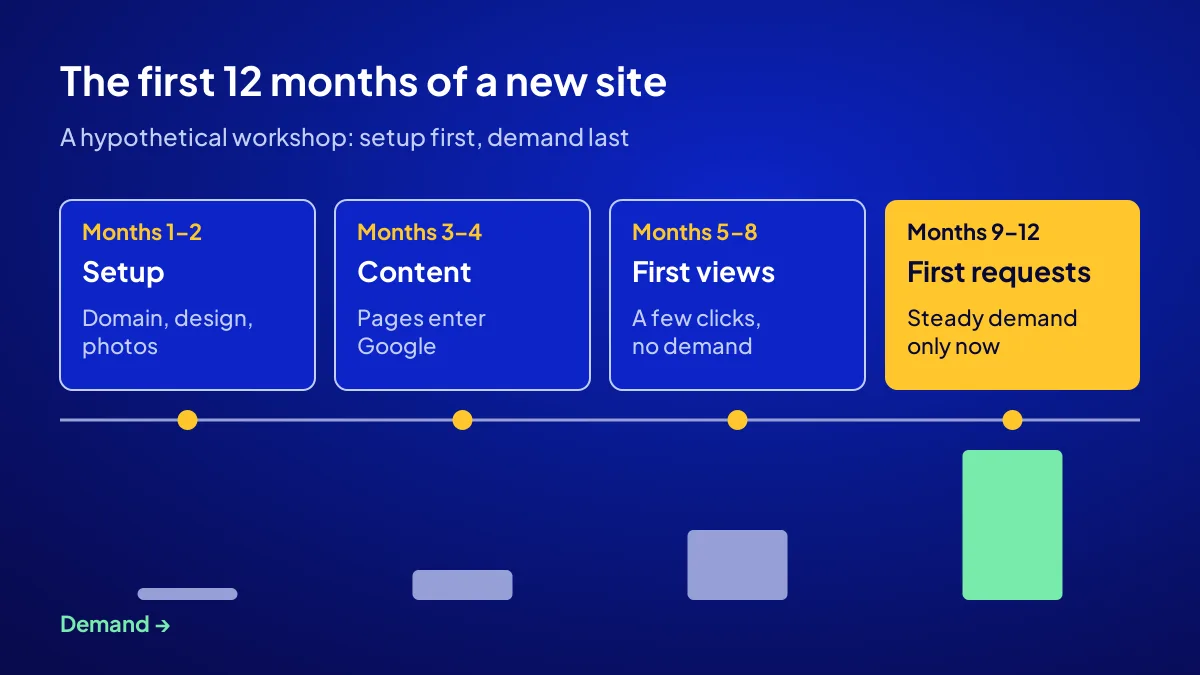
- Months 1–2: setup
- Months 3–4: content and recognition
- Months 5–12: the first requests
In our hypothetical workshop, the first 12 months fall into four stages. The first two months go to setup, the next two to content. After month five come the first impressions and a few scattered clicks. Steady demand appears only towards the last quarter, and only if things go well.
Months 1–2: setup
Domain, design, product photos and payment. Most of the effort goes into photos and product descriptions. It feels like you have opened the shutters, but nobody is walking past the shop yet.
Months 3–4: content and recognition
Pages enter Google and indexing starts. Articles answering questions like “made-to-measure curtain price” go up. Impressions start to stir, but clicks are close to nothing.
Months 5–12: the first requests
Pages that match search intent start to rise. The first order forms arrive, and some months none come at all. By the end of the year you finally hold real data: who searches, for what, with which words.
How much does the hidden cost of time come to?
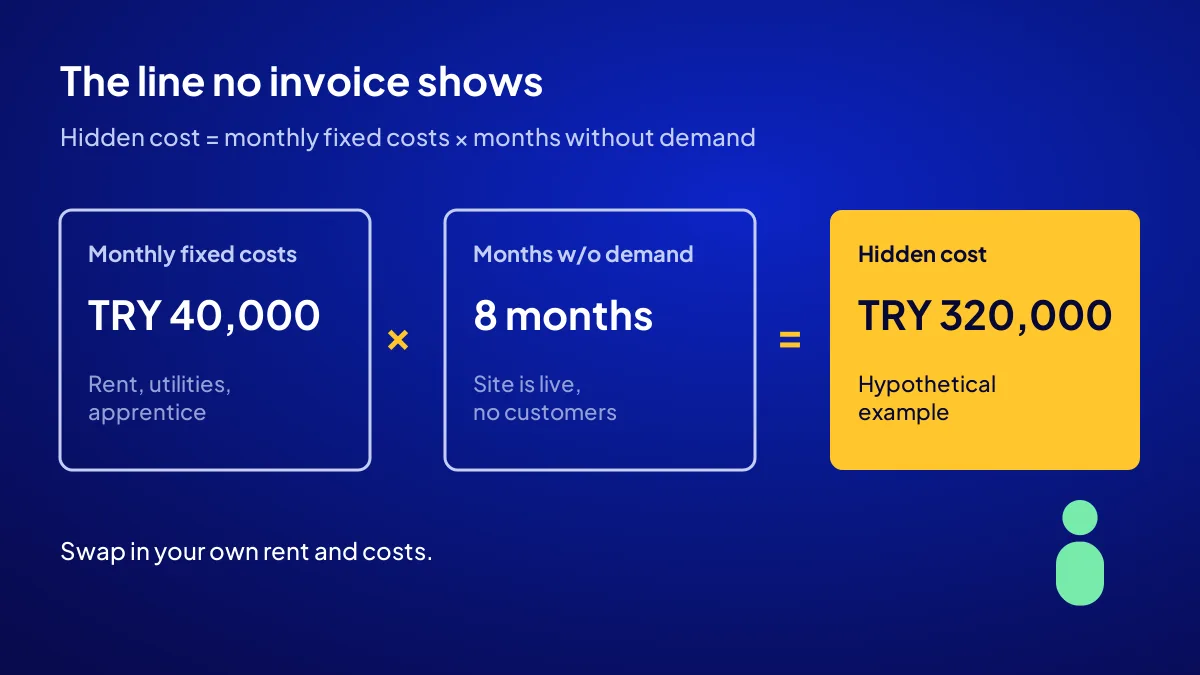
Every month without demand costs you that month’s fixed expenses. Rent, electricity, an apprentice’s wage and your own labour get paid whether the site brings requests or not. So the real question is not “what does a site cost to build” but “how many months can I wait without demand”. Once you do the maths, the number usually beats the build cost.
| Item (hypothetical workshop) | Monthly | Over 8 empty months |
|---|---|---|
| Rent and utilities | TRY 25,000 | TRY 200,000 |
| One apprentice’s wage | TRY 15,000 | TRY 120,000 |
| Your 2 hours a day on the site | No invoice | About 480 hours |
Swap in your own numbers
The amounts above are examples; your rent is different. The method stays the same: multiply your monthly fixed costs by the number of months the site brings no demand. The result is the unbilled line of building from scratch.
Your hours have a price too
Two hours a day on the site comes to roughly 480 hours over eight months. In those hours no orders get sewn and no customers get called. Every hour taken from bread-and-butter work is money that never reaches the till.
The surprising finding: why does year one pass without learning?
The real loss is not money but learning time. A site with no demand teaches you nothing. Which product draws interest, which price people accept, which question keeps coming back: you cannot know. No data, no decisions. Whoever builds from scratch spends the first year waiting for the very data needed to decide.
An empty shop window cannot be tested
Lower the price or raise it, the result looks the same, because nobody is looking. The conversion rate cannot be measured, because there are no conversions. If customers are not walking in, you cannot tell what changing the window did.
A site that collects demand talks from day one
A working site tells you something even in its first week. Incoming forms, searched words, the most viewed page. This is the information a builder from scratch only gets after a year.
What exactly are you buying in a ready-made digital asset?
With a ready-made digital asset you do not buy just a domain or a design. You take over a structure that is set up, working and already collecting demand. On Adapte’s ASSETOR digital assets for sale page, these assets are e-commerce sites, production businesses and service platforms. Part of what a builder spends a year trying to accumulate comes ready.
Three tiers, three prices
The assets are listed in three tiers: Platinum with 6 assets at TRY 180,000, Gold with 2 assets at TRY 90,000, and Silver with 6 assets at TRY 60,000. The process has three steps: inspect, choose, take over.
Read what is inside the asset
We break down what handing over a domain, site, content and demand together means in what is a digital asset for sale. The full calculation is in the guide to buying a ready-made online business.
Taking over saves time, but does it guarantee results?
No, it does not. Taking over gives you back part of the lost first year, but it does not run the business for you. A site that collects demand can lose it if it is poorly managed. ASSETOR makes no promise of earnings either. You decide based on your own budget, time and business.
What you gain is a starting point
Instead of starting from zero, you start with some demand already on the books. That gap is not small, but your own work still shapes what comes next.
Look at what failed stores have in common
Most sites that bring no sales fail not at setup but in the gap that follows. We list these common mistakes in why online stores fail.
When is building from scratch still the right choice?
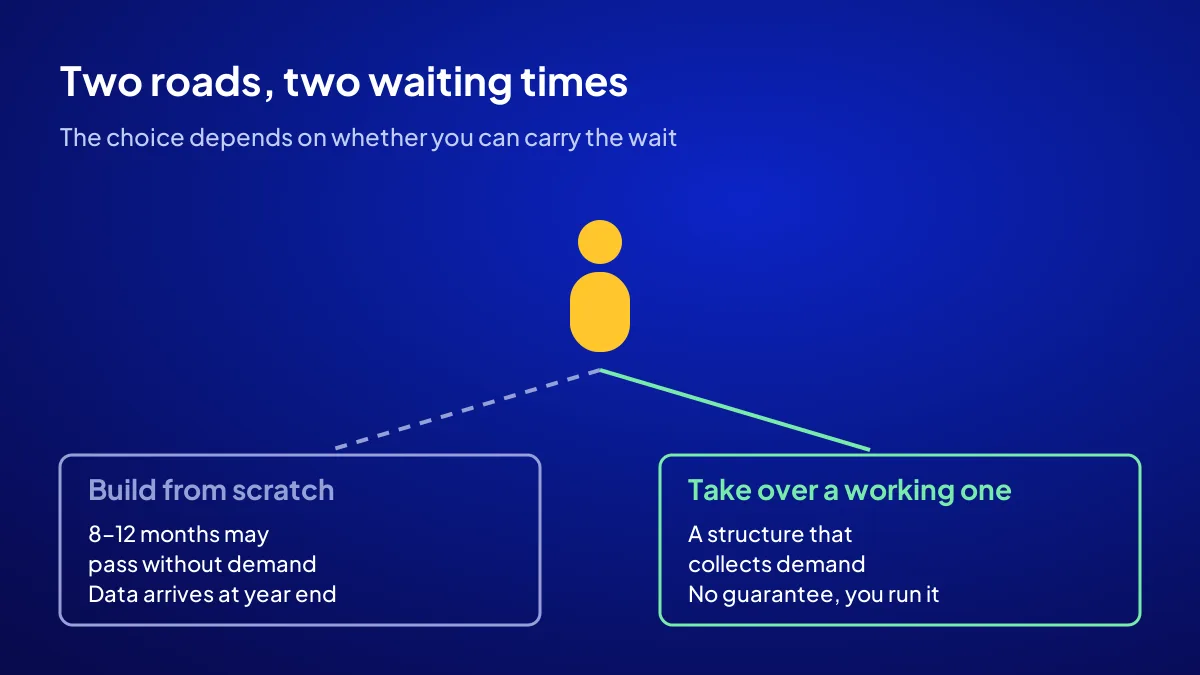
Building from scratch is not always wrong. If you are not in a hurry, if what you sell is very specific, or if you already get steady demand elsewhere, starting from zero can make sense. The point is to choose the waiting period knowingly. To compare building and buying price by price, see build or buy a digital asset.
- Cash is not tight and you can carry 8–12 months without demand.
- Your product has no close match and no suitable asset is available to take over.
- Your customers already come from another channel and the site is only a shop window.
Put the waiting period on paper
Write down two numbers: how many months you can wait without demand, and the fixed costs of those months. If both look comfortable, building from scratch stays on the table.
One principle
The price of building from scratch is not the setup invoice but the months you wait. Decide by looking at those months.
Quick Summary
- Building a site from scratch is technically easy; collecting demand takes time.
- Google says some changes can take several months to show an effect.
- The hidden cost: monthly fixed costs times months without demand.
- Year one loses learning time as much as money: no data, no decisions.
- A ready-made digital asset hands over a working, demand-collecting structure.
- Taking over saves time; it does not guarantee earnings.
Short Glossary
Indexing: Indexing is the process Google uses to find a page and make it eligible to appear in search results.
Search intent: Search intent is the term used to describe what a person actually wants when typing a query.
Digital asset: A digital asset is the term used to describe a domain, site, content and incoming demand as one transferable whole.
Next Step
If you would rather start with a structure that already collects demand than wait a year, browse the digital assets for sale on ASSETOR and pick the tier that fits you.
Sık Sorulan Sorular
Technically no; a site can go live within a few weeks. The hard part is getting it to collect demand. Without content, trust and search history building up, steady demand does not arrive, and that build-up can take months.
You take over a digital asset that is set up, working and already collecting demand. ASSETOR’s assets are e-commerce sites, production businesses and service platforms, listed in three tiers: Platinum TRY 180,000, Gold TRY 90,000 and Silver TRY 60,000.
No. Taking over shortens part of the waiting period of building from scratch, but it does not guarantee earnings. The result depends on how you run the asset.
Updated: October 2026