
Grocery and Corner Shop Licences: The Eight-Step Order
The document side of opening a grocery or corner shop is one of the most settled processes in the food sector. The order is known, the steps are predictable, and the file usually gets stuck in the same two places: the zoning status of the premises and the extra permissions brought by the product groups you put on your shelves.
Below we set the process out in eight steps, each with its duration and the paperwork it calls for. At the end we gather the extra permissions that change with the product group into one table, because selling tobacco, alcohol, bottled gas and bread under the same sign means four separate applications.
Step 1: Make the product group decision
What separates a supermarket from a corner shop is not floor area but what sits on the shelves. A shop selling only dry and packaged goods does not open the same file as a shop with a delicatessen counter, a bread shelf and tobacco sales.
Common mistake: widening this decision after the licence has been issued. Every product group added later creates a new application and sometimes a new condition on the premises.
Duration: 1-2 days. Needed: a list of the product groups you will sell at opening.
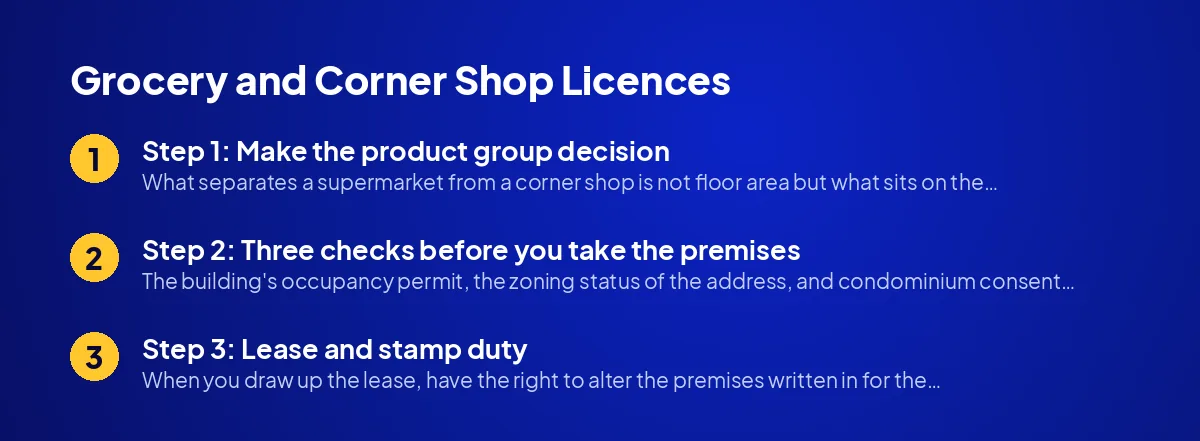
Step 2: Three checks before you take the premises
The building’s occupancy permit, the zoning status of the address, and condominium consent if the building is residential. In a grocery a fourth joins those three: whether a goods reception and storage area can be built.
A grocery’s working capital sits in the store room rather than on the shelf. In a place with no storage area you are forced to order daily, which means both delivery costs and the risk of running out of stock.
Duration: 1-3 days. Needed: zoning enquiry, occupancy permit, building management plan.
Step 3: Lease and stamp duty
When you draw up the lease, have the right to alter the premises written in for the shelving system, the power supply for refrigeration cabinets and a goods reception door if there is one. Grocery refurbishment raises the electrical load; ask in advance whether the building’s infrastructure can carry it.
Duration: 1 day. Needed: lease, stamp duty payment.
Step 4: Commencement notice and tax certificate
The notice is filed through your accountant or the interactive tax office, the tax office carries out a site visit and the certificate is issued. At corner shop scale a sole trader is common; if there is a multi-branch growth plan, the company structure is set up from the start.
Duration: 3-7 days, longer if you are incorporating. Needed: lease, identity documents, accountant.
Step 5: Chamber registration
A sole trader registers with the tradesmen’s chamber, a company with the trade chamber. It is a quick step and it feeds the applications that follow.
Duration: 1-3 days. Needed: tax certificate, identity documents, company papers.
Step 6: Registration on the food side
For businesses selling food a registration regime runs on the Ministry of Agriculture and Forestry side, handled through the provincial directorate of agriculture and forestry. In a grocery this food business registration certificate is assessed according to the product groups you sell.
If you will sell loose goods, set up a delicatessen counter or keep bread, the scope of registration widens. Obtain written confirmation from the district municipality and the provincial directorate of agriculture and forestry as to which scope applies in your own file.
Duration: weeks, depending on scope. Needed: business details, premises plan, declaration of activity.
Step 7: The municipal licence
The workplace opening and operating licence comes from the district municipality. Groceries and corner shops are usually assessed as sanitary establishments, but processing carried out on the premises or the product groups kept there can change that classification.
Documents typically requested: the application form, the lease or title deed, the occupancy permit, the tax certificate, the chamber registration document, hygiene training certificates and, depending on the activity, a fire brigade report.
Duration: 1-3 weeks if the file is complete. Needed: all the documents above.
Step 8: Social security, scales and opening
If you will employ staff, the social security workplace declaration is filed before the first employee starts. If you will sell loose goods the weighing instrument is inspected, and the licence and tax certificate are displayed where they can be seen.
Duration: 2-5 days. Needed: licence, staff paperwork, scale inspection record.
Extra permissions that change with the product group
What enlarges a grocery’s document table is not the basic process but the product groups you add. The table below shows which group opens a separate door.
| Product group | What it calls for | Note |
|---|---|---|
| Tobacco products | A separate sales document | Distance and scope conditions apply |
| Alcoholic drinks | A separate sales document | Distance condition and class assessment |
| Bottled gas | Separate authorisation and storage conditions | The classification may change |
| Bread and bakery goods | Rules on keeping and selling | The packaged or loose distinction matters |
| Delicatessen counter | Refrigeration and hygiene arrangements | The scope of registration widens |
| Fruit and vegetables | Registration and wholesale market paperwork | The supply side must be registered |
How each of these is applied in your own district is a separate question. Distance conditions in particular can vary from province to province and even from street to street; ask before you take premises.
The headings inspections look at most
The first inspection after opening usually looks in the same places. Setting these up from the start is easier than dealing with a report later.
- No product past its expiry date on the shelf
- Temperature records kept for refrigeration cabinets
- Labelling and information for loose goods
- The weighing instrument having been inspected
- Hygiene training certificates for staff
- The document for tobacco and alcohol sales on display
- Invoices and delivery notes matching the goods held
These seven headings cover the greater part of grocery inspections. A weekly habit of checking them is enough.
The right method for fees and charges
The licence fee, the signboard tax and the charges for extra sales documents vary with the tariff of the municipality and the relevant authority, and those tariffs are updated annually.
When you build your budget, ask the district municipality’s revenue department for the current tariff rather than guessing. You then know from the start how much cash each of the eight steps calls for.
Checklist
Before taking the premises: the product group decision, the occupancy permit, zoning status, storage area, products subject to a distance condition.
After the lease: stamp duty, commencement notice, tax certificate, chamber registration, hygiene training.
Before selling: registration on the food side, the municipal licence, extra sales documents, scale inspection.
At opening: the social security declaration, licence and tax certificate displayed, supplier file, temperature record book.
For the general order authority by authority see the business licence roadmap, and for capital and earnings bands see our herbalist and food sector page. If you are considering an extra income line have a look at our bottled water distributorship article, and for the fruit and vegetable side our greengrocer article.
In Short
- What separates a supermarket from a corner shop is not floor area but what is on the shelves
- The product group decision sets the scope of your licence file
- Every product group added later can create a new application
- Before taking premises, check zoning, occupancy, consent and the storage area
- A grocery’s working capital sits in the store room rather than on the shelf
- Food registration runs through the provincial directorate of agriculture and forestry, by scope
- Tobacco, alcohol and bottled gas bring separate documents and distance conditions
- Distance conditions vary from province to province; ask before taking premises
- Fee figures vary with each authority’s tariff and are updated annually
- Inspection gathers around seven headings; a weekly check is enough
- Scale inspection and temperature records are set up at opening, not rescued later
Quick Glossary
Sanitary establishment: the class of workplace accepted as carrying no heavy health effect on its surroundings. Distance condition: the requirement that certain product groups be sold a set distance from particular buildings. Food business registration certificate: the document recording a food business’s activity officially, handled on the provincial directorate of agriculture and forestry side. Goods reception area: the separate section where incoming goods are checked and taken into store.
Next Step
Let’s draw up your product group decision and your eight-step timetable together: consultation request form.
Frequently Asked Questions
Updated: September 2026
Sık Sorulan Sorular
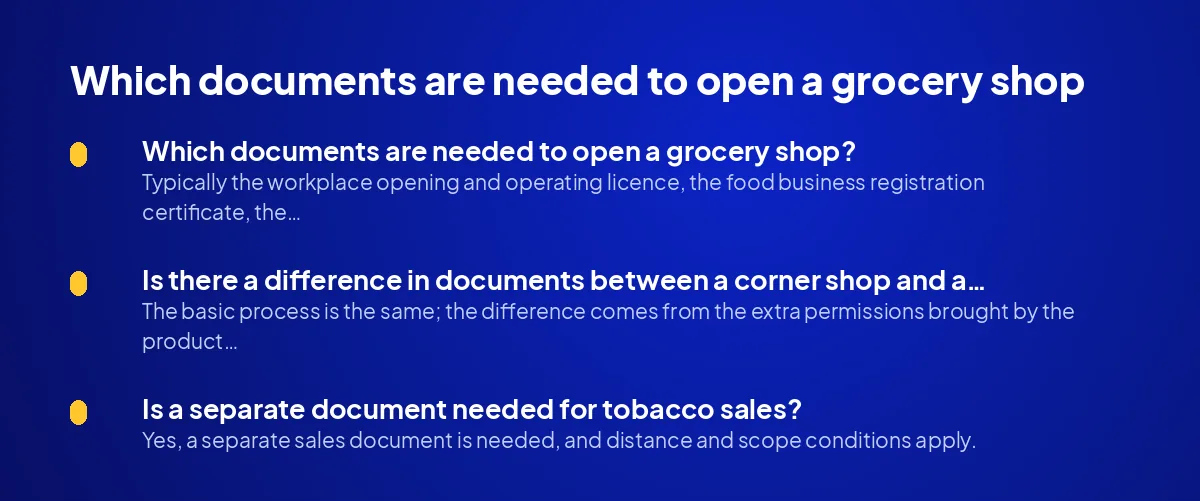
Typically the workplace opening and operating licence, the food business registration certificate, the tax certificate, chamber registration and hygiene training certificates. Further documents are added according to your product group.
The basic process is the same; the difference comes from the extra permissions brought by the product groups you sell.
Yes, a separate sales document is needed, and distance and scope conditions apply.
A separate sales document and an assessment of the distance condition are needed; have your district’s practice confirmed in writing.
It varies with the municipality’s own tariff and is updated annually. Ask the revenue department for the current figure.
It does. Refrigeration and hygiene arrangements are expected, and the scope of the food registration widens.
It is expected of everyone working in jobs involving contact with food; at inspection everyone working that day is assessed.
If you sell loose goods the weighing instrument is expected to have been inspected, and this is checked at inspection.
Four to eight weeks if the paperwork is complete and the premises suitable. Extra sales documents can lengthen it.