
Paper and Product Declaration in Online Jewellery Sales

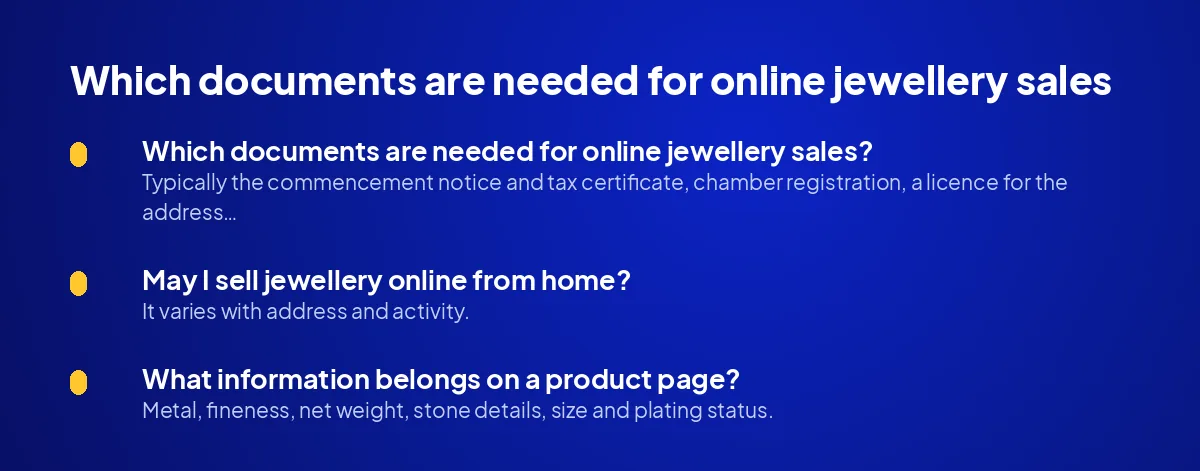
In a business selling jewellery online the paper side is made of learnable items: the commencement notice and tax certificate, chamber registration, a workplace opening and operating licence for the address where stock waits, the electronic commerce information duties, and an identification routine if you sell precious metals. What sets a business apart lies elsewhere: showing a piece’s fineness, stone and weight on record.
In businesses in this branch we set up one system: a product declaration and returns file. It has four record layers, goes in within a week, and pays for itself in the first month’s returns rate. Below we set out how it is built and why it works.
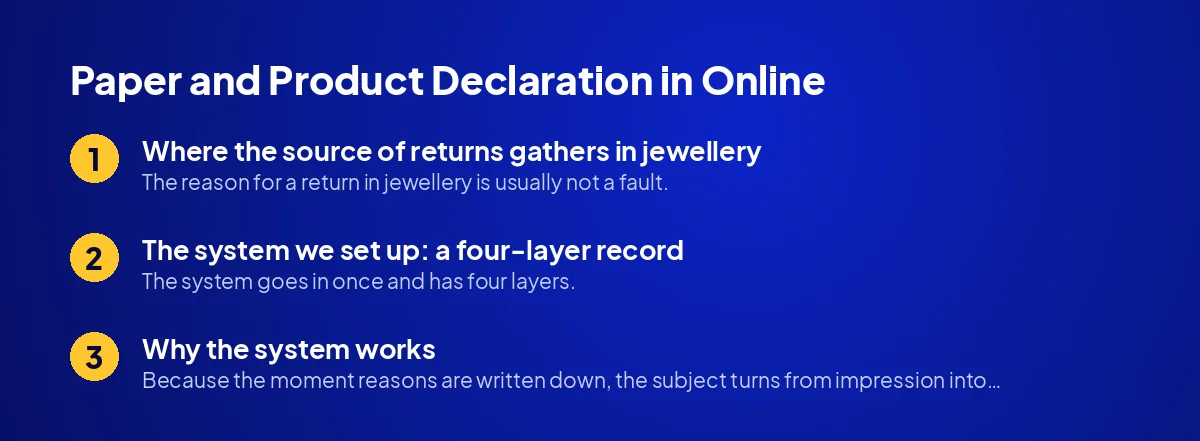
Where the source of returns gathers in jewellery
The reason for a return in jewellery is usually not a fault. The customer takes the piece in hand and finds its size, weight or colour different from what was expected.
The gap has three typical sources: the wrong ring size chosen, the piece arriving smaller than it looked, and plated and solid goods confused. All three come from information missing on the product page.
The system we set up: a four-layer record
BU BÖLÜMÜN ÖZETİ
- 1. Metal and fineness record
- 2. Stone and quality record
- 3. Size and dimension record
- 4. Reason for return record
The system goes in once and has four layers. Each layer answers a particular question that arrives after a sale.
1. Metal and fineness record
For every piece the metal, fineness, net weight and plating status are held on one line. That line is both the declaration given to the customer and the record shown under inspection.
2. Stone and quality record
Where a piece holds stones, their kind, number, total weight and report number are recorded. The line between synthetic and natural stone must stand clearly here.
3. Size and dimension record
Inner diameter for a ring, length for a chain, outer measurement for a pendant. A size reference beside the image is the visible face of this layer.
4. Reason for return record
Every return is entered under four headings: size did not fit, smaller than expected, declaration differed, changed my mind. Those four rates show which part of the catalogue has the trouble.
Why the system works
Because the moment reasons are written down, the subject turns from impression into measurement. Which product group, price band and sort of image the gap gathers in becomes visible.
The picture we see is this: most returns come from pages with the size information missing. Correct the size line and image reference there and the rate falls without touching the rest of the catalogue.
The paper side: which frame applies
| Heading | From where | Note |
|---|---|---|
| Commencement notice and tax certificate | Tax office | The activity code must cover the product group |
| Chamber registration | Tradesmen’s or trade chamber | Varies with the structure of the business |
| Licence for the address where stock waits | District municipality | Assessed by address and activity |
| Electronic commerce information | With you, published on the site | Scope confirmed by the Ministry of Trade |
| Distance selling routine | With you, contract and process | Prior information and confirmation steps |
| Product declaration and fineness | With you and the supplier | Plated goods stated separately |
| Identification routine | With you | Arises in precious metal sales |
| Invoice and dispatch record | With you | Must match the courier record |
This table is a frame for preparation, not a closed list. Learn from the Ministry of Trade how far the electronic commerce and consumer duties reach.
If you sell precious metals the reporting routine applies
A business selling pieces containing gold, silver or precious stones can fall within the duties of the precious metals field even where the sale is online. Customer identification and suspicious transaction reporting are live here too.
We bury that routine inside the order flow: buyer details, payment method and product declaration in one record. Thresholds, reporting manner and scope are set by legislation and renewed periodically; describe your sales volume and take confirmation from your accountant and the legislation in force.
The address where goods sit is skipped in most files
The heading most often missed online is the position of the place where the product physically waits. The sale runs on the internet; the box sits at an address.
That address’s fitness and zoning position are a separate matter. In jewellery it is also a store of value, so security and insurance begin there. Ask the district municipality in writing about your storeroom or office address.
Distance selling and the right of withdrawal
In selling at a distance the consumer is informed before the sale, and the conditions of withdrawal stated plainly. In jewellery this heading carries two further details.
First, pieces made to order: a necklace with a name on it may not be judged as a ring off the shelf. Second, goods requiring hygiene; earrings stand apart. Rather than settle these here, put your process in writing and have the scope confirmed by the Ministry of Trade. What you describe to the customer must be what you follow.
Courier and declared value routine
Jewellery is small, light and valuable. That trio wants its own routine on the courier side, and the unseen fifth page of our file sits here.
We set up three record lines together, and all three end the conversation when a claim of loss arrives.
- Whether the parcel left with a declared value, and what that value was
- Whether a signature or delivery confirmation was taken on handover
- Whether the packing and sealing of the parcel was filmed
The third line is a small habit but the most useful record. A short film taken while sealing answers both the missing-item and the wrong-item claim on its own.
A marketplace against your own site
The duty side of the two channels is not a copy of the other, and the difference wants seeing from the start.
On a marketplace the platform’s rules and information routine come into play, while the truth of the declaration stays with the seller. On your own site the information, the contract and the returns process rest on the routine you build. Running both, make the declaration record the shared source.
The order in which the system is built
- Add a metal, fineness and net weight line to every catalogue piece
- Tie stone details to a record by kind, number and natural or synthetic
- Put the size line and the reference beside the image in place
- Start gathering reasons for return under four headings today
- A month on, correct the product group in which returns gather
The fifth line is the step at which the system pays. The first four are the build; the fifth is the gain.
The method in summary
The paper side of this branch is the learnable part. What sets a business apart is showing a piece’s fineness and size on record, and making the reason for a return measurable.
Address-linked fees are read from the municipality’s tariff; that tariff is revised during the year, so do not tie the budget to a fixed figure. For the full sequence of authorities see the business licence roadmap, and for investment and cost ranges our jewellery and accessories sector page. If you will build supply yourself, our jewellery wholesale article follows this system, as does our handmade jewellery article if you sell pieces you make.
In Short
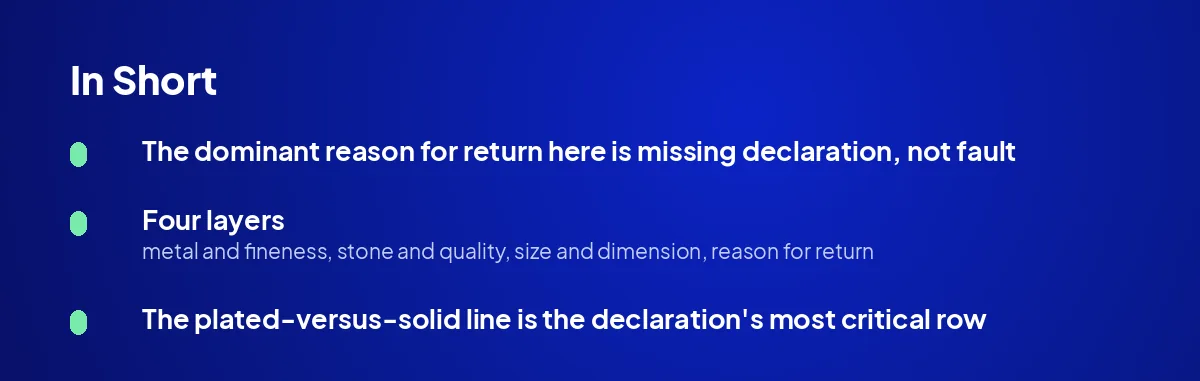
- The dominant reason for return here is missing declaration, not fault
- Four layers: metal and fineness, stone and quality, size and dimension, reason for return
- The plated-versus-solid line is the declaration’s most critical row
- The synthetic and natural line must stand clearly in the stone record
- A size reference beside the image reduces size returns
- Once the reason is written, impression turns to measurement
- Identification and reporting are live in precious metal sales
- The licence and security of the storage address is the most skipped heading
- Withdrawal for made-to-order and hygiene goods is written separately
- Declared value, signature and unpacking records are three defences
- Learn the electronic commerce scope from the Ministry of Trade
Quick Glossary
Product declaration: the information in which a piece’s metal, fineness, weight and stone details are set out for the customer. Net weight: the metal weight of a piece, excluding stones and packaging. Declared value: the sum notified to the carrier for the contents of a parcel. Distance selling: a sale formed by remote communication, the parties never meeting.
Next Step
Let us build your product declaration and returns file together: consultation request form.
Frequently Asked Questions
Updated: September 2026
Sık Sorulan Sorular
Typically the commencement notice and tax certificate, chamber registration, a licence for the address where stock waits, and the electronic commerce information duties.
It varies with address and activity. Have the district municipality confirm in writing the position of the address where stock waits.
Metal, fineness, net weight, stone details, size and plating status. Those lines form the footing of any argument over a return.
Write plainly that it is plated, with the base metal and thickness where known. Do not use the wording of a solid piece.
If you sell precious metals the duty arises. Confirm the scope and manner against the current legislation.
For goods requiring hygiene the process is written separately. Settle your practice in advance and ask the relevant authority about the scope.
The declared value, signature and packing records answer that. Make the three a routine from the start.
The truth of the product information stays with the seller. The platform’s own information routine works on top of that.
A week’s work, depending on the size of the catalogue. The return shows in the first month’s returns rate.
Source: Ministry of Trade — Electronic Commerce Information Platform