
Hospital Textiles: Manufacture or Wholesale?
In hospital textiles a single question settles the document load: will you make the product, or will you sell a product someone else has made? Wholesale runs within the standard commercial framework; manufacture, depending on the product group, can fall under the medical device rules.
That distinction changes the set-up cost, the timeline and the margin together. Let us set the two models side by side, criterion by criterion.
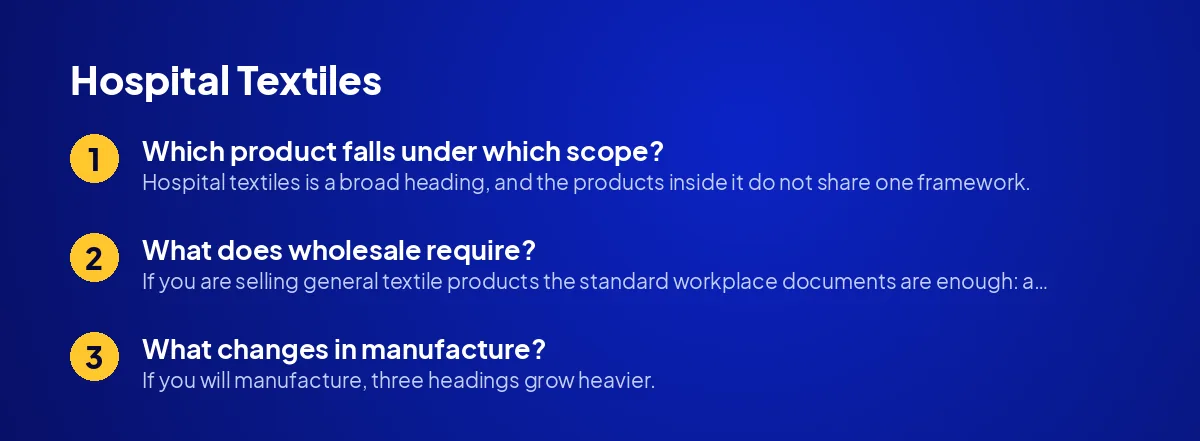
Which product falls under which scope?
Hospital textiles is a broad heading, and the products inside it do not share one framework. What draws the line is whether the product is used for a medical purpose.
| Product | Typical scope | Note |
|---|---|---|
| Patient gowns, bed linen, towels | General textiles | Standard commercial framework |
| Surgical drapes and sterile sets | May fall in medical device scope | Sterilisation decides it |
| Surgical gowns | Varies with intended use | Check product by product |
| Mattress protectors, incontinence sheets | By product group | Separate rules for absorbent products |
The second row is critical: products placed on the market as sterile can fall within the medical device scope, and at that point the whole table changes.
Comparison: manufacture or wholesale?
| Criterion | Wholesale | Manufacture |
|---|---|---|
| Document load | Standard commercial | Heavier by product group |
| Set-up time | Weeks | Months |
| Start-up capital | Mostly stock | Machinery and premises |
| Premises | A warehouse | Production space, licence class may change |
| Product liability | With the manufacturer | With you |
| Margin | Narrow | Wide |
| Customer | Hospitals, clinics, dealers | Wholesalers and institutions direct |
| Who it suits | Those strong in trade and logistics | Those who can run production |
What does wholesale require?
If you are selling general textile products the standard workplace documents are enough: a lease, the building’s occupancy permit, a tax certificate, trade chamber registration, the workplace opening licence and a social security declaration.
If you will sell products falling within the medical device scope, a sales centre authorisation certificate and Product Tracking System (ÜTS) registration come into play. Your product portfolio, in other words, sets your document list.
Warehouse conditions
With textiles, humidity and cleanliness matter. If you carry sterile products, a storage arrangement that protects packaging integrity is expected; a sterile product in torn packaging cannot be used.
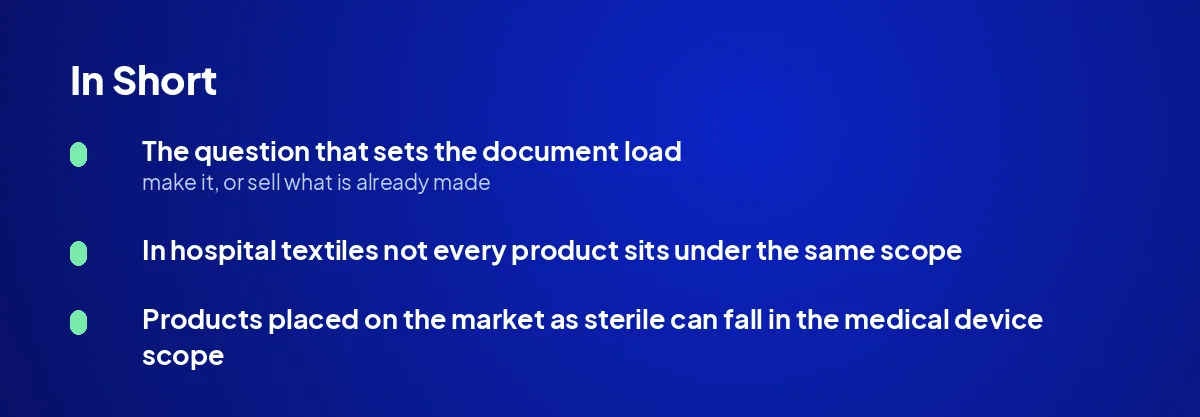
What changes in manufacture?
If you will manufacture, three headings grow heavier. First the premises: a production area can change the licence class, and a non-sanitary establishment assessment may come up.
Second, product liability: you become responsible for the conformity of what you make. Third, for products within the medical device scope, manufacturer obligations come into play, and that is an entirely separate regime.
Sterilisation is a separate investment
If you will make sterile products, the sterilisation process, its validation and its records are all required. Even where that step can be bought in from outside, it does not take the liability off you.
Which one suits whom?
Wholesale suits the entrepreneur whose trading and logistics side is strong. It is set up quickly, capital turns in stock, and the customer relationship runs on price and delivery speed. The margin is narrow because the product is comparable.
Manufacture suits the entrepreneur who can run a factory and build quality discipline. It is slow to set up and asks for machinery and premises; in return the margin is wide and selling direct to institutions becomes possible.
The mixed route
A common model is to start with wholesale and move into your own production once volume has built. Proceeding in that order means investing after you have learned which product actually turns.
Tenders feature in both models
A large share of hospital textiles is bought through public and private hospital tenders. If you will bid, prepare the documents the specification asks for from the start; these are generally product conformity documents, references and financial standing items.
A tender customer gives steady volume, but the price pressure is high and the payment timetable long. Build your cash flow plan around that.
The decision, in one sentence
If you are new to the sector and your capital is limited, start with wholesale and learn which product turns. Consider moving into manufacture only once steady volume has built in a particular product group. Going into sterile product manufacture is a separate decision; enter that field only if you can build the quality system.
For the general licence order see the business licence roadmap, for the manufacturing side our medical manufacturing article, and for capital bands our medical sector page.
Samples and approval decide the sale
In hospital textiles, selling runs on samples. An institution will not decide without seeing the product, handling it and putting it through a wash test.
What is asked at the sample stage
- What is the fabric weight and the blend ratio?
- How many washes does it stand, and does it hold colour and shape?
- Are the stitching and edge finishing fit for industrial laundering?
- Will the same quality arrive on a repeat order?
The fourth question is the critical one. The gap between the quality shown in a sample and the quality delivered in production is the number one cause of lost trust in this business.
The reality of industrial laundering
Hospital textiles are washed hot and washed often. A fabric that pleases at home can become unusable within a few months of industrial laundering. When you submit a sample, always have its wash durability tested.
The payment timetable sets the cash plan
In hospital textiles the customer is usually an institution, and institutional buying runs on a long payment timetable. That is the most decisive item in the trade.
How the flow really works
You make or source the product, deliver it and issue the invoice. Payment arrives some time later. By then you have already paid your fabric supplier, your labour and your carrier.
Your capital, in other words, stays tied up in the gap between delivery and payment. Growing volume without working out that gap creates a business that turns a profit and still runs out of cash.
When you build the plan
- Find out the payment term in the contract precisely
- Talk terms with your own supplier; a one-sided term is the riskiest arrangement
- Put a ceiling on the value of open work you can carry in one period
- Choose tender sizes to match your cash capacity
The fourth item is the hardest call. Winning the big tender looks attractive, but work beyond your cash capacity can turn a won contract into a loss.
Private hospitals and the public side differ
Hospital textiles has two customer groups, and their sales processes do not resemble each other.
The public side buys by tender; the specification decides, price pressure is high and the process is predictable. Private hospitals buy direct; decisions come quickly, brand and appearance matter, and the margin is a little wider.
For a new business the private hospital side is more reachable: taking a sample round, getting to know people and starting with a small order is all possible. The references and financial standing needed to bid for public tenders build up over time.
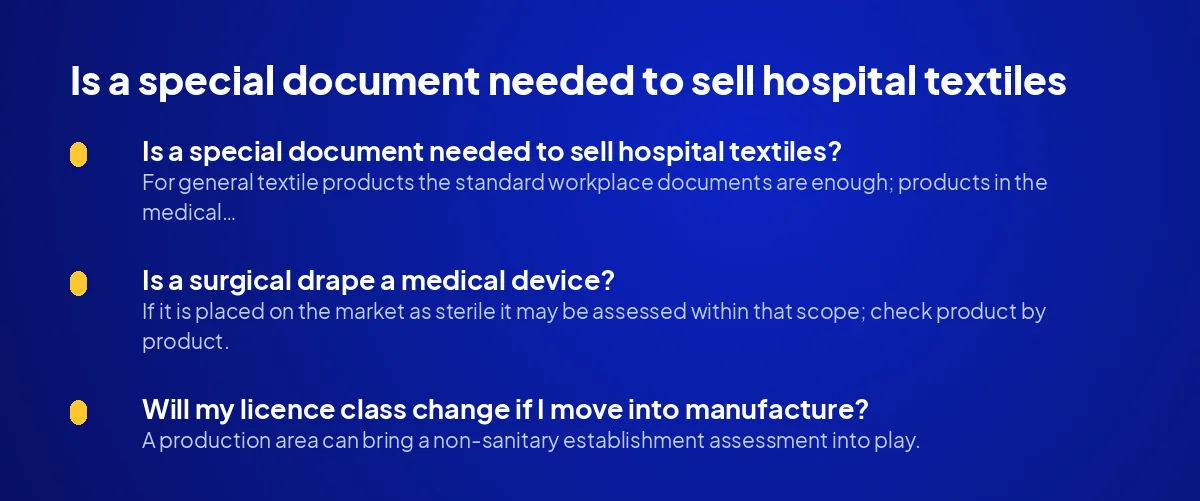
In Short
- The question that sets the document load: make it, or sell what is already made
- In hospital textiles not every product sits under the same scope
- Products placed on the market as sterile can fall in the medical device scope
- In wholesale your product portfolio sets your document list
- In manufacture premises, product liability and manufacturer obligations all grow heavier
- Buying sterilisation in from outside does not take the liability off you
- The common route: start wholesale, move into manufacture once volume builds
- Tenders give steady volume but bring price pressure and a long payment timetable
- The gap between sample quality and production quality is the main cause of lost trust
- Capital stays tied between delivery and payment; cap the value of open work
- For a new business the private hospital side is more reachable than public tenders
For a neighbouring branch see our laboratory supplies article as well.
Quick Glossary
Sterile product: a product packaged free of micro-organisms. Sterilisation validation: the testing and record process showing the treatment was effective. Specification: the document defining the product and document conditions required in a tender. Packaging integrity: the sterile product’s packaging remaining undamaged.
Next Step
Let’s settle together which model you should start with: consultation request form.
Frequently Asked Questions
Updated: September 2026
Sık Sorulan Sorular
For general textile products the standard workplace documents are enough; products in the medical device scope need sales centre authorisation.
If it is placed on the market as sterile it may be assessed within that scope; check product by product.
A production area can bring a non-sanitary establishment assessment into play.
You can, but if the product goes to market in your name the liability stays with you.
Manufacture has a wide margin but a heavy set-up; wholesale has a narrow margin and a quick set-up.
The product conformity documents, references and financial standing items the specification asks for.
It gives steady volume, but price pressure is high and the payment timetable long.
Humidity and cleanliness; and, for sterile products, protecting packaging integrity.
Once steady volume has built in a particular product group; learn first what actually turns.