
Medical E-Commerce: The Rules Changing Towards 2027
The direction in medical e-commerce is clear: the line between what may be sold and what may not is sharpening. There are restrictions on the distance selling of medical devices and not every product group is treated alike; the platforms are carrying that distinction into their own controls as well.
For an orderly seller that cuts two ways. On one hand you need to know, product by product, where you may sell what; on the other, the seller who draws that line correctly is left standing in a field their less careful rivals have dropped out of.
What is being looked at now?
There are three layers in medical e-commerce. First the business layer: a sales centre authorisation certificate, Product Tracking System (ÜTS) registration, a responsible manager and a workplace licence for your warehouse.
Second the channel layer: electronic commerce registration, a distance sales contract, and return and delivery terms. Third the product layer: which device is suitable for distance selling at all.
The third layer is the one most often missed
A product sitting on your shelf does not mean it can be sold online. For devices tied to a prescription, requiring fitting, or adjusted to the individual, distance selling restrictions come into play.
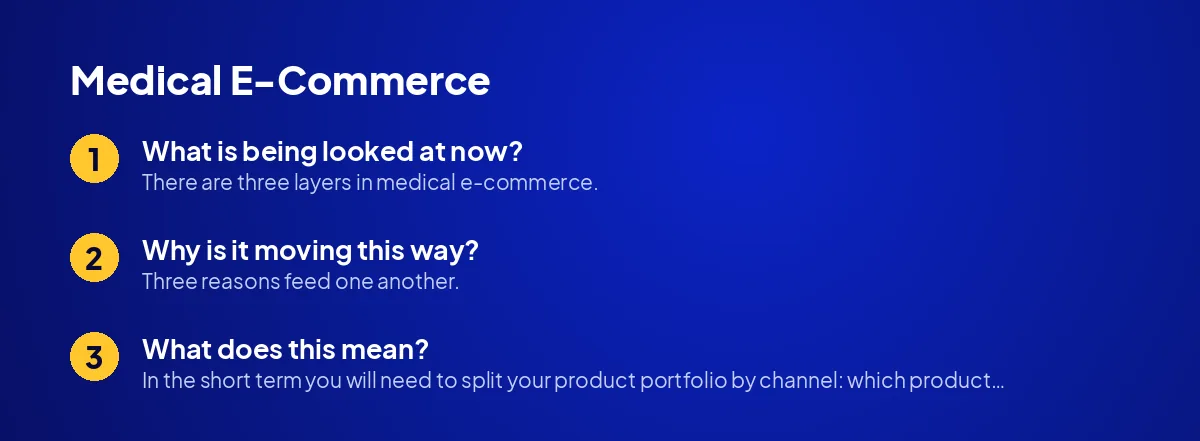
Why is it moving this way?
Three reasons feed one another.
- The risk of misuse. A device needing fitting and adjustment does not come out of the box and work correctly on its own
- The breaking of traceability. If the record of who received the device weakens in distance selling, a recall stops working
- Platforms sharing liability. Marketplaces ask sellers for documents and category conformity to reduce the risk sitting on them
What does this mean?
In the short term you will need to split your product portfolio by channel: which product may be sold where. In the medium term this will follow: sellers who cannot draw the line will drop out of the category.
Your own site, or a marketplace?
| Criterion | Your own site | Marketplace |
|---|---|---|
| Category restriction | The regulatory limit | Regulation plus platform rule |
| Document checks | With you | The platform asks too |
| Commission | None | Yes |
| Customer data | With you | With the platform |
| Corporate sales | Possible | Limited |
In medical, your own site holds a clear advantage over a marketplace. The reason is not the commission: corporate customers, quotations and tenders all run through your own site.
Consumables and support products are different
The soundest ground in medical e-commerce is consumables and support products that need no fitting. Dressings, single-use items, simple support products and hygiene supplies sit in that group.
These products suit distance selling and they create repeat purchase. Building your portfolio from here is more sustainable than wrestling with restricted items.
Repeat purchase is the engine
With consumables the customer returns at regular intervals. If you can see from the order history when each customer will buy again, a reminder is enough to keep that cycle running.
Three recommendations for the period ahead
- Draw up your product channel list today. Write down, for each product group, which channel it may be sold in; if it is unclear, do not sell it
- Tie the serial number to the order record. Traceability must survive into distance selling too
- Build the portfolio from the consumables side. Grow with groups that create repeat purchase rather than with restricted items
For the general licence order see the business licence roadmap, for the physical shop side our medical supply shop article, and for distribution our medical distribution article.
The product page is a compliance area too
In online selling the product page takes the place of the shelf and the sales assistant in a physical shop. Every sentence you write there is judged as though it had been said across the counter.
What the page must carry
- The product’s real name, brand and model
- Manufacturer or importer details
- The intended use, as the manufacturer defines it
- Any warnings and conditions of use
What the page must not carry
Any claim absent from the manufacturer’s product information. Statements that it treats, cures or prevents a disease cannot be written unless the manufacturer has defined it that way.
This is the most common error in writing sales copy. Reaching for a stronger line and adding a new purpose to the product moves that product into a different regulatory class.
Marketplace or your own site?
There are two channels in medical product sales, and each carries different obligations and different economics.
| Criterion | Marketplace | Your own site |
|---|---|---|
| Getting started | Fast | Slow |
| Traffic | Ready-made | You build it |
| Commission | Yes | None |
| Customer data | Limited | With you |
| Product page control | Restricted | Full |
| Category approval | Subject to platform conditions | Your own responsibility |
The fourth and fifth rows matter particularly on the medical side. You are responsible for the wording on the product page, yet on a marketplace the platform sets some parts of it; conformity still rests with you.
The sensible order
Starting on a marketplace to learn which product turns, then building your own site around that group, is a common and low-risk route. Running both channels together is possible too; if you do, settle price and stock synchronisation at the outset.
Delivery and returns work differently in medical
In online medical selling the two most critical points of the operation are delivery and returns. Both differ markedly from ordinary e-commerce.
Some products need a temperature range or intact packaging; if a sterile product’s packaging is damaged in transit the product becomes unusable. Your packing standard has to be built around that.
On the returns side hygiene decides: putting back on sale a product that has touched the body or had its packaging opened is not right. Writing your return terms plainly on the site heads off the dispute before it starts.
The advertising line is crossed more easily online
There are limits on promoting medical devices and medical products, and that limit is crossed more easily in online channels, because the copy, the image and the advert headline keep changing.
A headline carrying a health claim, a layout that pushes a customer review forward as a promise of treatment, or phrases of the “guaranteed result” kind all create risk. You do not need to add a purpose in order to sell the product; telling the manufacturer’s stated purpose accurately is enough.
Setting up an internal step that approves advertising copy one item at a time cuts that risk noticeably. If you work with an outside agency in particular, put a check on every piece of copy before it goes live.
In Short
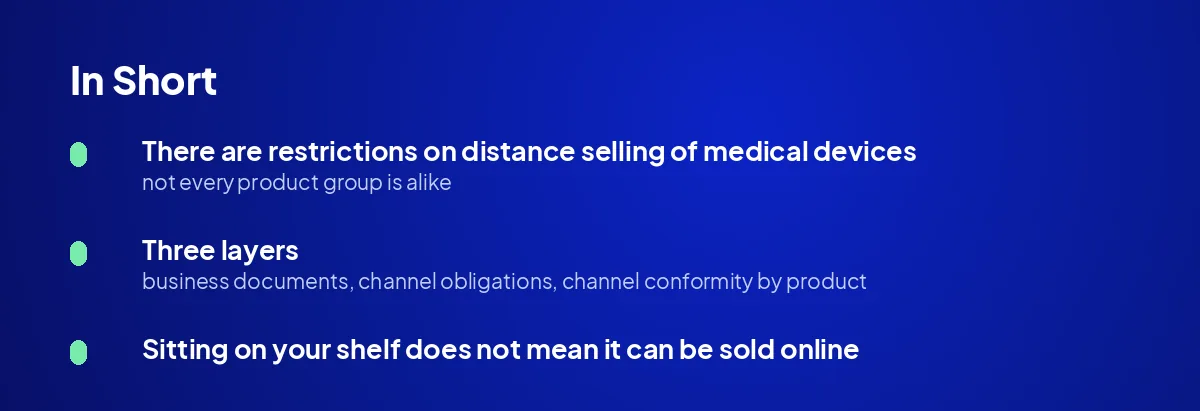
- There are restrictions on distance selling of medical devices; not every product group is alike
- Three layers: business documents, channel obligations, channel conformity by product
- Sitting on your shelf does not mean it can be sold online
- Restrictions arise for devices needing fitting and adjustment
- Holding the serial number in the order record keeps traceability alive
- In medical your own site holds the advantage; corporate work and tenders run through it
- The soundest ground is consumables and support products needing no fitting
- Consumables create repeat purchase; that is the engine of the business
- The product page is like the shelf in a shop; no claim the manufacturer has not defined can appear
- Starting on a marketplace and building your own site on the group that turns is a low-risk route
- In delivery packaging integrity decides; in returns hygiene decides
For a neighbouring branch see our orthopaedic products article as well.
Quick Glossary
Distance selling: a sale made without the parties meeting in person. Channel conformity: which sales channel a product may be offered in. Repeat purchase: the same customer reordering at regular intervals. Serial number: the code identifying each device as a single unit.
Next Step
Let’s build your product channel list and your record system together: consultation request form.
Frequently Asked Questions
Updated: September 2026
Sık Sorulan Sorular
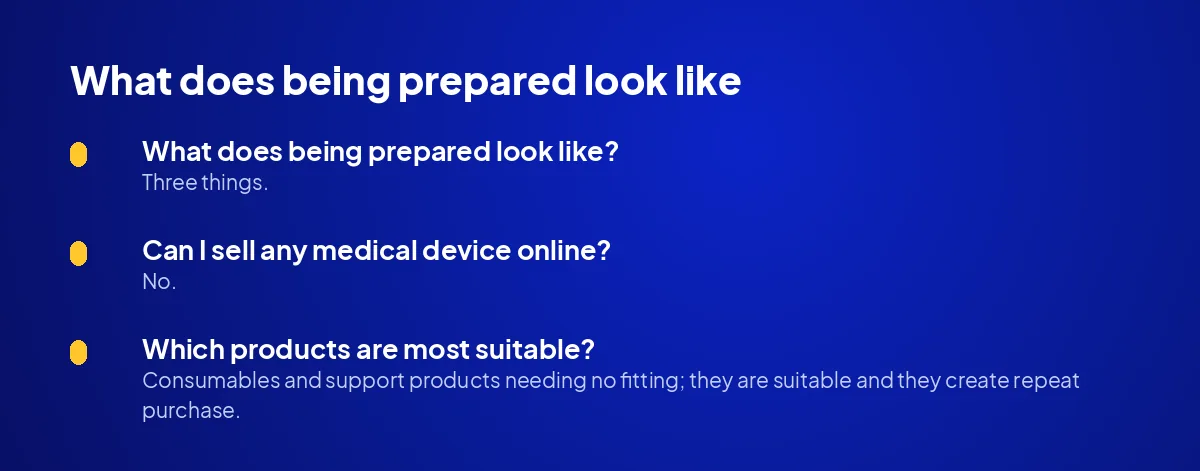
Three things. A channel conformity list by product, complete system registration for every product group, and the device serial number held in your order records.
The third matters most: being able to work out, at the moment of a recall, who received which device is what shows traceability has survived into distance selling.
No. There are restrictions on distance selling and they vary by product group; if it is unclear, do not sell it.
Consumables and support products needing no fitting; they are suitable and they create repeat purchase.
In medical your own site holds the advantage; corporate customers, quotations and tenders run through it.
The device serial number and customer details; that record is what a recall runs on.
To reduce the risk sitting on them; this has become the condition of entry to the category.
Yes. The address where you store must hold workplace registration and a licence.
Check the distance selling position of the product group before selling; uncertainty means risk.
It depends on the product group and the state of the packaging; for opened and used devices direct resale is not appropriate.
By reading the renewal date from the order history and sending a reminder.