
New business visibility: how to get seen on maps, search and AI in the first 90 days
New business visibility is built in four shop windows: maps, search, social accounts and AI assistants. The order for the first 90 days is clear. First comes listing and verifying on maps, then writing your name, address and phone the same way everywhere, then the first reviews and pages that answer real customer questions. Running ads before this groundwork is like inviting customers to a shop that has no sign yet.
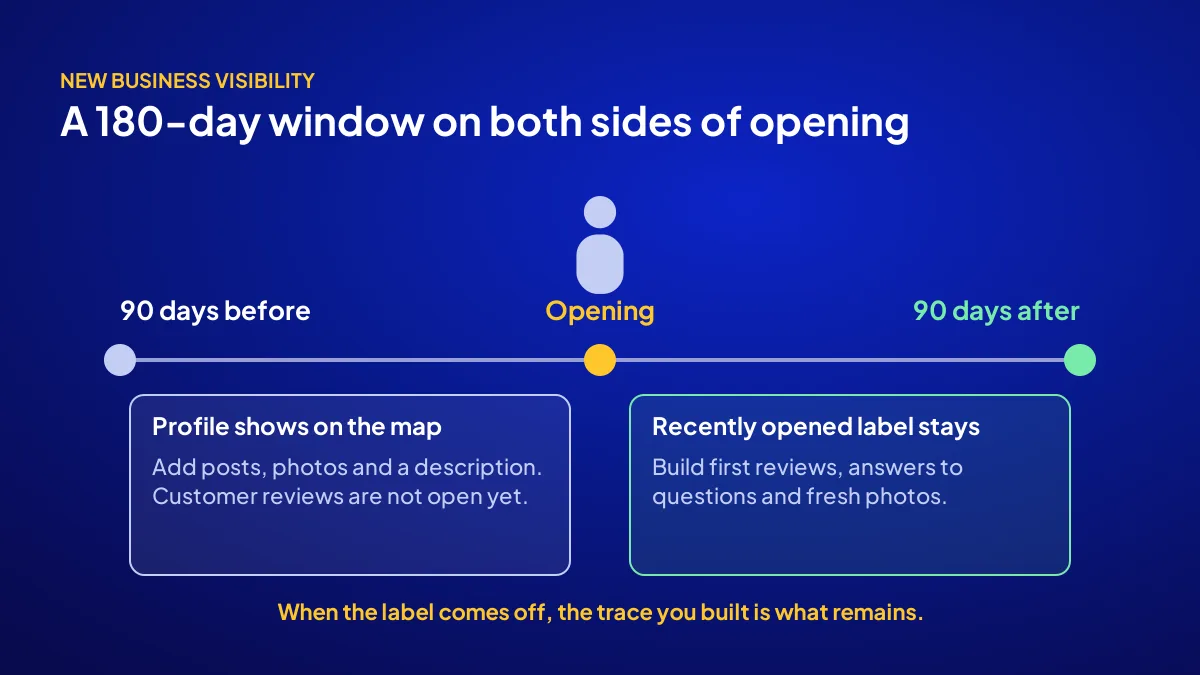
Look, the shutters are up and nobody walks in; do not rush to burn a budget. Google shows a Business Profile with a future opening date 90 days before you open, and for 90 days after, the profile carries a newly opened label. That is a 180-day window, and below I walk you through it channel by channel.
Why is a new business invisible, and where does visibility start?
BU BÖLÜMÜN ÖZETİ
- Four windows, four customer moments
- What I keep seeing: the missing piece is a trace, not the product
- Think of visibility as a counter
A new business is invisible because neither Google nor the customer has any trace of it: no reviews, no photos, no mentions, nobody searching its name. Visibility starts as those traces pile up. The first is the map listing, the second a page in search, the third a social account, the fourth consistent information AI can read.
Four windows, four customer moments
On maps, someone nearby finds you. In search, someone asking a question finds you, such as “barber open on Sunday in Beylikdüzü”. On social, someone who heard about you looks; in AI, someone asking an assistant. Each window catches a different moment.
What I keep seeing: the missing piece is a trace, not the product
I have been looking at search results for new businesses for fifteen years. Many shops with a good product and a fair price miss only one thing: a trace online. Google does not put a business it does not know at the top, and a customer does not walk through an unknown door on day one.
Think of visibility as a counter
Every correct listing, review and answered question adds one click to the counter. Ads speed it up, but do not start it from zero.
How do you use the 90 days before and after opening?
You can enter a future opening date in your Google Business Profile. According to Google’s help page, the profile starts appearing on Google 90 days before the opening date. After you open, a label showing that you recently opened stays on the profile for 90 days. Before opening you can add posts, photos and a description, while customers cannot add reviews or photos in that period.
The 90 days before opening: put the sign up online first
If the lease is signed and the opening month is set, create the profile now. Renovation photos, an opening day announcement, hours and a short description belong here. Passers-by and map browsers find the answer to “what will this place be” right there.
The 90 days after opening: do not waste the label
The label tells viewers you are a new place. Use this stage for first reviews, answers and fresh photos; when the label comes off, the trace you built is what remains. We explain why visibility rises and falls after opening in the Google new business boost.
What decides the top spot on maps, and can you pay for it?
According to Google, three things decide local ranking: relevance, distance and prominence. Relevance is how well your profile matches the search. Distance is how close you are to the person searching. Prominence is how well known you are; review counts and the sites that mention you feed it, and Google states plainly that this order cannot be bought.
The primary category is a decision on its own
The primary category decides which map searches you appear in. “Cafe” or “breakfast restaurant”, “hairdresser” or “beauty salon”? Pick the one closest to what customers type, and limit extra categories to services you offer.
Why should your name, address and phone match everywhere?
Because Google, Apple, Yandex and AI assistants compare these three details to recognise you as one business. If one place says “Cad.” and another says “Caddesi”, or one still shows an old phone number, matching gets harder. The industry calls this NAP consistency: name, address, phone. If a new business sets it up on day one, no clean-up is needed later.
Write one business record
Before opening, write your business record on paper: sign name, postal address, phones, web address, hours. Copy it into every listing instead of typing from memory.
What is the difference between appearing in search and being clicked?
BU BÖLÜMÜN ÖZETİ
- Broad keywords bring impressions, not clicks
- Long, intent-driven questions climb fast
- If you do not even show up for your own name
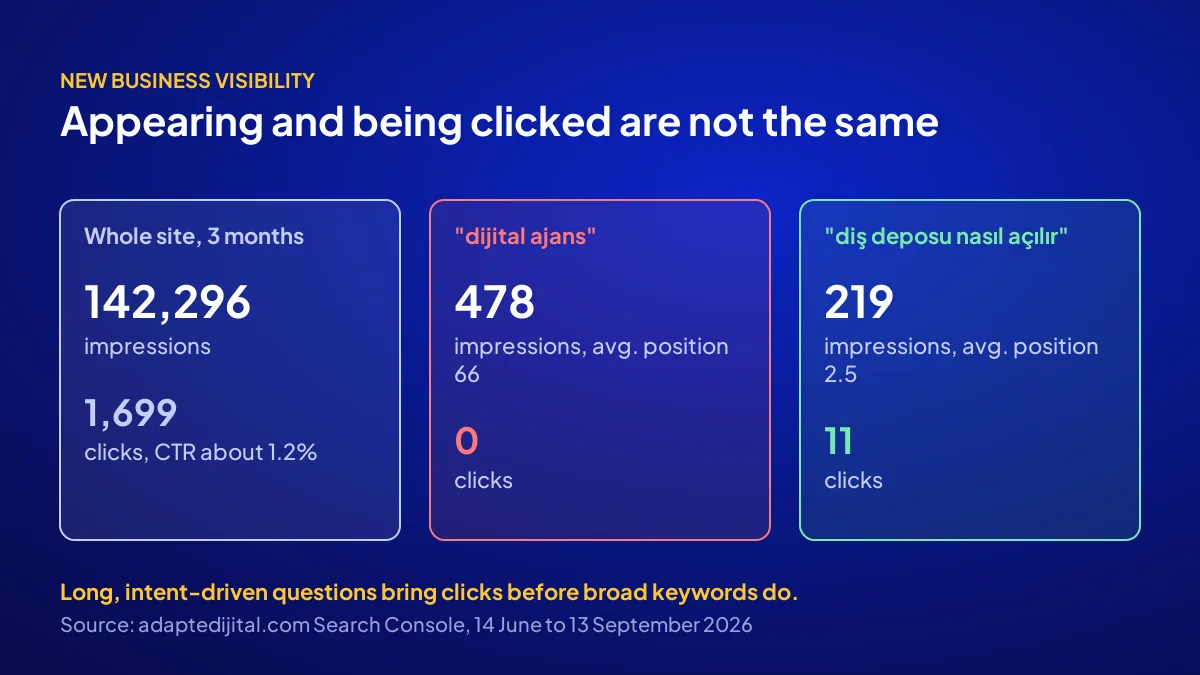
Appearing means your name is in the results; being clicked means someone chose you, and the two are not the same. Here is an example from our own site: Search Console data for adaptedijital.com for 14 June to 13 September 2026 shows 142,296 impressions and 1,699 clicks. The average click-through rate is about 1.2 percent. So a hundred people see it and one walks in.
Broad keywords bring impressions, not clicks
In the same period, the query “dijital ajans” (digital agency) gets 478 impressions at an average position of 66 and zero clicks. Ranking 66th is a shop on a back street: the address exists, nobody passes by. That is what broad keywords give a new business early on.
Long, intent-driven questions climb fast
In the same period, the query “diş deposu nasıl açılır” (how to open a dental supply store) gets 219 impressions at an average position of 2.5 and brings 11 clicks. The longer and more intent-driven the question, the fewer the competitors and the faster the ranking comes. A new business builds its search window here too: pages that answer real questions such as “walk-in barber in Esenyurt”.
If you do not even show up for your own name
If you do not appear even when you type your own name, the problem is not ranking but the listing. We give the checklist in 9 steps in if your business does not show on Google.
What does a social account give a new business, and what does it not?
A social account lets someone who already heard of you look inside; it does not bring a stranger on its own. A zero-follower account is a window on a street nobody walks down. It is still necessary: a customer from maps or search checks your Instagram and looks for a line to message.
Someone on a phone does not wait
Your profile and your account should have one-tap call and message buttons. People looking on a phone do not fill in forms; they press a button. Set up the greeting message and opening hours in WhatsApp Business before you open.
Prepare 9 posts before opening
Three renovation posts, three product or service posts, three team and venue posts. That keeps the profile from looking empty; after that, a weekly rhythm will do.
How do AI assistants recognise a new business?
Before ChatGPT, Gemini or Perplexity can mention a business, they have to recognise it. Recognition starts with consistent, readable information online: the same name and address, pages that say what you do, text that answers questions directly. A new business has no such trace yet, so the assistant does not know you or mixes you up. Nobody can guarantee a recommendation.
Build a question map
Write down what customers ask: price range, hours, parking, appointments, payment. Answer each briefly on your site. Your own answer beats someone else’s guess.
In what order are the first 90 days set up?
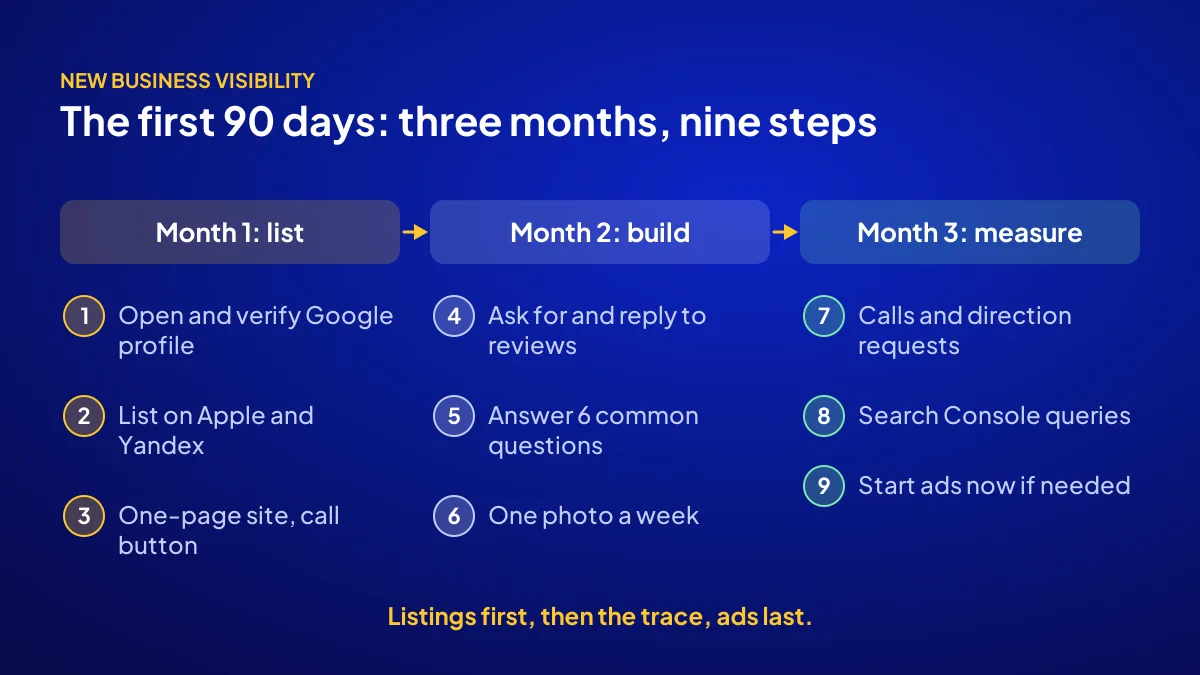
The order is: the first 30 days for listings and the business record, the second 30 days for building a trace, the third 30 days for measuring and expanding. Each month has three jobs, nine steps in total. Breaking this order is like putting up a roof before the foundation. Ads then send customers to the wrong address, a closed door or an empty profile.
- Open your Google Business Profile, verify it and enter the opening date.
- List on Apple and Yandex maps with the same business record.
- Launch a one-page site with call and WhatsApp buttons at the top.
- Ask first customers for reviews and reply to each within 48 hours.
- Answer the 6 questions customers ask most on your site.
- Add one photo and one post to the profile every week.
- Check calls, direction requests and searches in profile insights.
- See which queries you appear for in Search Console and write the missing answers.
- If you need ads, start them now; with the groundwork ready, less budget is wasted.
The detailed channel order for month one
We give the week-by-week, channel-by-channel breakdown of the first 30 days in where a new business should appear first. There we rank which of six channels to open first.
Should you set it up yourself or buy a package?
With time and patience, you can do most of the nine steps yourself; most map listings are free. If cash is not turning over and you cannot leave the shop, a fixed-price package is the clearer sum. Adapte’s Get Visible Online campaign offers a 3-month period for TRY 36,000 + VAT, paid upfront at a fixed price. It is aimed at small and medium-sized businesses.
Let me ask you one thing
Over the next 90 days, will you be behind the counter or behind a screen? If your answer is “the counter”, visit the Get Visible Online campaign page and fill in the needs form.
Quick Summary
- A new business shows up in four windows: maps, search, social and AI.
- A Google profile can appear 90 days before opening and carries a new label for 90 days after.
- Local ranking depends on relevance, distance and prominence; it cannot be bought.
- Copy your name, address and phone from one business record into every listing.
- Broad keywords bring impressions; long, intent-driven questions bring clicks.
- Order: listings and record, building a trace, measuring; ads come last.
Short Glossary
Prominence: Prominence is the local ranking factor Google uses to measure how well known a business is, through signals such as review counts and links.
NAP consistency: NAP consistency is the term used for keeping a business’s name, address and phone number identical across all listings.
Entity: An entity is the concept search engines and AI use to recognise a business as one specific, distinct identity.
Next Step
My decision is this: listings first, then the trace, ads last. If you would like us to set this order up for you, apply to the Get Visible Online campaign and get a recipe suggestion based on your needs form.
Frequently Asked Questions
Source: Google Business Profile Help — Tips to improve your local ranking on Google
Sık Sorulan Sorular
Google does not let people add reviews or photos to a business that has not opened yet. So plan your first reviews around opening day. Start with the first customer at the till; you learn the road by walking it.
You cannot change distance. Relevance is in your hands: the right category, a full description, real hours. A new business is weakest on prominence, because reviews and links take time.
We give the order for listing on Google, Apple and Yandex maps step by step in how to add a new business to maps. Here I will say only this: an unverified profile is like a shop sign leaning against the wall on the pavement. Everyone sees it, nobody is sure.
When the phone changes, the shop moves one door down, or a shortened name goes on the sign. Updating one place and forgetting another is the usual cause. Twice a year, compare every listing with the record.
An entity is how AI tells you apart as one specific business. Your name, address, sector and the structured data on your site build that identity; without it, you get mixed up with a namesake.
We look at how new businesses will appear in assistants in new business AI visibility toward 2027. For businesses that want to build this groundwork in one go, the AI SEO Campaign works with 108 articles. There is no recommendation guarantee there either; readability and recognisability are built and measured.
Ads bring customers to the door. With no sign, hours or reviews there, they turn around. Ready the door, then invite people.
At month end, check three numbers: searches the profile appeared in, calls and direction requests, and messages from the site. Rising means the order is right; flat means a step is missing.
You pick one of three recipes: Website, Google Ads or Meta Ads. The Website Recipe covers a mobile-friendly sales page, contact buttons, Google Business Profile, basic SEO and visitor tracking. The ad budget is not included; it is paid separately to Google or Meta.
With 20 percent VAT, the upfront payment is TRY 43,200; rates can change, so check the current rate on the invoice. The process starts with a needs form, Adapte suggests the right recipe, and delivery starts with payment. Results are reviewed together at the end of the first month. If you have a coupon code, simply mention it when you apply or during the call.
If you enter a future opening date in your Google Business Profile, the profile starts appearing on Google 90 days before opening. For 90 days after opening, a label showing that you recently opened stays on the profile.
No. Google states that local ranking cannot be requested or bought. Relevance, distance and prominence decide it. Ads are a separate area and are marked as ads.
No. During the pre-opening period, customers cannot add reviews or photos to the profile. Plan your first reviews around opening day.
No. Nobody can guarantee a recommendation. What can be done is to make sure your business information is online in a consistent, readable, question-answering form, and to measure it.
No. The TRY 36,000 + VAT package fee covers setup and 3 months of work. With the Google Ads or Meta Ads Recipe, the ad budget is paid separately to Google or Meta.
Simply mention your coupon code when you apply or during the call.
Updated: October 2026