
Music copyright audits can cover 5 years of posts, are your brand’s Reels at risk?
A music copyright audit service now offers to scan the music brands have used in Reels, Stories, Shorts and YouTube videos as far back as five years, making the copyright risk in their social media visible (Perakende.org, 7 October 2026). The text is a service announcement: the provider is not named in the body, and only the tags mention SMG Music.
If you are a retailer making content with popular songs on Instagram and YouTube, here is what it means for you. Old posts do not sit quietly in the archive; they stay open to rights holders’ scans. An audit does not give you a licence, it gives you a risk map, and reading that map to decide what to remove, fix or license is up to you.
Why do a brand’s old Reels and Stories carry copyright risk today?
Because as long as a post stays live, so does its music. A campaign video shot with a trending song can still be matched by a rights holder’s system months later. That is why old content never counts as “done and gone”. It behaves like stock that sits on the shelf but is still for sale.
Let’s say you run a coffee chain
Picture a coffee brand with a few branches in Istanbul. The social team shoots a Reel for every new drink, set to that week’s popular song. The agency uploads the campaign film to YouTube, and an influencer posts a tagged Story. Nobody asks about the licence for those songs, because the posts seem buried deep in the feed.
What steps does a social media music copyright audit follow?
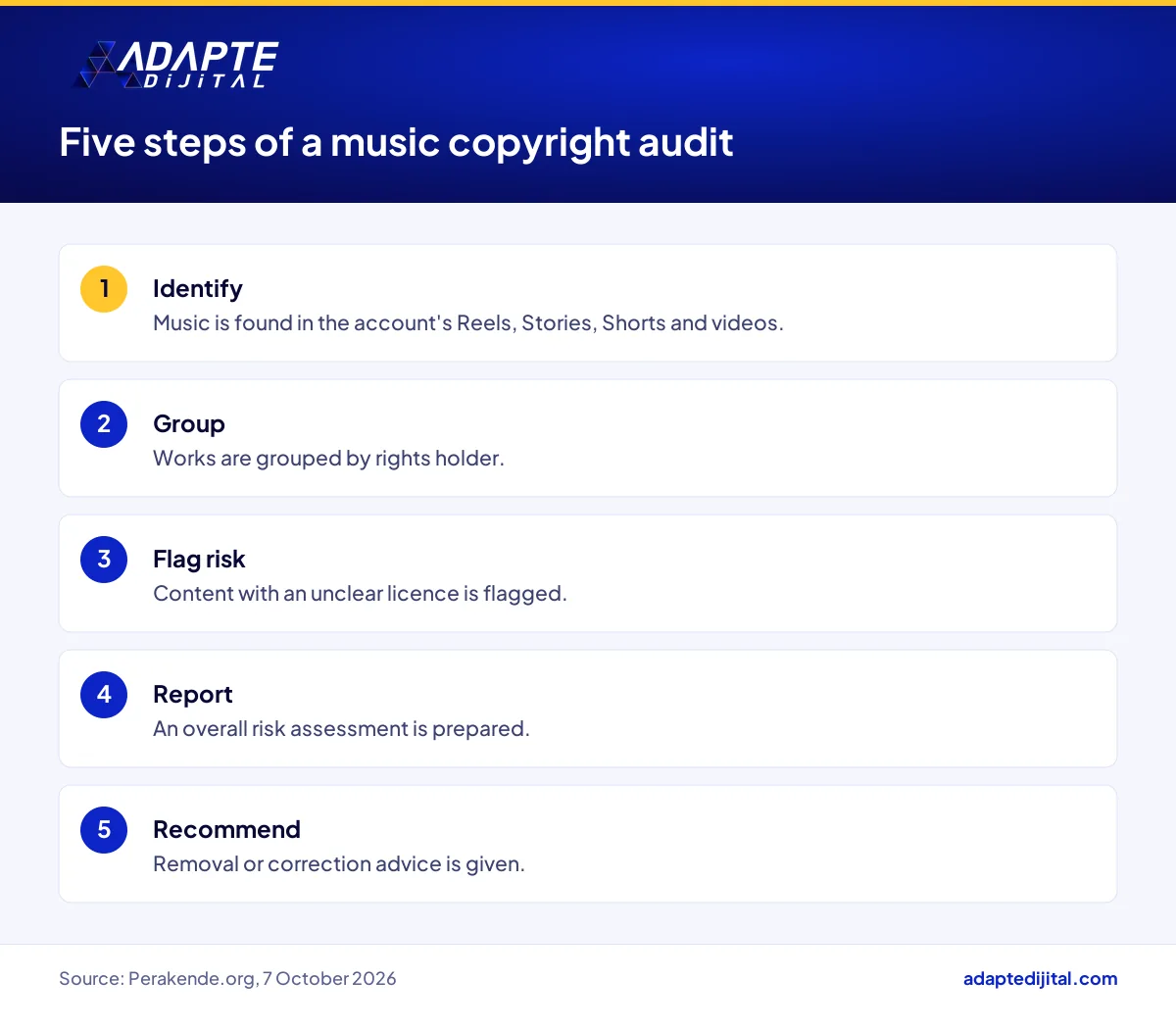
It follows five steps. First, the music used across the account is identified, then the works are grouped by rights holder. Next, risky content is flagged, and a report with an overall risk assessment is prepared. Finally come recommendations to remove or correct content; the output is a report, not a licence.
Which retailers does music copyright risk concern most?
It matters most to retailers who use social media as a shop window and produce content fast. Café and restaurant chains, fashion and cosmetics brands, and e-commerce sites that grow through influencer deals come first. An industrial supplier that shows its products in catalogue photos is far less exposed. Agencies and production companies are affected indirectly.
How does a YouTube Content ID match affect a brand’s digital visibility?
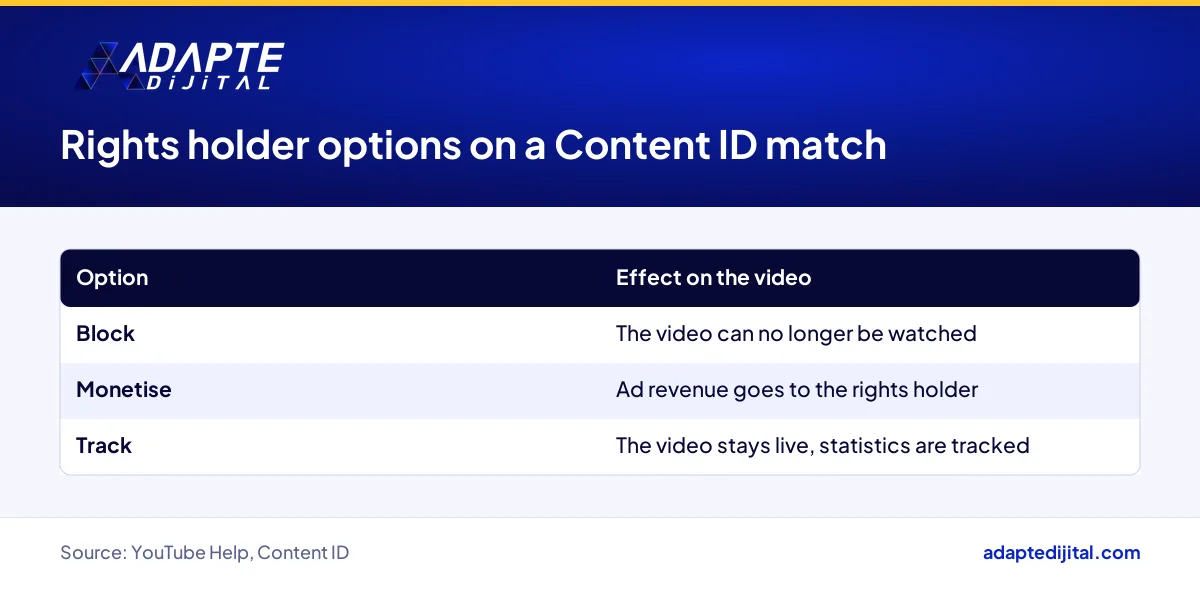
It decides who controls the video. In YouTube Content ID, rights holders upload audio and visual reference files, and a matching video receives a claim. The rights holder can block the video, redirect its ad revenue to themselves or simply track it. According to Google’s help page, the outcome can vary by country.
How does a licensed music catalogue change a retail brand’s content calendar?
It moves the calendar from chasing trends to planned production. The text names a Snapmuse membership as the forward-looking fix: a licensed music catalogue, licence compliance for YouTube Content ID and for Instagram and Facebook, and usage tracking by platform. It does not explain how the audit provider and Snapmuse are connected, so compare the options against your own needs.
What should a business using music on social media do this week?
BU BÖLÜMÜN ÖZETİ
- List every post with music on your accounts
- Check your agency and influencer contracts
- Set up a decision table for risky content
This week, build an inventory, check your collaboration contracts and write a music rule for new content. All three take only a few days, and they show how much risk you carry before any outside audit. We build this inventory with brands as part of our digital media consulting work.
List every post with music on your accounts
Put your music posts on Instagram, Facebook and YouTube into one sheet. Give each row the publish date, the song title and who produced the content. That sheet also makes any audit report much easier to read.
Check your agency and influencer contracts
Look for who holds responsibility for the music licence, and whether the contract says so. If it does not, add it before the next collaboration. Verify with the official source; this is not legal or financial advice.
Set up a decision table for risky content
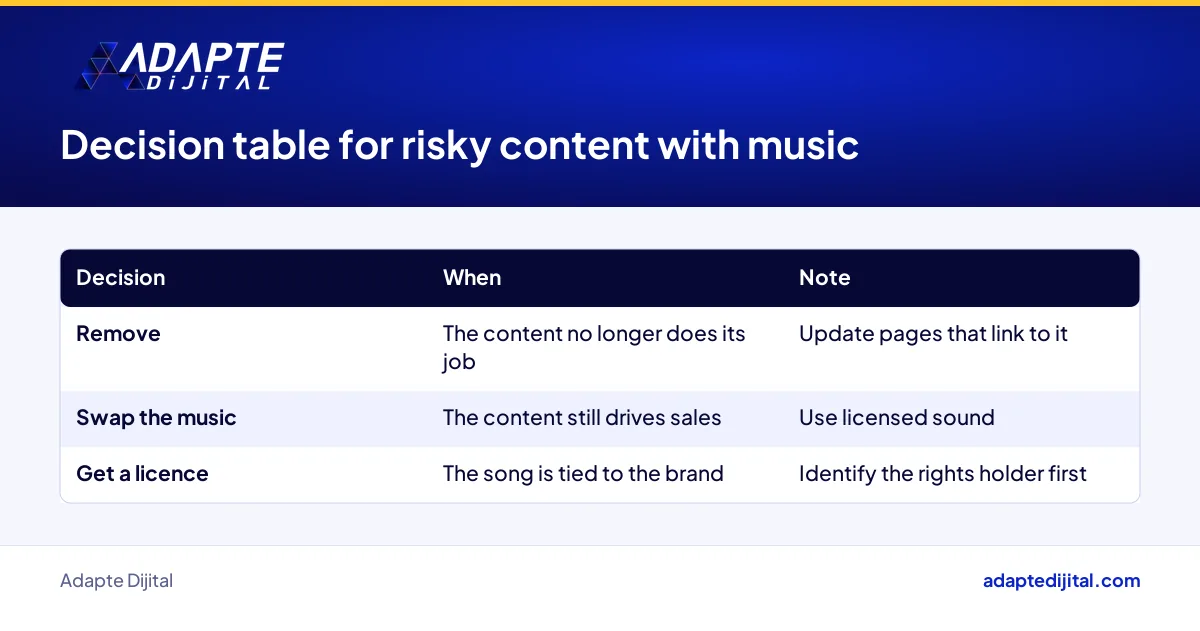
Remove, swap the music, get a licence: a three-column table is enough. Before you take down content that sells, try changing its music first.
Another file may land on your desk the same week: if you sell to the EU, the EU’s €3 e-commerce duty affects your prices. If you are looking for growth funding, the investment figures discussed at the Bacacı summit offer a frame. The full agenda is on our retail page.
Keep one principle in mind: content with unknown music is like goods with an unknown owner; it does not go on the shelf.
Quick Summary
- The audit service described can scan posts going back as far as five years (Perakende.org, 7 October 2026).
- Posts by agencies, production companies and influencers can fall inside the scope.
- The audit delivers a report and risk assessment, not a licence.
- The text names content removal and correction as the risk; it mentions no fines or account closures.
- The forward-looking fix is a licensed catalogue plus a music source record for every post.
Short Glossary
- Copyright audit
- A copyright audit is the review used to scan an account’s music use by rights holder and report the risky content.
- Content ID
- Content ID is the system used to match YouTube videos against reference files uploaded by rights holders.
- Licensed music catalogue
- A licensed music catalogue is the library used to offer works already cleared for commercial content in one place.
Frequently Asked Questions
Next Step
If you want to build an inventory of the music content on your accounts together, fill in the consult your expert form.
Sources: Perakende.org, 7 October 2026 · YouTube Help, How Content ID works · MESAM
Updated: October 2026
Sık Sorulan Sorular
Let me put it plainly: the problem may not even be in a video you shot. The audit scope can include posts by your agency, your production company and the influencers you work with. You think your own account is clean, and the collaboration content ends up at the top of the list.
The text does not say. It is not clear whether it reflects a limitation period or simply a commercial choice by the service. Do not read the scan window as a legal boundary; the right range for you depends on how old your account is and how much you post.
Reels, Stories, Shorts and YouTube videos are scanned one by one. The platforms named are YouTube, Instagram and Facebook. Remember to add archived Stories and highlights to your own list as well.
Each work has a different owner. In Türkiye, music authors and composers are represented and licensed by MESAM, the Turkish collecting society for musical works. No licensing conversation starts until you know who owns which song.
The report shows you which content is risky. You decide whether to remove it, swap the music or get a licence. A brand that never turns the report into an action list has only documented its worries.
The brand whose content calendar depends on trending sounds. A café or boutique that posts several Reels a week, each with a popular song, may face a long list after a scan. The more collaborations you run, the harder control becomes.
The brand that works with licensed music, or original sound, from the start. Its list of risky content is short, so its ad and collaboration plans keep running without interruption. When competitors are busy taking content down, that brand stays visible.
Because content often comes off the agency’s own server. If the contract does not say who holds the music licence, the question of responsibility lands on the table. That gap between brand and agency can be one of the things an audit brings to light most often.
The views, comments and shares it has gathered stop working for you. A blog post, product page or email campaign that links to it now opens onto an empty window. The customer clicks, finds nothing and turns away.
Promoting an organic post means carrying its music to a much wider audience. Before you boost a Reel whose licence is unclear, check its music. The creative library in your ad account belongs inside the audit scope too.
A promo video embedded on your site depends on the original upload. If that upload is blocked or removed, the page loses the video as well. Keep your content inventory and your list of embedded videos side by side.
No, but it draws a line. You can still make timely, fast content with sound chosen from a licensed catalogue. What matters is recording where every track comes from.
No, they are separate licensing questions. The licence for the background music playing in your store does not cover using the same song in a Reel. Make that distinction clear to your team.
Content with unknown music does not go live. Add a music source line to every post draft, and if the line is empty, no approval. A short rule is a rule people actually follow.
The text mentions no fines, damages or account closures; the risk it names is content removal and correction. Get legal advice for your own situation.
No. An audit delivers a report and a risk assessment; for a licence you need a separate agreement with the rights holder or a licensed catalogue.
If the videos are on your brand’s account or published on your behalf, they can fall within an audit’s scope. Who is responsible depends on the licence clause in your agency contract.