
MediaMarkt says smartphones led September searches, can site search data guide your stock?

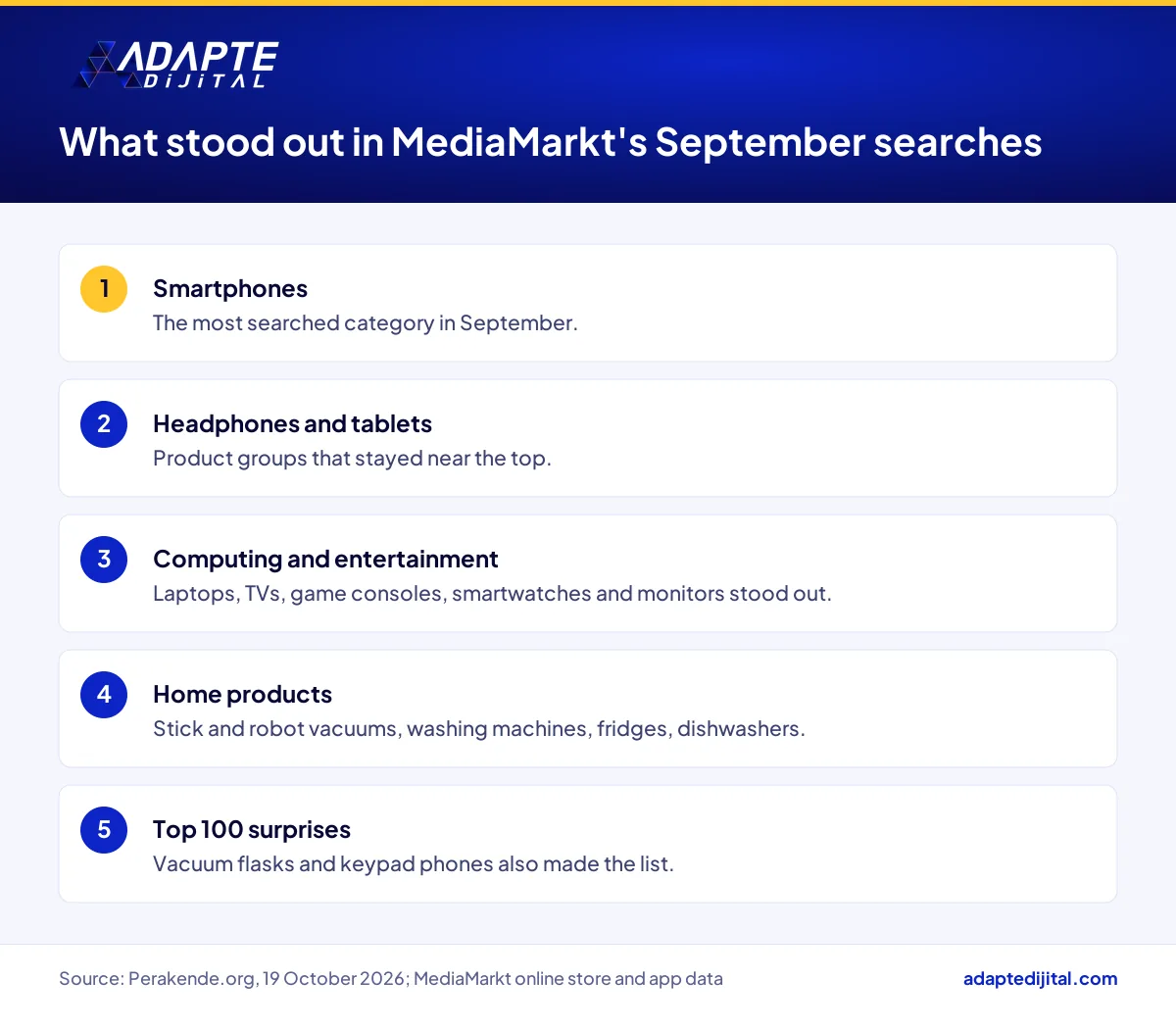
Smartphones were the most searched category in September on MediaMarkt Türkiye’s online store and app, with headphones and tablets also near the top (Perakende.org, 19 October 2026). Vacuum flasks and keypad phones also made the top 100 searched products.
Here is why it matters to you: the search box is the one place where customers describe what they want in their own words. A sales report shows what you sold; a search report shows what you failed to sell. Any electronics, homeware or gift retailer with an online store can turn this data into stock, campaign and content decisions.
Which products stood out in MediaMarkt’s September search data?
Technology and home products, led by smartphones. Headphones and tablets stayed near the top, and laptops, TVs, game consoles, smartwatches and monitors were also on the list. On the home side, shoppers searched for stick and robot vacuums, washing machines, fridges and dishwashers. Among small appliances, coffee machines and irons stood out (Perakende.org).
What does it mean that vacuum flasks and keypad phones made MediaMarkt’s top 100?
It does not reveal a definite reason, because the source gives none. Our reading as a desk is that the search box shows demand for products no one features in the window. Vacuum flasks and keypad phones are not what comes to mind first in a technology store, yet customers search for them. Surprises like these appear in search reports, not sales reports.
How does site search data become a stock decision, using MediaMarkt as an example?
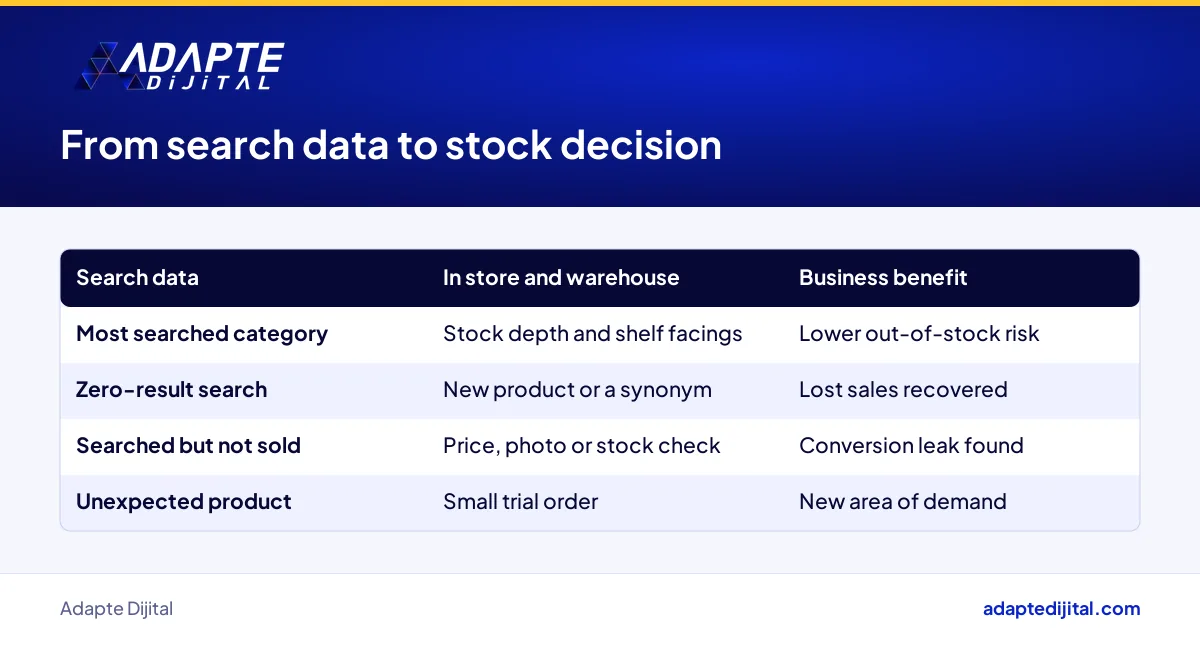
In four steps: group the searches, separate zero-result searches, compare with stock and write down the decision. Site search is the log of words typed into your own site’s search box. Most e-commerce platforms and analytics tools can keep this log. The table below shows what each type of search data turns into in store and in the warehouse.
| Search data | In store and warehouse | Business benefit |
|---|---|---|
| Most searched category | Stock depth and shelf facings | Lower out-of-stock risk |
| Zero-result search | New product or a synonym | Lost sales recovered |
| Searched but not sold | Price, photo or stock check | Conversion leak found |
| Unexpected product | Small trial order | New area of demand |
Which retailers does search analysis like MediaMarkt’s affect, and how?
Multichannel retailers who read search data regularly gain; businesses that set stock only on last year’s sales struggle. In autumn 2026, electronics, white goods and small appliance chains in Türkiye compete with neighbourhood tech shops and marketplace sellers for the same customer. Suppliers feel it indirectly, because orders follow searches.
How can search data like MediaMarkt’s guide ad and content decisions?
Customers’ own words are the most accurate keyword list for ads and content. A customer who types “keypad phone” into your search box probably types the same into a search engine. Move those words into product titles, category pages and ad keyword lists. That way, site search feeds visibility outside your site.
What should an online store owner do with search box data this week?
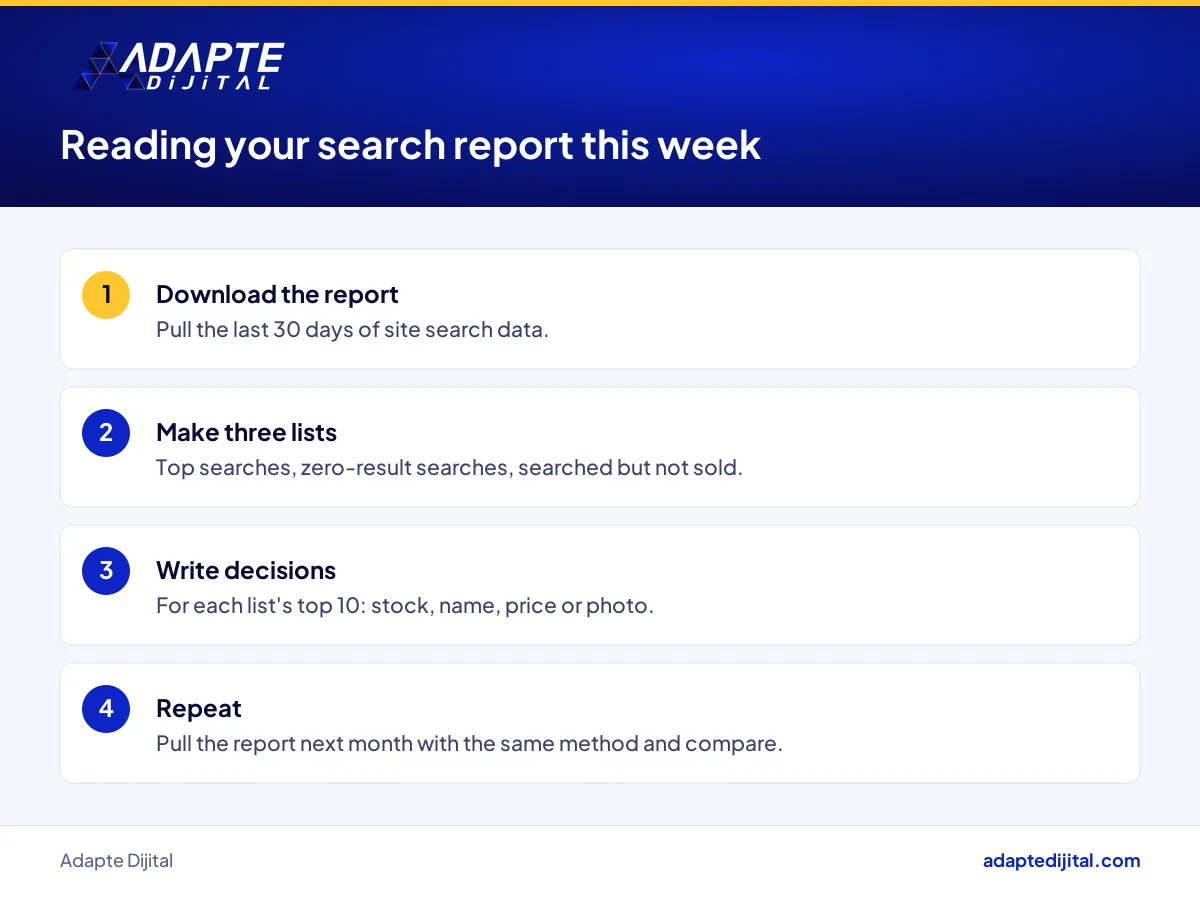
This week, download the last 30 days of search data and make three lists: top searches, zero-result searches and searched-but-not-sold. For the top 10 items on each list, write one decision: stock, rename, price or photo. Pull the report again next month with the same method, and your own comparison data starts to build.
Quick Summary
- Smartphones were the most searched category in September on MediaMarkt Türkiye’s online store and app (Perakende.org, 19 October 2026).
- Headphones and tablets stayed near the top, with laptops, TVs, game consoles, smartwatches and monitors also prominent.
- Vacuum flasks and keypad phones were among the top 100 searched products (Perakende.org).
- The report gave no percentages, rank numbers or search volumes.
- According to the company, MediaMarkt Türkiye runs 102 stores in 32 provinces and has sold online since 2013.
Short Glossary
- Site search
- Site search is the term used to describe the log of words customers type into an online store’s own search box.
- Zero-result search
- Zero-result search is the term used to describe searches for which a site shows no product at all.
- Conversion rate
- Conversion rate is the ratio used to show how many visits or searches turn into sales.
Frequently Asked Questions
Next Step
Let’s read your site’s search report together and turn it into stock and page decisions; fill in the consult your expert form.
Sources: Perakende.org, MediaMarkt’s September search trends, 19 October 2026 · MediaMarkt Türkiye, about us page
Updated: October 2026
Sık Sorulan Sorular
From September searches on MediaMarkt Türkiye’s online store and the MediaMarkt App, so it is company data. It is not a sales list but a summary of what customers typed into the search box. The report gives no percentages, rank numbers or search volumes.
According to the company, MediaMarkt Türkiye runs 102 stores in 32 provinces and has sold online since 2013. Its corporate “about us” page also places it within MediaMarktSaturn Retail Group (CECONOMY). A wide store network and online search under one roof mean the data can be read for both shelf and warehouse.
Not from this report, which offers no comparison with earlier months. Setting lists from different periods side by side, without knowing the method, can mislead. If you apply one method on your own site every month, the comparison builds itself.
This is interpretation, not fact. A simple phone for an older relative, a spare line for work or a wish to cut screen time are possible reasons. Only by reading your own search and sales data together can you tell which applies.
Think long tail first: products searched rarely one by one, but together forming real demand. Step one is to check whether the searched item exists on your site at all. If it does not, a rival is taking that sale.
Because most reports are read only for the top 10 items. Nobody looks further down, so the wanted product is never bought in, or the wrong one sits on the shelf. Reading the search report down to at least row 100 should be a habit.
A zero-result search is one where your site shows no product for the word a customer typed. Either the product is missing or it is listed under another name. Both end the same way: the customer walks out.
Demand exists but conversion does not; conversion is the share of searches that become sales. The cause is usually price, photos, stock or delivery time. If visits come in but the till does not turn over, open the product page as a customer would.
Yes, especially when stores and the online shop draw from the same warehouse. A product searched often online gets asked about in store as well. With search data by region, you can choose more accurately which SKU goes to which store.
A big chain’s search list can be a rough guide to general demand. In small, fast-moving items such as headphones, smartwatches and accessories, a small shop can move quickly. But copying the chain’s list without knowing your own customers’ searches means the wrong stock.
Vacuum flasks, coffee machines and irons also sell outside technology stores. A home product searched in a tech store is a demand signal for homeware sellers too. Category lines are drawn in the store’s shelf plan, not in the customer’s head.
For expensive products, customers search first, then want to touch the item in store. We explain the logic of in-store experience zones in our piece on Teknosa’s planned zones for Samsung foldables. Search data helps you choose which product earns a place there.
For a product group that is searched often but missing from your category tree, open a separate category or filter. Write the page title in the customer’s own words. A short description tells both shoppers and search engines what the page offers.
AI-assisted search tools that understand what customers type and make suggestions are also on the agenda. We look at this approach in our piece on Loops AI and the search box. Assistant or search box, nothing changes if no one reads the data.
A product that is searched often and held in depth gets ad priority. Advertising a popular product that is out of stock means paying for customers who will walk out. Building the ad calendar together with the stock report prevents that waste.
From the admin panel of most e-commerce platforms or the analytics tool linked to your site. If there is no report, site search tracking has to be switched on. If you plan to link search logs to individuals, check personal data rules with the official source; this is not legal advice.
Purchasing, the category manager and the content team, each separately. Purchasing fixes missing products, the category manager fixes naming errors, the content team fixes page copy. When everyone sees their own row, the report does not end up in a drawer.
When you have the data but no time to read it or no setup to collect it. We run site search analysis and product page fixes through our e-commerce consulting work. Retail news is interpreted for you on our retail page.
No. Search shows what customers want, sales show what they bought; read together, they reveal lost sales.
Yes, even with few visitors, zero-result searches reveal missing products and wrong product names. After a few months of data, trends become readable too.
The source gives no reason; it only says keypad phones were in the top 100. Any explanation of why is a guess.