
Securitas Alarm and Drivee pair crash detection with emergency calls, is your fleet safe?
A partnership between Securitas Alarm and Drivee has produced a service that pairs AI-assisted crash detection with a 24/7 emergency call line to protect drivers, vehicles and cargo (Perakende.org, 25 September 2026). The report carries the views of Murat İdil, General Manager of Drivee Teknoloji, and Emre Erdal, General Manager of Securitas Alarm. Its official name, price and target customer are not given.
If your business delivers goods or runs a field sales team by vehicle, here is what it means: who reaches your driver and cargo after a crash, and how fast, is now a service you can buy. The report dates from late September and has no product details. For retailers and distributors running fleets in Türkiye in autumn 2026, the right move is a question list before any purchase.
What does the Securitas Alarm and Drivee crash detection service offer?
According to the report, the service brings three areas of safety under one roof: the driver, the vehicle and the cargo. AI-assisted crash detection identifies a possible accident, and it is combined with a 24/7 emergency call service. The page gives no official product name, price or statistics.
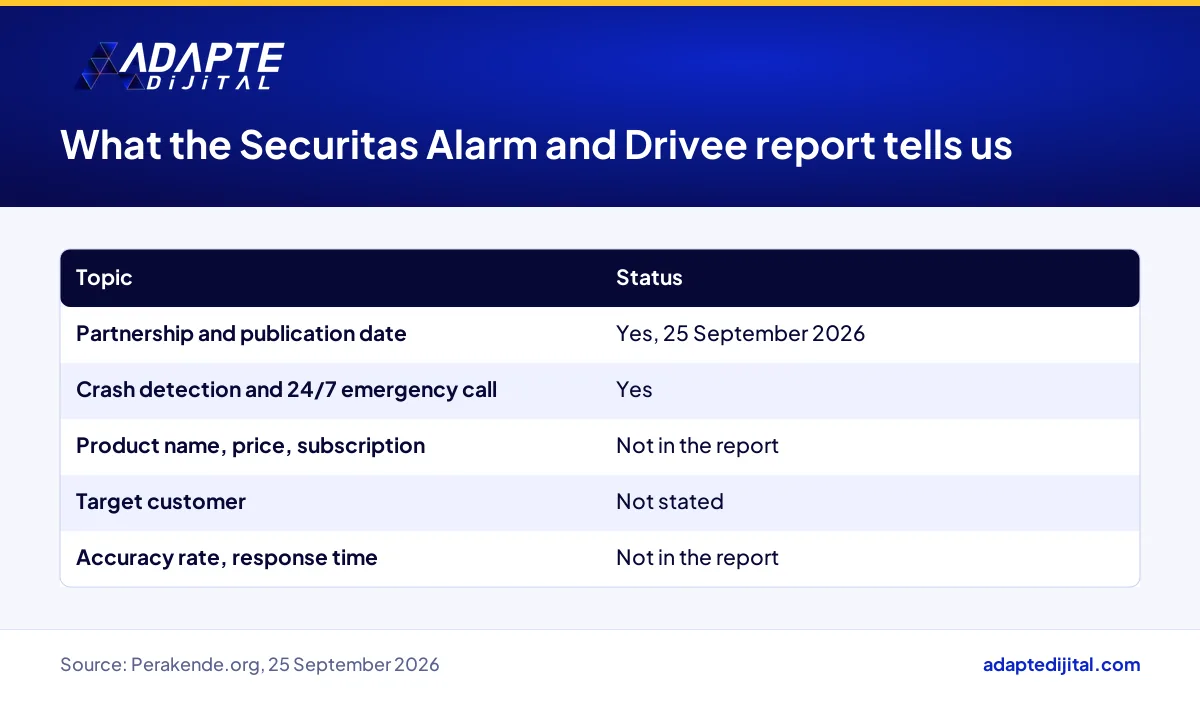
What information is missing from the Securitas Alarm and Drivee partnership?
Most of what drives a buying decision is missing. The product or package name, price, subscription model and installation method are not in the report. The target customer, whether fleet, individual driver or logistics firm, is unclear. The accuracy of crash detection and the response time are not shared either.
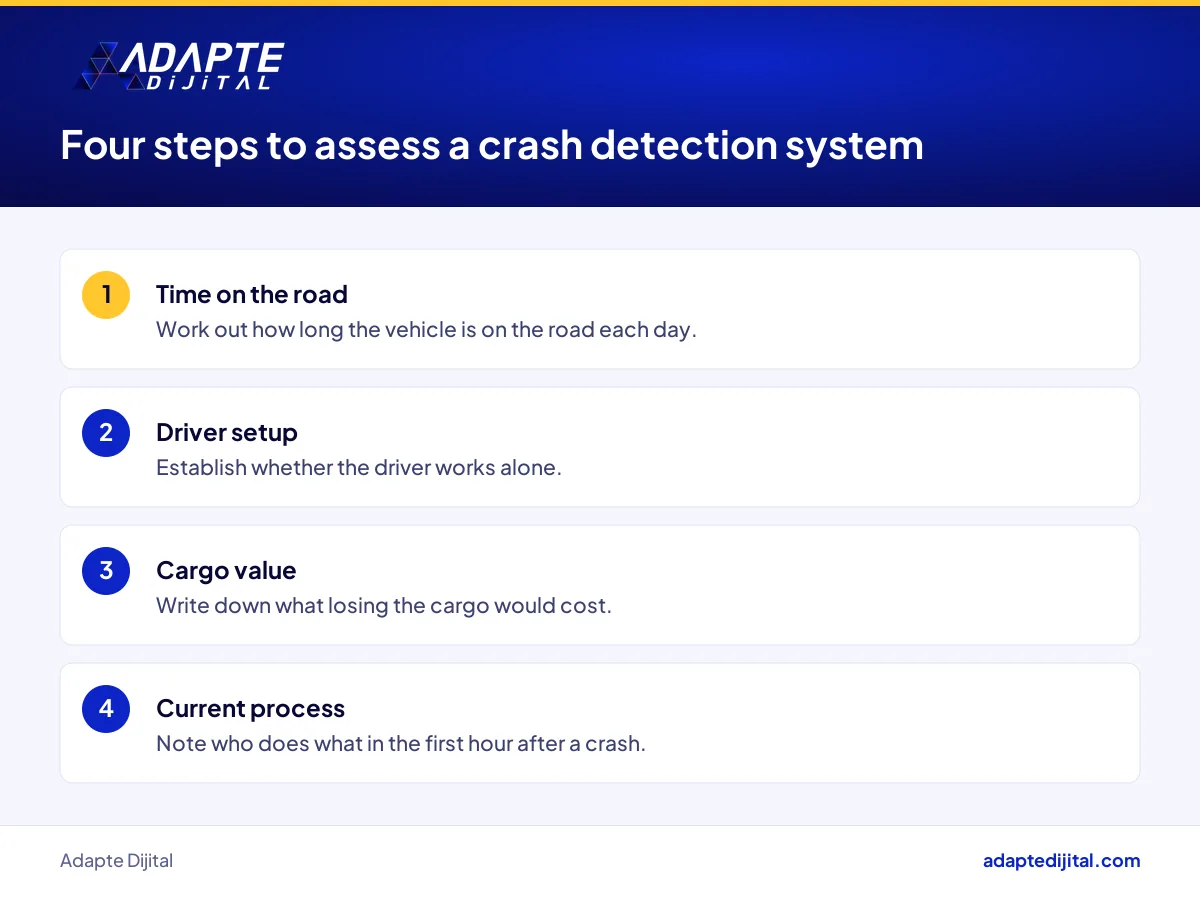
How can a business that delivers or sells in the field assess a crash detection system?
In four steps: how long the vehicle spends on the road each day, whether the driver works alone, what the cargo is worth and how the current post-crash process runs. The answers show whether the system is an insurance-like safeguard for you or one more subscription. The table links each reported feature to a business benefit and a supplier question.
| Feature (per the report) | What it means for the business | Ask the supplier |
|---|---|---|
| AI-assisted crash detection | A crash is noticed without the driver calling | Accuracy rate and false alarms |
| 24/7 emergency call | Support on night and weekend runs | Response time |
| Driver safety | Peace of mind for lone field staff | How driver data is used and stored |
| Vehicle and cargo safety | Faster damage and cargo handling | Access to records and reports |
What does crash detection and vehicle data change on the digital side of delivery?
It makes your delivery promise easier to measure. Data created during a crash or delay can be used to update customers on time, set a realistic delivery promise on your website and protect your marketplace performance.
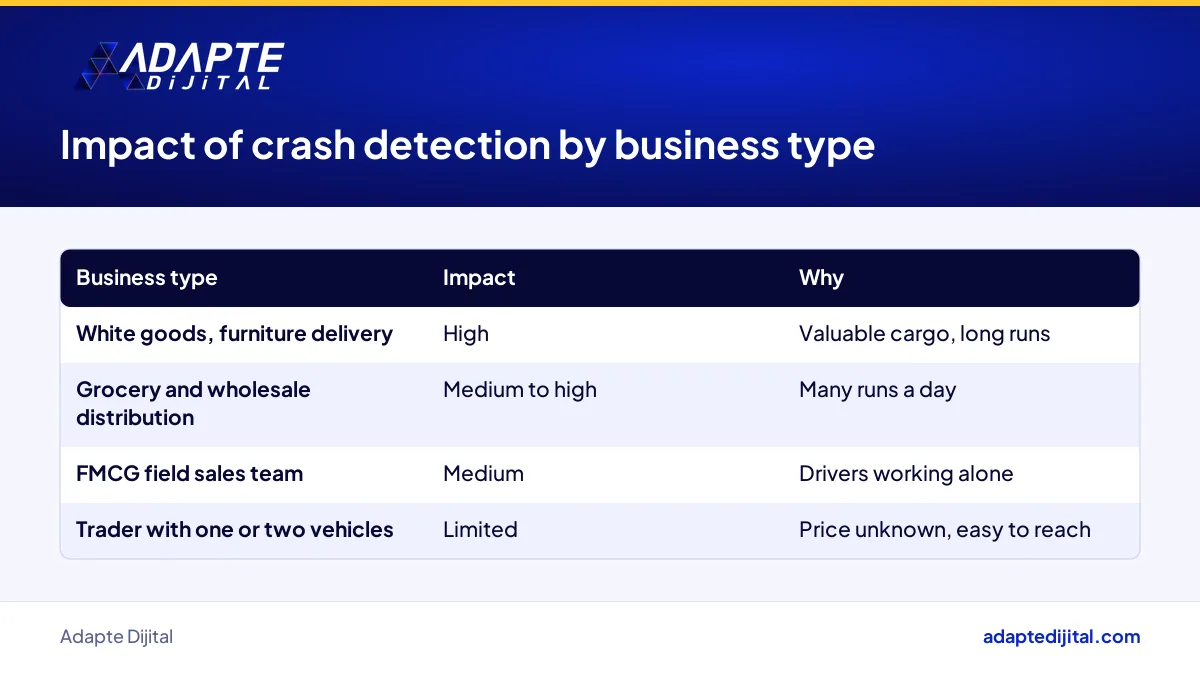
Which businesses does adding AI to vehicle safety affect, and how?
The most direct effect falls on grocery, furniture, white goods and wholesale distribution businesses that deliver with their own vehicles. FMCG distributors whose field sales teams travel by car belong in the same group. For tradespeople with only a vehicle or two, the effect is limited, and without a price, cost per vehicle cannot be worked out. Insurers, fleet leasing firms and parcel carriers feel it indirectly.
What should an owner whose business delivers by vehicle do this week?
This week, put your fleet’s post-crash process on paper: who calls whom after a crash, where the cargo goes and who tells the customer. Then draw up your supplier questions. These two documents let you judge every offer, Securitas Alarm and Drivee included, by the same yardstick.
Quick Summary
- Securitas Alarm and Drivee offer a service that combines AI-assisted crash detection with a 24/7 emergency call line (Perakende.org, 25 September 2026).
- The report gives no product name, price, subscription model, accuracy rate or response time.
- According to Hürriyet, Drivee’s SafeCall device was in about 9,500 vehicles as of 13 December 2018.
- According to Securitas, its July 2021 purchase of Tepe Güvenlik made it number two in Türkiye’s monitoring market.
- The desk recommends mapping your post-crash process and asking suppliers for figures in writing before requesting quotes.
Short Glossary
- Crash detection
- Crash detection is the technology used to identify a likely accident automatically from impact and driving data in the vehicle.
- Telematics
- Telematics is the system used to collect and transmit a vehicle’s location and driving data remotely.
- SLA
- An SLA is the contract clause used to define the timing and quality level a provider commits to deliver to a customer.
Frequently Asked Questions
Next Step
If you would like to assess crash detection or vehicle data integration for your fleet, fill in the Consult Your Expert form and we will build the question list around your vehicles and delivery setup. Our retail page, where we interpret the retail agenda for you, gathers the other stories.
Sources: Perakende.org, “Securitas Alarm ve Drivee’den araç güvenliğine yeni nesil çözüm” (A new-generation vehicle safety solution from Securitas Alarm and Drivee), 25 September 2026 · Hürriyet, 13 December 2018 · Securitas AB press release on the Tepe Güvenlik acquisition (linked in the text)
Updated: October 2026
Sık Sorulan Sorular
Crash detection, in plain terms, infers a likely accident from what happens to the vehicle. An emergency call service is the human side: someone who reaches the driver or rescue teams when the alert comes in. According to the report, both parts come together in one service; it does not say which data the detection relies on.
According to the Turkish daily Hürriyet (13 December 2018), Drivee’s SafeCall device is a sensor that analyses driving, detects impacts and sends the crash location to medical teams. Sales began in October 2018, and by the date of that report the device was in about 9,500 vehicles. The 2026 report does not say whether the new service builds on it.
According to a Securitas press release, the company bought the Turkish electronic security firm Tepe Güvenlik A.Ş. in July 2021 for about EUR 10 million. The release mentions 250 employees and more than 50,000 connections. According to Securitas, the deal made it number two in Türkiye’s monitoring market.
The report is dated 25 September 2026. Read in mid-October, it is a few weeks old. Price and package details may have appeared since, so confirm them with the companies.
The report summarises the views of İdil and Erdal rather than quoting them directly. These are the companies’ own assessments, not measured performance data. For a decision, ask the supplier for figures in writing.
Businesses that run intercity distribution, schedule night runs or send drivers out alone. For short, same-day deliveries, the need may be more limited.
Telematics is the technology that collects a vehicle’s location and driving data remotely. If your fleet already has a tracking device, ask about integration rather than a second device. Two separate dashboards only make a supervisor’s job harder.
Since no price has been published, the desk recommends setting any quote against your current crash costs. Start with last year’s damage files, workshop days and the value of cargo stranded on the road.
If the order system does not know a vehicle is stuck, the customer keeps waiting on the order screen. Link vehicle data to the order system, and delay notices can go out automatically. On marketplaces, that lowers the risk of bad reviews and cancellations.
An SLA is the delivery-time commitment you make to a business customer. If the post-crash process speeds up, a spare vehicle and driver can head out sooner. For businesses that run payments and delivery together, our piece on who should manage a store’s payment setup looks at the same question from another angle.
Location and driving data can count as personal data about an employee. Tell drivers in writing which data is collected, how long it is kept and who can see it. Verify with the official source; this is not legal or financial advice.
With loads such as white goods, electronics and furniture, every hour after a crash means lost goods and lost customers. When the cargo is stuck on the road, the till stops ringing too.
For a tradesperson with one or two vehicles, the driver is often the owner, and a phone call is enough to reach them. Without published price and package details, a subscription decision at this scale is premature.
AI in the vehicle and automation at the till ask the same question: where does it support people, and where does it open a new risk? We look at the till side of that question in our piece weighing self-checkout against staffed tills.
Open last year’s crash and breakdown records and note what happened in the first hour of each. The gaps, when nobody was called or cargo sat unattended, show where a system helps most.
Accuracy rate, false-alarm frequency, average response time, monthly fee per vehicle and contract length. The report does not include these figures, so request them in writing at the quote stage.
Linking crash and location data to ordering, notification and reporting is a separate project. Integrating AI-assisted tools into business systems falls within our AI consultancy work.
That is not known. The Perakende.org report includes no price, subscription model or package name, so get current details directly from the companies.
The report does not name a target customer. Even so, the benefit looks clearer for businesses with several vehicles, night runs or valuable cargo; for a trader with one or two vehicles, the need may be limited.
The report does not say which data is collected. Ask the supplier, and tell your driver in writing which data will be kept and for how long.