
WatchGuard sees endpoint malware up over 2,000%, how can small firms stay safe?
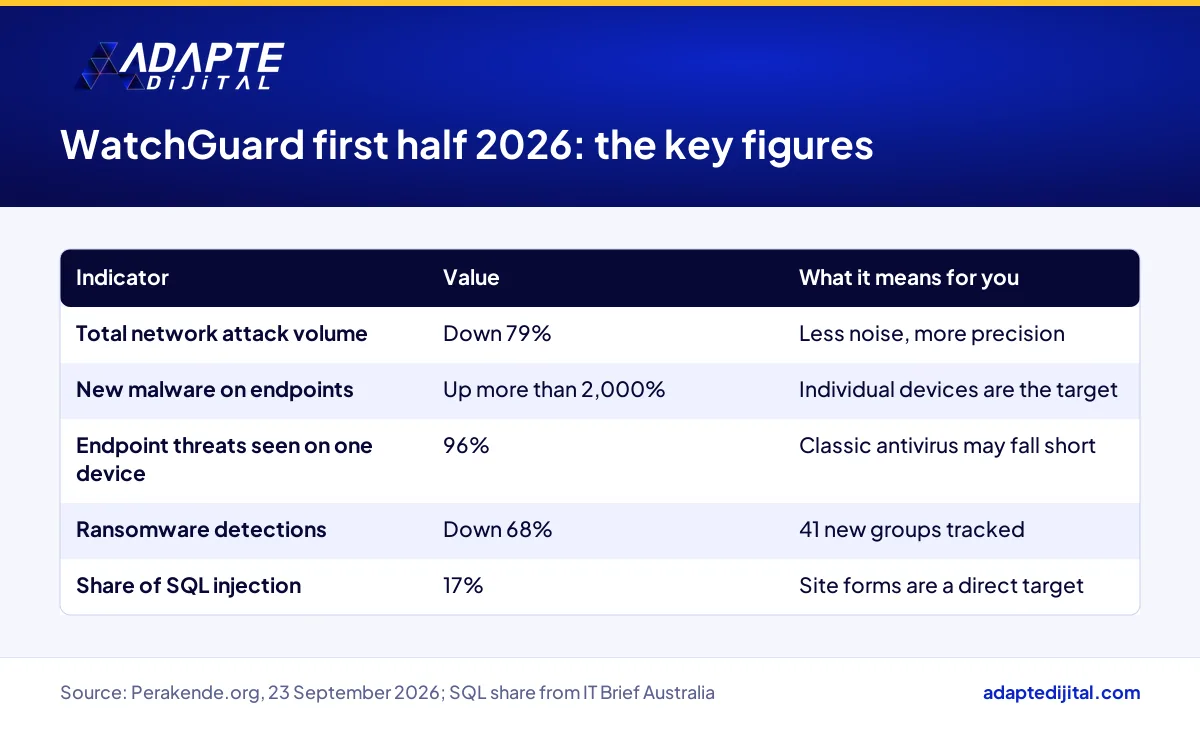
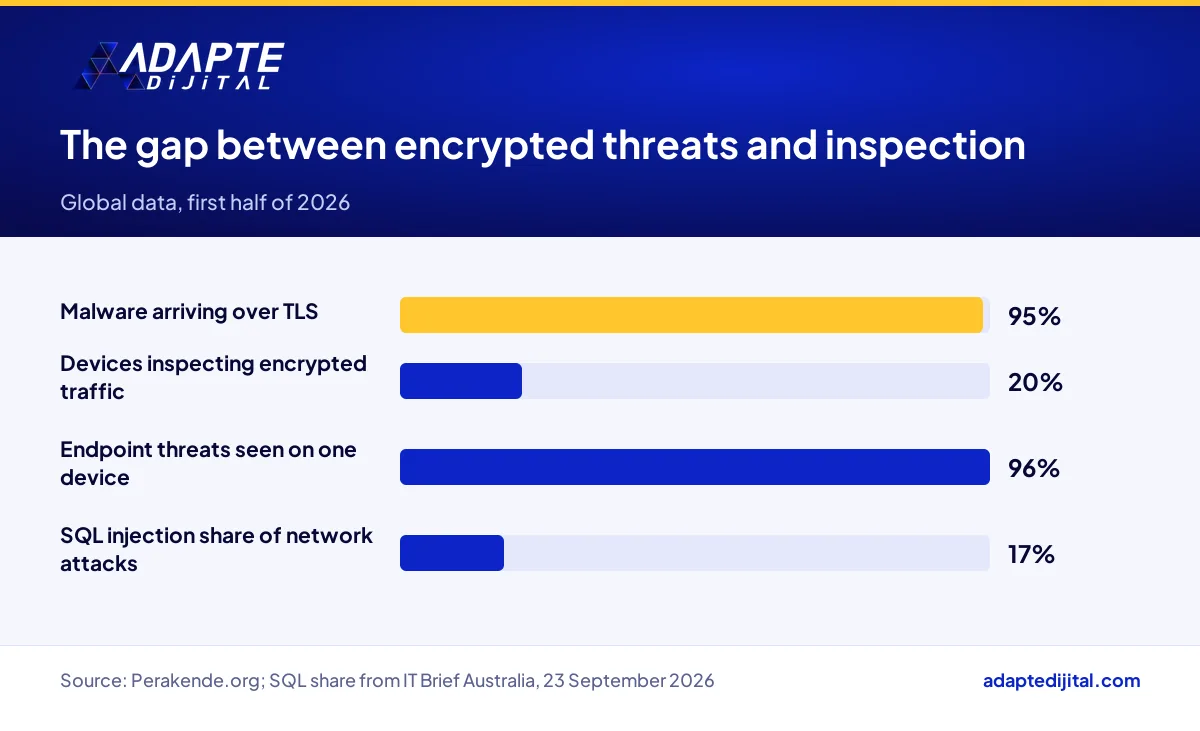
WatchGuard Technologies reports that the total volume of network attacks fell 79% in the first half of 2026, while detections of new malware on endpoints rose by more than 2,000% (Perakende.org, 23 September 2026). The same global threat report says 95% of malware now arrives over encrypted TLS connections, yet only 20% of installed devices inspect encrypted traffic.
For small and mid-sized businesses running an online store and a chain of shops in Türkiye in autumn 2026, the message is simple. There are fewer attacks, but they hit closer to the target. The POS computer at the till, the laptop in the stockroom and the admin panel of your website are now picked off one by one. The figures are global; the report gives no breakdown for Türkiye or for retail.
What does WatchGuard’s first-half 2026 report say about where attacks are heading?
It says attacks are changing direction, not disappearing. According to the report, attackers are using AI-assisted tools to move away from high-volume attacks and toward targeted malware, low-intensity scanning and access through stolen credentials. The noise goes down and the precision goes up. So if you judge your risk by the number of alerts, you reach the wrong conclusion.
How does malware get into a small business network, according to WatchGuard?
Through three doors: encrypted connections, old unpatched software and stolen user credentials. The report says 95% of malware arrives over TLS. IT Brief notes that 31 of the 44 network attack signatures that reference a known vulnerability target flaws that are a decade old. Credentials are the third door, and they let the attacker walk in with a key instead of breaking the lock.
Which businesses do WatchGuard’s findings affect, and how?
The findings matter most for online stores with forms and search boxes on their sites, and for retailers whose branches share one network. When attacks target a single device, every new branch adds another device to watch. Accounting and logistics firms connected to a retailer can be affected indirectly through those links.
What does the WatchGuard report mean for an online store’s digital security?
Your website is directly in the line of fire. IT Brief reports that SQL injection makes up 17% of network attack detections, and this attack comes in through forms and search boxes. A compromised site can lose search visibility, put your ad and marketplace accounts at risk and send customers away at the door. For an online store, security is part of the sales funnel.
Does WatchGuard’s 68% drop in ransomware give small businesses room to relax?
No, it does not. The report says ransomware detections fell 68%, yet 41 new ransomware groups were tracked in the same period. Detections go down while the number of players goes up. Corey Nachreiner, WatchGuard’s Chief Information Security Officer, put it plainly: “Attackers are not less dangerous because alert totals declined” (IT Brief).
What should a business owner check this week after the WatchGuard report?
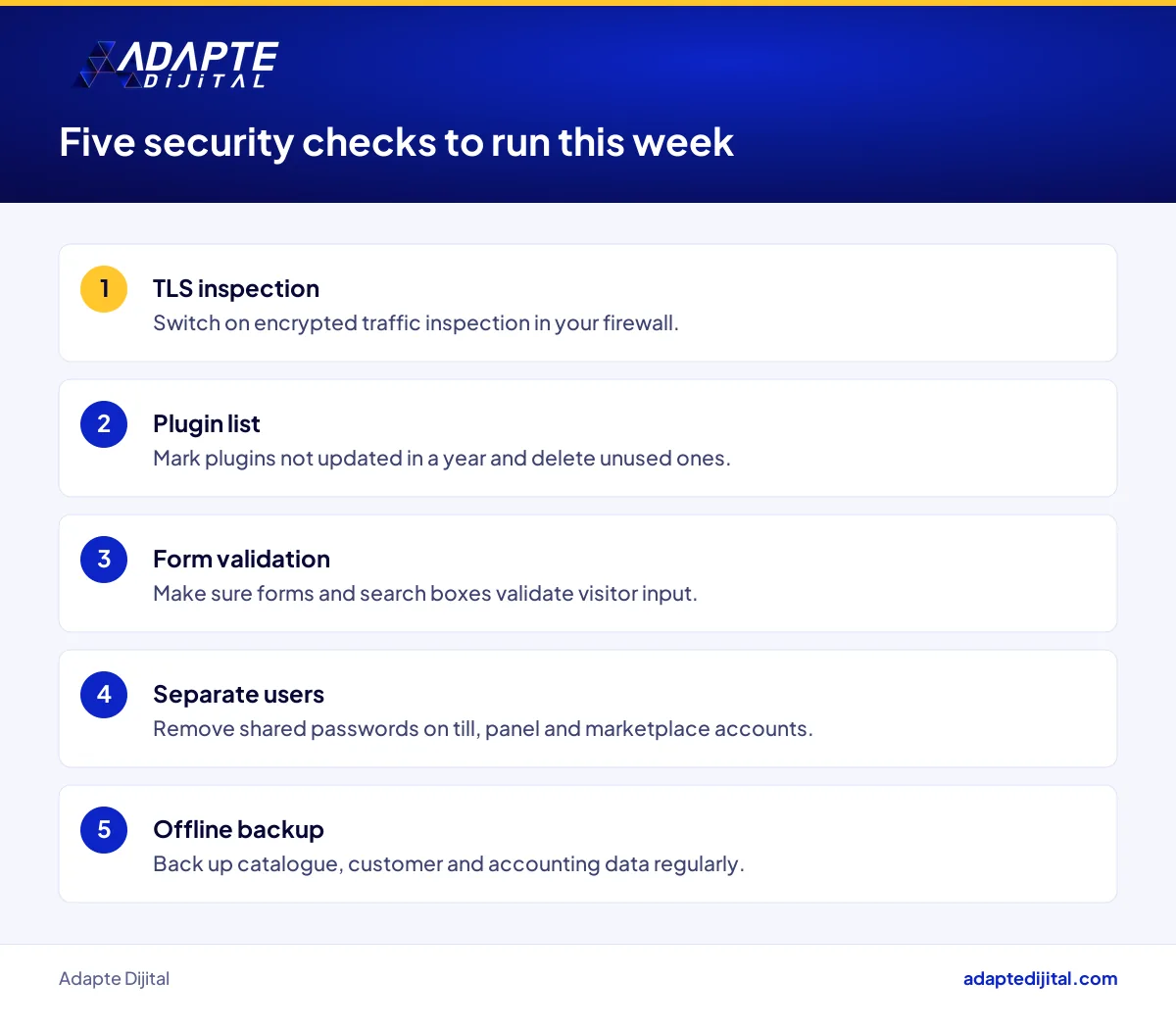
Three checks fit into this week: whether TLS inspection is switched on in your firewall, which plugin and server versions your site runs, and whether critical accounts use multi-factor authentication. Each one can be clarified quickly. For costs, get a quote for your own setup.
Quick Summary
- According to WatchGuard, the total volume of network attacks fell 79% in the first half of 2026 (Perakende.org).
- New malware detections on endpoints rose by more than 2,000% (Perakende.org; IT Brief reports 2,065%).
- 95% of malware arrives over TLS, while only 20% of devices inspect encrypted traffic (Perakende.org).
- Ransomware detections fell 68% while 41 new ransomware groups were tracked (Perakende.org).
- The figures are global; the report has no breakdown for Türkiye or for retail.
Short Glossary
- Endpoint
- Endpoint is the security term used to describe devices that connect to a network, such as computers, phones and POS terminals.
- TLS inspection
- TLS inspection is the method used to open and examine the content of encrypted connections on a security device.
- SQL injection
- SQL injection is the attack type used to reach a database by typing malicious commands into website forms.
Frequently Asked Questions
Next Step
If you want to see together which door is open in your network and on your site, fill in the consult your expert form, and our team will draw up a check plan for your business.
Sources: Perakende.org, 23 September 2026 · IT Brief Australia, 23 September 2026 · WatchGuard Internet Security Report page
Updated: October 2026
Sık Sorulan Sorular
It measures the year-on-year fall in the total volume of network attacks (IT Brief Australia). WatchGuard’s own dashboard shows other metrics too, and those are different measurements that should not be mixed with this one. What this means: a drop in volume does not mean a drop in targeted attacks.
Perakende.org puts the rise in new endpoint malware detections at more than 2,000%, while IT Brief Australia reports 2,065%. The one-line reading: malware nobody has seen before is surging on end devices such as computers and phones.
WatchGuard publishes this report twice a year, based on data its team collects from customer devices. You can find the report page in the WatchGuard security hub. The news coverage does not say how many devices the sample covers, so it is safer to read the percentages as trends.
A padlock icon tells you the road is encrypted, not that the content is safe. If your firewall does not open that traffic and look inside, a malicious file simply walks through. Only 20% of installed devices perform this inspection. What this means: on four devices out of five, the door is left ajar.
Yes. According to IT Brief, the median vulnerability targeted by network attack signatures dates from 2014. An unpatched plugin or server leaves the attacker a ready-made entrance. Here’s something many shop owners miss: the website that was built years ago and never touched again is often the easiest target in the business.
An attacker who logs in with a stolen password looks like a normal user inside your systems. That makes it easier to move around without setting off alarms. A shared till password or one admin account used by the whole team makes this risk bigger.
Businesses that patch regularly, inspect encrypted traffic and use multi-factor authentication pull ahead. Let’s say two shops sell the same product online. The one that protects customer data also protects trust at checkout, and that shows up in the basket.
Boutique stores that had a site built years ago and never updated it, WordPress sites running old plugins, and chains that use one shared password at the till will struggle. In these businesses, the gap is usually found only after the damage is done.
Developers who build marketplace integrations, shipping and payment providers, and accounting offices that serve retailers are all part of the same chain. A weakness in one link can spread to every business connected to it.
Pages with injected malicious code can be flagged by search engines and browsers. When that happens, organic traffic drops and the till stops ringing. Winning back trust after the cleanup takes time.
If your store panel, marketplace seller account and ad account all hang on the same email address, one password opens them all. An account where someone changes prices or the SKU list can cause serious losses on the order side.
Yes. Every new form and campaign page adds another door that needs checking. Brands entering a new category, as in Pınar’s move into cold coffee, should review their launch pages with this in mind too.
Each new group brings different methods and a different list of targets. What this means: the threat is spreading out, and no single measure closes it.
In a ransomware attack, what saves you is a regular backup kept separate from your network. Your product catalogue, customer list and accounting records may look like stock gathering dust, but they are the real capital of the business.
No. This piece is for information only; this is not investment advice. The figures give you a frame for ranking security priorities. On our retail page, where we interpret the retail agenda for you, we read other developments through the same lens.
Find the TLS or HTTPS inspection setting in your network device’s admin panel. If it is off, ask the company that installed it to switch it on and roll it out to your branch devices.
Export the plugin list from your admin panel and mark anything that has not been updated in a year. Delete what you do not use, and make sure forms and the search box validate what visitors type in.
Give everyone a separate user on the till, the admin panel and marketplace accounts, and make multi-factor authentication mandatory. We run this kind of change, process and software together, as part of our digital transformation management work. If you take in used devices through trade-ins, the data on those devices is a separate issue; you can read MediaMarkt’s doorstep buyback model from this angle as well.
The report is based on global data and gives no breakdown for Türkiye. Even so, the risks from encrypted traffic, old software and stolen credentials apply to businesses in every country.
Yes. The report says attacks are shifting toward targeted malware and low-intensity scanning. Any site with a form or a search box is a potential target for SQL injection.
No. 96% of endpoint threats were seen on only one device, which suggests classic signature-based protection can miss new threats.