
Meze Deli Licences and Permits: What Is the Difference Between Producing and Selling?
Opening a meze deli has two separate versions. A shop that weighs out ready-made meze runs within food retail; a shop that makes its meze in the back counts as a production business, with an entirely different table of obligations.
Perhaps you did not know this: the line between them is not on the signboard but at the kitchen door. The moment you blend a tub of yoghurt with spices, your file changes. This article sets out exactly where that line begins.
Two activities, two tables
In a deli that only sells, responsibility for the product stays with the producer; you are the last link in the chain. In a deli that produces, you make the product, which means you are the one answerable for the recipe, the hygiene and the shelf life.
The comparison
| Criterion | Deli that only sells | Deli that produces |
|---|---|---|
| Nature of the business | Food retail | Food production business |
| Registration side | Registration as a sales business | Registration within production scope |
| Premises | Counter, refrigeration, store | Also a production and preparation area |
| Product responsibility | With the producer | With you |
| Label and shelf life | Set by the supplier | Set by you |
| Set-up time | Weeks | Months |
The last line of the table surprises most people. Moving to the production side is not just a permission; it means dividing the premises, building a work flow and settling an arrangement ready for inspection.
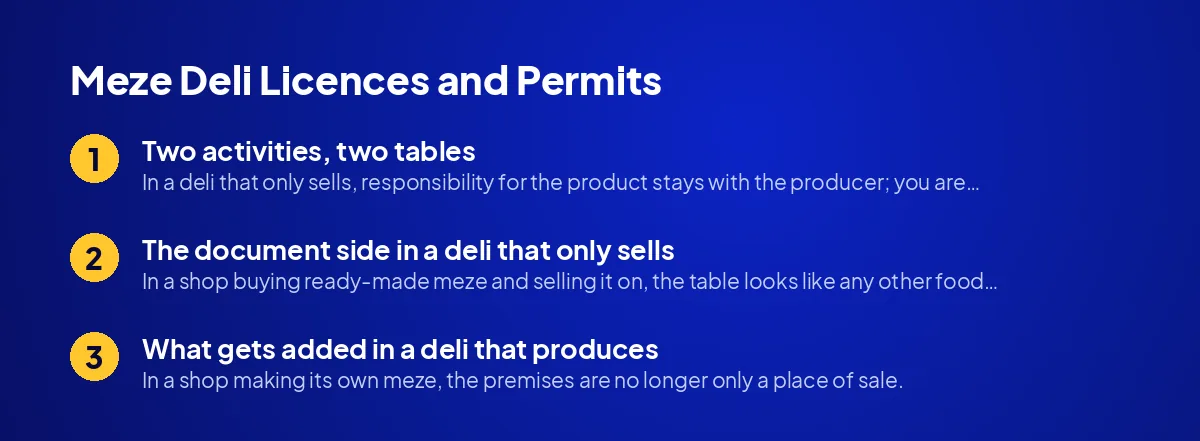
The document side in a deli that only sells
In a shop buying ready-made meze and selling it on, the table looks like any other food retail shop’s. Typically the workplace opening and operating licence, the food business registration certificate (issued by the provincial directorate of agriculture and forestry), the tax certificate, chamber registration and hygiene training certificates for staff are requested.
The real burden here is not the paperwork but the chain: you must keep a record of where the product came from, its batch and its expiry date. Because you handed it to the customer, the first question comes to you.
What gets added in a deli that produces
In a shop making its own meze, the premises are no longer only a place of sale. The preparation area is expected to be separated from the sales area, raw materials stored apart from finished products, and the cleaning regime set out in writing.
In some production businesses the appointment of a responsible manager also comes into play. Whether that is expected in your own activity depends on the subject of production and the capacity; obtain written confirmation from the provincial directorate of agriculture and forestry.
Where exactly does the line begin?
Let me say this too: many founders answer with “I do a bit of blending”, and that “bit” finds no echo at inspection. The operations below move you, in practice, towards the production side.
- Processing a raw material to create a new product: making haydari, atom or şakşuka
- Opening a ready-made product, putting it into your own container and selling it under your own label
- Blending two products to obtain a third
- Packaging under your own brand and supplying other outlets
None of this is forbidden; it simply has to be done within the right scope. The trouble comes from producing while appearing to only sell.
The one situation that stays grey
Simple preparations made in front of the customer, to their order, can be assessed differently from products prepared in the back and placed on the counter. The distinction varies by province; for your own file ask the district municipality and the directorate for written confirmation.
The cold chain is the backbone of the trade
Meze has a short shelf life and is sensitive to temperature. So refrigeration here is not a choice of equipment but a founding condition of the business.
Recording the display cabinet’s temperature through the day, opening the lid less often, and selling in the order goods entered are the three basic habits. Together they cut product loss noticeably.
Labelling and information for the customer
In packaged sales the label is expected to be complete; in loose sales the product’s contents and allergen information are expected to be presented visibly to the customer.
If you sell your own product under your own label, every line on it becomes your declaration. An optimistic expiry date creates trouble not at the first inspection but at the first complaint.
Which model should you start with?
The sales model is quick to set up, keeps capital in stock and lets you learn your customers. The margin is limited, because the product is comparable.
The production model is slow and calls for premises and staff; in return the product is yours and the margin widens. The right order is usually: sell first, learn which meze turns over, then produce those two or three lines yourself.
The price of going in the reverse order
Those who begin with production take on premises and staff before knowing what sells. A production set-up built when capacity is full stands on its own feet; one built without volume ties up capital.
Is a mixed model possible?
It is possible, and in practice the most common arrangement: buying some lines in and making others yourself. But the production side’s conditions must be met separately, however small it is.
The same warning holds for contract production. If the product reaches the customer under your label, the chain of responsibility touches you; set out in the contract who does what and who keeps which records.
The premises plan is decided at the outset
When viewing premises, what matters is not floor area but whether the space can be divided. If you may move to production, look for a place where the preparation area, raw material store and sales area can be kept apart.
The water and drainage line decides next. Water use in a preparation area is heavy, and plumbing cannot be run in afterwards. Have the right to alter the premises written into the lease.
Four questions to ask while viewing premises
- Can the preparation area be physically separated from the sales area
- Can the water and drainage line be carried to the preparation area
- Is there enough electrical capacity for the refrigeration cabinets
- Can condominium consent be obtained if the building is residential
If the answer to those four is no, the place may suit the sales model but not production. Today’s decision draws tomorrow’s boundary.
Now you know this
Opening a meze deli is not one trade but two, and the line begins at the kitchen door. That decision changes your plan for the space even while taking premises; finding a place where a preparation area can be built beats dividing one later.
For the general order authority by authority see the business licence roadmap, for the point at which cold chain responsibility passes to the seller see our delicatessen article, and if you are considering mass production see our catering article. For capital and earnings bands have a look at our herbalist and food sector page.
In Short
- A deli that sells and a deli that produces are two different kinds of business
- The line begins at the kitchen door, not on the signboard
- In the sales model responsibility sits with the producer; in production it sits with you
- In production the preparation area is expected to be separated from the sales area
- In some production businesses a responsible manager has to be appointed
- Selling a ready-made product under your own label moves you towards production
- Have the grey situations confirmed in writing by the directorate
- Refrigeration is not a choice of equipment but a founding condition of the trade
- Every piece of information on your own label is your own declaration
- The right order is to start by selling and move on to producing the lines that turn over
- In contract production, if the product carries your label the responsibility touches you
Quick Glossary
Food retail: the activity of a business selling a product to the customer without altering it. Responsible manager: the person appointed in some food production businesses as accountable for compliance with the rules. Cold chain: the unbroken arrangement keeping a product at a suitable temperature from production to customer. Allergen information: the sensitivity-causing contents present in a product that are expected to be declared to the customer.
Next Step
Let’s settle which model to follow and plan your space together: consultation request form.
Frequently Asked Questions
Updated: September 2026
Sık Sorulan Sorular
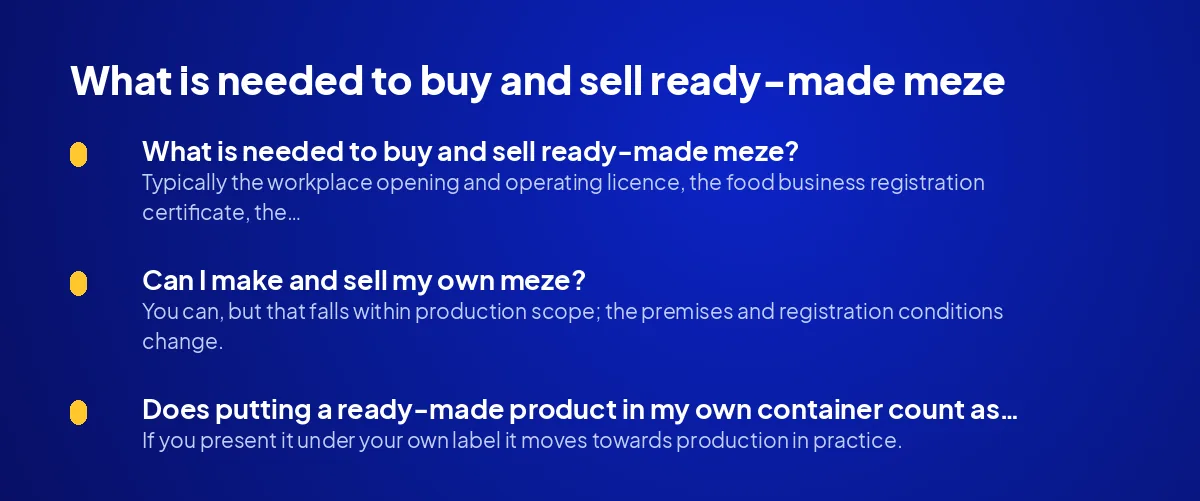
Typically the workplace opening and operating licence, the food business registration certificate, the tax certificate, chamber registration and hygiene training certificates.
You can, but that falls within production scope; the premises and registration conditions change. Ask the directorate for written confirmation.
If you present it under your own label it moves towards production in practice. Obtain written confirmation for your own file.
It is expected in some production businesses; it depends on the subject of production and the capacity.
In businesses that produce, the preparation area is expected to be separated from the sales area.
It is possible, but the conditions on the production side must be met separately, however small that side is.
For a product you make yourself, yes, and that is a declaration. For a ready-made product the supplier’s label applies.
If the product reaches the customer under your label the chain of responsibility touches you; make it clear in the contract.
In the sales model it is measured in weeks, in the production model in months.
Source: Ministry of Agriculture and Forestry — Food and Control