
Whose Document Does a Hearing Aid Centre Need?
A hearing aid centre is not an ordinary medical device sales point. Devices are not simply sold here, they are fitted to a person: hearing is tested, a device is chosen, a mould is taken and the settings are adjusted. A practitioner trained in the field is therefore expected on the premises, and the licensing process runs through the provincial health directorate.
Perhaps you did not know this: the person who must hold the document is usually not the owner but the person fitting the device. You can open a centre as an investor, but without a competent practitioner the centre cannot operate.
Why is it separate from other medical branches?
Because the work here involves testing and fitting. You can take a blood pressure monitor off the shelf and sell it; a hearing aid is chosen according to a person’s hearing loss, moulded to their ear and programmed for them.
The three stages of the work
- Testing: establishing the hearing level, which needs the right environment and equipment
- Selection and mould: deciding the device type and taking the ear mould
- Adjustment and follow-up: programming the device for the person and the later checks
All three call for expertise, and all three create conditions the premises must satisfy. A quiet testing environment, a fitting area, and a set-up for programming devices.
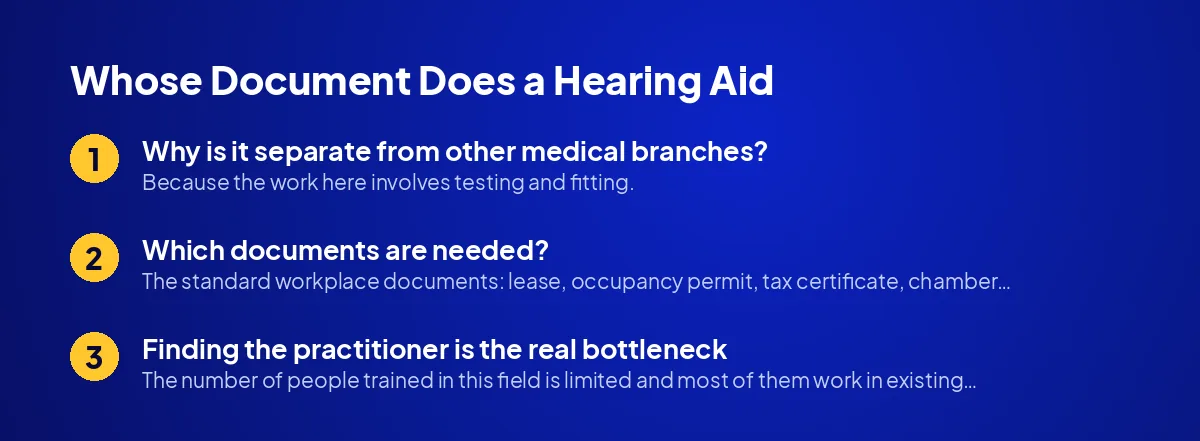
Which documents are needed?
The standard workplace documents: lease, occupancy permit, tax certificate, chamber registration, workplace opening licence, social security declaration. On the medical device side, the sales centre authorisation certificate and Product Tracking System (ÜTS) registration are added.
What really decides the matter, though, is whether the centre meets the practitioner and premises conditions, and how the provincial health directorate assesses it.
The right move to make
Before taking premises, go to the provincial health directorate, describe the work you intend to do and ask for the conditions in writing. The requirements here are detailed and they shape your layout directly; altering the premises later is both expensive and slow.
Finding the practitioner is the real bottleneck
The number of people trained in this field is limited and most of them work in existing centres. If you plan to open a centre, finding that person may be harder than finding premises.
The practical order
Find the practitioner first, then take the premises. Those who do it the other way search for staff while paying rent, and the search can run for months. Partnership or a long-term contract is a common solution in this field.
Reimbursement and sales on report
A large share of hearing aids is bought on a clinician’s report and within reimbursement cover. That shapes both the flow of customers and the cash flow.
If you will work with reimbursement bodies, a separate contract and record-keeping routine is required. Learn the conditions directly from the relevant body; they differ by device group and are updated from time to time.
Follow-up is part of the work
The job does not end when the device is sold. Adjustment, maintenance, batteries and mould renewal create a continuing relationship. That relationship is the source of both income and recommendation; build the follow-up routine as you build the centre.
Batteries and consumables are the steady part of the income
Device sales are high in value but infrequent. Batteries, filters and mould renewals are small in value but continuous. The second group carries the cash flow of the business.
The check-up appointment
Giving a check-up appointment at set intervals both preserves device performance and keeps the relationship alive. Those appointments also mean the need for a new device is noticed in good time.
Now you know this
In a hearing aid centre the answer to the document question lies not in the premises but in the person. A competent practitioner is the condition on which the centre’s operation depends, and finding that person is the step that sets the pace.
For the general licence order see the business licence roadmap, for a branch with a similar competence condition our optician shop article, and for capital bands our medical sector page.
The physical layout shapes the service
In a hearing aid centre the premises are built around testing and fitting rather than the window display. That layout affects both the quality of the service and the headings looked at on inspection.
The areas that must be separated
- Quiet test area: a section insulated from noise so the test is accurate
- Fitting and trial area: a private place where the device is worn and adjusted
- Technical area: a separate bench for mould preparation and small repairs
- Reception and waiting: positioned so it does not carry sound into the test area
The first item is the most critical. A test carried out in a noisy environment gives the wrong result, and a device programmed on a wrong result does the user no good.
When choosing premises
A high-traffic unit on a main road is good for the window but makes a quiet test area hard to build. In this trade a calmer position slightly off the main street is usually the better fit; the customer arrives on referral rather than walking in past the window.
The trial period decides the sale
A hearing aid is not a product decided on without trial. A user cannot know whether they will adapt to a device without wearing it through their ordinary day.
Offering a trial is therefore not a marketing choice in this branch but a requirement of the work. Staying in touch during the trial, correcting the settings and setting expectations properly are the steps that complete the sale.
A user who decides against it at the end of the trial is not a loss either: a process explained well leads that person to recommend you to those around them. In this branch customers come largely by word of mouth.
In Short
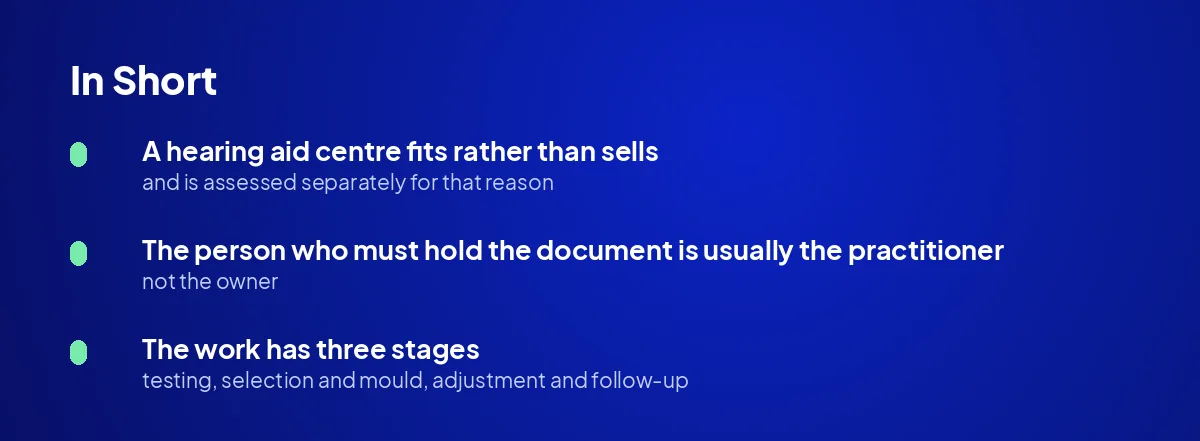
- A hearing aid centre fits rather than sells, and is assessed separately for that reason
- The person who must hold the document is usually the practitioner, not the owner
- The work has three stages: testing, selection and mould, adjustment and follow-up
- A quiet test environment and a fitting area are expected on the premises
- Ask the provincial health directorate for the conditions in writing before taking premises
- Finding a practitioner can be harder than finding premises; find the person first
- A large share of devices is sold on report and within reimbursement cover
- After-sales follow-up is part of the work and keeps the income steady
- Cash flow is carried by batteries, filters and mould renewals, not by device sales
- Premises where no quiet test area can be built undermine the accuracy of the test
- A trial is not a marketing choice in this branch but a requirement of the work
For a neighbouring branch see our medical technical service article.
Quick Glossary
Ear mould: the custom mould taken so the device sits properly in the ear. Device programming: adjusting a hearing aid to the person’s hearing level. Sales centre authorisation certificate: the document from the provincial health directorate permitting medical device sales. Reimbursement: part of the device cost being met by a public body.
Next Step
Let’s draw up your centre’s set-up and practitioner plan together: consultation request form.
Frequently Asked Questions
Updated: September 2026
Sık Sorulan Sorular
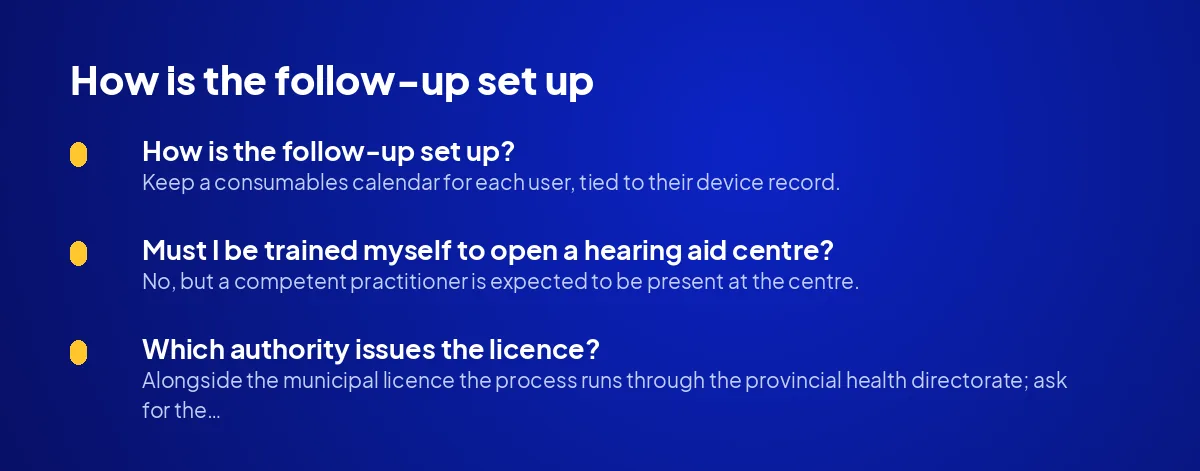
Keep a consumables calendar for each user, tied to their device record. With the battery type, average life and last purchase date on file, you can send a reminder as renewal approaches.
This simple system does two things: the customer is never left without a working device, and you gain regular sales. It also means the device’s general condition is checked whenever the user comes in.
No, but a competent practitioner is expected to be present at the centre. You can open one as an investor.
Alongside the municipal licence the process runs through the provincial health directorate; ask for the conditions in writing before taking premises.
A quiet test environment, a fitting area and a set-up for device programming; the conditions are detailed.
The number trained in this field is limited and most work in existing centres. Find the person first, then the premises.
A separate contract and record-keeping routine is required; learn the conditions from the relevant body, they differ by device group.
Adjustment, maintenance, batteries and mould renewal continue; that follow-up is a source of both income and recommendation.
Yes. Hearing aids are medical devices and traceability reporting applies.
Given the practitioner constraint, starting with one centre and settling the follow-up routine is more realistic.
Weeks if the practitioner is ready and the premises conditions are met; without those two it stretches into months.