
Dry cleaner Google Business Profile: the right category and 6 key fields
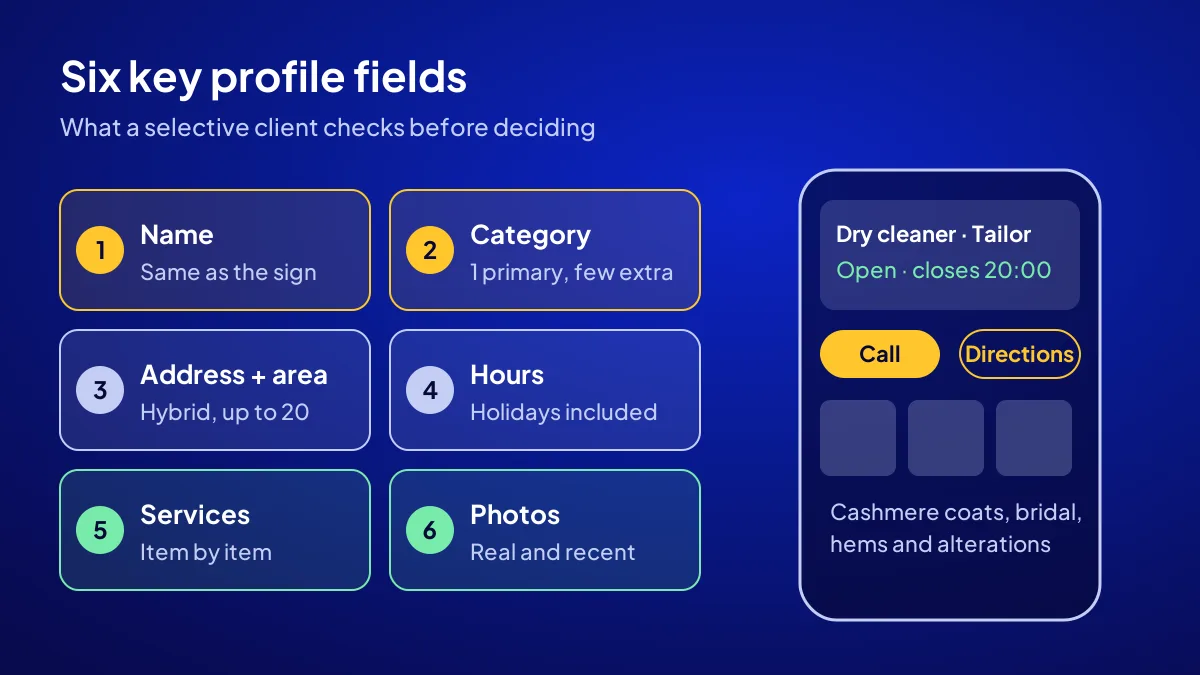
A dry cleaner Google Business Profile is the shop window a selective client sees first, and it comes down to six fields: name, category, address and service area, hours, services and photos. Fill those six correctly and someone typing “dry cleaner” in Beşiktaş finds you on the map, understands what you do and calls. Leave one out and even the passer-by goes to a competitor.
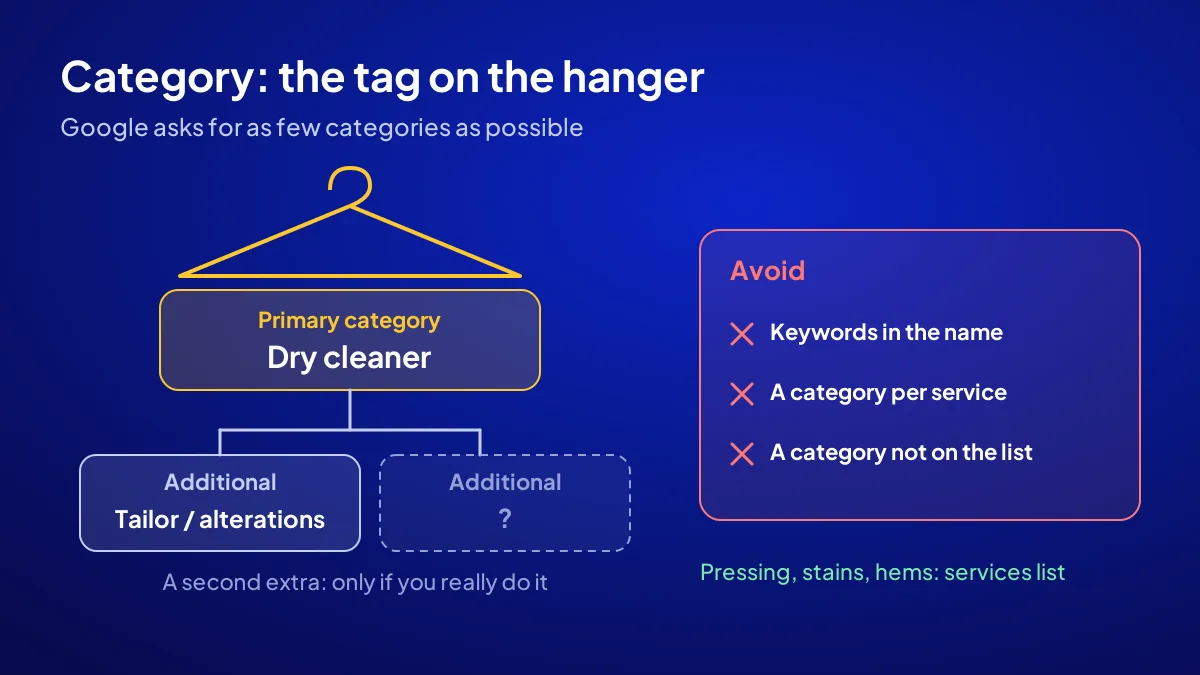
Most owners do not know this: Google asks you to pick as few categories as possible. Ticking dry cleaner, tailor, ironing, shoe shine and laundry all at once does not make the profile stronger. The better path is one primary category plus one or two additional ones for work you really do; the rest belongs in the description.
Why do these six fields start with the category?
Because the category is the first signal Google uses to decide which searches you belong in. However beautiful your photos are, a shop in the wrong category sits on the wrong rail. Think of the category as the tag on a hanger: a jacket can be stunning, but nobody looks for it on the rail marked “trousers”.
You cannot invent a category
You choose from Google’s list. You cannot type your own category name.
Describe the business, not the equipment
Google wants the category to say what the business is, not what it owns. A sewing machine in the back room does not make you a tailor; offering alterations to clients does.
How do you split primary and additional categories?
The primary category describes the work that keeps the till ringing. If most of your tickets come from dry cleaning, the primary category is the narrowest option that describes dry cleaning. If tailoring and alterations are your second income line, they go in as an additional category. Google’s own example: grocery store primary, bakery and deli additional.
A typical split for a premium shop
Dry cleaning as primary, tailor or alterations as additional. Pressing and stain removal are not categories; they are lines in your services list.
A tailoring room with its own entrance
If the tailoring side has a separate door, its own sign and its own hours, things change. Google expects separate profiles for distinct departments that serve the public on their own. If both jobs happen at the same counter, one profile is enough.
| Situation | Primary category | Additional category |
|---|---|---|
| Most tickets are dry cleaning | Dry cleaner | Tailor / alterations |
| Most tickets are alterations and sewing | Tailor | Dry cleaner |
| Tailor has its own entrance and hours | Two separate profiles | Each with its own work |
Why should the business name carry no keywords?
Because Google wants the name written exactly as it appears on your sign and official documents. Marketing taglines, phone numbers, web addresses and unnecessary extras break the rules. Gluing “best dry cleaner Beşiktaş” onto the name can, over time, lead to a suspended profile.
The same name as the sign
If your sign shows only the shop name, the profile shows the same. District and service words belong in the category and address fields; do not squeeze them into the name.
Name, address and phone the same everywhere
Same name, address and phone on Instagram, on the website and on the invoice. We walked through why that consistency matters in how to set up a Google Business Profile.
Address, service area or both?
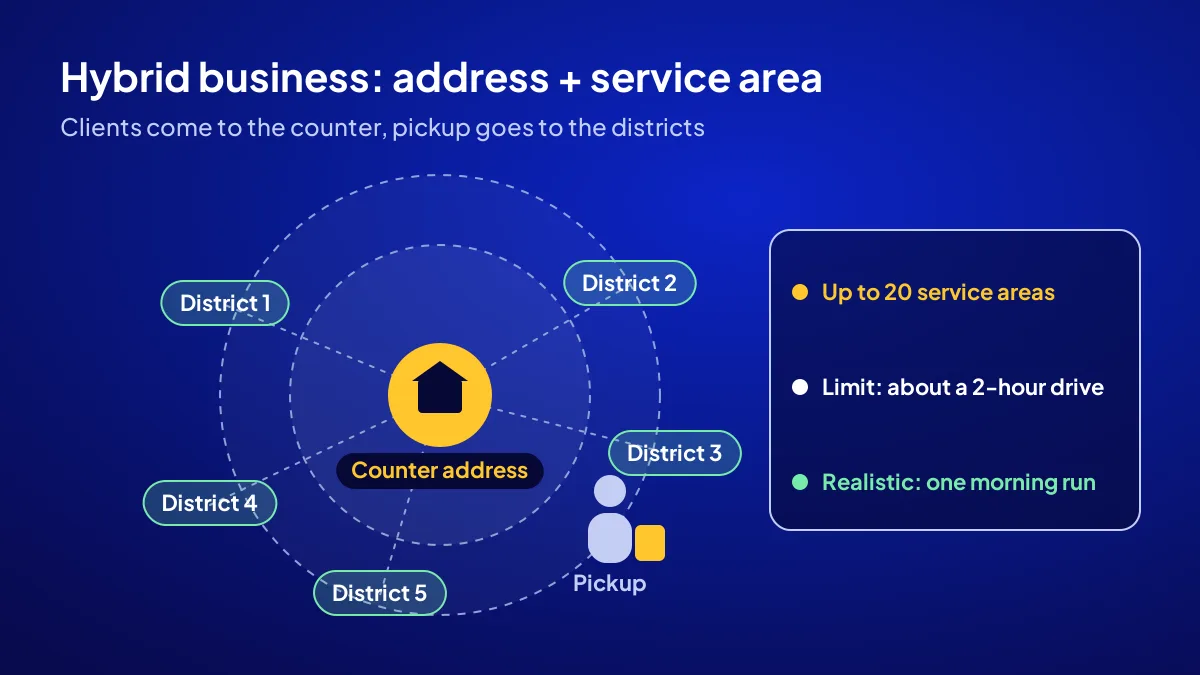
For a dry cleaner with pickup and delivery the answer is usually both. Google calls this a hybrid business: one that serves clients at its address and also delivers to their door. A hybrid business shows its storefront address and adds service areas.
Up to 20 service areas
Google lets you set up to 20 service areas by city, postal code or region. The boundary should not stretch beyond roughly two hours of driving from the business. For a dry cleaner, the realistic area is the one you can cover and return from in a single morning run.
What do hours and the opening date tell a selective client?
Hours answer the question “is it open if I go now”, and a premium client rarely gives a second chance after a wrong answer. For someone who drops a jacket on the way to work, opening at 08:00 is the service itself. If you have just opened, fill in the opening date field as well.
Regular hours and special hours
Google asks you to list the regular hours when you receive clients. Add special hours for public holidays and New Year. Showing open on a closed day turns into a review from the client who found the shutters down.
Why the opening date helps
You can enter an opening date up to one year ahead. Once the date is in and the business is verified, the profile starts appearing on Google 90 days before opening.
Which question do services and photos answer?
The services list answers “do they do this”, the photos answer “do they do it well”. List items one by one: cashmere coats, silk shirts, leather jackets, wedding dress cleaning, hemming and taking in a waist. A selective client does not trust a vague “cleaning services” line; they want to see the name of their own garment.
Six photo frames
Storefront and entrance, the counter, the pressing table, finished pieces on the rail, the tailoring corner and the garment bag you hand over. Each should be real and recent. A stock photo is where a premium expectation first cracks.
The description field
In two or three sentences, say what you do, which garments you specialise in and where you deliver. We covered how visibility works district by district in visibility in affluent districts.
What comes after the profile is ready?
The profile is a start; what brings clients through the door is the routine behind it. Check calls and direction requests from the profile once a week. If the same question comes three times, add the answer to the description. We set out the steps to the first clients, with numbers, in finding clients for a new dry cleaner.
The link to the first 90 days
The next steps are laid out in order in the first 90 days plan. The full promotion framework is in the new dry cleaner promotion guide.
Getting it set up in one go
If you want the profile, a mobile page and contact buttons set up together, the Website Recipe in the Get Visible Online campaign covers the Google Business Profile, a mobile-friendly sales page, basic SEO and visitor tracking. TRY 36,000 + VAT, paid upfront at a fixed price for a 3-month period; details on the campaign page.
Now you know: a profile is not a form, it is a hanger tag. A jacket on the right rail gets found when someone looks for it.
Quick Summary
- Google asks for as few and as specific categories as possible.
- The primary category is your main earner; the additional one is your second line.
- The business name matches your sign; no keywords are added.
- A shop with pickup and delivery is hybrid: address visible, up to 20 service areas.
- The services list names garments one by one, and photos are real.
- Regular and special hours are always up to date.
Short Glossary
Primary category: The primary category is the Google Business Profile field used to define the main business with a single option.
Hybrid business: A hybrid business is the Google term used for a business that serves clients at its own address and also delivers to or visits clients.
Service area: A service area is the profile field used to show the cities, postal codes or districts where a business goes to serve clients.
Next Step
To set up your profile, mobile page and contact buttons with a ready-made recipe, apply for the Get Visible Online campaign. Fill in the needs form and the right recipe for your shop is recommended.
Frequently Asked Questions
Source: Google Business Profile Help — Guidelines for representing your business on Google
Sık Sorulan Sorular
If you have no shop and only collect from homes to process in a workshop, the address is hidden and only the service area remains. If you have a counter that receives clients, hiding the address means losing the person who would have walked in.
The primary category is the narrowest one that describes your business best; if most tickets come from dry cleaning, that is dry cleaning. Tailoring and alterations go in as an additional category if you offer them. Google asks for as few categories as possible, and you cannot type your own category name.
Not if you receive clients at the shop. In that case you are a hybrid business: the address stays visible and the places you deliver to are added as up to 20 service areas. If you have no address where you receive clients, the address is hidden.
Yes. The Website Recipe includes the Google Business Profile, a mobile-friendly sales page, contact buttons, basic SEO and visitor tracking. The package is TRY 36,000 + VAT, paid upfront at a fixed price; at 20 percent VAT that is TRY 43,200, but check the current rate on the invoice. Results are reviewed together at the end of the first month.
Updated: October 2026