
How to find a brand name: 9 steps to a name that is available and easy to remember
Finding a brand name works by order, not inspiration: write the brand’s one-line promise, produce 30 candidates, run an ear test, and only then check TÜRKPATENT and the domain. These 9 steps take 2 to 3 days and cost nothing if you do them yourself.
A good name meets three conditions: spelled right after one hearing, hinting at the business without naming it, and open to registration and a domain. Miss one, and the name looks nice on the sign but customers cannot find you. Each step lists its time, cost and what you need.
Where do you start looking for a name?
You start from what the brand promises, not from a dictionary. Without the promise, a name ends up a pleasant word that says nothing. So the first two steps use a pen, not a screen: one hour, one sentence, one word pool.
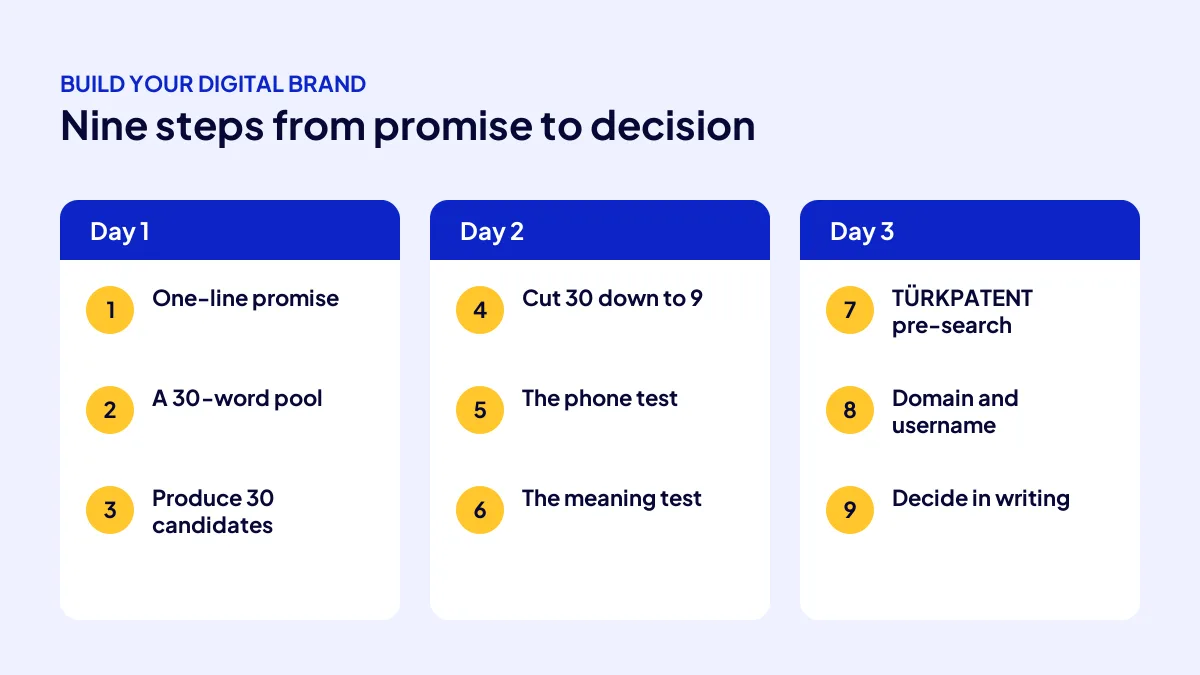
Step 1: A one-line promise (time: 30 minutes, cost: TRY 0)
What you need: pen and paper. Answer “for whom, for what, why us” in one sentence. Say you are setting up a homemade jam brand in Esenyurt, Istanbul: “Low sugar, lots of fruit, jam made to a family recipe.”
Step 2: A word pool (time: 30 minutes, cost: TRY 0)
What you need: the promise sentence. Pull 3 fields from it: feeling (warm, home, mother), material (fruit, garden, jar) and place (district, village). Write 10 words each: a pool of 30.
Which type of name suits you?
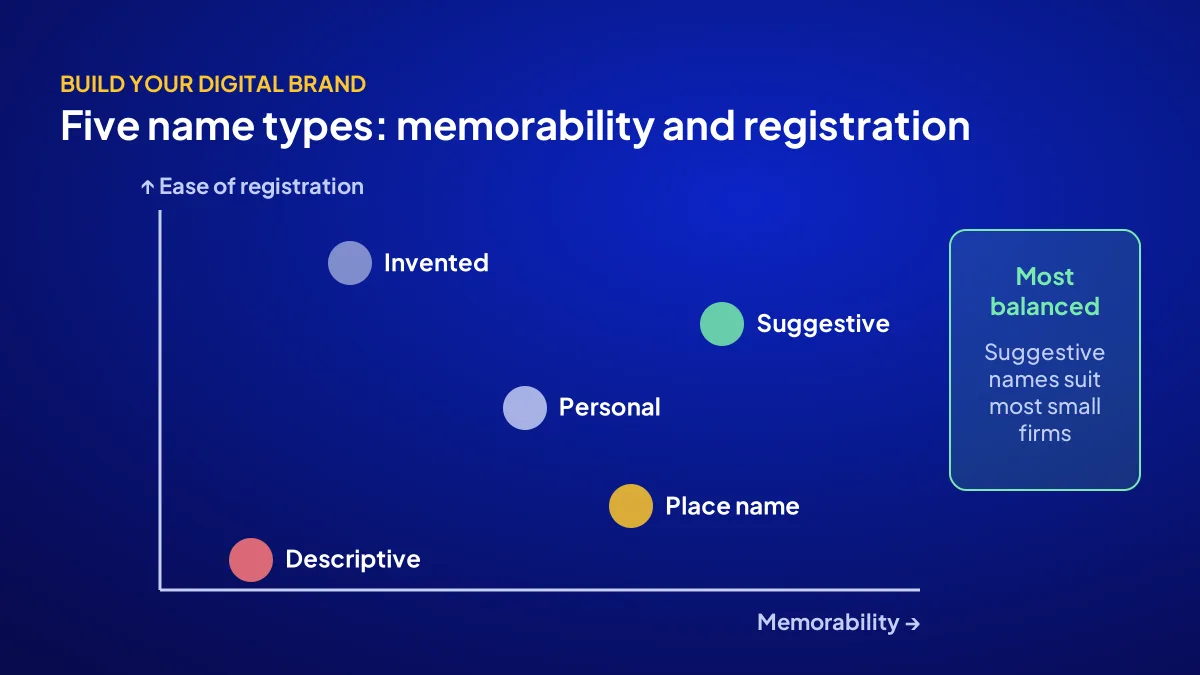
Brand names fall into five types: descriptive, suggestive, invented, personal name and place name. Each differs in memorability and ease of registration. Descriptive names that state the product’s kind or quality are usually refused for lacking distinctiveness. For most small businesses, suggestive names are the most balanced route.
| Name type | Example (hypothetical) | Memorability | Ease of registration |
|---|---|---|---|
| Suggestive | Bahçedendir (“from the garden”) | High | Medium to high |
| Invented | Rovela | Takes effort | High |
| Personal name | Nermin Hanım’s Kitchen | Warm | Medium, many similar names |
| Place name | Ören Jams | High, locally | Low, a place name alone is hard |
| Descriptive | Tasty Jam | Low | Very low |
How do you produce 30 candidates?
The rule is quantity first, elimination later. Do not cut before you have 30, because the first 5 names that come to mind have usually occurred to someone else too. Combine, shorten and play with roots. These two steps take one evening.
Step 3: 30 candidates with three techniques (time: 2 hours, cost: TRY 0)
What you need: the word pool and a pot of tea. Get 10 candidates each from combining (garden + jar), shortening (first syllables) and root play (a Latin or Anatolian root).
Step 4: First cut, from 30 to 9 (time: 30 minutes, cost: TRY 0)
What you need: the candidate list. Keep 9 that pass 3 criteria: up to 3 syllables, few Turkish-specific letters (ç, ş, ğ, ı, ö, ü), not a product category.
Common mistake: narrowing the list only by your own taste. The name is chosen not for you, but for the customer standing at the till trying to type it into a phone.
How does a name pass the ear and language tests?
A name can look good on paper and sound bad on the phone. The ear test checks spelling after one hearing; the language test checks for bad meanings abroad. Both take a day and cost nothing. Half of the 9 candidates fall out here, which is good news.
Step 5: The phone test (time: 1 hour, cost: TRY 0)
What you need: 3 people you know. Say each candidate once by phone; they write it down. Two different spellings out of three, and it is out.
Step 6: The meaning test (time: 1 hour, cost: TRY 0)
What you need: a translation tool and a search engine. Check languages your customers may speak, such as English, Arabic, German and Russian. Drop any bad, silly or brand-like meaning.
Is the name available: how do you check it at three gates?
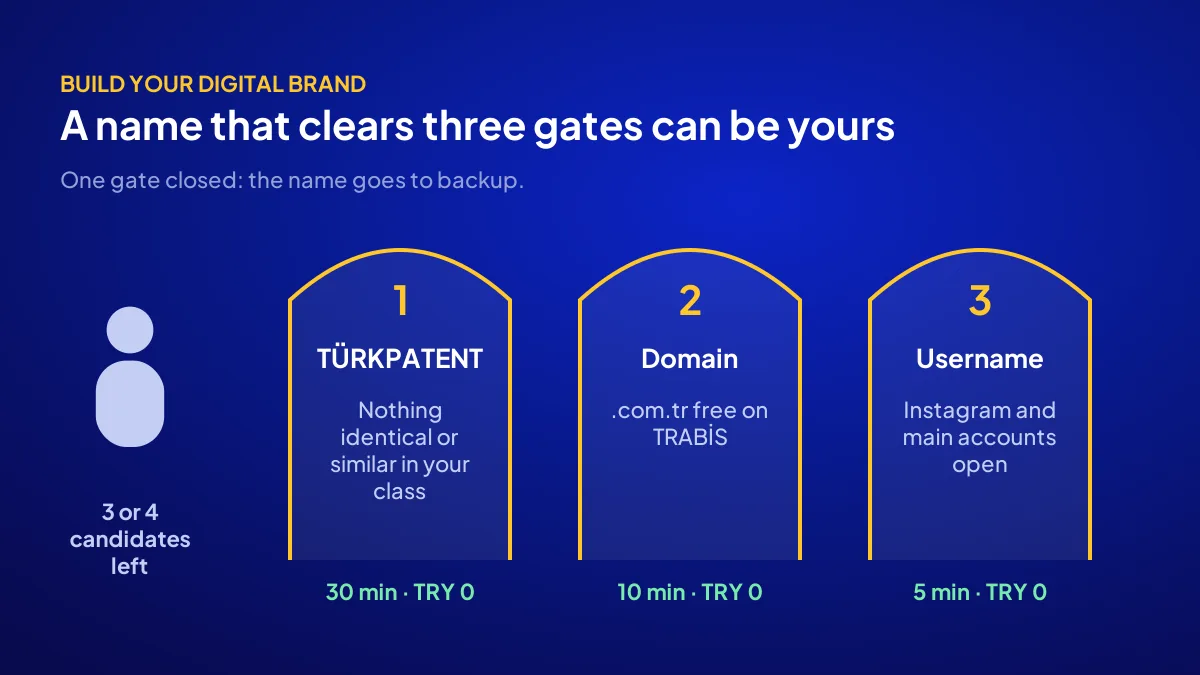
Whether your remaining 3 or 4 candidates could actually be yours is checked at three gates: TÜRKPATENT, the domain and the social media username. Each gate is free and takes 15 to 30 minutes. Fail one, and the name goes to the backup list, however much you love it. Open them in this order; the first is the hardest.
Step 7: A TÜRKPATENT pre-search (time: 30 minutes, cost: TRY 0)
What you need: candidates and 2 to 4 class numbers. Search each with “equals” and “contains”. We walk through the screen in TÜRKPATENT trademark search.
Step 8: Domain and username (time: 15 minutes, cost: TRY 0)
What you need: the “Domain Query” screen on TRABİS and your social apps. According to BTK data, 988,743 .com.tr names were registered as of the end of 2025, so short, generic names are long gone. A free .com.tr plus an open Instagram handle means a pass.
No name yet: how is one found in the campaign?
If you do not have a name yet, the Build Your Digital Brand campaign proposes one during the consulting stage. The name comes to the table alongside positioning, audience and brand language. Candidates go through a TÜRKPATENT preliminary search and availability check. This check is not a legal opinion; registration filing is an add-on offer handled with a trademark attorney.
Step 9: Decide in writing (time: 30 minutes, cost: TRY 0)
What you need: the 2 remaining candidates and a partner. Score each 1 to 5 on fit with the promise and pick the higher one. Keep the second as a backup.
Campaign price and slots
TRY 36,000 + VAT, fixed and paid upfront; with 20% VAT that is TRY 43,200, but check the current rate on the invoice. There are 12 brand slots and the last day is 1 November 2026. To apply and see details, go to the Build Your Digital Brand campaign page.
A 9-point checklist before you decide
Before saying a final “yes” to the name you like most, tick the 9 items below one by one. All yes, and the name is ready; one no, and the backup steps in. Signs, business cards and packaging all come after this list.
- There is no identical or very similar record in my class at TÜRKPATENT.
- The name does not directly state the product’s kind or quality.
- At least two of three people spell it right after hearing it once.
- The .com.tr domain is free.
- The username is open on Instagram and other main accounts.
- No bad or silly meaning abroad.
- It has no more than 3 syllables or shortens easily.
- It matches the promise sentence.
- A backup candidate is ready.
Quick Summary
- Start from a promise sentence, not a dictionary.
- Produce 30 candidates, cut to 9, then to 2.
- Suggestive names balance memorability and registration best.
- Descriptive names are usually refused registration.
- Every name passes three gates: TÜRKPATENT, domain, username.
- No name yet? The campaign proposes one.
Short Glossary
Distinctiveness: Distinctiveness is the registration criterion used to measure whether a name sets you apart from other businesses doing the same work.
Descriptive name: A descriptive name is a name used to state a product’s kind, quality or feature directly, and it is hard to register.
Positioning: Positioning is the work used to define in one sentence who the brand is for and why it should be chosen.
Next Step
If you have a name, get it checked; if not, let us find one together. Apply to the Build Your Digital Brand campaign and get the name, availability check, identity, site and 108 articles set up in one package. For the 10% coupon, just mention the code when you apply or during the call.
Sık Sorulan Sorular
A suggestive name does not state the business; it lets you feel it. Customers guess “jam”, yet the word is no product category, so it sticks and registers more easily.
If you plan to expand into other products, an invented name serves you well. The price: you fill its meaning through ads and content, and word of mouth takes longer.
A harsh name clashes with a soft-spoken brand. See how to write your tone in how to write a brand voice.
Do not wait. .com.tr names go to the first applicant, and earlier trademark filings rank first. Take the domain the week you decide.
Next comes identity: 3 directions are presented, the chosen one is finalised. We explain this method in three directions, one brand. The full build order is in building a digital brand.
Yes. A name is proposed during consulting and goes through a TÜRKPATENT preliminary search and availability check.
About 2 to 3 days on your own, mostly in the ear test and availability check.
No. A domain and a trademark are separate; owning the domain says nothing about TÜRKPATENT.
Updated: October 2026