
Mısırlı targets 111 stores by end-2027, how does a manufacturer build its own retail?
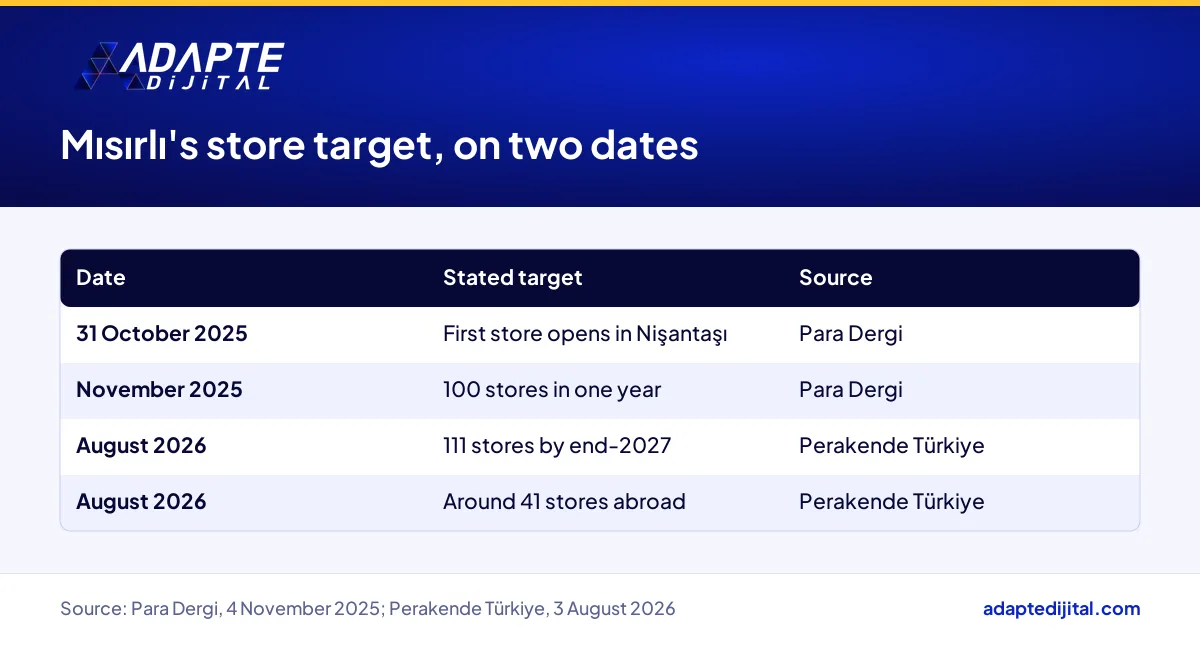
Mısırlı Underwear and Socks, a Turkish underwear and sock manufacturer, plans a physical network of 111 stores by the end of 2027, with around 41 of them abroad (Perakende Türkiye, 3 August 2026). The first store is in Nişantaşı, Istanbul, and the first store abroad is in Lefkoşa, the Turkish name for Nicosia. In Türkiye the targets are Istanbul, Ankara, Mersin and Adana; abroad, the UK, Germany, Dubai, Egypt and the US follow Lefkoşa.
What it means for you: a manufacturer with roots in contract production is planning stores, an online channel and foreign markets at the same time, to put its own name on the shelf. If you make products and dream of your own brand, the real question is in what order you open those three channels and how you prepare for each.
What does Mısırlı’s 111-store target for end-2027 cover?
The target is one physical store network covering Türkiye and abroad together. Around 41 stores are planned outside Türkiye. According to board member Murat Eren Taşçı, the retail investment was “deliberately accelerated”, and growth is supported by an online sales channel. Today’s store count is not in the report.
Why would a contract sock manufacturer like Mısırlı open its own stores?
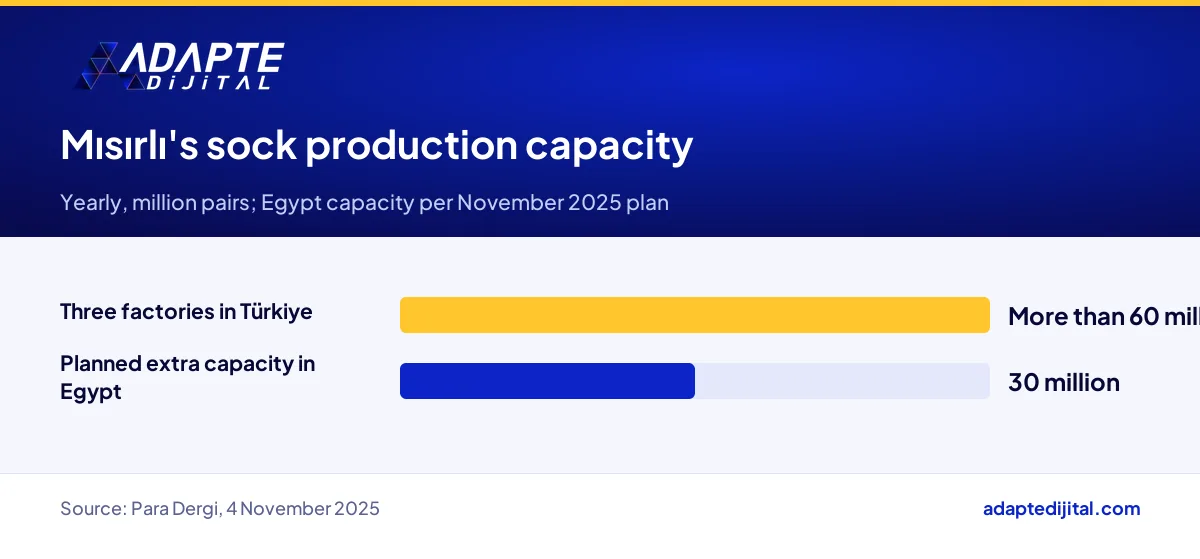
Because in contract manufacturing, the brand value stays with the client’s brand. According to Para Dergi, the company has three factories in İkitelli, Yozgat and Kütahya and makes more than 60 million pairs of socks a year. Around 80% of output goes to brands such as Hugo Boss, Tommy Hilfiger and Calvin Klein. Its own stores are a way to sell that production power under its own name.
Which manufacturers and retailers does Mısırlı’s store target affect, and how?
Textile and underwear manufacturers doing contract work feel it most, because they watch a peer turn toward its own brand. Small chains that sell socks and underwear in malls meet a new rival on the shelf. Firms offering store design, visual merchandising and e-commerce infrastructure feel it indirectly.
In what order should a manufacturer brand like Mısırlı open stores, online and abroad?
There is no single right order, but there is a sensible one. Start with one flagship store, open the online channel at the same time, then add cities at home and leave distant markets for last. Mısırlı’s announced steps follow a similar line: it starts in Nişantaşı and takes its first step abroad in Lefkoşa, a nearby market.
How does a manufacturer moving into retail like Mısırlı build its digital infrastructure?
A manufacturer’s digital gap is usually not the website; it is the product data. In contract work, product information flows into the client’s system. With your own brand, you manage product names, sizes, fabrics, photos and stock yourself. If the store, website and marketplace are not fed from the same data, the confusion shows up at the till.
What should a manufacturer weighing its own brand do this week?
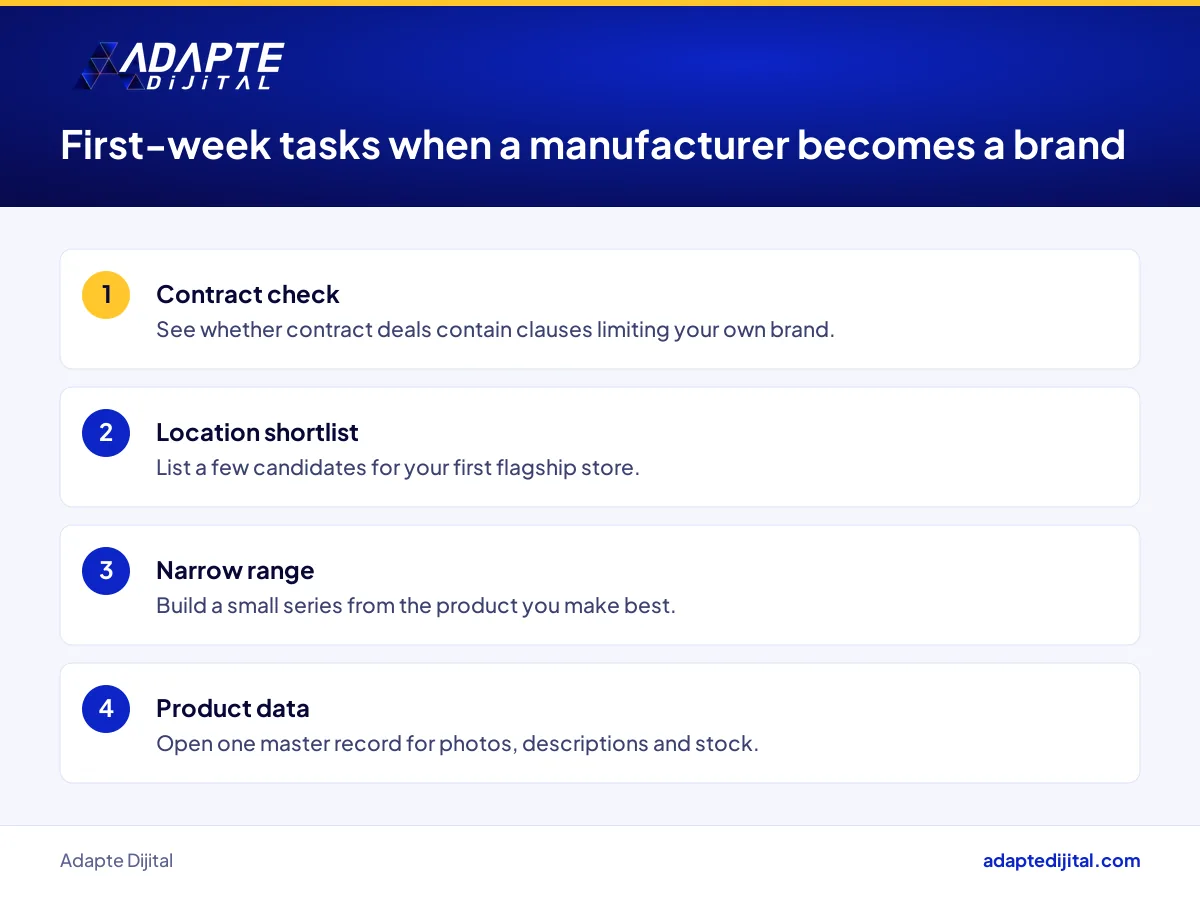
Do three things this week. Check whether your contracts with contract clients include any clause that restricts your own brand, shortlist two or three locations for a first flagship store, and choose a narrow range to sell under your own name. We build brand positioning and channel sequencing under brand consultancy.
You can find more store network stories on our retail page, where we interpret the retail agenda for you.
Quick Summary
- Mısırlı plans a 111-store network by the end of 2027, around 41 of them abroad (Perakende Türkiye).
- The first store is in Nişantaşı and the first store abroad is in Lefkoşa (Perakende Türkiye).
- In November 2025 the target was stated as “100 stores in one year” (Para Dergi).
- The company makes more than 60 million pairs of socks a year, and around 80% of output is contract work (Para Dergi).
- Today’s store count and the investment amount are not disclosed.
Short Glossary
- Contract manufacturing
- Contract manufacturing is the term used for a manufacturer producing goods to order that another brand sells under its own name.
- Flagship store
- Flagship store is the phrase used for a brand’s first, highly visible store, where it tests product, price and customer profile.
- SKU
- SKU is the stock code used to track each product variant in inventory separately.
Frequently Asked Questions
Next Step
If you want to assess your move from production to your own brand together, fill in the consult your expert form.
Sources: Perakende Türkiye, 3 August 2026 · Para Dergi, 4 November 2025 and 22 December 2025 · Fintables, July 2026 Retail Bulletin · Republic of Türkiye Ministry of Trade, Retail Trade page.
Updated: October 2026
Sık Sorulan Sorular
The Nişantaşı store opened on 31 October 2025, and at that time the target was stated as “100 stores in one year” (Para Dergi, 4 November 2025). The target announced in August 2026 is 111 stores by the end of 2027 (Perakende Türkiye).
Whether the stores will be company-owned or franchised, the investment amount and the online share of sales are not in the report. So we make no comment on the cost or profitability of the network.
According to Para Dergi, a Turkish business magazine, Münif Abdurrahman Mısırlı founded the brand in 1927. It was later acquired by Murat Eren Taşçı, owner of Eren Çorap and Aytuğ Çorap; Para Dergi spells the surname Taşcı. The brand changed hands around 2021 and was repositioned under the name Mısırlı Underwear and Socks.
Let’s say you are standing in a sock and underwear store on a busy Istanbul street. A shopper takes a pair from the shelf and walks to the till. Somewhere else, a pair from the same kind of factory line sells under another brand’s label. The difference is not in the yarn; it is in the label and the store.
Here is the surprising part. A factory that produces for world-famous brands seems to be starting from zero to make its own name known. Production quality is in place, but customer recognition is built store by store.
The report says nothing of the kind, and most output still goes to contract clients. For most manufacturers, the sensible path is to run both businesses side by side for a while. Contract work carries the cash flow, and the brand carries the long-term value.
When a peer enters retail with its own brand, the idea that a manufacturer can also be a brand gets stronger across the sector. If you are thinking about your own brand, that makes conversations with partners and investors easier.
A brand that owns its factory starts with a cost advantage. A small chain buying through middlemen will struggle to compete on price. It has to stand out on product range, service and average basket size.
According to Fintables, which reports AYD data, sales per square metre in Turkish malls rise 41.6% nominally for clothing and 33.5% for footwear in May 2026. In November 2025, Para Dergi also reported a plan for a 10 million dollar factory in Egypt, adding 30 million pairs a year and 600 jobs. We explain how to read the mall figures in our piece on AYD’s May mall index.
Price, packaging and customer profile get tested in the first store. If the product just sits on the shelf, find out why before you open a second one. Keeping the SKU count narrow at this stage makes mistakes easier to spot.
A customer who sees the product in the store often wants to make the second purchase from a phone. If the online channel is closed, that customer walks away and does not come back. At Mısırlı, too, growth is supported by an online channel.
A market that is close in language, logistics and customer profile lowers the risk. On Mısırlı’s list, Lefkoşa comes first, with the UK, Germany, Dubai, Egypt and the US as later targets. Before you open a store in a distant market, settle your local partner and your lease model.
Open one master record for each product and let photos, descriptions and stock flow from there to every channel. A different price in the store and on the website damages trust from day one.
As stores open, people start searching for the brand name. A local business profile for each store, a city page and correct opening hours turn those searches into store visits and site traffic.
Pick the product you make best for your contract clients and build one series around it. A wide catalogue creates stock pressure in the first store. A narrow range shows quickly what sells.
Store rent and staff are fixed costs that contract manufacturing never had. We look at how a brand protects margins as sales slip in our piece on Mavi’s first quarter. For contracts and company structure, verify with the official source; this is not legal or financial advice.
According to Türkiye’s Ministry of Trade, retail employs around 11.1 million people, about 56% of total employment; details are on the Ministry’s retail trade page. As a manufacturer entering that field, keep one principle. Grow the product that sells off the shelf, not the store count.
It can, but it should first check its contract agreements and test a narrow range in a single store. The online channel should be open from day one.
The report does not give today’s store count. What is known is that the first store is in Nişantaşı and the first store abroad is in Lefkoşa.
That depends on your contracts and on how different your products are. Starting with a separate series instead of a product that competes with your client lowers the risk.