
Mavi posts 543 million TL Q1 net profit, how can a brand protect margins as sales slip?

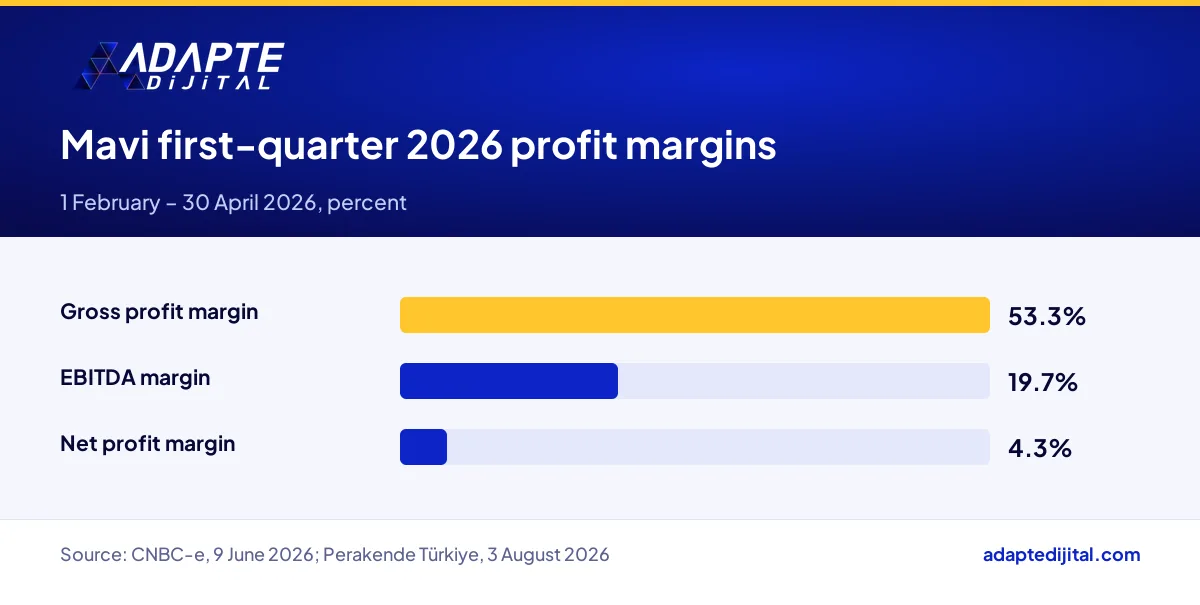
Mavi, the Turkish apparel retailer, reported TL 12.701 billion in consolidated revenue and TL 543 million in net profit for its first quarter, covering 1 February to 30 April 2026 (CNBC-e, 9 June 2026; Perakende Türkiye, 3 August 2026). Revenue fell by about 2% and net profit dropped 49% year on year, yet the gross profit margin improved by 110 basis points to 53.3%.
Here is what it means for you: sales can shrink while the share you keep from each sale grows, and the profit that reaches the bottom line can still melt away. If you run an apparel store, or any other kind of shop, you need to see which line you are protecting when demand goes quiet.
Why does Mavi’s gross margin rise while its revenue falls?
Because gross margin does not measure how many items you sell, it measures what each sale leaves over cost. Mavi’s revenue slips by about 2% while its gross profit margin climbs to 53.3% (CNBC-e). So even with fewer items sold, each item leaves a wider gap above its cost. Lighter discounting, a better product mix or lower sourcing costs can produce this result, and the reports do not say which one Mavi used.
Let’s say you run a small boutique
It is Saturday afternoon, the shelves are tidy and the till is calm. You ring up fewer receipts than last season, but you have not pulled the end-of-season sale forward. Month-end revenue is a little lower, yet the share left in your pocket is wider. Mavi’s numbers are this scene at a much larger scale.
What does Mavi’s EBITDA say while its net profit halves?
EBITDA (FAVÖK in Turkish reports) shows profit before interest, tax, depreciation and amortisation, and at Mavi it is TL 2.5 billion with a 19.7% margin (Perakende Türkiye; CNBC-e). So stores and operations keep generating cash. Net profit, however, stands at TL 543 million, down 49% year on year, with a net margin of 4.3%. Neither report explains the gap, so guessing at the cause would be a mistake.
Which businesses protect profit in slow demand like Mavi’s, and which struggle?
BU BÖLÜMÜN ÖZETİ
- Winners: boutiques and chains that sell their own brand
- Under pressure: multi-brand sellers who lean on discounts
- Indirectly affected: mall tenants and suppliers
Businesses that know their gross margin, turn stock quickly and know their customers have an easier time. Retailers who prop up sales with discounts and carry stock on borrowed money struggle. At Mavi, retail sales in Türkiye fall 0.8% and online sales fall 4.3% (CNBC-e). Even in a large chain, a slowdown reshuffles profit line by line.
Winners: boutiques and chains that sell their own brand
A business selling its own brand sets its own prices and builds its own product mix. That gives it more room to defend gross margin. A brand store in a mall and a design boutique in your neighbourhood use the same advantage at different scales.
Under pressure: multi-brand sellers who lean on discounts
A shop selling other people’s brands has little room to negotiate on price, so its margin is harder to protect. When customers walk out empty-handed and the owner answers with deeper discounts, the average basket may hold up while the profit disappears.
Indirectly affected: mall tenants and suppliers
Large chains’ investment plans shape a mall’s tenant mix and supplier orders. We cover the mall side in our article on the mall sales productivity index.
How do Mavi’s loyalty programme and app data support profitability?
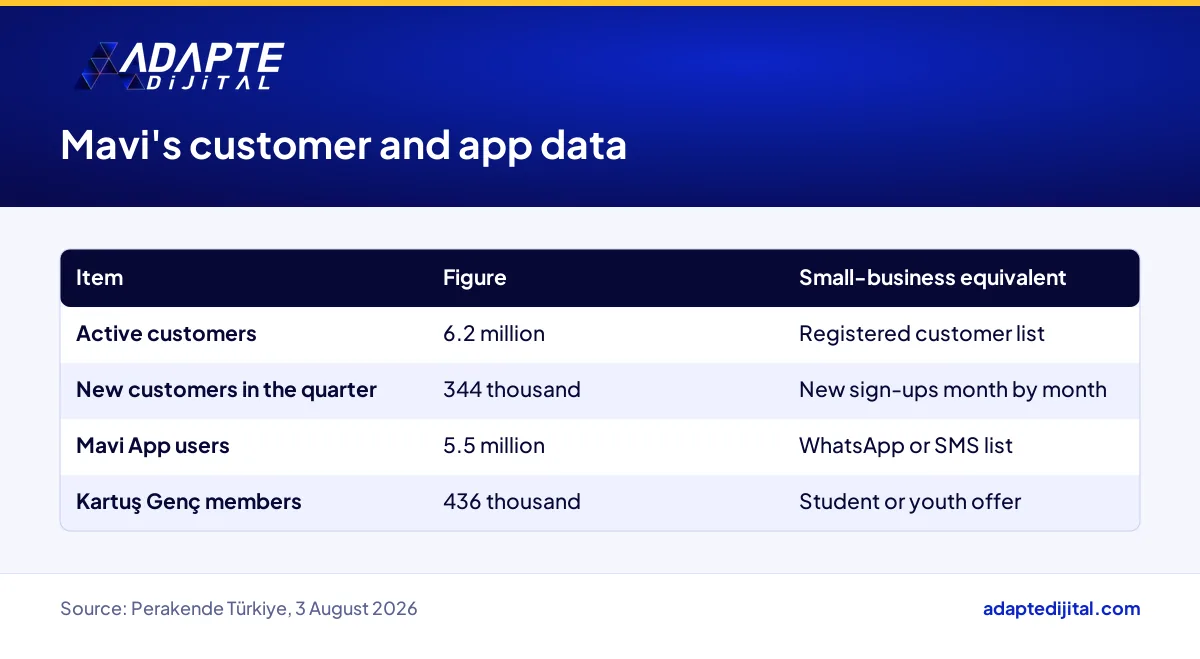
Knowing your customers lets you give a discount to the right person instead of everyone. Mavi has 6.2 million active customers, 344 thousand of them new this quarter, while Mavi App has 5.5 million users and the Kartuş Genç youth programme 436 thousand members (Perakende Türkiye). That data supports personal offers instead of blanket discounts. The report does not say in detail how the company uses it.
Where does Mavi’s sales slowdown show up in digital channels?
It shows up in online sales, search visibility and customer data. Mavi’s online sales fall 4.3% (CNBC-e), so the digital channel does not escape the slowdown either. What protects profit online is not a bigger ad budget but bringing existing customers back and product pages that sell. Showing up in local search also feeds foot traffic.
What should a store owner do this week to protect margins, given Mavi’s results?
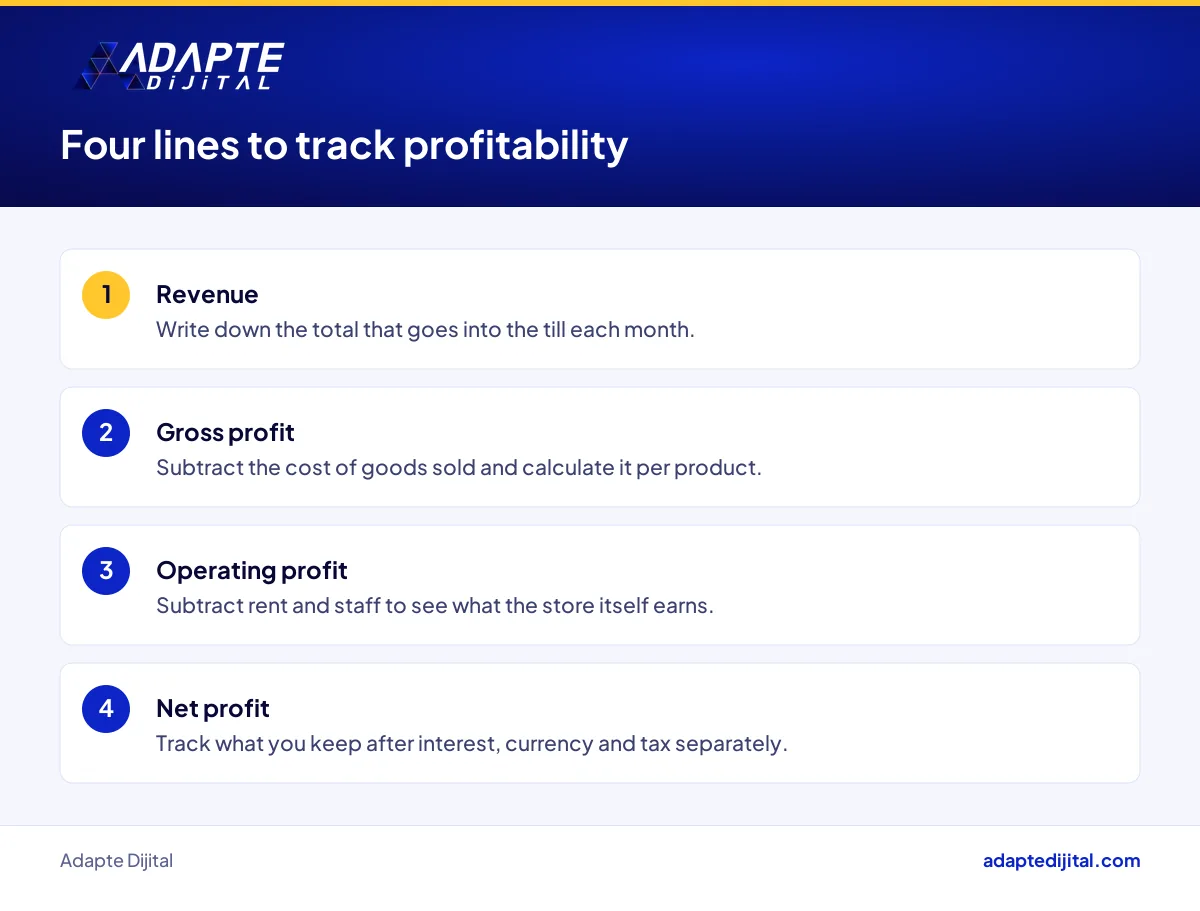
Start by calculating three lines separately: revenue, gross profit and the net amount you actually keep. Then work out the gross margin of your ten best sellers and flag the products that sit on the shelf longest. Mavi’s results show that margin can be managed even when revenue falls. Do not decide on a campaign before you see your own table.
Quick Summary
- Mavi reported TL 12.701 billion in revenue and TL 543 million in net profit for the first quarter of 2026 (Perakende Türkiye; CNBC-e).
- Revenue fell about 2% while the gross profit margin rose 110 basis points to 53.3% (CNBC-e).
- EBITDA came to TL 2.5 billion with a 19.7% margin, while net profit was down 49% year on year (Perakende Türkiye; CNBC-e).
- The reports do not explain the drop in net profit or say whether the figures are real or nominal.
- The lesson for a small business is to track revenue, gross profit and net profit separately and manage discounts with data.
Short Glossary
- Gross profit margin
- Gross profit margin is the measure used to show what share of revenue remains after the cost of goods sold is subtracted.
- EBITDA
- EBITDA is the operating profitability indicator used to show earnings before interest, tax, depreciation and amortisation, called FAVÖK in Turkish reports.
- Basis point
- A basis point is the unit used to describe percentage changes, equal to one hundredth of a percentage point.
Frequently Asked Questions
Next Step
If you would like to read your revenue, margin and customer data together, fill in the consult your expert form and we will make a first assessment for your business.
Sources: Perakende Türkiye, 3 August 2026 · CNBC-e, 9 June 2026 · Mavi investor relations (mavicompany.com)
Updated: October 2026
Sık Sorulan Sorular
No. Revenue is the total money that goes into the till. Gross profit is what remains after you subtract the cost of the goods you sold. Revenue can fall while the gross margin rises, because the two answer different questions.
Not at all. Product mix, negotiation with suppliers, stock turnover and return rates all move gross margin too. Out-of-season stock that sits on the shelf eventually leaves at a low price and drags the average down.
Financing costs, currency differences, depreciation and tax all live in that space. Even when the store performs well, these items can shrink the last line. The lesson for an owner is simple: track operating profit and take-home profit in separate books.
Mavi ends the quarter with a net cash position of TL 7.037 billion (Perakende Türkiye). A cash-strong business can pay suppliers upfront for a discount in a slow period and leans less on loans.
The reports do not make that clear. It is not stated whether the declines are real, meaning inflation-adjusted, or nominal. Before you compare them with anything, check the company’s own disclosure. This is not investment advice, and it contains no comment on the share price.
Revenue is the result of one period, while active customers are the potential of the next one. A customer who comes back costs less in advertising than a new customer you still have to find.
You do not need an app. Sign-up with a phone number, a simple purchase history and a birthday offer are enough to start. What matters is knowing which customer comes in and how often.
Treating one age group on its own, the way Mavi does with Kartuş Genç, sharpens the language of your campaigns. On a small scale, that can be a student discount or a back-to-school offer.
Retargeting people who already know you usually works better than broad ads to a cold audience. Look at the gross margin of the orders your ads bring in, not only the cost per click.
Accurate photos, a size chart and clear return terms lower the return rate. Up-to-date opening hours and stock information on your business profile also keep customers from making a wasted trip.
Your customer data should live in your own system, not on a marketplace. A marketplace brings sales, but it builds the customer relationship in your place.
Open the last three months of sales product by product. Separate the items that go on sale often and turn over slowly. Before reordering them, check their sales speed one more time.
Instead of cutting prices, try an outfit bundle or a deal on the second item. It raises the average basket while wearing down gross margin less. Announce the offer to your registered customers first.
Reading sales, advertising and customer data in one table takes time. We do this work alongside businesses through our digital consulting service.
For brands looking for growth in flat demand, see our article on Türkiye’s cosmetics market. You can find the company’s own disclosures on Mavi’s investor relations site. Our retail page, where we interpret the retail agenda for you, stays up to date as well.
Yes, it can. Fewer discounts, a better product mix or cheaper sourcing widen what each sale leaves behind. To see it, you need to calculate revenue and gross profit separately.
A rough calculation is useful. What remains after rent, staff and the cost of goods sold shows what the store earns from its own work. Keep loan interest and tax on separate lines.
No, you do not. Signing customers up by phone number and keeping a simple purchase history is enough to start. An app is worth considering once your customer base grows.