
Retailers Ask Malls for 1–2 Month Rent Deferral: What 6 Signals Mean for Your Store
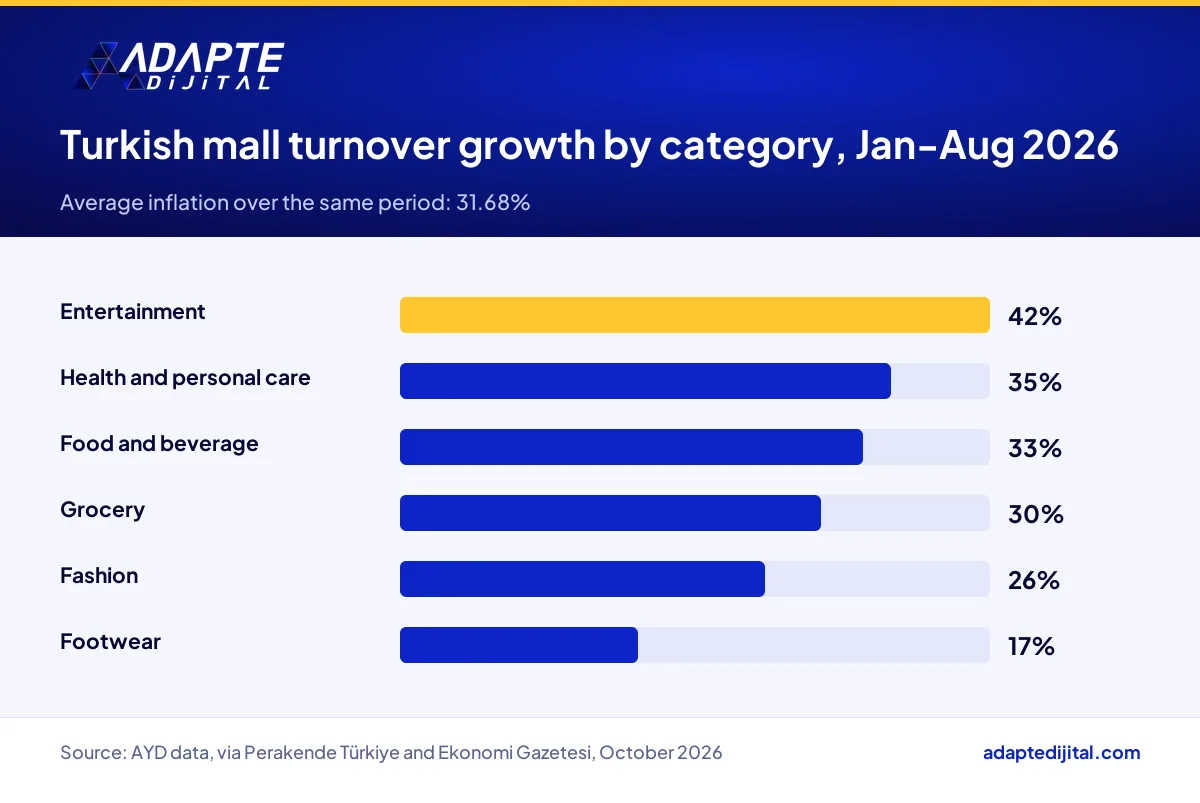
Some retail brands are asking Turkish shopping malls to defer rent payments by one to two months (Perakende Türkiye, 1 October 2026). In the Ekonomi Gazetesi interview behind the story, Nuri Şapkacı, chairman of AYD, Türkiye’s Shopping Centers and Investors Association, says mall turnover grew 30% in the first eight months of 2026, against 31.68% average inflation. Visitor numbers are flat, and categories are pulling apart.
Here is what it means for you: if you run a store in an AVM, the Turkish term for a shopping mall, rent is now a cash question you negotiate. Şapkacı calls the situation manageable, thanks to strong balance sheets built in 2022-2024. The outlook is a harder first half of 2027, with recovery in the second half. In that window, the tenant who arrives without data signs the most expensive deal.
Why are rent deferral requests at Turkish malls rising in autumn 2026?
For three reasons: turnover is running behind inflation, footfall is standing still, and spending is moving from fashion to experiences. Look, asking for a deferral usually does not mean a business is going under. When cash in and cash out stop lining up, it is the first reflex.
What do the 6 signals in the AYD figures tell your mall store?
Read together, they say Turkish malls are full, but the tills inside are not filling evenly:
- Some brands are asking for one to two months of rent deferral.
- Mall turnover is up 30% in the first eight months, against 31.68% average inflation.
- Visitor numbers are level with last year.
- Categories are diverging: entertainment is up 42% while footwear is up only 17%.
- The first half of 2027 is expected to be harder, with textiles and fashion hit hardest.
- Occupancy at successful malls sits at 95-100%, and new large mall projects are limited.
Which stores do the mall rent deferral requests affect, and how?
BU BÖLÜMÜN ÖZETİ
- Under pressure: fashion, textile and footwear stores
- Doing better: entertainment, personal care and food and beverage
- Indirectly affected: grocery chains, small tenants and suppliers
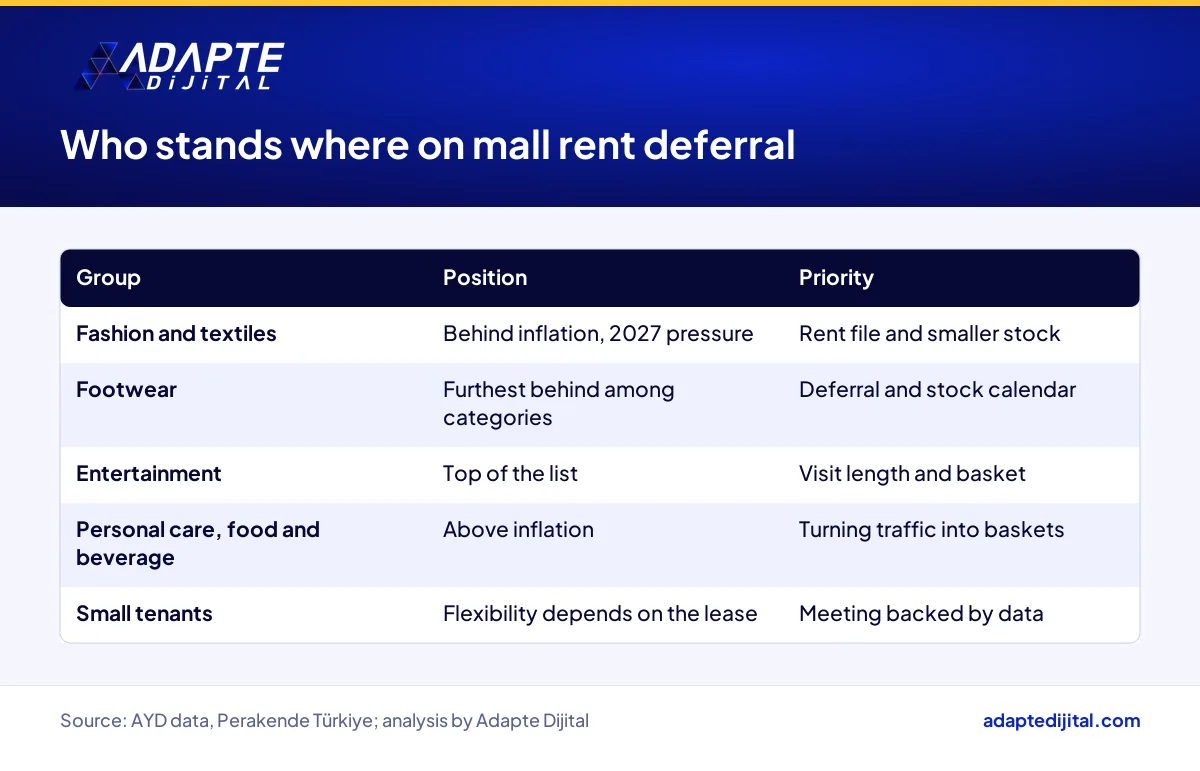
They hit textile, fashion and footwear stores hardest, while entertainment, health and personal care, and food and beverage businesses sit in a more comfortable zone. Small tenants in the mall’s tenant mix and their suppliers feel it indirectly, because a delayed payment slides down the chain.
Under pressure: fashion, textile and footwear stores
Fashion at 26% and footwear at 17% trail inflation by the widest margin. Textiles and fashion are also named as the area hit hardest in the first half of 2027. We look separately at why a big fashion chain still opens large stores in this climate through Mavi’s new store at 67 Burda Mall in Zonguldak.
Doing better: entertainment, personal care and food and beverage
Entertainment leads the list at 42%, and the story mentions seasonal jumps of up to 350% at cinemas. Shoppers are shifting budget toward socialising and experiences. Here the question is how to turn the same traffic into longer visits and bigger baskets.
Indirectly affected: grocery chains, small tenants and suppliers
Grocery sits right at the average with 30%, and you can see the scale of a large grocer in Migros’s first-half sales as filed on KAP, Türkiye’s public disclosure platform. The more sensitive group is the single-branch café or cosmetics shop, whose lease may not carry the flexibility a big tenant wins.
Should your mall store ask for a rent deferral, and what data should you bring?
If your cash gap is temporary and seasonal sales will close it, asking for a deferral makes sense. If turnover is falling for good, a deferral only postpones the problem by two months. Let me ask you one thing: over the last six months, has your sales per square metre grown faster or slower than your rent? Your answer makes the decision for you.
How can online orders and local search ease a mall store’s rent burden?
By loading a second sales channel onto the same square metres. If the store becomes the pickup point for online orders on top of mall traffic, rent is spread over two channels instead of just the people who walk in. Local search also points visitors already in the building toward your door.
What should a mall store owner in Türkiye do this week?
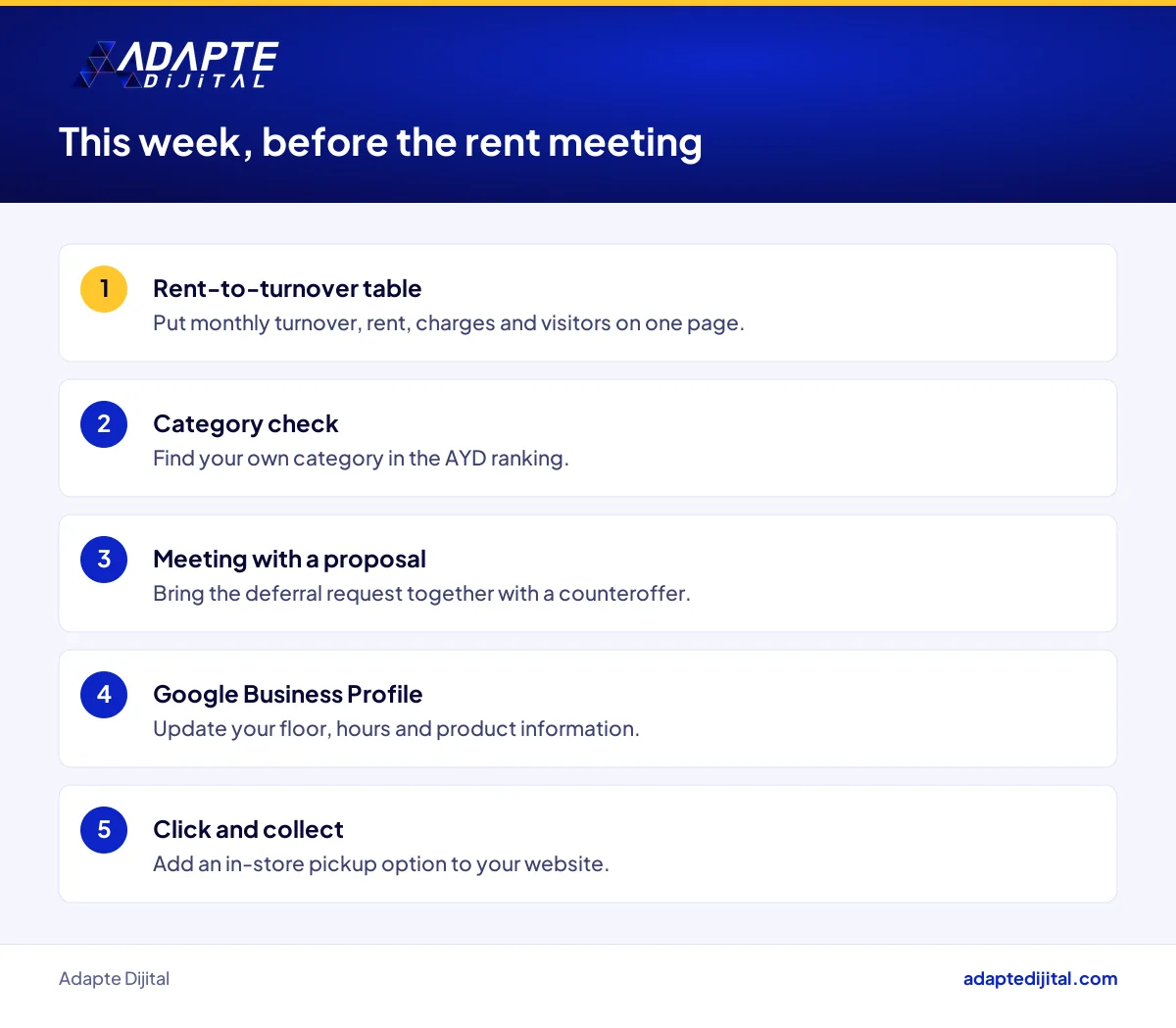
Do three things this week: pull a rent-to-turnover table for the last 12 months, compare your category with the AYD ranking, and put a first meeting with mall management in the calendar. Bring a proposal built on data, and finish two digital settings in the same week.
Quick Summary
- According to Perakende Türkiye, some brands are asking Turkish malls for one to two months of rent deferral.
- Per AYD figures, mall turnover rose 30% in the first eight months of 2026 while average inflation was 31.68%.
- Visitor numbers are level with last year, so growth has to come from basket size.
- In the category data from the story, entertainment leads at 42%, while fashion at 26% and footwear at 17% trail inflation.
- The first half of 2027 is expected to be harder, so store owners should negotiate rent with sales per square metre and digital traffic data.
Short Glossary
- Rent deferral
- Rent deferral is the payment arrangement used to move a rent payment to a date later than the one in the lease.
- Sales per square metre
- Sales per square metre is the productivity measure used to show how much revenue each square metre of a store’s selling space generates.
- Tenant mix
- Tenant mix is the planning concept used to describe the spread of stores, categories and brands inside a shopping mall.
Frequently Asked Questions
Next Step
If you want to read your rent-to-turnover table and your digital channel data together, fill in the consult your expert form and we will decide the first step for your store together.
Sources: Perakende Türkiye, 1 October 2026 · Ekonomi Gazetesi, 30 September 2026 · AYD-Akademetre mall index, August 2026 · Turkish Ministry of Trade, Shopping Centres. For more on category data and the 2027 outlook, see our retail page, where we interpret the Turkish retail agenda for you.
Updated: October 2026
Sık Sorulan Sorular
Because 30% turnover growth sits below 31.68% average inflation. The sign says growth, the bank account says shrinkage. If staff, energy and rent move with inflation and sales fall one step behind, the till stops turning.
The story puts visitor numbers at the same level as last year. So new customers are not arriving, and growth can only come from average basket size or conversion rate. Keep pushing the price tag up, though, and at some point that customer turns around at the entrance.
Şapkacı’s reading leans toward the second. Brand balance sheets are solid, and the requests are limited to one or two months. Let’s say your store tied up cash in stock at the start of the season and sales only pick up mid-season. Two months of shifted rent works as a bridge across that gap.
The fourth one. A 30% average makes everyone look the same, yet fashion at 26% and footwear at 17% sit well below inflation, while personal care at 35% and food and beverage at 33% sit above it. Find your own category before you plan.
With occupancy at 95-100%, a departing store is easy to replace, so management is not driven by fear of losing tenants. Limited new large mall projects also narrow your options to move. Your leverage comes from the traffic and turnover data you bring to the table.
The AYD-Akademetre index shows 22.9% nominal growth and a 6.5% real contraction for August alone. The story’s 30% covers eight months, from an unclear calculation. In your negotiation file, note which figure you use and its source.
Deferral suits a strong brand with a temporary cash squeeze, and a temporary discount suits a tenant in lasting decline who wants to stay. Turnover rent ties part of the rent to sales and shares the risk. Which one fits depends on your lease; read the regulatory framework for malls on the Turkish Ministry of Trade’s shopping centres page. Verify with the official source; this is not legal or financial advice.
Monthly sales per square metre, rent plus service charges as a share of turnover, and the visitors you bring into the mall. Here’s the thing I keep seeing: a tenant with these three numbers makes a proposal, not a plea. I call it the “three-line rent file”, updated every month in the same format.
The expectation is that recovery waits until the second half of 2027. So build a cautious scenario for the first six months and line up rent, stock and staff against it. In fashion, smaller stock batches lower the risk of product sitting on the shelf.
A customer who orders online and picks up in store removes your shipping cost and steps inside your shop. Any add-on sale at pickup raises the yield of the space you rent, as long as stock data matches between website and store.
Mall visitors often search “near me” on their phone. If your profile shows floor, hours, product photos and stock, your share of a fixed visitor pool grows. Let’s say your competitor’s profile is empty: same corridor, two stores, one visible.
Direction requests, search clicks and click and collect orders prove you bring traffic into the mall. I have been looking at store owners’ digital dashboards for years, and in most businesses I see this data sitting there, never opened.
Put monthly turnover, rent, service charges, visitors and average basket on one page. You will see at once which months rent climbs as a share of turnover. The same table drives your stock and staffing decisions for early 2027.
Put a proposal on the table, not a problem: “I am open to extending the lease in exchange for a two-month deferral”, for example. A full mall still wants reliable tenants. Remember, the most persuasive line in a negotiation is sometimes a spreadsheet cell. At least it lasts longer than the mall manager’s coffee.
Update your Google Business Profile with floor, hours and products, and add a “pick up in store” option to your website. We build this setup with businesses, linking store data to the rent negotiation and the digital channel, in our digital consulting work. My decision is clear: sit down at the rent table this month, with data, and with your second channel already open.
A request alone does not break the lease, but any change to the payment date should be made in a written addendum. Do not rely on verbal approval; read your lease with a lawyer.
It can, but you need data. A tenant who shows sales per square metre, rent-to-turnover ratio and the traffic they bring to the mall speaks with more weight, whatever their size.
First split your stock purchases into smaller batches, then open second channels such as click and collect and local search. Your rent negotiation stands on firmer ground after those two steps.