
Migros First-Half Sales Reach TL 241.3 Billion: What the KAP Filing Tells Retail

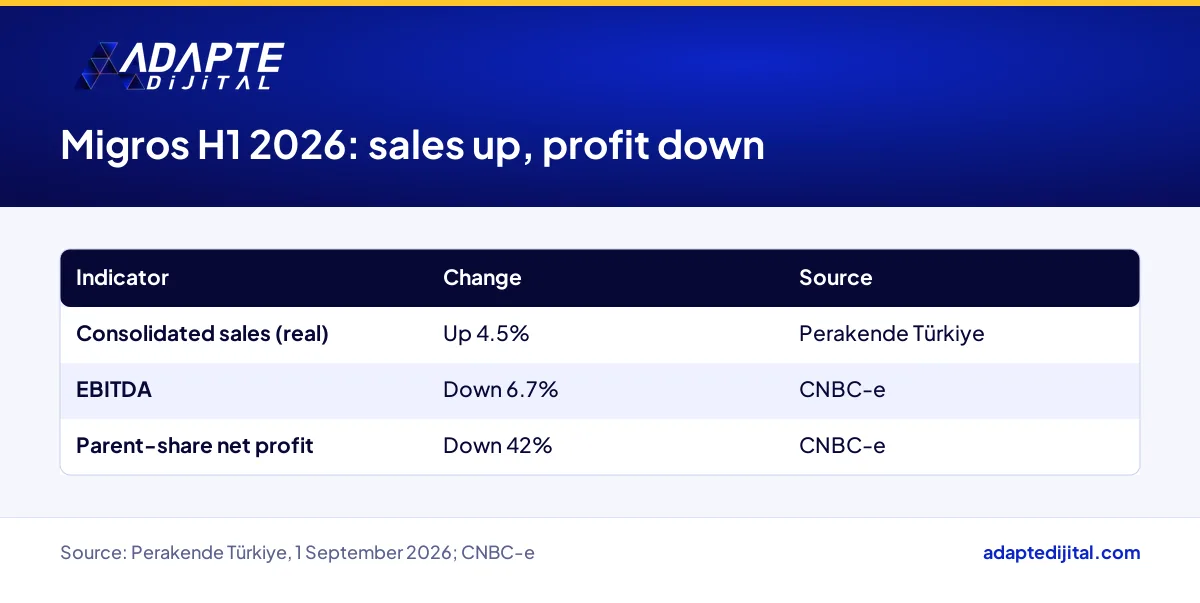
Migros, one of Türkiye’s largest food retailers, reports consolidated sales of TL 241.3 billion for the first half of 2026, up 4.5% in real terms (Perakende Türkiye, 1 September 2026). The financial report the company filed on 11 August 2026 with KAP, Türkiye’s public disclosure platform, shows profit for the period of about TL 1.08 billion. Net profit attributable to the parent company is about TL 1.01 billion, and the store count stands at 3,830.
What it means for you: at a 3,830-store food retailer, sales grow while profitability gets squeezed. Every retailer holding shelf prices with discounts in 2026 feels the same squeeze. The lesson for a small store: watch margin, not turnover.
Which figures stand out in Migros’s first-half 2026 KAP report?
Revenue, profit, cash and channel figures. According to KAP, revenue for 1 January to 30 June 2026 is TL 241,298,039 thousand, or about TL 241.3 billion. The table gives each figure its source and a one-line reading; the two profit rows use different definitions.
| Indicator | Figure | Source | What it says |
|---|---|---|---|
| Consolidated sales | TL 241.3 billion | KAP, Perakende Türkiye | Volume grows; customers keep coming. |
| Real sales growth | 4.5% | Perakende Türkiye | Growth stays above inflation. |
| EBITDA | TL 10.967 billion, down 6.7% | CNBC-e | Operating profit does not follow sales. |
| Net profit, parent share | ≈TL 1.01 billion, down 42% | KAP, CNBC-e | The bottom line narrows sharply. |
| Net cash position | TL 31.8 billion | Perakende Türkiye | Cash stays strong despite the squeeze. |
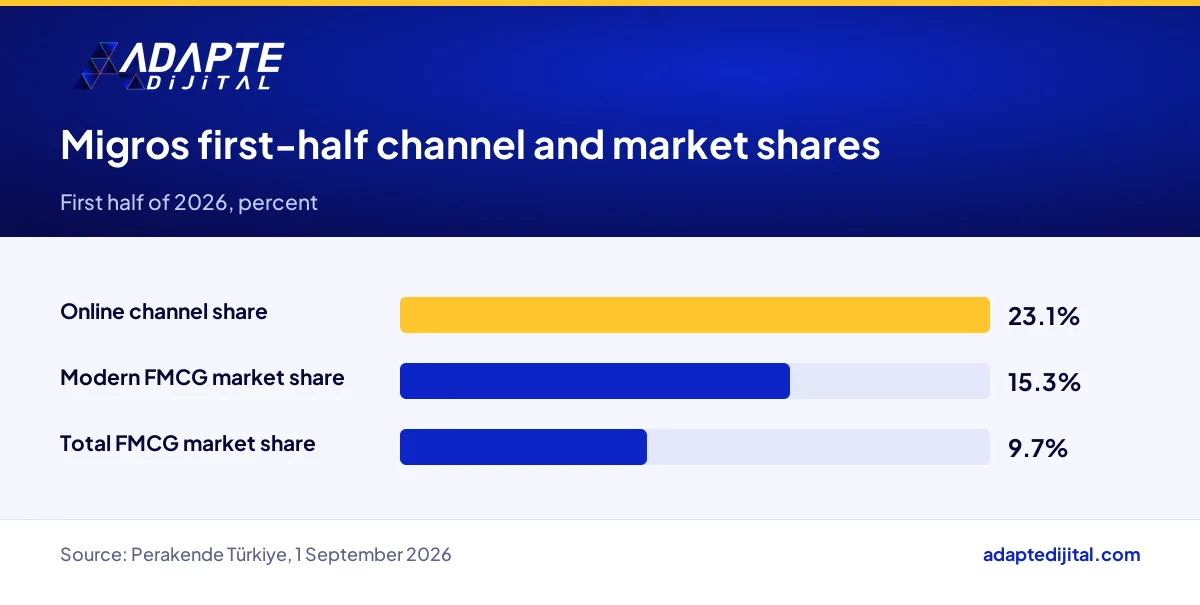
| Online channel share | 23.1% | Perakende Türkiye | About a quarter of sales come from digital. |
Why is Migros’s profitability falling while its sales grow?
By the company’s own account, the main reason is the weight of promotions and discounts. Özgür Tort, CEO of Migros Group, says that in an inflationary climate they support customers with heavy promotion and discount campaigns, bringing suppliers along with them. Discounts keep customers coming through the door, but they eat into margin. The result shows in the table: the till is busy, yet less stays in the pocket.
What do Migros’s 3,830 stores and online share say about channel balance?
The physical network keeps growing while the digital channel becomes a major part of sales. The company opens 115 new stores in different formats in the first half, reaching 3,830. Over the same period, online channels account for 23.1% of sales. Store and screen work as two doors for the same customer, not as rivals.
Which Turkish retailers do Migros’s first-half results affect, and how?
Independent grocers and corner shops feel it most, as a big chain’s promotion pace presses on their shelf prices. Supplier brands face requests for discount contributions. Non-food retailers in malls and on high streets are hit indirectly. While shoppers chase discounts at the grocery, they turn more careful elsewhere.
What does Migros’s online data tell a small retailer about digital strategy?
Customers do part of their grocery shopping on a screen. If a chain next door gets 23.1% of sales online and you are invisible online, you never meet those customers. Being found in local search, taking orders and tracking the basket is enough to start.
What should a small retailer do this week to protect margin, given Migros’s results?
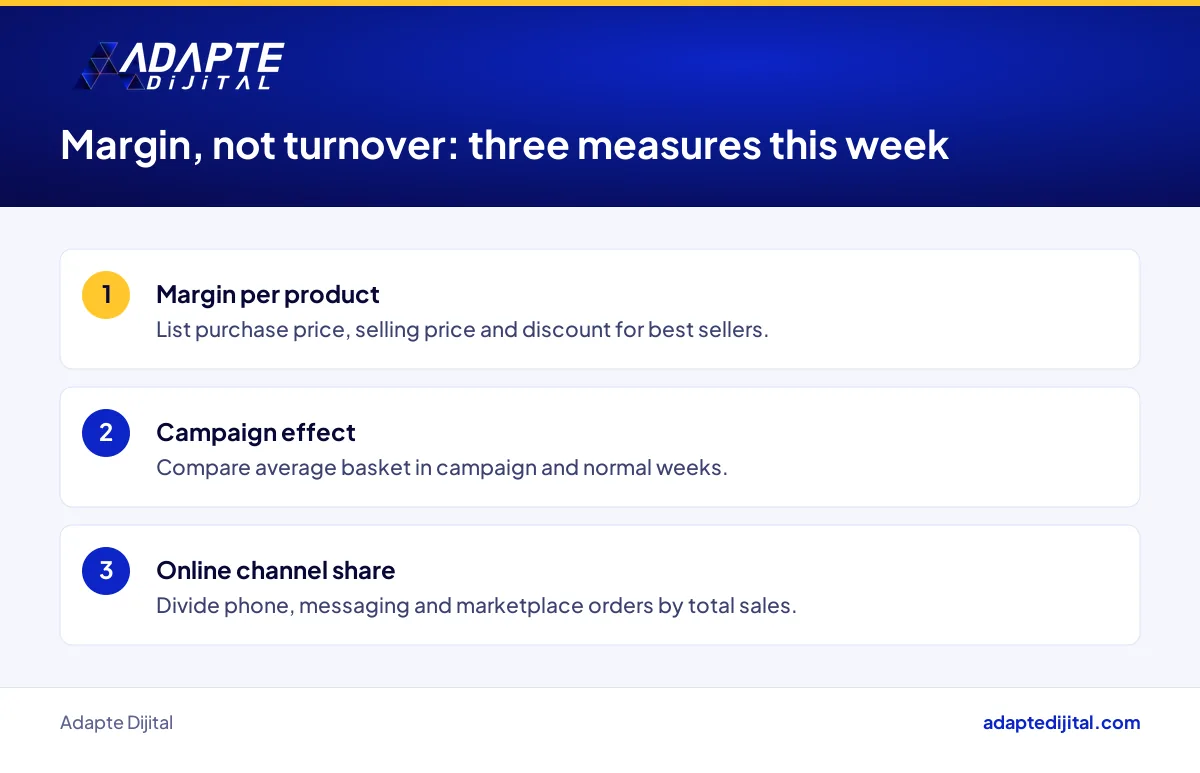
Do three things this week. Work out the margin of your best-selling products one by one, measure what discounted items bring to the basket, and calculate your digital channel’s share of sales. Before you celebrate rising turnover, see where the profit goes. This is not investment advice; check the figures against the primary source.
Quick Summary
- According to KAP, Migros’s first-half 2026 revenue is about TL 241.3 billion.
- Sales grow 4.5% in real terms according to Perakende Türkiye, while CNBC-e reports EBITDA down 6.7% and parent-share net profit down 42%.
- According to KAP, profit for the period is about TL 1.08 billion and parent-share net profit about TL 1.01 billion.
- According to Perakende Türkiye, the online channel share is 23.1% and the store count is 3,830.
- The lesson for a small retailer is to track margin per product, not turnover.
Short Glossary
- EBITDA
- EBITDA is the financial indicator used to show earnings before interest, tax, depreciation and amortisation, called FAVÖK in Turkish.
- Parent-share net profit
- Parent-share net profit is the term used for the part of group profit left to the parent company’s shareholders after non-controlling interests.
- Consolidated sales
- Consolidated sales is the term used for a group’s total sales, shown together with its subsidiaries in a single statement.
Frequently Asked Questions
Next Step
If you want to read your store’s margin and online channel data together, fill in the consult your expert form.
Sources: Perakende Türkiye, 1 September 2026 · KAP, Migros Ticaret financial report filing, 11 August 2026 (linked in the text) · CNBC-e and Ekonomist reports (EBITDA, net profit change, cash figures).
Updated: October 2026
Sık Sorulan Sorular
According to KAP, profit for the period is TL 1,078,256 thousand and net profit attributable to the parent is TL 1,010,950 thousand. The first is the whole group’s profit; the second is what remains for Migros shareholders after non-controlling interests. Both numbers circulate in the news, so check which one you are reading.
According to the KAP filing, the statements went through a limited independent review by PwC. That is a normal level of review for an interim report. The pages reviewed do not state which date’s purchasing power the inflation-adjusted figures use.
Free cash flow is TL 5.8 billion, capital expenditure TL 6.3 billion and net cash TL 31.8 billion. The company keeps investing and holds a strong buffer, which a small retailer does not have.
According to CNBC-e, EBITDA, known in Türkiye as FAVÖK, is TL 10.967 billion, down 6.7% year on year. A fall in earnings before interest, tax, depreciation and amortisation points to pressure in store operations, not in financing. The report gives no EBITDA margin, so do not present your own calculation as an official figure.
Tort’s words show that part of the cost is shared with suppliers. A big chain can fund discounts with supplier contributions. A small grocer has little bargaining power, so the discount usually comes straight out of its own margin.
Tort says customer traffic improved in seasonal stores in July. That is an observation, not a forecast; the report gives no year-end target or separate second-quarter sales.
According to Perakende Türkiye, Migros holds 9.7% of the total FMCG (fast-moving consumer goods) market and 15.3% of the modern FMCG market. The gap shows that a large part of the market still runs through traditional channels: corner shops, open-air markets and independent grocers. That is exactly where small retailers have room.
In food retail, online is no longer side income; it is one of the main lines. The report gives only the share, not the TL value of online sales. Even so, the ratio shows customers are used to doing grocery shopping on a screen.
The 115 new stores show that physical proximity still carries value, and fast delivery draws on the store network. Competition tightens at neighbourhood level.
When a chain puts a discount in the window, customers compare prices and walk out the door. If an independent grocer matches the discount without supplier support, its margin melts. The way to stand apart is fresh produce, proximity and personal service.
Chains bringing suppliers into campaigns make the shelf-entry maths heavier for a new brand. We walk through planning costs and campaign budgets before launch in our piece on Çamlıca Enerji and the 9 steps a new drink brand takes before launch.
While food spending is protected through discounts, customers may get choosier on clothing, home goods and accessories. AVM is the Turkish term for a shopping mall, and you can find signals on rent and turnover balance in our piece on rent deferral requests in Turkish malls. More sector news sits on our retail page, where we interpret the retail agenda for you.
A customer looking for a grocer nearby checks the map first. A shop with no current hours, phone number, product photos or delivery details stays invisible, like stock gathering dust on the shelf. That is why a Google Business Profile is a small grocer’s first digital shop window.
Instead of pushing discounted items in the online basket, make higher-margin products visible. Track average basket and margin per product weekly. If a marketplace charges commission, add it to your cost line.
List your best sellers in a table: purchase price, selling price, discount and weekly units. Mark the high-volume items with thin margins. The “turnover but no profit” problem usually hides in those rows.
Compare the average basket in a campaign week with a normal week. If the discounted item does not pull other products into the basket, the campaign is eating margin. Put supplier contributions on the negotiating table too.
Record phone, messaging and marketplace orders separately and divide them by total sales. That ratio tells you how much effort digital deserves. We set up online sales channels and basket tracking through our e-commerce consulting work.
For the data itself, you can go straight to Migros’s first-half 2026 financial report on KAP.
Both are correct, but they use different definitions. According to KAP, TL 1.08 billion is profit for the period and TL 1.01 billion is net profit attributable to the parent.
This piece does not comment on shares. This is not investment advice; the aim is to read what the figures tell a retail business.
Rather than matching the discount, it stands apart on fresh produce, proximity and service. It tracks margin per product and picks only campaigns that grow the basket.