
Türkiye’s cosmetics market reaches $3.3 billion, how can local brands win a bigger share?
Türkiye’s cosmetics market was put at $3.3 billion, with double-digit annual growth, at the 4th “Future of Cosmetics: What Should We Produce” summit held by KÜAD, the Turkish cosmetics manufacturers and researchers association, on 18 June 2026 (Perakende Türkiye, 4 August 2026). The report adds that the sector exports to around 200 countries. It also says competition is being shaped by consumer expectations, sustainable production, digitalisation and value-added products.
For a business that makes or sells cosmetics, the meaning is this: the market is growing, but the share goes to the brand that earns trust, not to whoever simply gets a product onto the shelf. The report does not say which year the figure covers or which study it comes from. So it is safer to read the size as a direction rather than a precise measure.
What does a $3.3 billion cosmetics market in Türkiye actually show?
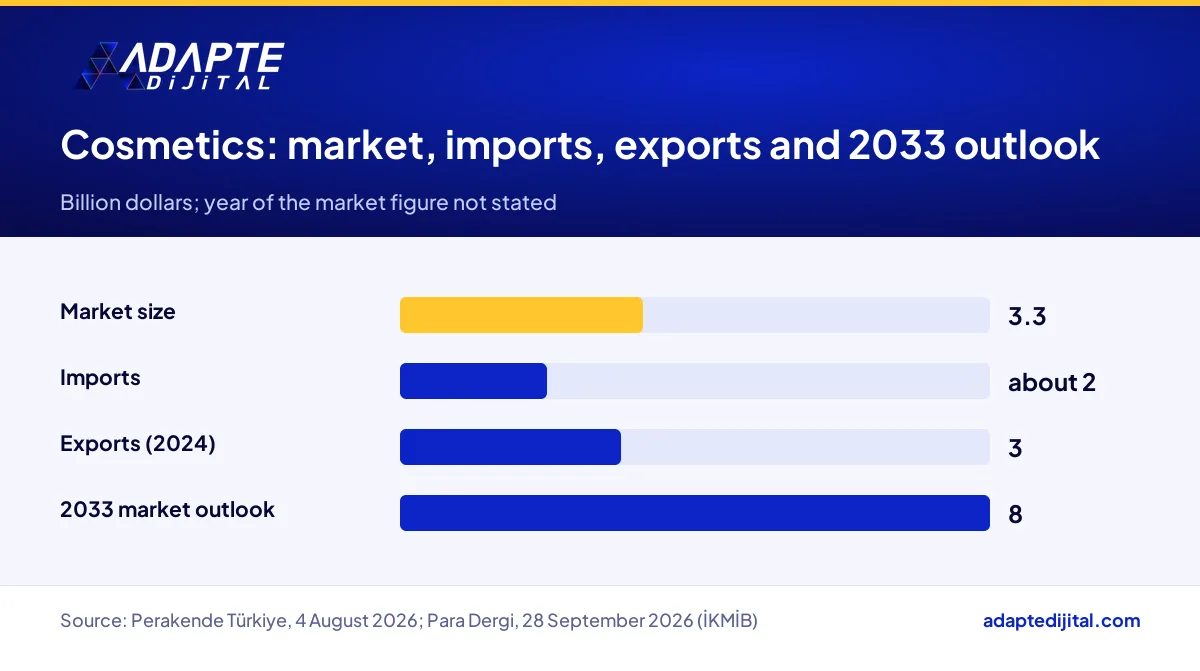
It shows the domestic market is large enough to make room for local brands, but on its own it is not a firm measure. The report presents the figure as market size without stating its year or source (Perakende Türkiye). Para Dergi, a Turkish business magazine, gives the same amount on 28 September 2026. The table below sets the figures from both sources side by side, with what each one means for a business.
| Indicator | Figure | Source | What it tells you |
|---|---|---|---|
| Market size | $3.3 billion | Perakende Türkiye; Para Dergi | Scale of domestic demand, year not stated |
| Annual growth | Double-digit / 8-10% | Perakende Türkiye / Para Dergi | The two sources give different ranges |
| Imports | About $2 billion | Para Dergi | Imported products still weigh heavily on shelves |
| 2033 outlook | $8 billion | Para Dergi | A long-term growth assumption |
Why should Türkiye’s cosmetics market not be confused with cosmetics exports?
Because the two describe different customers. The market is what consumers in Türkiye spend, and exports are products sold abroad. In December 2024, KÜAD chairman Levent Kahrıman gave the same $3.3 billion figure as the 2025 export target. Today it appears as market size, and a brand that plans without separating the two uses may invest in the wrong channel.
Which businesses gain or lose from growth in Türkiye’s cosmetics market?
BU BÖLÜMÜN ÖZETİ
- Winners: local brands in skin care, hair care and soap
- Under pressure: small producers fighting on price with a single product
- Indirectly affected: chain stores and distributors
Producers that build their own brand and retailers that specialise in a category gain. Sellers who stay with contract manufacturing, remain unbranded and compete on price struggle. In Turkish malls, sales per square metre for personal care and cosmetics rose 59% year on year in nominal terms in March 2026 and 48% in May (AYD data, Fintables bulletin). AYD is the Turkish shopping mall and retailers association, and its figures show demand at store level is still lively.
Winners: local brands in skin care, hair care and soap
In December 2024, Levent Kahrıman said local brands had reached market leadership in these three categories. In them, trust is already built and shelf share is already won.
Under pressure: small producers fighting on price with a single product
A product that tries to win shelf space on price alone just sits there once the promotion ends. A brand arriving with few SKUs needs to explain in one sentence why it is different.
Indirectly affected: chain stores and distributors
Chains are also opening shelf space to new imported brands. We look at how a Japanese makeup brand enters Türkiye through a single chain in our article on MilleFée and Distribution Group.
How can a local cosmetics brand meet Turkish consumers’ demand for trust and transparency?
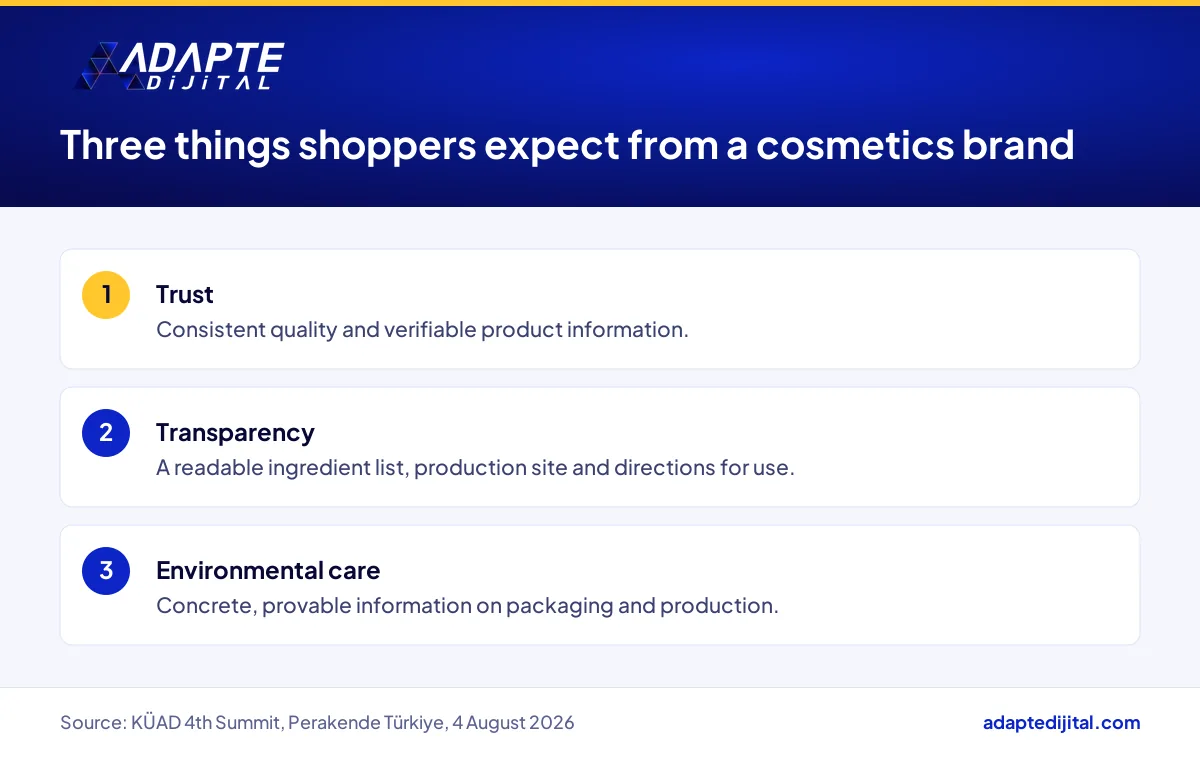
By showing its ingredient list, production site and testing process openly. KÜAD summit chair Ü. Belgin Sile says consumers want to bond with “trustworthy, transparent and environmentally conscious brands” (Perakende Türkiye). That expectation has to be met at every touchpoint, from packaging to the product page, or the shopper reads the label, is left with questions and walks out empty-handed.
Where does growth in Türkiye’s cosmetics market show up online?
On product pages, in search results and in marketplace reviews. The report lists digitalisation among the forces shaping competition (Perakende Türkiye). In cosmetics, shoppers research ingredients, usage and reviews before they buy. A brand that is invisible in that research is passed over even when it is on the shelf, so digital visibility is where the expectation of trust is met first.
What should a cosmetics brand owner in Türkiye do this week?
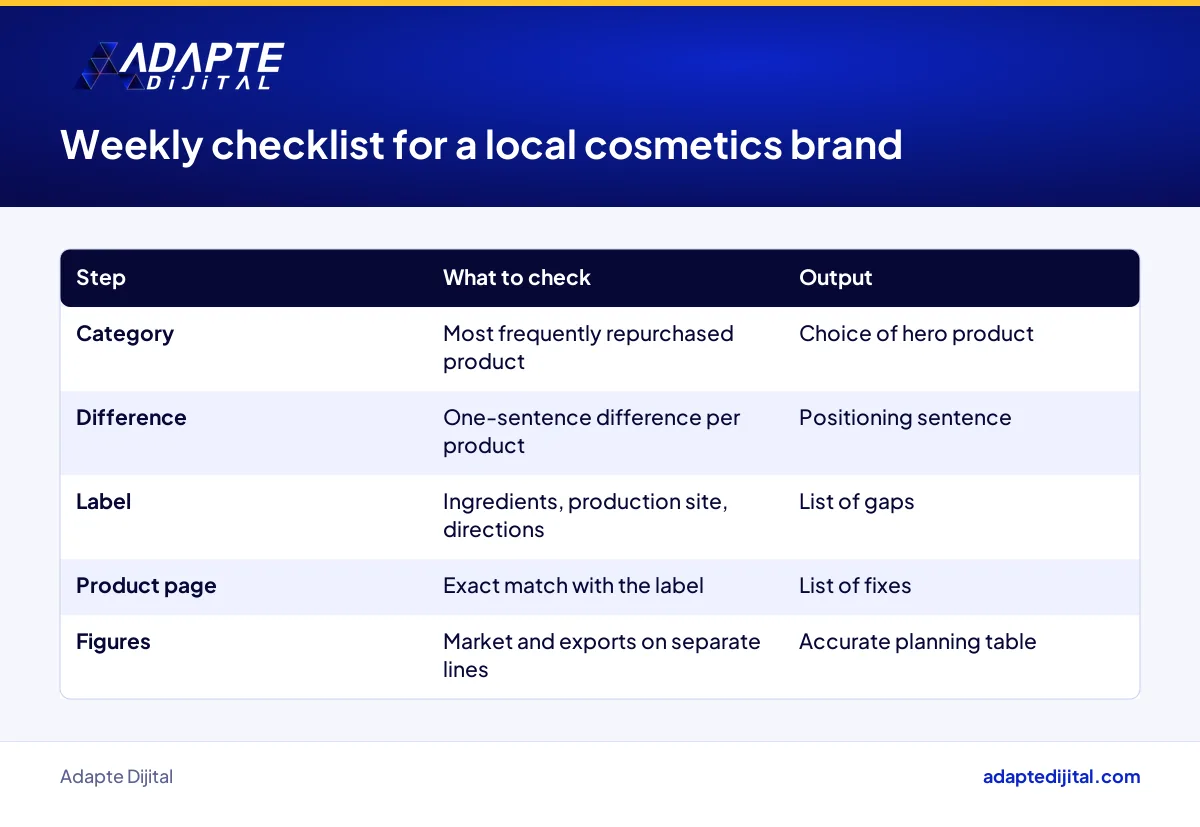
Start by grouping your product list by category and writing a one-sentence difference for each product. Then check whether packaging and product pages carry complete information on ingredients, production site and use. Keep market and export figures on separate lines in your own plan. For keeping one message consistent across dealers and points of sale, our article on Bosch’s dealer standards may give you ideas.
Quick Summary
- Türkiye’s cosmetics market was put at $3.3 billion at the KÜAD summit, with no year or source stated (Perakende Türkiye).
- Growth appears as double-digit in Perakende Türkiye and as 8-10% a year in Para Dergi.
- The $13.8 billion in the report is the entire chemicals sector’s exports for January to May 2026 (Perakende Türkiye).
- According to Para Dergi, imports are about $2 billion and 2024 cosmetics exports were $3 billion.
- Consumers look for trustworthy, transparent and environmentally conscious brands, and local brands should position themselves accordingly.
Short Glossary
- Market size
- Market size is the measure used to describe total consumer spending on a category in one country over a year.
- Value-added product
- A value-added product is the term used for a product that offers value beyond its price through formula, design or user experience.
- Shelf share
- Shelf share is the retail term used to describe the space a brand takes on store shelves relative to the total space for its category.
Frequently Asked Questions
Next Step
If you would like to review your brand’s positioning against the market’s expectation of trust together with us, fill in the consult your expert form.
Sources: Perakende Türkiye, 4 August 2026 · Para Dergi, 28 September 2026 · AYD data, Fintables July 2026 retail bulletin · Bengütürk, December 2024 · İKMİB (ikmib.org.tr)
Updated: October 2026
Sık Sorulan Sorular
Perakende Türkiye describes growth as double-digit, while Para Dergi writes an annual range of 8-10%. The gap may depend on whether growth is measured in dollars or in Turkish lira, and the report does not say. The safe approach for a business is to read the two numbers as a range.
This amount, given by Para Dergi, suggests that a large part of what sits on shelves still comes from abroad. For a local brand, that means looking for categories where it can take the place of imported products.
Para Dergi’s $8 billion outlook for 2033 is a scenario, not a guarantee. Rather than tying a capacity or investment decision to this single number, read it alongside your own sales data. This is not investment advice.
No. The $13.8 billion mentioned in the report is the export total of the entire chemicals sector for January to May 2026 (Perakende Türkiye). The report does not give the cosmetics share of that amount.
Citing İKMİB data, Para Dergi puts 2024 cosmetics exports at $3 billion. İKMİB is the Istanbul exporters association for chemicals and chemical products. The figure is a reminder that exporting producers move on a separate path from brand building at home. For official export statistics, see İKMİB’s website.
According to Para Dergi, more than half of production goes abroad. Turkish manufacturers have production strength, but turning that strength into a brand in the home market is a different job.
A readable ingredient list, a stated production site and clear directions for use are the basic steps. Verifiable information builds trust where vague claims do not.
Give concrete information about packaging material, refill options or the production process. An environmental claim without proof damages trust instead of building it.
The report says competition is being shaped by value-added products. That means standing out through formula, packaging or the experience of using the product, rather than making the same thing more cheaply.
The ingredient list, skin-type suitability, the order of use and storage conditions. If the page does not answer these, the shopper moves to a competitor’s page.
Reviews speed up a new customer’s decision to trust you. Replying to negative reviews openly and quickly is the digital form of the transparency people expect.
Yes. What ingredients or problems people search for shows where product gaps are. That data can guide a decision about a value-added product.
Break your sales data down by category and find the product customers buy again most often. Building your positioning around that product sharpens your message.
The information on the packaging and on the web page should match exactly. Any inconsistency weakens a transparency claim at the very first contact.
Turning trust, transparency and a category difference into one brand language takes time. We do this work with brands through our brand consultancy service.
We gather other developments in Turkish cosmetics retail in autumn 2026 on our retail page, where we interpret the retail agenda for you.
The report does not state the figure’s year or source. So it should be read as a direction. Weigh any investment decision together with your own sales data and official statistics; this is not investment advice.
First you need a clear category difference and complete product information. A chain’s buying team wants to see why the product deserves its place on the shelf. Working with a distributor is another option.
The summit noted that consumers want to bond with environmentally conscious brands. The effect depends on backing the claim with concrete information. A claim without proof damages trust.