
Watsons Türkiye releases third sustainability report, how can small retailers write one?
Watsons Türkiye has released its third sustainability report, covering the year 2025 (Perakende Türkiye, 1 September 2026). According to the report, all 20 million kWh of electricity the company used in 2025 came from I-REC certified renewable sources, 50 stores run an energy monitoring system and 234 stores use timer plugs. Women make up 82% of employees and 71% of managers, and the shelves carry more than 1,000 sustainable products.
Here’s what it means for you. In autumn 2026, the big cosmetics and personal care chains in Türkiye describe their environmental and social impact in numbers. If you own a shop with two branches, this is not a reporting race. The real question is which few items you start measuring today.
Which figures stand out in Watsons Türkiye’s third sustainability report?
Energy, emissions, products and employment. Carbon emissions fall by about 33%, and the report records annual energy savings of 963,745 kWh (Turkchem). The number of saplings reaches 500,000 by the end of 2025, with a 2030 target of 1 million. Sustainable products number more than 1,000, and the 2030 target is 3,000.
Why do big chains like Watsons describe sustainability in numbers?
Because a sustainability claim without numbers doesn’t land with customers or business partners. Watsons belongs to A.S. Watson Group, an international health and beauty retailer with more than 17,000 stores in 31 markets, and group-level reporting expectations flow down to local companies. Mete Yurddaş, General Manager of Watsons Türkiye and GCC Development, calls sustainability “a transformation process that requires all stakeholders to act together” (Perakende Türkiye).
Which retailers does Watsons’ sustainability report affect, and how?
It affects three groups differently. Mid-sized cosmetics and pharmacy chains that already track energy and product data start with an edge. Small manufacturers who want shelf space in big chains but keep no product data of their own may struggle. The indirect effect reaches technicians who install energy monitoring, women producers’ groups and renewable energy certificate providers.
Where should a small retailer start measuring sustainability, using Watsons as a guide?
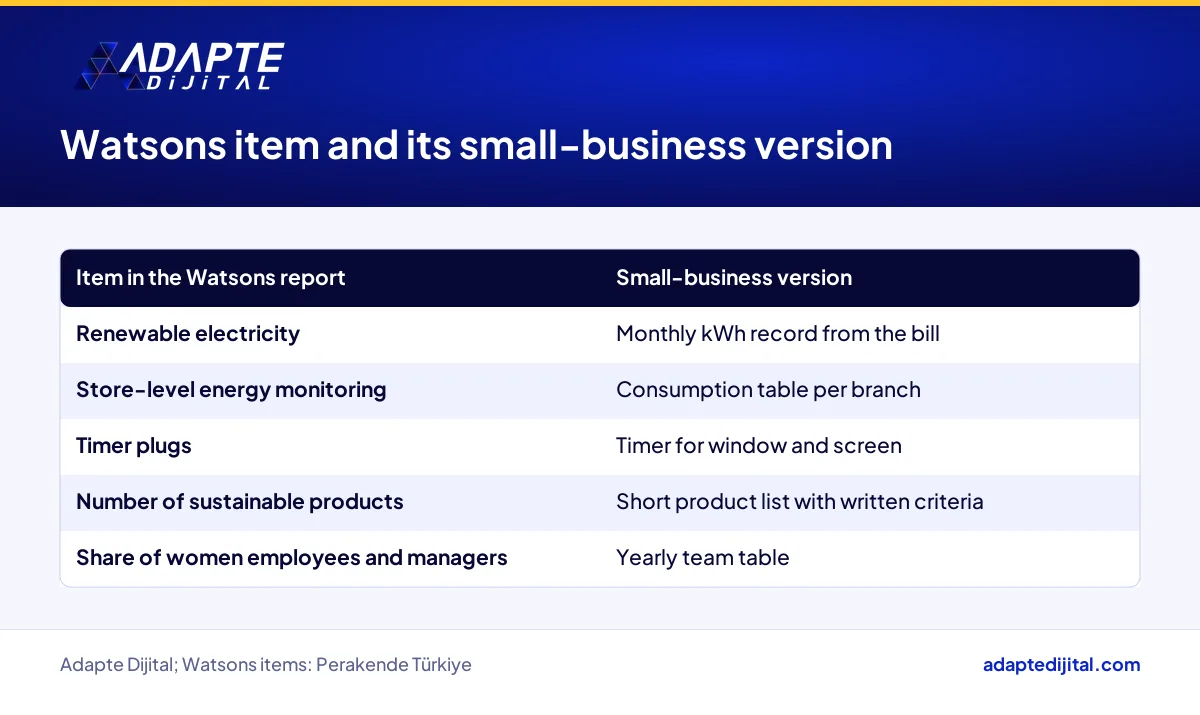
With the electricity bill. Energy is the backbone of the Watsons report, and it is also the easiest item for a small shop to measure. Writing the monthly kWh figure from each store’s bill into a table is the first line of your first report. Product, team and community items come after that.
How does sustainability information from a report like Watsons’ pay off on a retailer’s website and in search?
With one page and a few accurate sentences. Watsons lists its reports year by year on a separate page of its own site. For a small business, one “How we work” page, evidence-based labels on product pages and a short description on your map listing are enough to start. Information with numbers and dates is easier to quote in search results and in AI answers.
What should a small business owner planning a report like Watsons’ do this week?
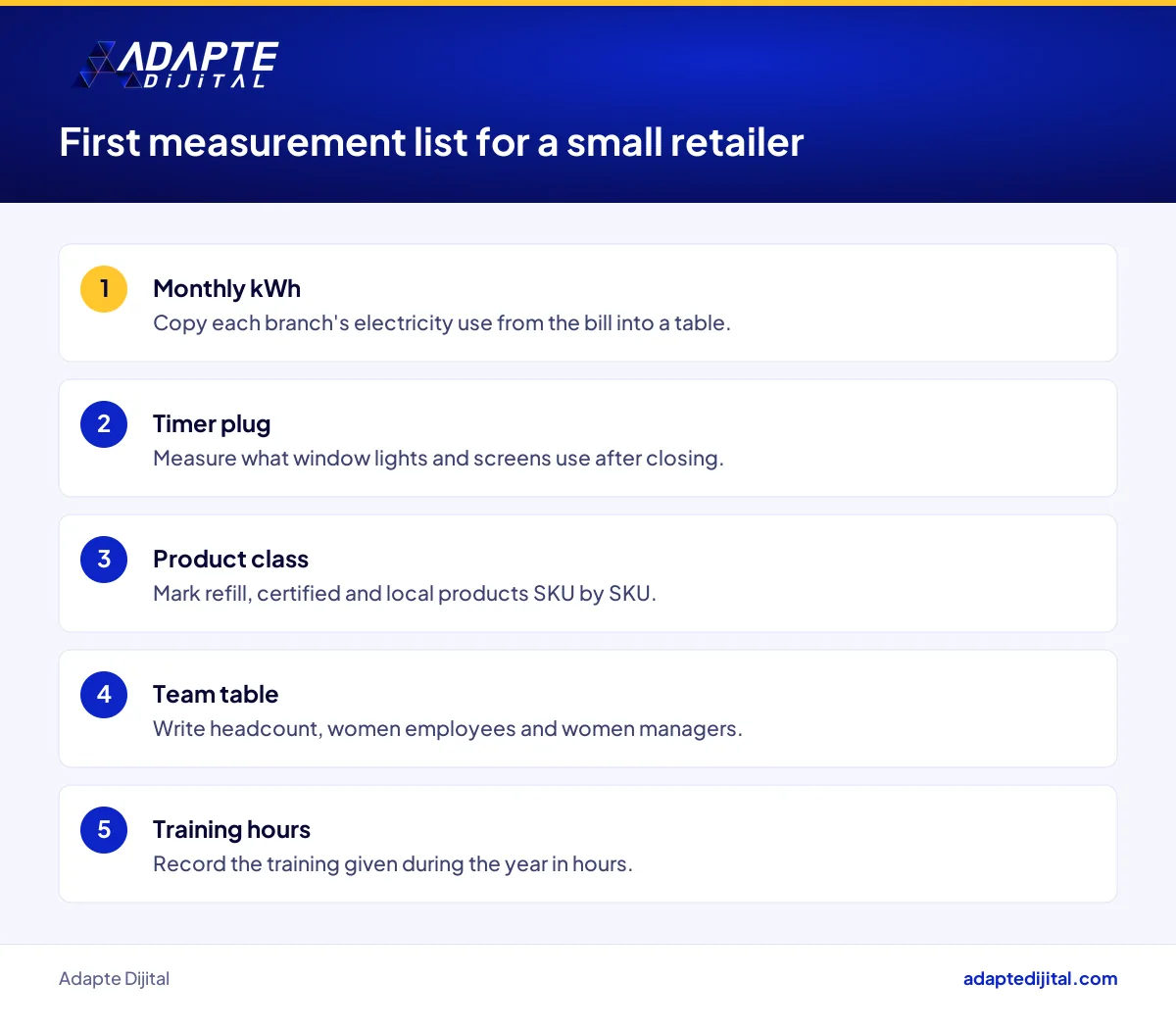
This week, open three tables: energy, product and team. Copy twelve months of electricity bills into one sheet in kWh. Split the products on your shelf into those that can count as sustainable and those that can’t. In the team table, write headcount, the number of women employees and managers, and training hours.
Quick Summary
- Watsons Türkiye released its third sustainability report, covering 2025 (Perakende Türkiye, 1 September 2026).
- All 20 million kWh of electricity the company used in 2025 came from I-REC certified renewable sources (Perakende Türkiye).
- Energy monitoring runs in 50 stores and timer plugs in 234 stores (Perakende Türkiye).
- The sources describe the base year of the roughly 33% emissions cut differently.
- For a small retailer, the first step is three tables: energy, product and team.
Short Glossary
- Sustainability report
- Sustainability report is the periodic document used to describe a company’s environmental, social and governance practices in numbers.
- I-REC certificate
- I-REC certificate is the international certificate used to document that the electricity consumed was produced from renewable sources.
- Energy monitoring system
- Energy monitoring system is the metering setup used to track a store’s electricity use in real time or by period.
Frequently Asked Questions
Next Step
One principle is enough: don’t tell what you haven’t measured, and measure what you tell. If you want to set up your first three tables together, fill in the consult your expert form.
Sources: Perakende Türkiye, 1 September 2026 · Turkchem · Watsons Türkiye, Sustainability · A.S. Watson Group · AYD April 2026 index (Borsa Gündem) · Perakende Türkiye (Rossmann)
Updated: October 2026
Sık Sorulan Sorular
This one needs care. Perakende Türkiye gives the cut as “over the last two years”, while Turkchem says “compared with 2023”. The base year, the scope and the absolute emissions figure are not clear in the sources, and we don’t know whether the report follows a standard such as GRI.
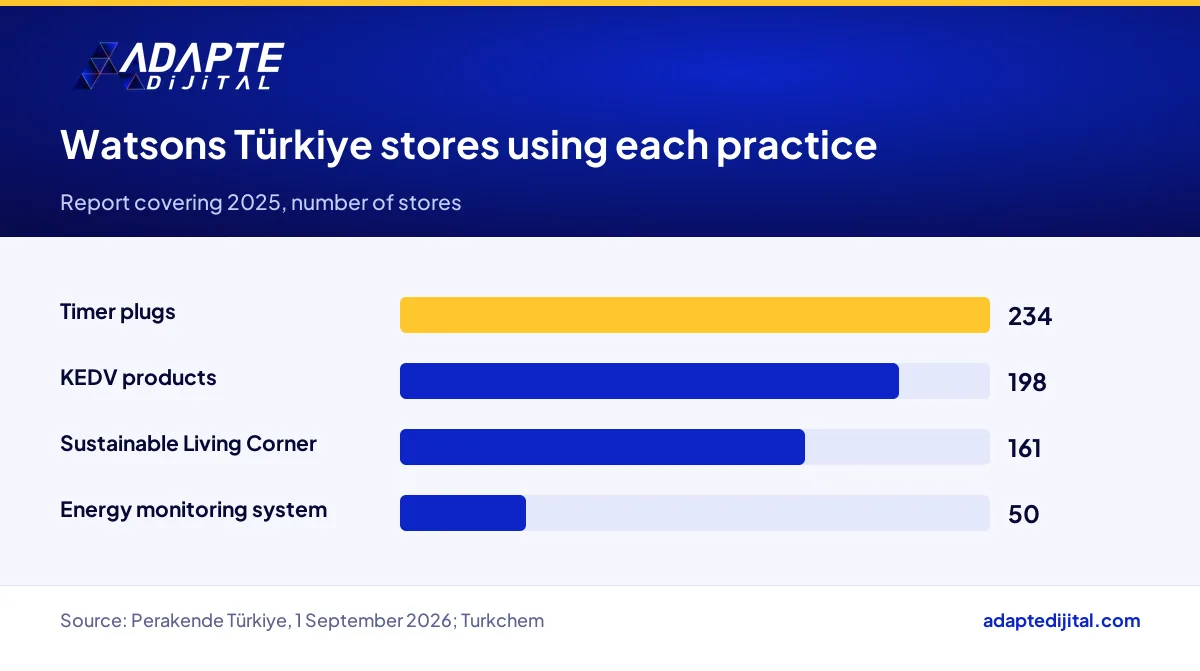
Through a partnership with KEDV, a Turkish foundation that supports women’s work, 150,000 products were sold, creating about TL 11 million in economic value and supporting more than 1,000 women. KEDV products are in 198 stores, and Sustainable Living Corners are in 161 stores. On training, the total comes to 43,538 hours.
The report covers 2025 and includes the work of the Watsons Kindness Movement. The company operates more than 500 stores in 72 provinces. The 2022, 2023-2024 and 2025 reports are listed on the Watsons Türkiye sustainability page, so reporting is moving to a yearly rhythm.
Talk is cheap. “We care about the planet” sits on almost every label, while “timer plugs in 234 stores” is something you can check. When readers see a number, they can weigh the claim.
The item worth talking about most is not a big investment. Timer plugs and store-level energy monitoring are things a small shop could set up tomorrow. Read that way, a big chain’s report tells a small business “start here”.
Cosmetics and personal care is the fastest-growing category in Turkish shopping malls, up 55.5% in nominal terms in the April 2026 index of AYD, the Turkish council of shopping centres. Rival Rossmann operates 226 stores in Türkiye with more than 2,000 employees. For chains competing on the same shelf, sustainability is a way to stand apart beyond price and range. We cover Rossmann’s own attempt to stand out on the shelf through its Trends For You corner.
The ones that keep their bills, product lists and staff records in order. When these businesses decide to write a report, they don’t start from zero. The data is already sitting in the drawer, waiting for a heading.
Small cosmetics manufacturers who want a place on big chains’ shelves. With Watsons aiming for 3,000 sustainable products by 2030, a maker who can explain clearly why a product counts as sustainable is easier to talk to. A maker who can’t explain it stays outside that conversation. We look at how manufacturers open up to shelves and exports through the ZUCHEX 2026 trade fair.
The KEDV partnership shows that products backed by a women’s work foundation can find room on a national chain’s shelves. For small producers, that is a separate door. To walk through it, product information, packaging and delivery routines have to be ready.
Let’s say you run a cosmetics shop with two branches. In the evening the shutters come down, but the window lights and the ad screen stay on until morning. A timer plug stops that light burning for nobody, and the difference on your next bill becomes your first measurement.
Mark, SKU by SKU, which products on your shelf are refill, certified or locally made. Watsons puts more than 1,000 products in this class; your list can start with a handful. What matters is writing down the criterion: why did each product make the list?
Headcount, the share of women employees and managers, and yearly training hours. Watsons reports these with figures such as 82% and 71%. In a small business, writing these numbers down once lets you see how they change over the years.
Write in one sentence why the product counts as sustainable: refill, certification or local production. Use claims you can prove instead of vague words like “natural” or “eco-friendly”. A claim you can’t back up chips away at your customers’ trust.
Carry the same evidence-based sentence into your marketplace product description. On social media, a yearly “our year in numbers” post gets read more than a long report. The numbers can be small; what matters is that they are accurate and dated.
Before you hand the text to anyone, own the data yourself; the writing comes later. This is work we do: through our brand consultancy, we turn a business’s data into a readable sustainability story.
The sources do not say which standard the Watsons report follows, so don’t claim compliance with a standard in your own first report. Verify with the official source whether you have any reporting obligation; this is not legal or financial advice.
Short and honest. A one-page, three-table, dated summary is worth more than a full draft that never leaves the drawer. Our retail page, where we interpret retail news for you, keeps similar cases together.
Yes. A few dated measurements under energy, product and team are enough to start a short first report.
The sources put it differently. One report says “over the last two years”, the other “compared with 2023”; the scope and the absolute amount are not clear.
The sources do not say which standard the Watsons report follows. Check your obligations and the right standard with the official source and an expert.