
Coffee Factory aims for 5 countries in 5 years, why trade franchising for central control?
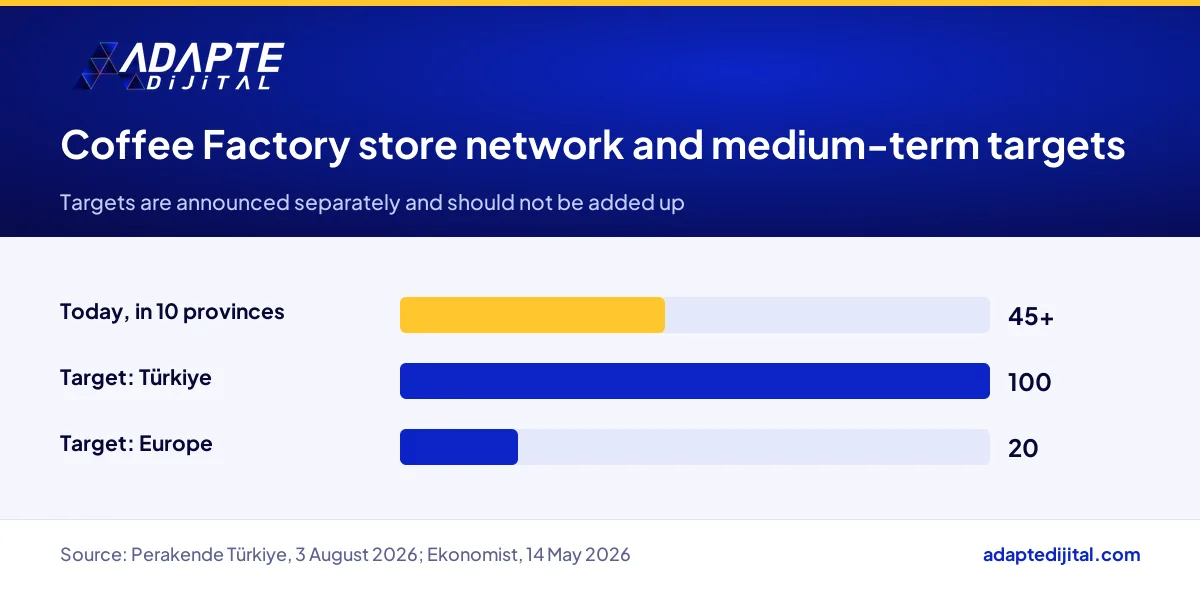
Coffee Factory, a Turkish coffee chain growing since 2018, plans active operations in at least five countries within five years and is moving its growth from a franchise model to a centrally operated one (Perakende Türkiye, 3 August 2026). The chain runs more than 45 stores in 10 provinces with over 300 employees, and its medium-term target is 100 stores in Türkiye and 20 in Europe. The plan first appeared in Ekonomist in May 2026.
Here is what it means for you. A growing coffee chain in Türkiye is putting product and service standards ahead of speed. If you run a café or a small chain, the question “do I open more branches, or do I make every cup taste the same?” is now on your table too. That choice shapes your rent, staffing and supply plans all at once.
Why is Coffee Factory choosing central operation over franchising?
Because the goal the chain names is consistency in product and service. According to the report, Coffee Factory is shifting from a franchise model to a central operating model and presents it as the way to keep quality the same everywhere. What happens to the existing franchise stores is not disclosed. So the direction is clear, while the timeline and the cost of the switch are not.
What do Coffee Factory’s targets of 100 and 20 stores say about the coffee market?
They send two separate messages: Türkiye is still the main market, and Europe is a measured step. The target is 100 stores in Türkiye and 20 in Europe. The report also gives a total of more than 150 without explaining the gap. The safest reading keeps the two numbers apart.
Who wins and who struggles as Coffee Factory moves to a central model?
The likely winners are domestic suppliers and customers who want the same cup every time. The ones who may struggle are small investors who hoped to grow through a coffee franchise. Landlords of shopping malls and high-street units feel it indirectly. A chain that grows centrally can be a more predictable partner for an owner planning a tenant mix.
How does a café owner choose between standards and speed, as Coffee Factory did?
Start by checking whether your standard exists on paper. If the recipe, preparation time and service steps are not written down, speed only multiplies mistakes. Let’s say you run a café with three branches. At nine in the morning the queue moves well in two of them, while in the third the same latte comes out two minutes later and the average basket drops.
What does Coffee Factory’s expansion change on the digital side of a café business?
The digital channel is becoming part of the standard too. The chain’s corporate website shows an app, a loyalty card and an online shop side by side. Central operation makes it easier to keep menus, prices and campaigns identical across branches and channels.
What should a café operator do this week after the Coffee Factory news?
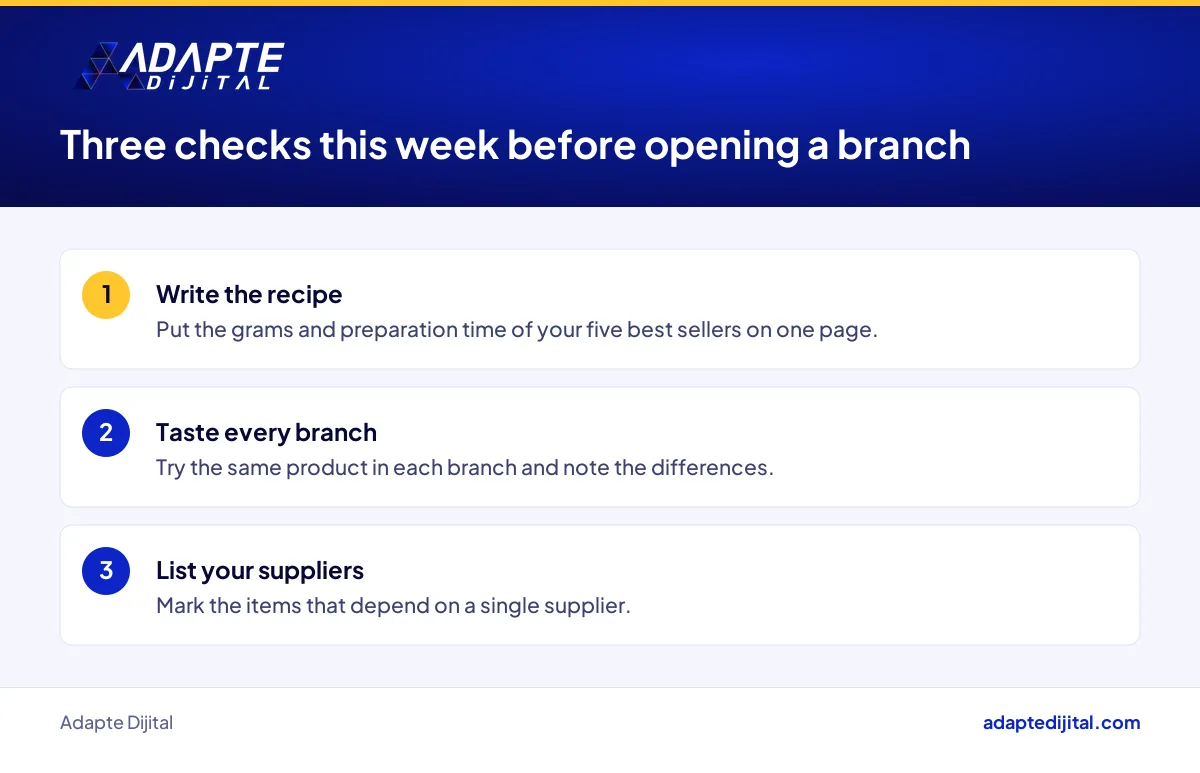
Focus on three jobs this week: write down the recipes of your five best sellers, taste the same product in every branch, and list your suppliers. They move your growth decision from guesswork to evidence. Our retail page, where we interpret retail news for you, covers similar decisions through other cases.
Quick Summary
- Coffee Factory aims for active operations in at least five countries within five years (Perakende Türkiye).
- The chain runs more than 45 stores in 10 provinces with over 300 employees (Perakende Türkiye).
- Its medium-term targets are 100 stores in Türkiye and 20 in Europe (Perakende Türkiye, Ekonomist).
- The chain is moving from franchising to central operation to put product and service standards first.
- The lesson for a café owner is to write down recipes and service standards before opening a new branch.
Short Glossary
- Central operation
- Central operation is the model used to run all of a chain’s stores with its own capital and staff, without granting franchises.
- Tenant mix
- Tenant mix is the management concept used to plan which brands occupy a shopping mall or street, and in what proportion.
- Average basket
- Average basket is the retail metric used to measure how much each customer spends on average over a given period.
Frequently Asked Questions
Next Step
If a decision about a new branch or format is on your desk, tell us briefly where you stand and we will look at it together: Consult Your Expert form.
Sources: Perakende Türkiye, 3 August 2026 · Ekonomist, 14 May 2026 · The Coffee Factory corporate website
Updated: October 2026
Sık Sorulan Sorular
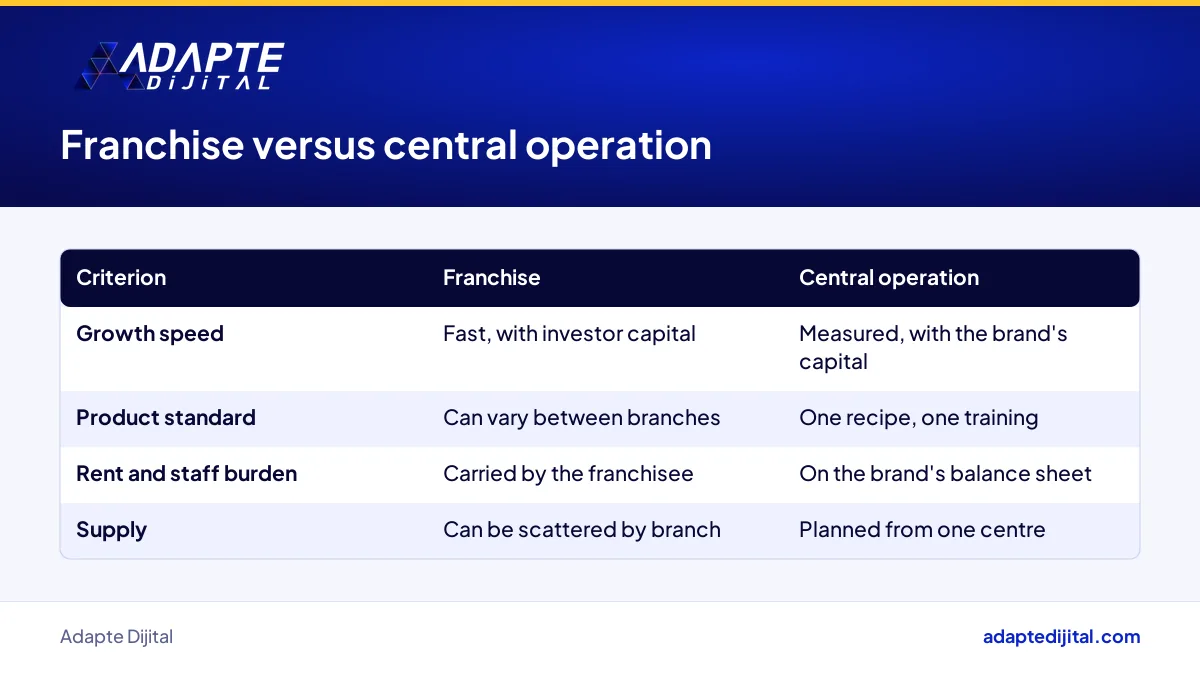
Franchising lets you open branches fast with someone else’s capital. The price is scattered control. When every store has a different owner, the milk brand, the wait time and the smile at the till can change from branch to branch. The name on the sign stays the same, but the experience does not.
When the brand opens its own stores, rent, staff and stock all land on its own balance sheet. In return, every branch can run the same recipe, the same training and the same presentation. If a branch gets it wrong, the mistake belongs to head office.
According to the report, Coffee Factory processes its coffee beans in Istanbul and buys milk, food and packaging from domestic suppliers. Central operation makes more sense once supply sits in one pair of hands. If the beans and the cups both come from the same centre, there is less room for the recipe to drift at branch level.
It means a sizeable domestic network on top of today’s 45-plus stores, a bet that home demand keeps growing. IPSOS data cited by Ekonomist shows household coffee consumption in Türkiye has risen fourfold over the past decade, to roughly 1.5 kg per person a year.
The report says trademark registration and business development talks are under way in Europe and the Middle East. Which five countries will be chosen, and how many years “medium term” covers, are not disclosed. Right now you have region names, not a country list.
The chain reports a 113 percent increase in its store count over the recent period. The period itself is not given. You need that before comparing it with any other chain.
More stores mean more volume from the same supplier. In a central model, orders come from one desk and one counterpart, which usually means a longer, steadier contract.
When a brand opens its new stores itself, the door for outside investors gets narrower. Someone looking for a coffee franchise has to weigh their options again. The choice is not new in the sector either: Kahve Dünyası runs more than 300 stores without franchising them.
As chain standards rise, customer expectations rise with them. The neighbourhood café wins on familiarity and flexibility. But if the cup tastes different every day, the customer turns around at the door and walks to the chain next door.
Usually in training, not in the machine. If a new barista learns the recipe by hearing it from the last barista, every branch ends up making its own coffee. Closing exactly that gap is the reason Coffee Factory gives for going central.
If your current branches serve products and service that look alike, and the till is busy in every one of them, growing makes sense. If one branch clearly stands apart from the rest, a new branch will copy that gap. Fixing the gap first and opening the door second costs less.
Do not open a branch before the standard is written. That is not stopping growth; it is putting the steps in order.
A customer searching for “café near me” looks at the map listing and the branch details. If hours or menus differ by branch, that customer sets off with wrong information. Central management makes it possible to keep every business profile up to date from one place.
It does, as long as the data is put to work. Knowing your returning customers means seeing which product sells at which hour. Even a paper stamp card is a useful start if you record it regularly.
Put grams, milk, temperature and preparation time on one page. Pin it behind the counter, and let every new hire start with it.
Ask “what happens if this item does not arrive tomorrow?” Mark every item that depends on a single supplier. Coffee Factory’s focus on domestic sourcing can be read as one answer to that question.
An outside view that weighs format, location and brand identity together helps. We do this work as part of our brand consultancy. If you are thinking about going abroad, HuQQabaz’s branch network across 9 countries is a good read for a checklist. If you want a smaller format, Kahve Dünyası’s Algötür format offers ideas on layout and location.
According to the report, the chain is moving from a franchise model to a central operating model. The status of existing franchise stores has not been disclosed, so check the latest position directly with the company.
No country list has been announced. According to the report, trademark registration and business development talks are under way in Europe and the Middle East.
The same principle applies to one branch: if your recipes, service and supply are written down, a second branch can open at the same quality. Setting that standard before you plan growth is the safest place to start.