
CarrefourSA names Hatice Evren CEO after 89.28% sale, what should suppliers expect?
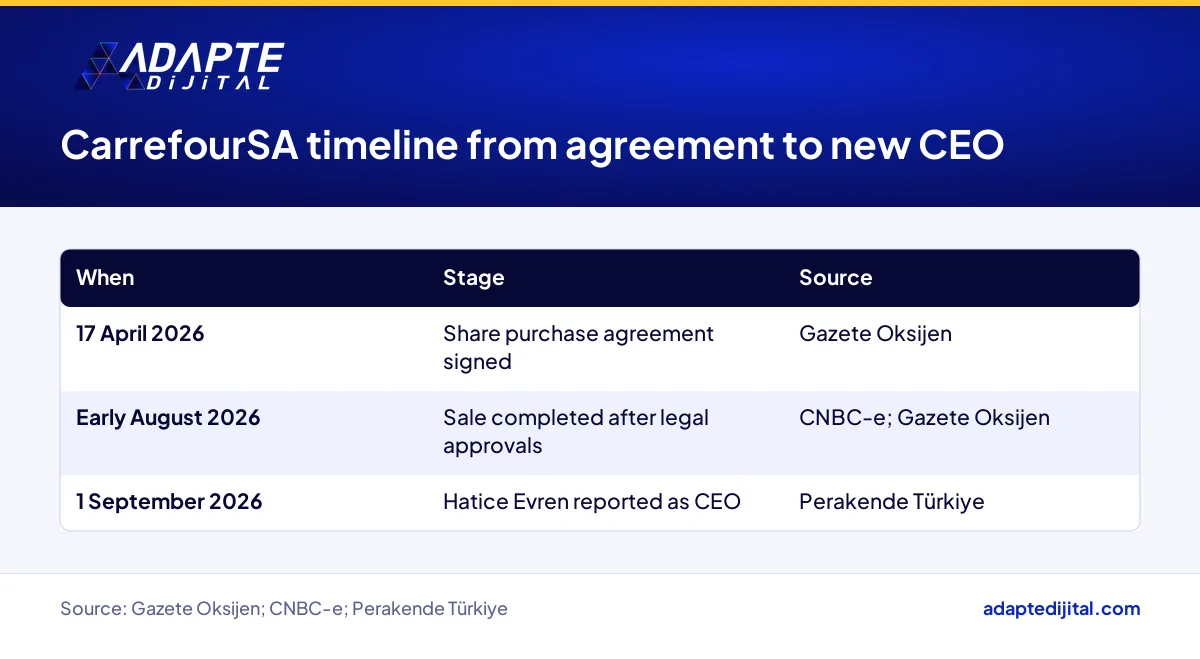
Hatice Evren is CarrefourSA’s new CEO, appointed as management is reshaped after the company passed to Yeni Mağazacılık, the group that also owns the A101 discount chain (Perakende Türkiye, 1 September 2026). The deal, completed in early August 2026, moved an 89.28% stake; Evren’s last role was CEO of Getir’s grocery operations in Türkiye.
What this means for you: if you are a producer or supplier selling to CarrefourSA, the face across the negotiating table is changing. The new owners talk about investing in supplier relations and expanding into more provinces, but no change to payment terms, pricing or private-label policy has been announced.
Who is CarrefourSA’s new CEO Hatice Evren, and which sale brings her in?
Hatice Evren is an industrial engineering graduate of Boğaziçi University who has held senior roles at BCG and Getir. At Getir she worked on transformation projects, global operations and the management of grocery operations in Türkiye. KAP, Türkiye’s public disclosure platform, lists her full name as Hatice Ümran Evren Balkoç and her title as General Manager.
How will CarrefourSA and A101 stay distinct under Yeni Mağazacılık?
Through separate management and separate brand identities. According to Gazete Oksijen and CNBC-e, CarrefourSA stays in the supermarket segment and A101 in discount retail. So there is one owner, but two shelf logics, two customer bases and two buying desks.
How does a local producer live through the management change at CarrefourSA?
Let’s tell it through a representative scene, not a real person. Picture a small olive oil producer in the Aegean whose bottles have sat on a supermarket chain’s shelves for years. She reads the news on her phone, and the first thing on her mind is her contract.
Which businesses does CarrefourSA’s change of ownership affect, and how?
Those most affected are food, cleaning and personal care producers that supply CarrefourSA directly, local and regional suppliers, and logistics firms. Producers with strong regional products may see an opportunity as the chain targets new provinces. Rival supermarkets and independent grocers in the same areas feel it indirectly.
What should a supplier to a grocery chain prepare on the digital side in this new era?
Prepare three things: product data, online visibility and brand search. In 2025, food and meal orders made up 20.3% of e-commerce transactions in Türkiye, so the online channel is a big line for grocery chains. In autumn 2026, a Turkish producer supplying a chain is also responsible for how its product looks on the online shelf.
What should a business supplying CarrefourSA do this week?
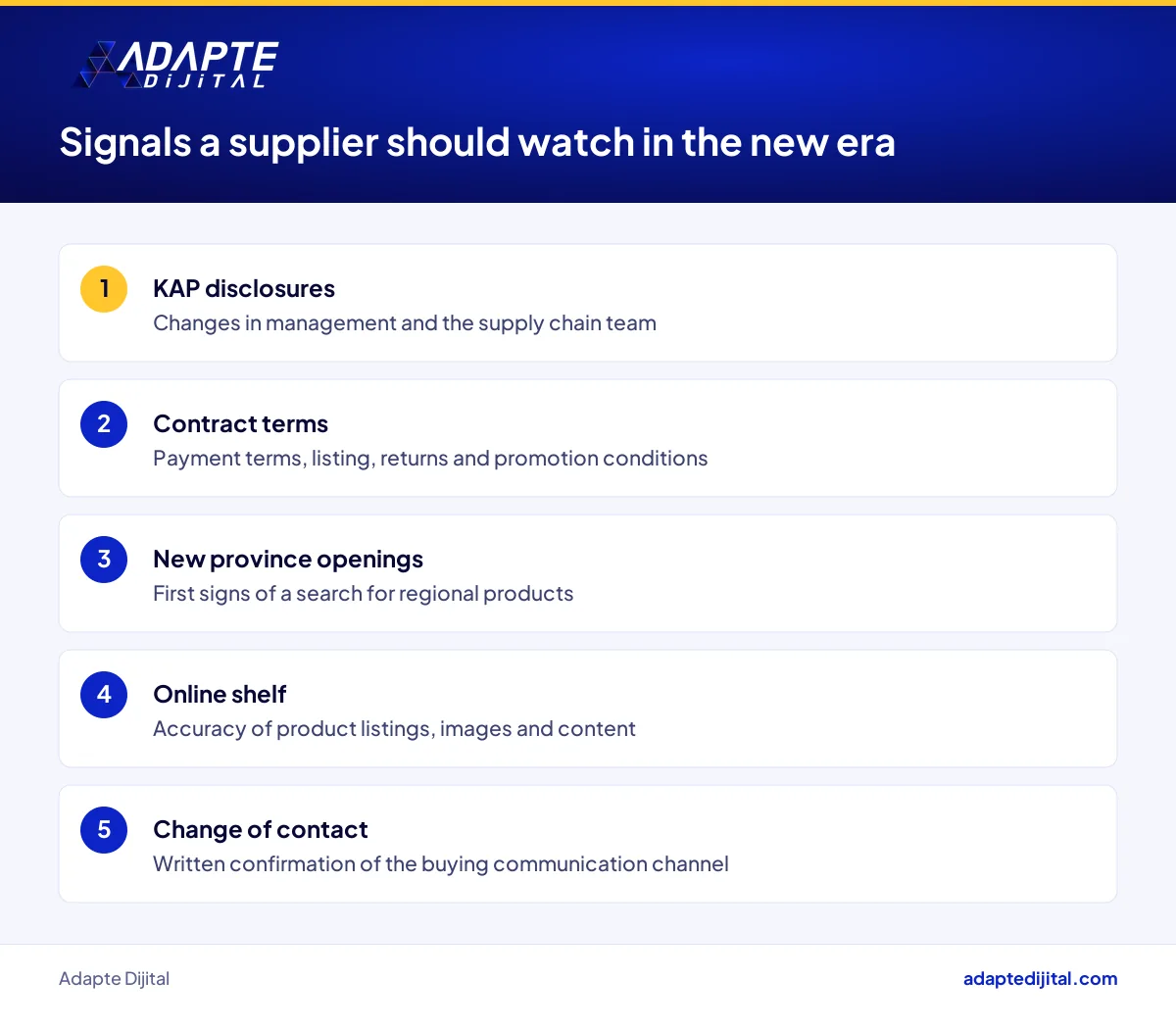
Do three things this week: list your current contract terms and the points that were only agreed verbally, put recent sales and returns data into one table, and ask your buying contact in writing for the communication channel under the new management. Until any change in terms is announced, do not act on assumptions about price or payment terms.
Quick Summary
- Hatice Evren became CarrefourSA’s new CEO (Perakende Türkiye, 1 September 2026).
- An 89.28% stake passed to Yeni Mağazacılık in the sale (Gazete Oksijen; CNBC-e).
- The deal closed in early August 2026 after legal approvals, including the Competition Authority.
- CarrefourSA will run as a supermarket and A101 as a discount chain, under separate management.
- No change to supplier terms has been announced yet, so preparation is the smartest move.
Short Glossary
- Share purchase agreement
- A share purchase agreement is the contract used to set the terms under which a company’s shares change hands.
- Listing
- Listing is the retail term used for getting a product onto a chain’s range and onto its shelves.
- Discount store
- A discount store is the name used for a grocery format that works with a narrow range and low prices.
Frequently Asked Questions
Next Step
If you would like to talk through how to prepare for the table with the chain in this new era, fill in the consult your expert form.
Sources: Perakende Türkiye, 1 September 2026 · Public Disclosure Platform (KAP), CarrefourSA company information · Gazete Oksijen · CNBC-e · Turkish Ministry of Trade, 2025 e-commerce data
Updated: October 2026
Sık Sorulan Sorular
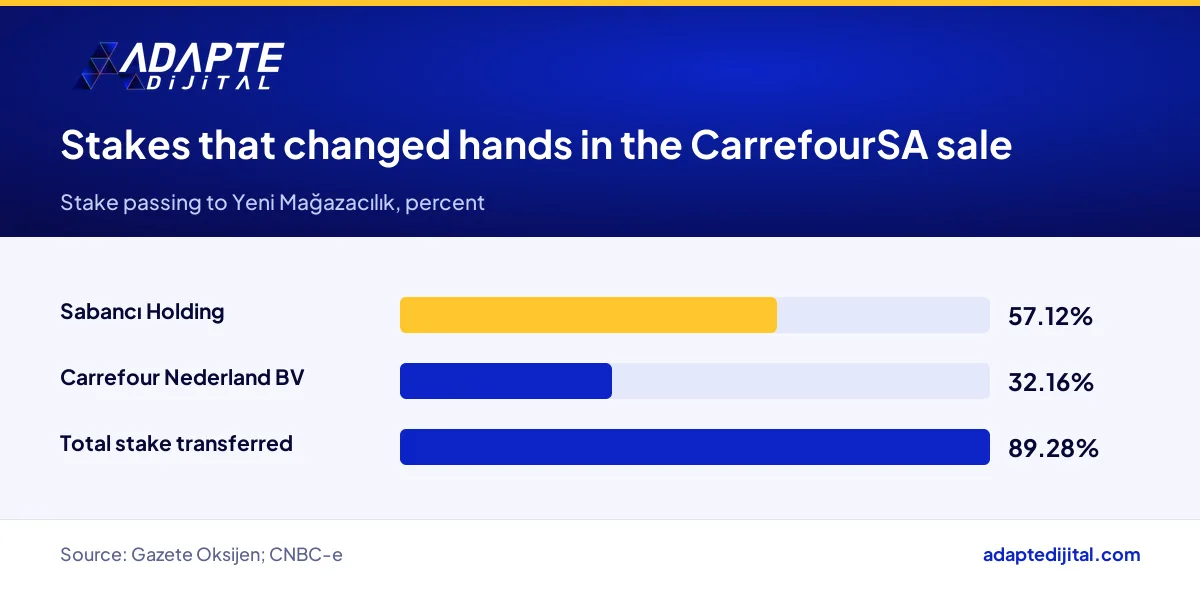
The total stake transferred is 89.28%. Of that, 57.12% belonged to Sabancı Holding and 32.16% to Carrefour Nederland BV. According to Gazete Oksijen, the share purchase agreement was signed on 17 April 2026 at a deal value of 325 million US dollars; that figure could not be confirmed on KAP.
Sources differ here: one points to 1 August, the other to 3 August 2026. The accurate wording is “early August 2026”. The deal closed after legal approvals, including clearance from the Turkish Competition Authority.
The report gives neither Evren’s start date nor the name of the previous CEO or how they left. CarrefourSA’s current store count, revenue and headcount are not in these sources either. You can follow official updates on CarrefourSA’s company page on KAP.
A supermarket usually works with a wider range and more brand choice, while a discount store typically runs a narrower range. A supplier selling to both chains may need two separate product files and two pricing logics. Let’s say you sell jam: the jar that fits one format may not fit the other.
According to reported comments by Erhan Bostan, board member at Aydın Group, the plan includes investment in the store experience, supplier relations and staff development. Expanding the store network into more provinces is also a goal. No timetable or budget for these goals has been published.
KAP records list deputy general managers for Finance, Human Resources and Sustainability, and Supply Chain alongside the General Manager. For a supplier, the supply chain desk matters most. Watching changes in this team on KAP is safer than relying on rumours.
For a producer, the relationship with a chain often rests on trust built with one category manager. When ownership changes, that trust has to turn into paper. Product files, listing terms and delivery schedules can no longer live in one person’s memory; they need to sit in a folder.
She rereads the contract on her desk and sees that several points were never written down. Shelf position, returns and promotion participation were always agreed by word of mouth. That gap is the most fragile point under a new management team.
A management change is not bad news on its own; a growing store network can also mean new shelf space. But a producer who walks into that growth prepared gets to talk at the table, while one who is unprepared waits in line. Is your file ready for that table today?
No change to existing category agreements has been announced, and nobody knows which terms, if any, will move. In the meantime, keeping your sales data and shelf performance ready strengthens your hand in any meeting. Treat the quiet period as preparation time.
A goal of expanding into more provinces can bring a search for local products in each region. A producer known in its area, with reliable deliveries, stands out in that search. Being the supplier whose product sells through, rather than sits on the shelf gathering dust, makes the difference.
A large supermarket arriving in a new town can squeeze the average basket of the independent grocer down the road. For these shops, the answer is closeness and service, not a price war. We look at how a similar management change plays out across channels through Boyner’s e-commerce appointment.
If the photo, ingredients or barcode of your product is missing in the chain’s online store, the customer walks away. A clean product data set at SKU level makes life easier for both the buying team and the online channel.
A shopper sees your product on the shelf and searches for it on their phone. If your brand has no web page with recipes, origin and contact details, the chain of trust breaks. Clear information on your own site also becomes a reference in talks with the chain.
Keeping your own sales data, regional demand trends and stock turnover in a simple table makes the first meeting with new management easier. We also discuss balancing stock and cash in a tough period through Koton’s first-half figures.
Payment terms, listing and shelf conditions, returns and promotion participation are the critical points. Verify with the official source; this is not legal or financial advice. Have your lawyer read the clauses.
Bring sales trends by product, regional demand and delivery performance. A short supplier file that introduces you to the new management leaves a lasting impression at the first meeting.
Organising product data, a brand page and online visibility together is consulting work. At Adapte Dijital we do this with suppliers and producers through our digital consulting service. You can also follow our retail page, where we interpret the retail agenda for you.
The report mentions no change to supplier terms. Review your contract and ask your contact for information in writing.
According to the announcements, the two brands will continue with separate management and brand identities. No details on the buying structure have been published.
Keep your product data, certificates and regional sales information ready. Approach the buying team once the timetable for new provinces becomes clear.