
FİLE Market expands its gluten-free Harras range, does a niche private label pay off?
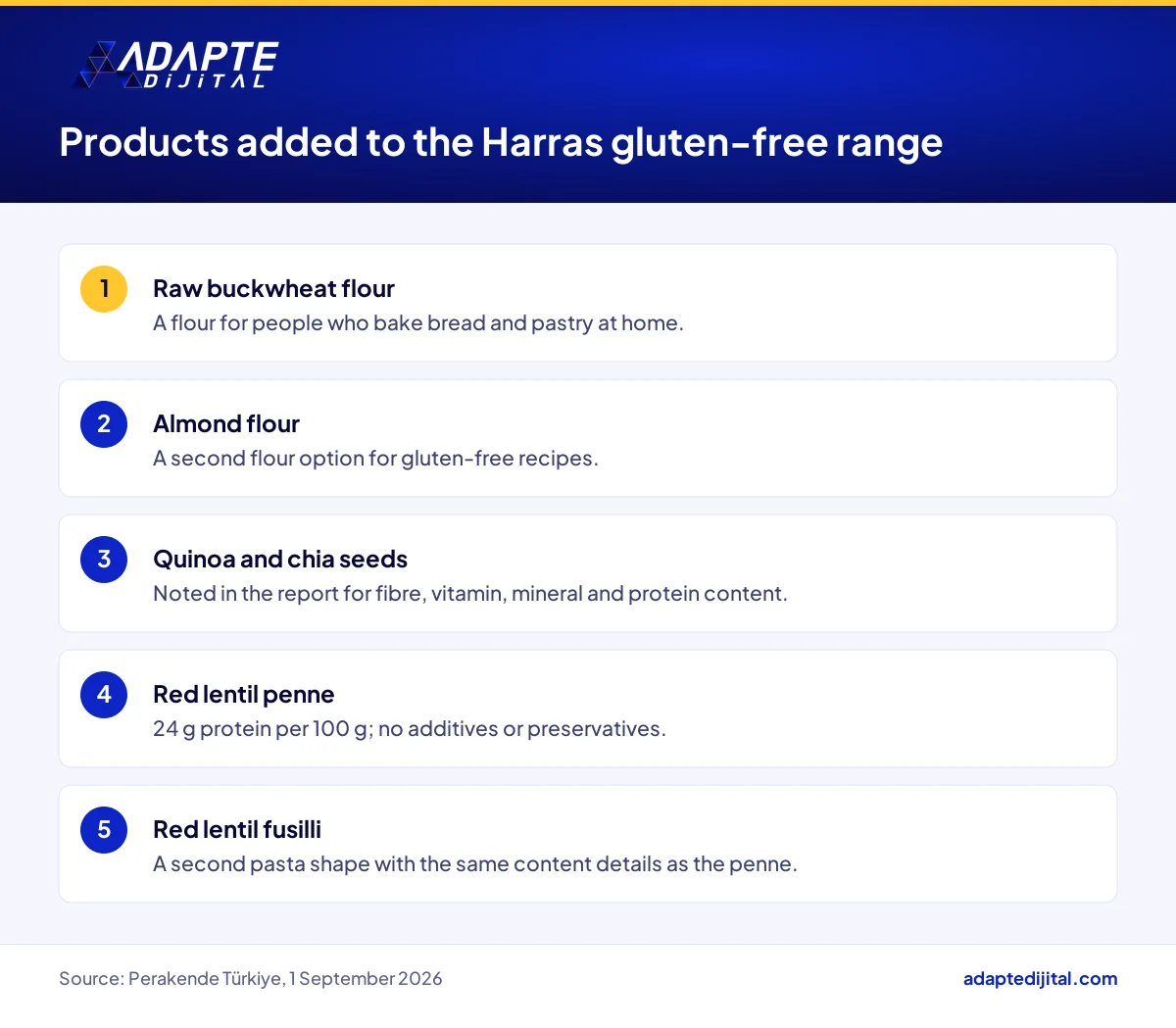
Turkish grocery chain FİLE Market has added raw buckwheat flour, almond flour, quinoa, chia seeds and red lentil penne and fusilli to the gluten-free range of its private label Harras (Perakende Türkiye, 1 September 2026). According to the report, the red lentil pastas contain 24 grams of protein per 100 grams and have no additives or preservatives.
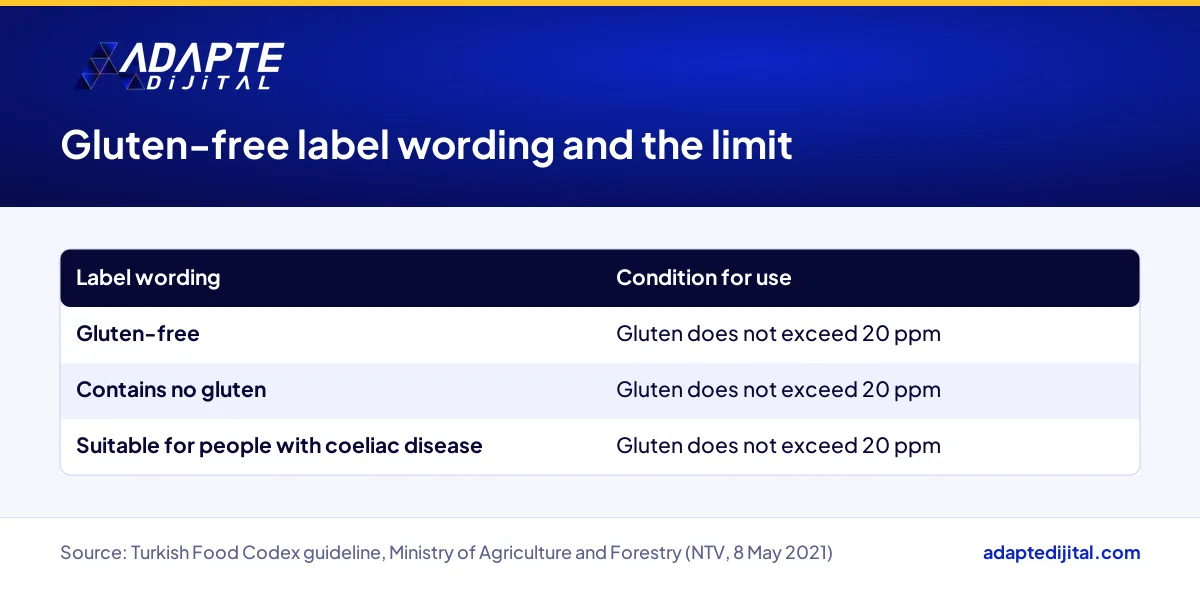
What it means for you: a private label is no longer just a cheaper copy; it is becoming a category tool for a niche need. If you run a grocery store in Türkiye in autumn 2026, or supply one, the question is when a line like this makes sense on your shelf. Then there is the label: under the Turkish Food Codex guideline, “gluten-free” can be used only if gluten in the product does not exceed 20 ppm.
Which products has FİLE Market added to the Harras gluten-free range?
Six products: raw buckwheat flour, almond flour, quinoa, chia seeds, red lentil penne and red lentil fusilli. Look, the list splits into three groups. Flours for home bakers, seeds and grains for the “superfood” shelf, and pasta for a quick meal. How many products the range holds in total is not stated.
When does a niche private label line like Harras make sense for a grocer?
When three conditions hold together: customers ask for it, the shelf has no reliable answer and you can document the label claim. Miss one, and the line becomes a collection sitting on the shelf, piling up stock costs. Let’s say customers ask, but you cannot back the label; then putting a trusted brand on the shelf is the better move.
What does Türkiye’s gluten-free labelling rule require from grocers and producers?
It requires a measurable limit. Under the Turkish Food Codex guideline, “gluten-free”, “contains no gluten” and “suitable for people with coeliac disease” can be used only if gluten in the product as sold does not exceed 20 ppm (Ministry of Agriculture and Forestry; reported 8 May 2021). So the label is a statement backed by analysis, not a marketing choice.
Which businesses does a gluten-free, high-protein private label like Harras affect, and how?
The winners are grocery chains that manage categories with data, and local producers with documents in hand who can manufacture under a retailer’s brand. Under pressure are small niche brands sitting on the same shelf without a price advantage, and neighbourhood grocers that stock none of these products. Indirectly affected are delis, online diet-food shops and cafe-bakeries serving gluten-free customers.
How does a niche private label product like Harras get found online and in search?
A customer looking for gluten-free products checks their phone first, with searches like “gluten-free pasta” or “where to buy lentil pasta”. If your product page does not clearly state ingredients, protein value and the label claim, you will not show up in that search.
What steps should a grocery owner take this week on a private label decision like Harras?
Four steps fit into this week: note niche product questions at the till and on the site, check labels on the gluten-free products you stock, ask a possible local producer for documents and analysis, and review these items’ product pages. None needs big investment; all produce data for the decision.
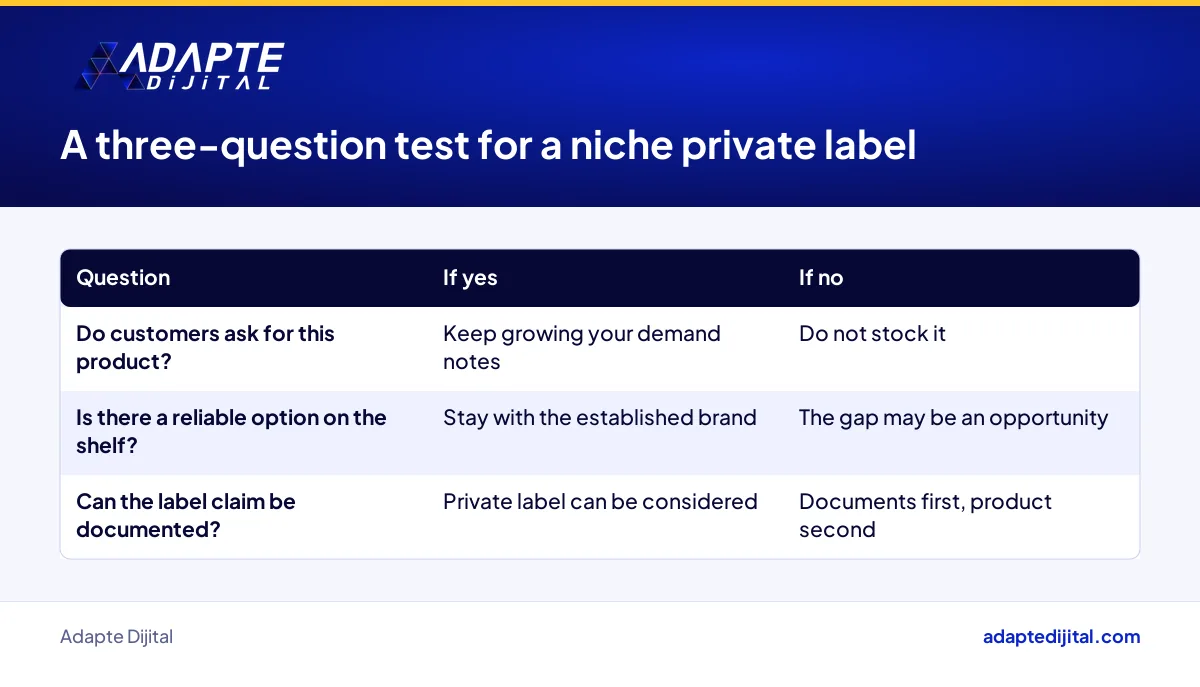
We collect similar decisions on our retail page, where we interpret the retail agenda for you. My decision is this: build a niche private label only when the customer’s question, the gap on the shelf and the documents behind the label are all there at once.
Quick Summary
- FİLE Market added flours, seeds and red lentil pastas to its Harras gluten-free range (Perakende Türkiye, 1 September 2026).
- The red lentil pastas contain 24 grams of protein per 100 grams (Perakende Türkiye).
- Under the Turkish Food Codex guideline, “gluten-free” can be used only if gluten does not exceed 20 ppm (Ministry of Agriculture and Forestry).
- The products’ certification status, prices and sales data are not in the report.
- A niche private label makes sense when demand, a shelf gap and a documented label come together.
Short Glossary
- Private label
- A private label is the brand structure a retailer uses to sell products under its own name or a brand it owns.
- Ppm
- Ppm is the unit used to express how many parts per million of a substance are present.
- Contract manufacturing
- Contract manufacturing is the production model used when a brand has another manufacturer make its product under the brand’s name.
Frequently Asked Questions
Next Step
If you want to work out whether a niche product line makes sense in your store, fill in the consult your expert form and we will look at demand, shelf and digital visibility together.
Sources: Perakende Türkiye, 1 September 2026 · FİLE Market corporate website · Turkish Food Codex gluten-free labelling guideline (as reported by NTV, 8 May 2021) · AYD-Akademetre Mall Sales Productivity Index, August 2026 (as reported by Foreks)
Updated: October 2026
Sık Sorulan Sorular
Because it meets two needs at once: gluten-free eating and high protein. According to the report, these pastas contain 24 grams of protein per 100 grams and no additives or preservatives. The gym-goer, the weight-watcher and the wheat-avoider meet on one shelf.
The report places quinoa and chia seeds among foods called “superfoods” for their fibre, vitamin, mineral and protein content. Here’s the thing, though: that is category language, not a health claim. If you use that language on your shelf, stay within what the product label says.
FİLE Market’s private label portfolio has three arms: Harras for food, Actisoft for cleaning and Daycare for personal care. The chain also runs a mobile payment system, FilePara. So Harras is the food arm of an established structure, not a one-off.
Your till staff are your best data source: note how many times a week someone asks “do you have anything gluten-free”. Check which searches return nothing on your website. Let me ask you one thing: when that customer gets no answer, do they walk out the door, or pick something else?
A private label gives you name, packaging and price position, plus the responsibility. An established brand leaves label and supply with the producer. If the category is small and demand is unclear, testing the shelf with a brand first and moving to private label once demand holds is the safer order.
I have been looking at the product pages of grocery and store websites for years, and here is what I see: the page for a specialty product is usually left with a one-line description. That is why I treat a niche line as a content decision as well as a product decision. We look at choosing a growth model from another angle in our piece on Terra Pizza’s franchise route.
Ppm stands for parts per million. 20 ppm means a product can contain at most 20 milligrams of gluten in every kilogram. And here is the part that makes me smile: neither you nor your most meticulous cashier can see that limit. It is measured in a lab, not by eye.
The report does not say whether they are certified or carry a coeliac suitability statement, and it does not name the producer. So we attribute no such quality to them.
A label statement should be backed by the product’s analysis results and by separation rules on the production line. If wheat flour is processed on the same line, no label should be written before cross-contamination risk is discussed. Verify with the official source; this is not legal or financial advice, so check the current rule with the Ministry of Agriculture and Forestry.
A private label lets a chain build a different price-value position from branded products in the same category. In August 2026, the AYD mall sales index shrank about 6.5% in real terms. In our reading, weaker purchasing power brings private labels and the price-value balance to the front. In a niche product, that balance becomes a reason for the customer to stay with the store.
When a chain’s private label lands on the same shelf, a small brand has to work harder for shelf share and visibility. The way out is to tell the product’s story and show its documents more clearly than the chain does.
A neighbourhood grocer cannot make every niche product under its own brand, but it knows its customers better than a chain does. If a few regulars ask for gluten-free products, keeping a few reliable ones on the shelf builds loyalty. Otherwise that customer goes to the chain and fills the whole basket there.
Product name, ingredients, nutrition table, weight and the exact label statement. Do not add a claim to the page that is not on the label; the page and the pack should say the same thing. Structured data helps search engines and AI assistants read it correctly.
A customer buying a niche product wants more proof than for an ordinary one. An analysis report, production details or an FAQ page can carry that proof. We cover making food safety visible in our piece on Migros publishing pesticide results in its app.
Add your gluten-free products to the products section of your business profile and show them with photos. Reviews that mention these products push you up in local searches in your neighbourhood. You can also see that FİLE Market shows its products under the Harras, Actisoft and Daycare brands on its own website.
Have a short chat with your till staff and list the products people asked for last week but could not find. That list shows whether the niche line idea rests on real demand or on a hunch.
Ask for the analysis report, whether wheat flour is processed on the same line and what backs each statement on the label. Price talk comes after those three. Putting a product with missing documents on the shelf under your own name means taking the risk under your own name too.
Purchasing owns the category decision, quality owns the label and the digital team owns the product page; all three should sit at the same table. We also build private label positioning and product stories with clients as part of our brand consultancy. As a system, ask three questions for every new niche product: is there demand, is the shelf empty, can the label be backed.
The report gives no information on certification or a coeliac suitability statement. Check the statement on the pack and, if needed, ask FİLE Market directly.
You can, but “gluten-free” can be used only if gluten in the product does not exceed 20 ppm. Ask the producer for an analysis certificate and verify the current rule with the Ministry of Agriculture and Forestry.
Without demand and documents, yes. Testing the shelf with a trusted brand first and moving to private label once demand holds is the safer order.