
Jimmy Key reaches 17 stores abroad, how should a fashion brand plan franchise growth?
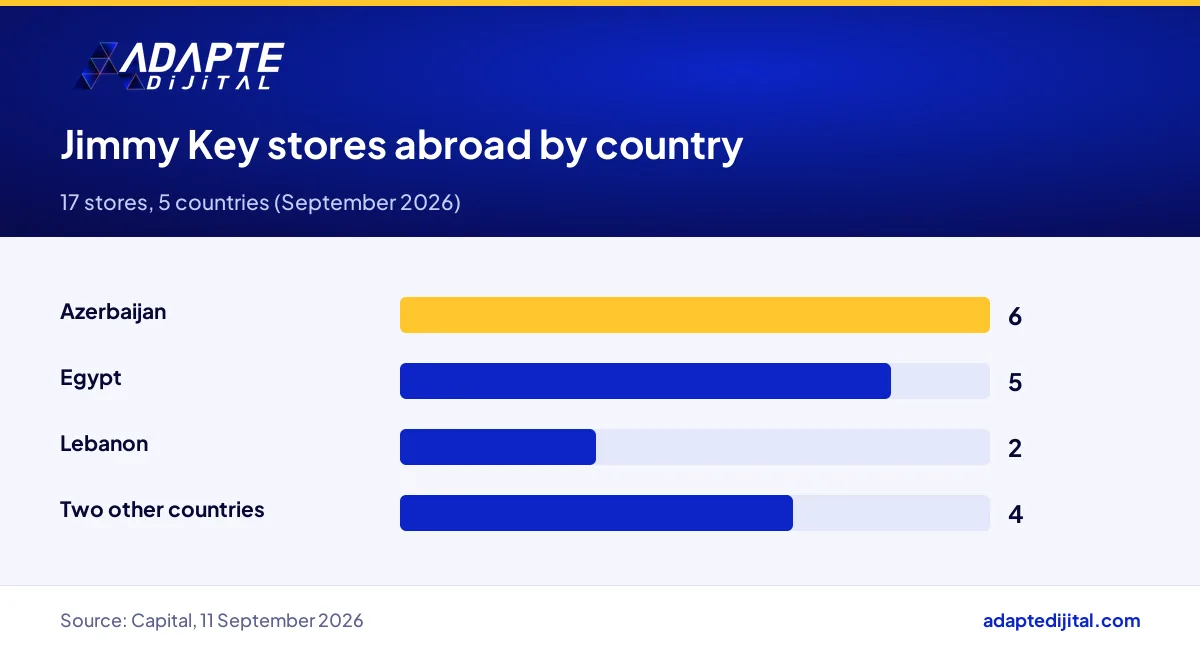
Jimmy Key, the Turkish fashion brand founded in Izmir, now has 17 stores outside Türkiye across 5 countries, after new openings at City Centre Beirut Mall in Beirut and Metropark Mall in Baku (Perakende.org, 11 September 2026). Azerbaijan leads with 6 stores, Egypt has 5 and Lebanon 2, while the remaining 4 sit in two other countries (Capital, 11 September 2026). For 2026 the company plans two stores in Casablanca in October, a first store in Amman and a sixth store in Cairo.
Here’s what it means for you. Jimmy Key grows abroad through franchise partners, not through stores it funds itself, and it plans to add online and wholesale channels alongside them. Look, if you run a growing fashion brand, the real question is not “should I go abroad”. It is “through which channel, and in what order”.
Which countries took Jimmy Key to 17 stores abroad?
Five countries. According to the reported breakdown, Jimmy Key has 6 stores in Azerbaijan, 5 in Egypt and 2 in Lebanon, with the other 4 spread across two more countries. The names of those two countries and how the 4 stores split between them have not been published. Store number 16 opened at City Centre Beirut Mall, and store number 17 at Metropark Mall in Baku.
Why is Jimmy Key growing abroad through franchise partners?
The report does not list the reasons one by one; it says the brand expands abroad through franchise partnerships. The general logic is well known: the partner takes on the store investment and local operations, and the brand supplies the product, the concept and the name. In the words of General Manager Erhan Çiçek, “growth abroad is not only about increasing the number of stores” (Perakende.org).
How does a fashion brand choose between franchise, own stores and online sales abroad, as Jimmy Key does?
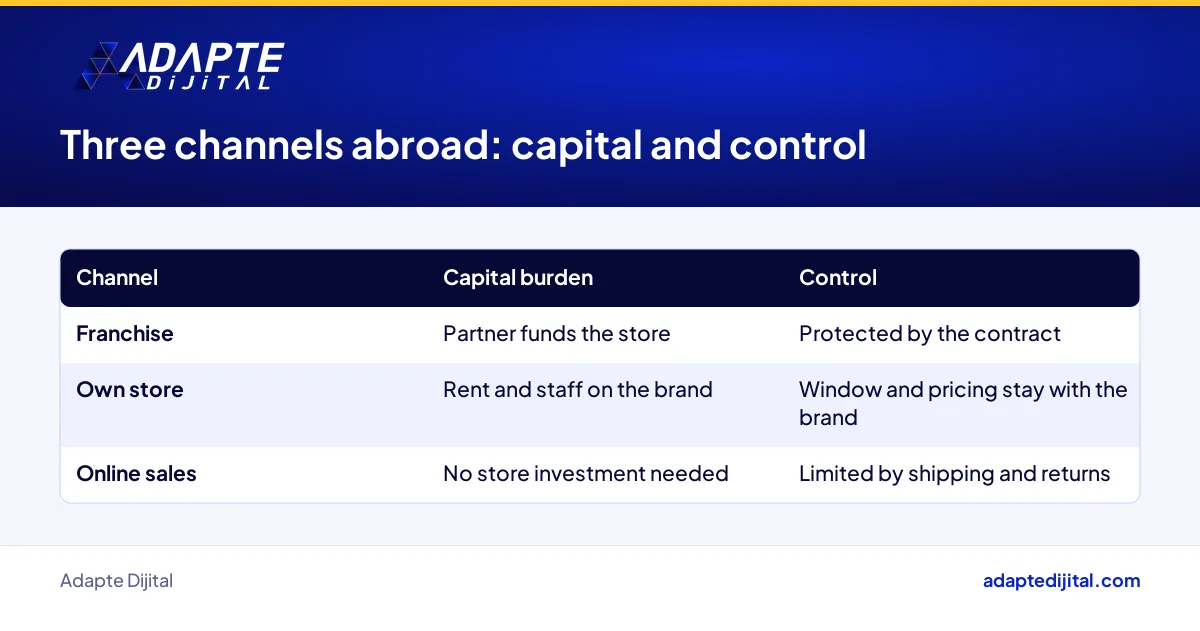
With three questions: how much capital do you have, how much control do you want to keep, and does anyone in that country know you yet? Jimmy Key’s choice is a franchise store network, with plans to develop online and wholesale channels next to it. The mix for your brand may be different. The order, though, usually stays the same: demand first, then a partner, and the store last.
Which businesses does Jimmy Key’s growth abroad affect, and how?
It affects three groups differently. The winners are Turkish fashion brands whose product and concept standards are written down and ready for a franchise model. The ones under pressure are small and mid-sized Turkish brands hunting for space in the same kind of malls. The indirect effect lands on the supply chain: garment manufacturers, export logistics firms and store fit-out companies.
What should a fashion brand going abroad like Jimmy Key prepare on the digital side?
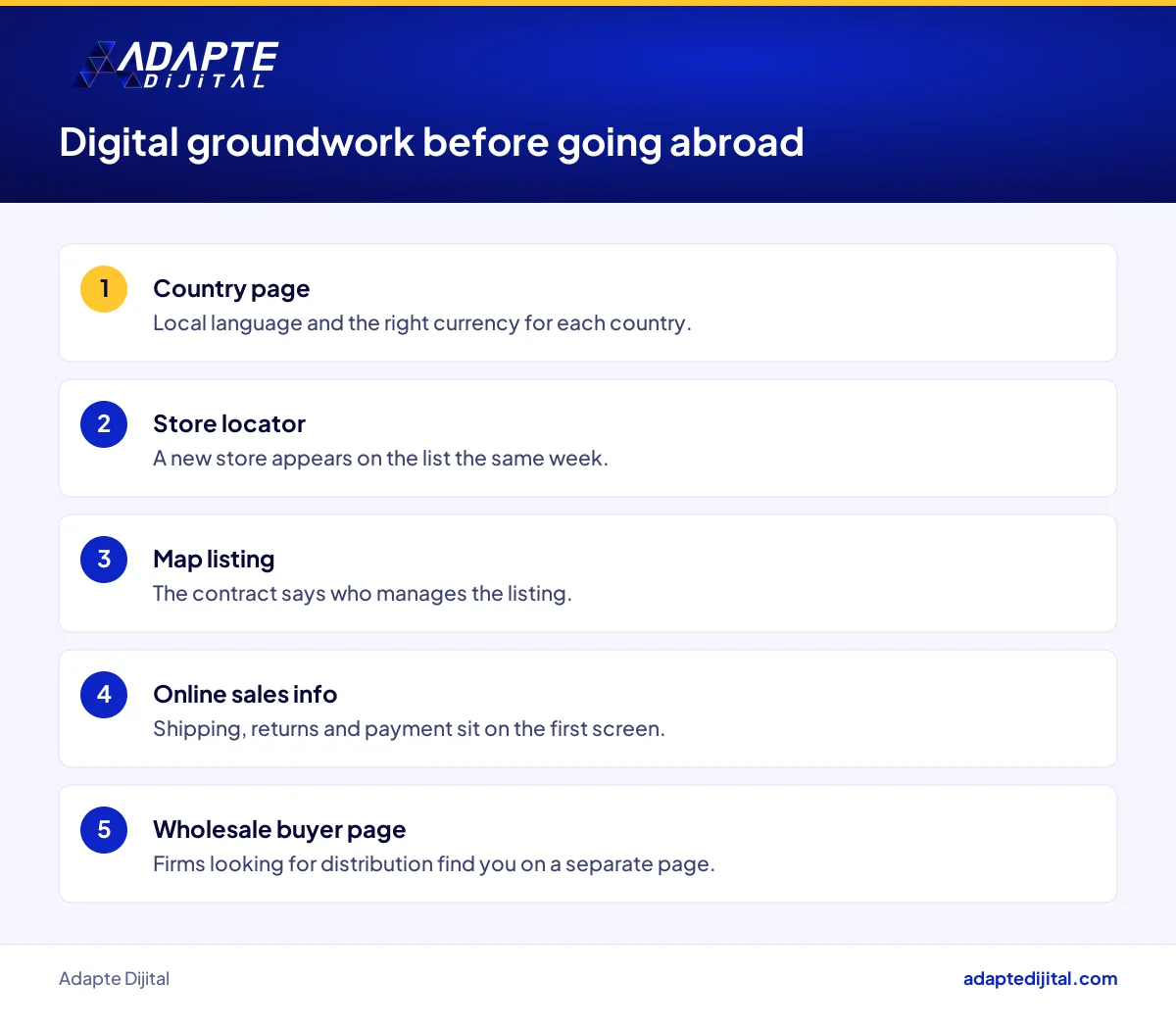
The search result opens before the store does. Picture a shopper in Baku searching for a brand and landing on a Turkish-only site, the wrong currency or an outdated store list. The window in the mall then has to do all the work alone. Digital preparation covers language, a store locator, map listings, the online sales setup and a page for wholesale buyers.
What should a brand owner weighing a Jimmy Key-style move abroad do this week?
This week, prepare the table, not the store. First, split your foreign online orders by country. Then write down your product, pricing and concept standards as if a partner were going to read them. Finally, check for yourself how your site shows up in search results in your target country.
Quick Summary
- Jimmy Key’s store count abroad rose to 17 across 5 countries (Perakende.org, 11 September 2026).
- The split is Azerbaijan 6, Egypt 5, Lebanon 2 and 4 stores in two other countries (Capital).
- Two stores in Casablanca, one in Amman and one more in Cairo are planned (Perakende.org).
- The brand grows abroad through franchise partners and plans to develop online and wholesale channels too.
- The decision order is online test first, then a partner, and a store network in one country last.
Short Glossary
- Franchise
- Franchise is the growth model used when a brand lets an independent operator use its name, concept and products under contract.
- Tenant mix
- Tenant mix is the retail term used to describe which categories and brands a shopping mall keeps together, and in what proportion.
- Store locator
- Store locator is the website feature used to show visitors their nearest store with an address and a map.
Frequently Asked Questions
Next Step
My decision is clear: online test first, then a partner, and the store last. If you want to set that order for your brand together, fill in the consult your expert form.
Sources: Perakende.org, 11 September 2026 · Capital, 11 September 2026 · Jimmy Key, About Us · Foreks, 16 September 2026 · Ministry of Trade of Türkiye · Para Dergi, April 2026
Updated: October 2026
Sık Sorulan Sorular
Metropark Mall is Jimmy Key’s sixth store in Azerbaijan. Here’s the thing: the real signal abroad is not the first store, it is the repeat opening in the same country. A brand that reaches its sixth store in one market appears to be past the trial stage there.
Lebanon shows 2 stores, and the Beirut opening is the sixteenth link in the network. The report does not give the location or opening date of the other Lebanese store. So the data cannot tell us whether Lebanon is a new market or a growing one.
The company’s corporate About Us page says the brand was founded in 1997 in Izmir and has more than 90 stores. A separate report dated 16 September 2026 puts the domestic network at 76 stores in 25 Turkish cities (Foreks). The country figure on the corporate page may cover a different kind of reach, and it is not confirmed. For the foreign network, we stick to the reported “17 stores, 5 countries”.
In the general model, the local partner carries the rent, the staff and the daily running of the store. The brand manages product flow, the concept book and brand standards. The terms Jimmy Key agreed with its partners, the investment amount and the partner companies’ names are not in the report, and we are not going to guess them.
Mall management relationships, rent negotiations, customs and hiring all take local knowledge. Let’s say you are looking for space at Morocco Mall or Aeria Mall in Casablanca. If someone at the table knows that mall’s tenant mix better than you do, you start the journey halfway down the road.
The model is established in food and beverage too. Coffy, a Turkish coffee chain, runs 74% of its existing network through franchising (Para Dergi, April 2026). So for Turkish brands, franchising is not an experiment. It is a familiar growth pattern.
When you cannot hand the product story to anyone else and your capital can carry it. In your own store, sales per square metre, staff and the window display stay with you. So does the bill: if the till isn’t ringing, you still pay the rent.
For most brands, it is the cheapest test. According to Türkiye’s Ministry of Trade, the country earned 5.1 billion dollars in foreign currency from e-exports in 2025. An online channel shows you whether a country has demand before you sign a lease. You read from the basket which sizes and which SKUs actually move in that market.
I think of it as three rings. The first ring is the online test: is there demand? The second ring is the partner: who will carry that demand into a physical store? The third ring is the network: a second and third opening in the same country, the way Jimmy Key does it in Azerbaijan.
Brands with a clear range, a measured stock turn and a concept that is already on paper. A local partner decides by looking at the numbers; nobody wants to put money into product that just sits on the rail. Brands that keep adding stores in the same country can help make Turkish fashion feel familiar to future partners.
A newcomer in a mall where similar brands already trade has to give shoppers a reason to choose it. Mall management rarely wants two look-alike brands in its tenant mix. Without a clear difference, shoppers walk straight past the door. We look at how a different format, the outlet, changes that balance through Boyner’s store at Florentia Village.
Garment manufacturers, export logistics firms and store fit-out companies in Türkiye. The planned openings in Morocco, Jordan and Egypt may mean work abroad for suppliers like these. Growth at home is happening in the same month too, so the domestic and foreign networks are expanding together.
A separate page for each country, in the local language and the right currency, tells search engines “this brand is here”. I’ve been opening brands’ international sites one by one for years. Here’s what I keep seeing: the store opens, and the site goes on showing the old country list for a long time.
Say a shopper in Beirut searches for the brand together with the mall’s name. If there is no map listing, or it points to the wrong floor, that search is wasted. Let me ask you one thing: will you add that listing, will your partner, or will you both assume the other one did it?
If you sell online, shipping, returns and payment details for each country belong on the first screen. For wholesale, a separate buyer page makes it easier for companies looking for distribution to find you. If both channels share one site, don’t blur the message for retail shoppers and trade buyers.
Twelve months of foreign orders, broken down by country, product group and average basket value. That table separates real demand from guesswork. If you have no such data, your first job is to run a small online test.
The store concept, the product range, the price band, a training plan and brand usage rules. If you also want to show how you handle sustainability, Watsons’ sustainability report shows where a small business can start. On contracts and tax, nothing here is legal or financial advice; verify with the official source and with your lawyer.
When choosing a target country, finding a partner and getting digitally ready all run at the same time. This is work we do: through our foreign trade consultancy, we plan those three steps at the same table with brands. Our retail page keeps similar cases together.
There is no single threshold. A prospective partner looks less at store count and more at whether the concept is written down, the product sells steadily and the brand has demand in the target country.
No. The report does not include franchise terms, the investment amount, the partner companies’ names or the share of revenue from abroad.
Yes. Online sales and a wholesale channel are among the lowest-cost ways to measure demand in a country before you open a store.