
Tavuk Dünyası invests $20.5 million in Gebze, what does a production plant give a chain?
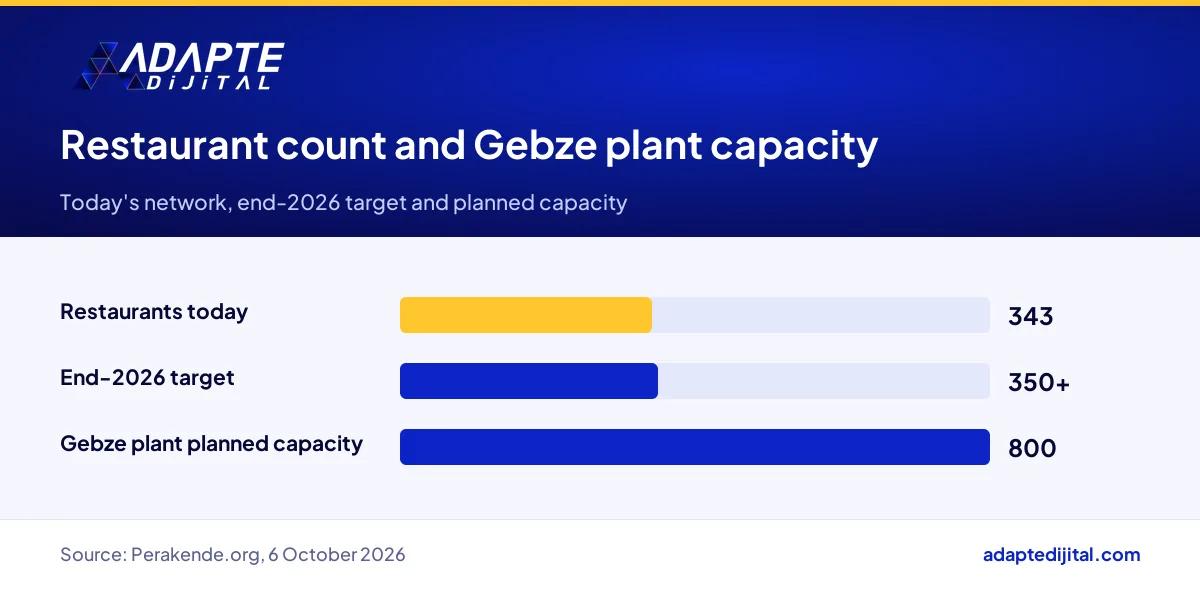
Turkish chicken restaurant chain Tavuk Dünyası has invested $20.5 million in its production plant in Gebze, an industrial town east of Istanbul, and put it into operation; the 10,200 m² plant is planned to serve up to 800 restaurants, while the chain runs 343 today (Perakende.org, 6 October 2026). At the plant, chicken breast and thigh meat is marinated and then distributed to the restaurants.
What it means for you: every restaurant chain that keeps opening branches meets the same question sooner or later. Do I keep a separate kitchen in every branch, or do I build one shared production point? Tavuk Dünyası answers by sizing capacity at more than twice its current restaurant count and by moving production closer to Marmara, where most of its business happens.
Why does Tavuk Dünyası put production in Gebze, close to demand?
Because roughly 55 percent of its business is in the Marmara region, the area around Istanbul. CEO Volkan Mumcu gives that share as the reason for bringing production closer to demand. The shorter the trip from plant to restaurant, the easier it is to manage freshness and logistics costs for marinated meat. For a restaurant chain growing its network in Marmara in autumn 2026, Gebze means a production point inside the region itself.
When should a restaurant chain like Tavuk Dünyası move to central production?
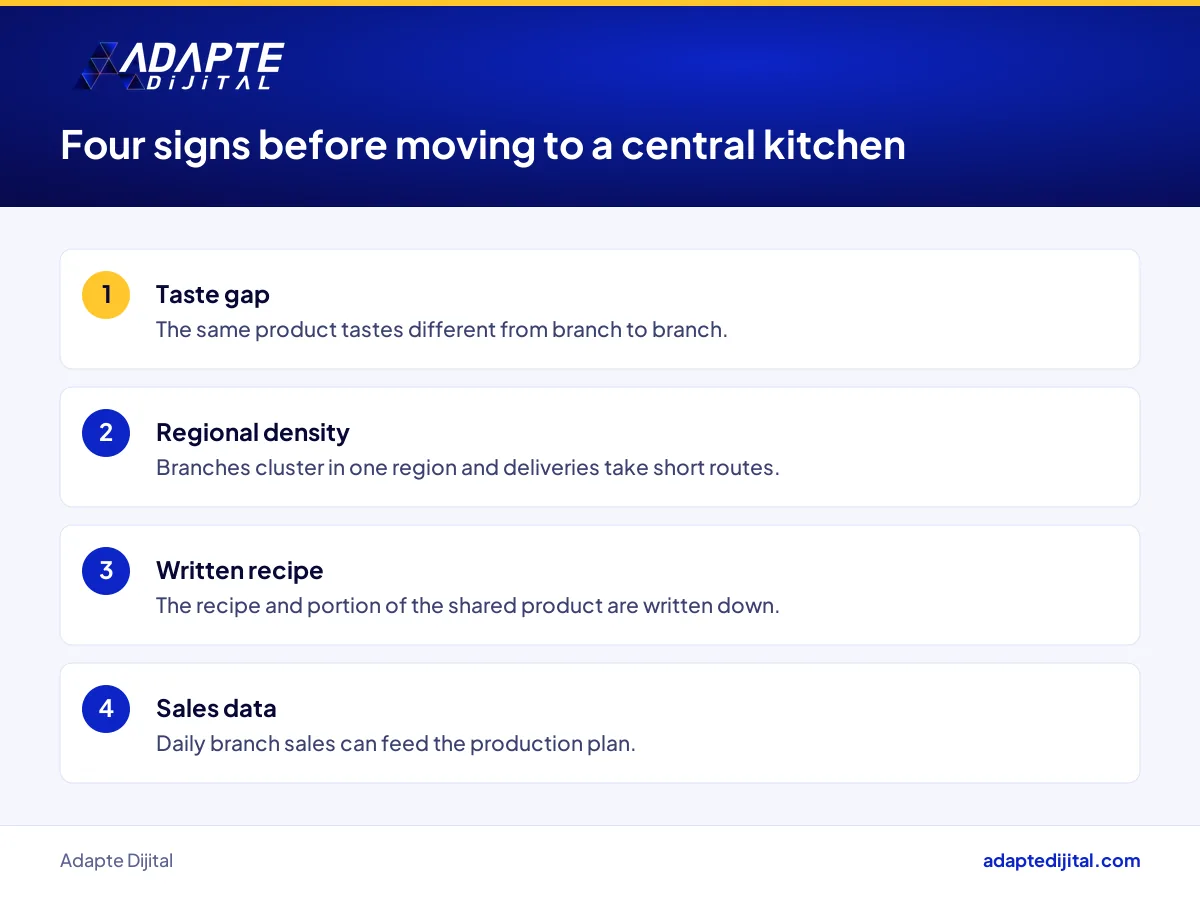
When keeping the same product at the same quality in every branch gets hard, and when branches cluster in one region. The real gain of central production is the standard: the same marinade, the same portion, the same taste in every branch. Let’s look at it through a scene.
Let’s say you run a three-branch wrap chain
Let’s say you have three branches, and each branch’s cook marinates the meat at their own counter. In the morning the sauce at branch one is a little spicy; at lunch, branch two’s is a little salty. A customer visits both and says, “It doesn’t feel like the same place.” In the evening you look at the till and wonder why one branch’s customers never come back.
Why does Tavuk Dünyası, with 343 restaurants, build capacity for 800?
Because it puts infrastructure ahead of growth rather than behind it. The chain plans to pass 350 restaurants by the end of 2026 and to open more than 30 new ones in 2027. The capacity sits well above that plan too. So the plant is designed not for today’s need but for a network years ahead.
Who does Tavuk Dünyası’s Gebze plant affect, and how?
It affects three groups. The workforce in and around Gebze gains new jobs. Chicken and food suppliers see a large buyer grow stronger in the region. Small restaurant chains in Marmara with similar menus and no central production face tougher competition on consistency and speed.
What does central production change on a restaurant chain’s digital side?
It changes the data. Product coming out of one kitchen makes it measurable how much goes to which branch and how much sells on which day. When till data and the production plan sit on the same screen, waste falls and the stock forecast stops being a guess.
What should a restaurant owner opening branches learn from Tavuk Dünyası this week?
This week, write your recipes down, use customer reviews to spot taste differences between branches, and list which products could be prepared in one kitchen. You do not need to build a plant. You first need to put your standard on paper.
Quick Summary
- Tavuk Dünyası invested $20.5 million in its production plant in Gebze (Perakende.org, 6 October 2026).
- The 10,200 m² plant can serve up to 800 restaurants, while the chain has 343 (Perakende.org).
- The company says roughly 55 percent of its business is in the Marmara region (Perakende.org).
- The chain plans more than 350 restaurants by the end of 2026 and more than 30 new ones in 2027 (Perakende.org).
- For a small chain, the first step towards central production is a written recipe and one shared product, not a plant.
Short Glossary
- Central kitchen
- A central kitchen is the production model used to prepare products for several branches in one place and distribute them.
- Marinade
- Marinade is the preparation method used to rest meat in sauce and spices before cooking.
- Capacity
- Capacity is the measure used to express the maximum volume a production plant can serve.
Frequently Asked Questions
Next Step
If you want to plan your branch growth together with the kitchen, supply and data side, fill in the consult your expert form and we will get back to you.
Sources: Perakende.org, “Tavuk Dünyası’ndan Gebze’ye 20,5 milyon dolarlık yatırım” ($20.5 million investment in Gebze from Tavuk Dünyası), 6 October 2026 · Tavuk Dünyası corporate website
Updated: October 2026
Sık Sorulan Sorular
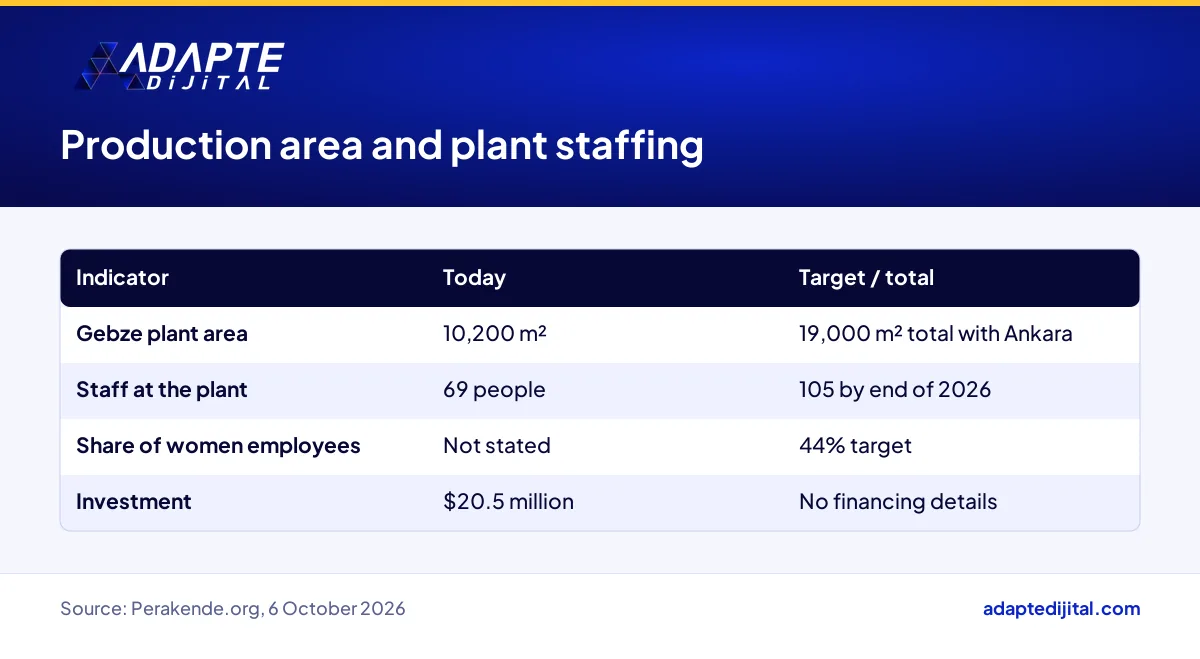
Together with the Ankara plant, the chain’s total production area reaches 19,000 m². The Ankara plant holds BRCGS, IFS, HALAL, ISO 9001, ISO 14001 and ISO 22000 certifications. The same certifications are planned for Gebze.
Mumcu keeps it short: “The Gebze investment is one of the concrete steps of this strategy.” In the report, that strategy is framed around bringing production closer to demand. The plant was also designed with a LEED Gold target, the green building rating.
The plant’s opening date, how the investment is financed, its daily production volume and how many of the 343 restaurants are franchises are not in the report. We do not guess at any of them.
No, the system is. The cook does good work, but every branch lives by its own recipe. Move the marinating to one kitchen and the cook can focus on service and speed while the taste is fixed in one place. Tavuk Dünyası marinating meat at the plant and shipping it to restaurants is the large-scale version of the same logic.
Dependence on a single point. When something goes wrong in that kitchen, every branch feels it. For a small chain, a backup supplier and a written recipe help soften that risk.
Here’s the thing: in most businesses the order runs the other way. First a branch opens, then an extra counter goes in when the kitchen cannot keep up, and supply comes last. Meanwhile quality wobbles and customers walk away at the door. Tavuk Dünyası’s numbers flip that order.
In the short run, utilisation can stay low, and that is a deliberate cost of the investment. The report gives no current utilisation rate or output volume. But capacity that is ready before the restaurant lets a new branch open with the same product from day one.
As the number of franchisees rises, the standard becomes the hardest thing to protect. In our piece asking whether your business is ready to franchise, supply is one of the four readiness questions too.
The report says 69 people work at the plant, with targets of 105 by the end of 2026 and a 44 percent share of women employees. It is not fully clear whether these figures cover only the Gebze plant; the report says “at the plant”.
For chicken producers, packaging firms and cold-chain logistics companies, a regular, high-volume buyer. A plant working towards food safety certifications is also likely to ask its suppliers for documented standards.
A wrap shop running on one kitchen in the same district struggles to compete with a big chain on price and consistency. We look at the supply options of small businesses without their own kitchen in our piece on how ToptanTR links small shops with makers.
A central kitchen works out how many portions to prepare each morning from the branches’ sales the day before. Without that data, production either runs over or falls short. Average basket and hourly sales are the raw material of the production plan.
On delivery and food apps, customers see the brand, not the branch. When every branch serves the same product, app ratings tend to even out across branches.
Indirectly, yes. A consistent product means consistent reviews, and consistent reviews mean every branch shows a similar rating on the map. One branch’s low rating can pull down the whole brand in a “near me” search.
The one whose taste varies most and takes longest to prepare. In many restaurants that is the sauce, the marinade or the dough. Preparing it at one counter and sending it to the branches is your first trial.
We bring production, branches and digital data into one business model as part of our adaptive business model and digital transformation management work. You can follow the chain’s own announcements on Tavuk Dünyası’s website and the wider sector on our retail page.
Build the kitchen that will feed the branch before you build the branch. When capacity is ready, every new door opens with the same taste.
There is no fixed branch count. If taste differences appear between branches and the branches sit in the same area, start by preparing one product centrally.
At plant scale, yes, but the first step is not a plant. Turning one existing branch’s kitchen into a shared prep point for sauce or marinade is a lower-cost start.
The report does not say. The split of the 343 restaurants between company-run and franchised outlets is not disclosed, so we do not guess.