
VitrA Tiles unveils The Code at Cersaie 2026, how can a trade fair open export doors?
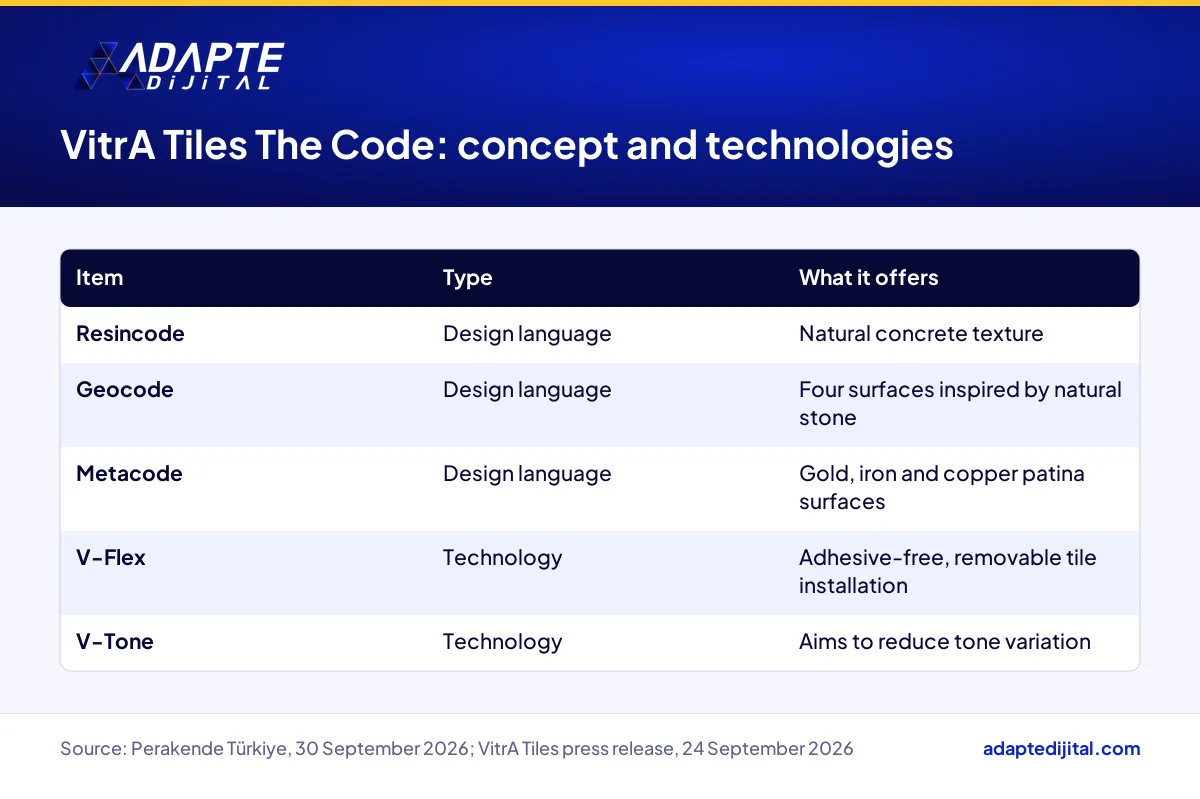
VitrA Tiles presented The Code concept and its 2027 collections, designed around a “Material Intelligence” approach, at Cersaie 2026, held in Bologna, Italy, from 21 to 25 September (Perakende Türkiye, 30 September 2026). The concept is built from three design languages. The other half of the stand covered two technologies: V-Flex, an adhesive-free installation system, and V-Tone, which aims to reduce tone variation.
For manufacturers and exporters, the lesson is clear: you go to an international trade fair with a concept, a few sub-collections and a technology you can explain in one sentence, not with a product list. In autumn 2026, Turkish ceramics and building materials makers use Cersaie as an export showcase. You can copy that setup step by step.
Which collections and technologies did VitrA Tiles present at Cersaie 2026?
One concept with three sub-collections, plus two technologies. The Code is made up of three design languages called Resincode, Geocode and Metacode. On the technology side, V-Flex offers adhesive-free installation, and V-Tone aims to reduce tone variation in production. The key details are also confirmed in VitrA Tiles’ press release of 24 September 2026.
How can VitrA Tiles’ The Code setup be turned into trade fair preparation?
In four steps: choose one concept name, split it into no more than three sub-collections, give each sub-collection one material story, and present the technology in a separate corner. VitrA Tiles’ stand follows this order.
How should technologies like VitrA Tiles’ V-Flex and V-Tone be explained at a fair?
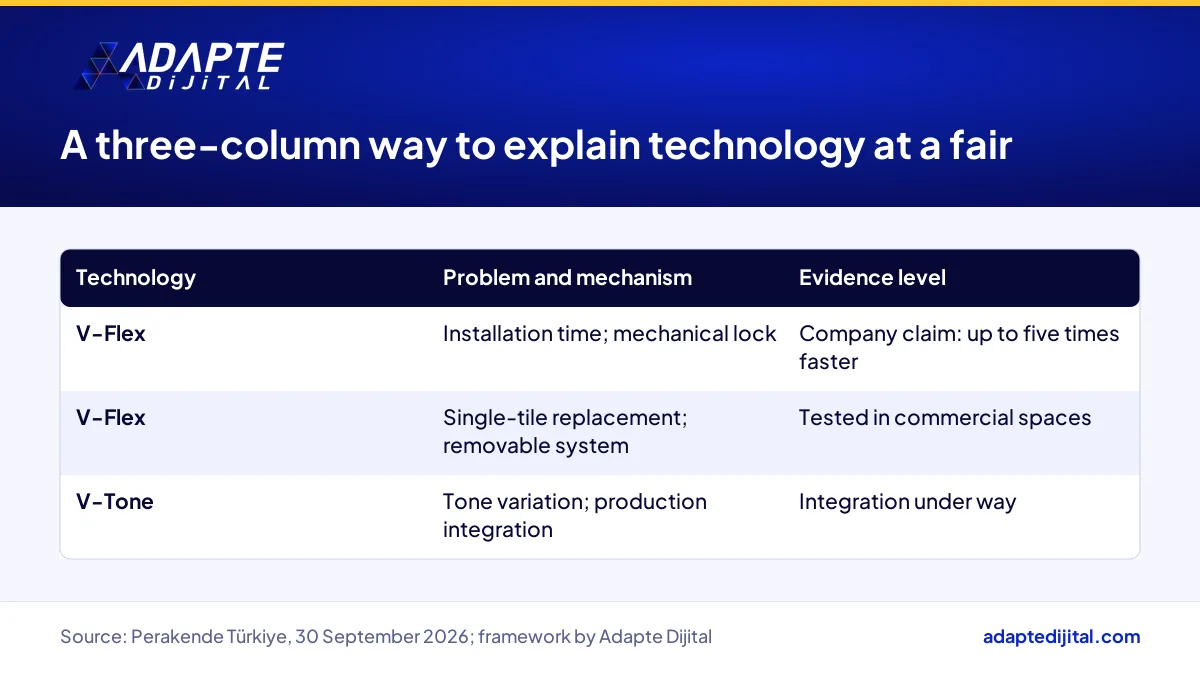
With one problem, one mechanism and one level of evidence. For V-Flex, the problem is installation time and removability, the mechanism is a mechanical lock, and the evidence level is a company claim. For V-Tone, the problem is tone variation and the status is integration in progress. That frame sells without overselling.
Who does VitrA Tiles’ Cersaie launch affect, and how?
The winners are Turkish ceramics and building materials exporters who adapt the concept approach to their own stands, and store, office and hotel operators who want shorter refits. Under pressure are makers who arrive at fairs with a price list alone. Indirectly affected are tile installers, DIY store chains and retail designers.
What should a ceramics exporter do online before and after a fair like Cersaie?
Build the collection pages before the fair and the meeting follow-up after it. Once visitors leave the stand, they search for the product online. If they cannot find the concept name, the sub-collections and the spec sheet, your business card stays in their bag. One note: The Code does not yet appear on VitrA Tiles’ corporate website, which shows that timing a new collection’s web launch is a planning item in its own right.
What should an exporting manufacturer do this week after the VitrA Tiles example?
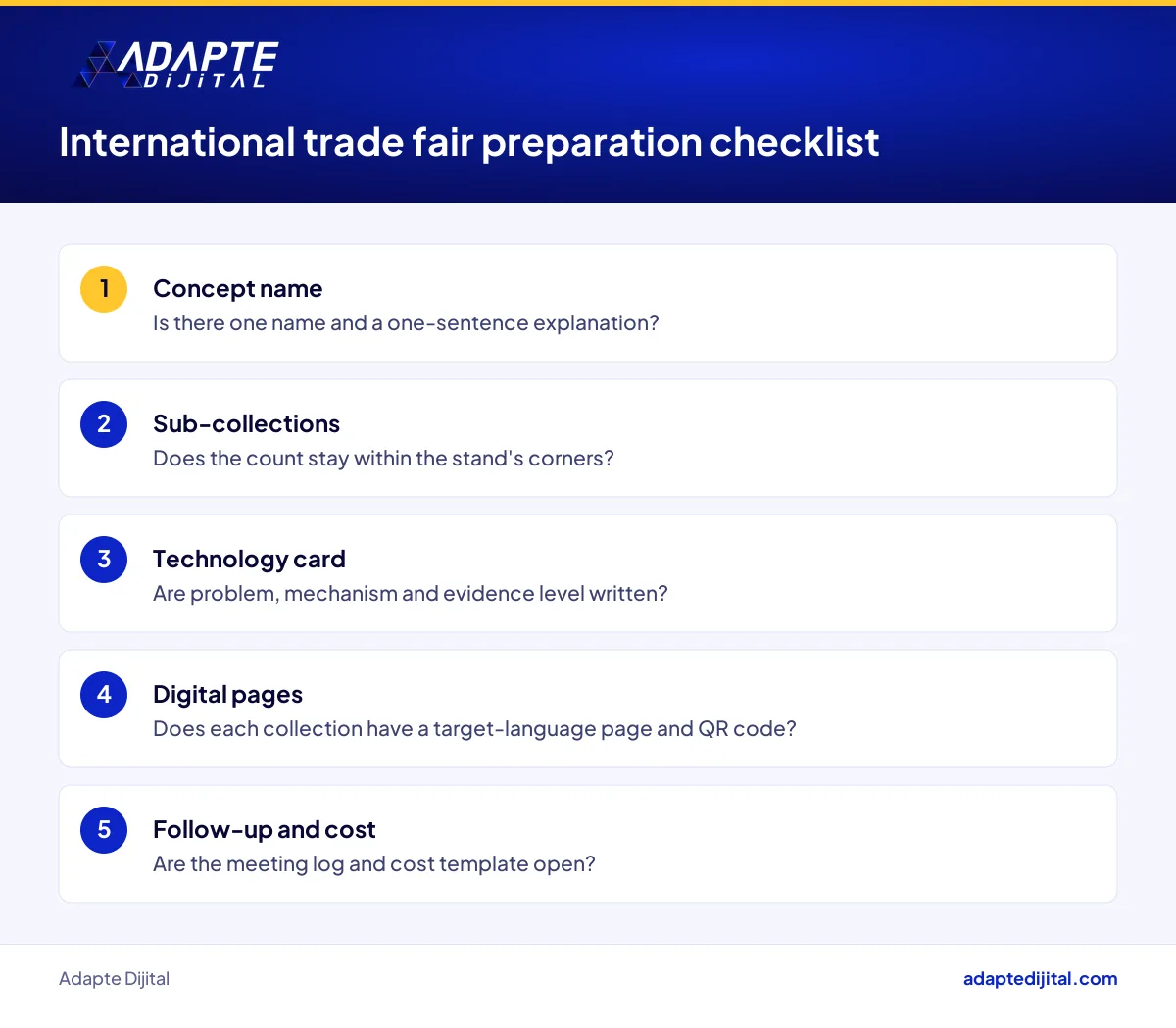
Do three things. Write down the concept name and no more than three sub-collections for your next fair, fill in the problem-mechanism-evidence trio for each technology, and open the fair cost template with your own numbers. Only then start stand design.
- Add up stand and build-up costs.
- Add samples and shipping.
- Add travel and accommodation.
- Divide the total by the number of qualified meetings: that is your cost per meeting.
- Add the first orders after the fair to the same table.
If you plan to use export support schemes, verify the conditions with the official source; this is not legal or financial advice.
Quick Summary
- VitrA Tiles presented The Code at Cersaie 2026, held in Bologna from 21 to 25 September (Perakende Türkiye, 30 September 2026).
- The Code consists of three design languages: Resincode, Geocode and Metacode.
- According to the company, V-Flex cuts installation time by up to five times compared with traditional methods; this is a company claim.
- V-Tone aims to reduce tone variation, and its integration into production is under way.
- Going to a fair with one concept, up to three sub-collections and a technology with a clear evidence level keeps preparation simple.
Short Glossary
- Mechanical locking
- Mechanical locking is the term used for joining tiles through interlocking edge profiles instead of adhesive.
- Tone variation
- Tone variation is the term used for differences in colour and shade between tiles produced in the same series.
- Patina effect
- Patina effect is the term used for applying the aged look that metal surfaces gain over time to a finished surface.
Frequently Asked Questions
Next Step
If you want to build the concept, collections and follow-up plan for your next fair together, fill in the consult your expert form.
Sources: Perakende Türkiye, 30 September 2026 · VitrA Tiles press release, 24 September 2026 · Foreks, 17 September 2026 · VitrA Tiles corporate website
Updated: October 2026
Sık Sorulan Sorular
Resincode brings the texture of natural concrete to the surface. Geocode offers four surface typologies, Alba, Imperio, Rio and Merano, inspired by Spanish limestone, marble, quartzite and gneiss. Metacode consists of three patina-effect surfaces in gold, iron and copper tones.
V-Flex is an adhesive-free ceramic tile installation system developed with Välinge’s Ceraloc mechanical locking technology. Tiles can be removed and replaced one by one when needed, and the system has been tested for commercial spaces such as offices, hotels and stores. According to the company, V-Flex cuts installation time by up to five times compared with traditional methods; that is a company claim, not an independent measurement.
V-Tone aims to reduce tone variation that arises in production. Its integration into production processes is still under way. When the full switch will happen has not been announced.
At a trade fair, visitors walk past many stands in a day and usually remember one name from each. A single umbrella name like The Code ties three sub-collections together in one sentence. Set a clear limit for your own stand: one concept name, one sentence of explanation.
VitrA Tiles goes with three sub-collections, and Geocode alone has four surface types. Here’s the formula: the number of sub-collections should not exceed the number of separate corners your stand can hold. Three corners means three collections. More turns the stand into a warehouse.
Each sub-collection links to one source: Resincode to concrete, Geocode to natural stone, Metacode to metal. That link helps visitors remember the product as a texture before they read the spec sheet. Write one source of inspiration for each of your series and put it on the stand label.
The most common mistake is pouring the entire catalogue onto the stand. The stand looks busy, but the lead book stays empty, because visitors cannot choose what to look at. VitrA Tiles separating concept and technology is the opposite of that mistake: story first, then solution.
A phrase like “up to five times faster” raises doubts rather than convincing buyers when the conditions are missing. If you are pitching a time or cost advantage for your own product, write the measurement conditions on the stand and in the spec sheet. If there is no independent test, say so plainly; professional buyers reward clarity.
You don’t explain a mechanical system; you show it. A small floor area on the stand where one tile is lifted out and clicked back in works better than a brochure. Ask: what can a visitor try with their own hands?
Yes, but with its stage. VitrA Tiles states openly that V-Tone’s integration is still under way. Presenting an unfinished technology as ready costs you trust at the ordering stage.
A refit means closing the shop and waiting, and every closed day is a sale that never reaches the till. Removable, adhesive-free flooring may affect that time. Still, how much shorter it gets is a company claim, and no Türkiye launch date or price for the system has been announced. Run the numbers yourself: closed days multiplied by average daily sales is the hidden cost of a refit.
Kale, another Turkish brand, also met visitors at the same fair (Foreks, 17 September 2026). Turkish ceramics brands use Cersaie as an export showcase. A fair works best when you plan it together with market choice and brand positioning; we cover that question through Günsan’s choice of focus markets.
Prepare a main page for the concept, a separate page for each sub-collection and a short explainer page for each technology. Publish them in the fair’s language and your target markets’ languages. The QR code on the stand should go straight to the relevant collection page, not the home page.
Log every meeting on the day of the fair and get back to each contact in the week the fair closes. Where to start keeping those records in one table is covered in our piece on the ZMD retail technology awards. If you want to back up fair traffic with ads, narrow your audience to the architects and distributors you met or want to meet.
Use this template, with your own figures in each line:
Fair selection, market language and post-fair follow-up belong to one plan. We handle international fair and market planning as part of our foreign trade consultancy work.
Neither the news report nor the company’s press release gives a launch date or price for Türkiye.
According to the company, V-Flex cuts installation time by up to five times, but this is not an independent measurement. Ask your installer for a written time estimate for your own store.
Yes. Even at a small scale, one concept name and a limited number of sub-collections make your stand easier for visitors to remember.