
AI local business recommendations: who gets named in Istanbul, and why?
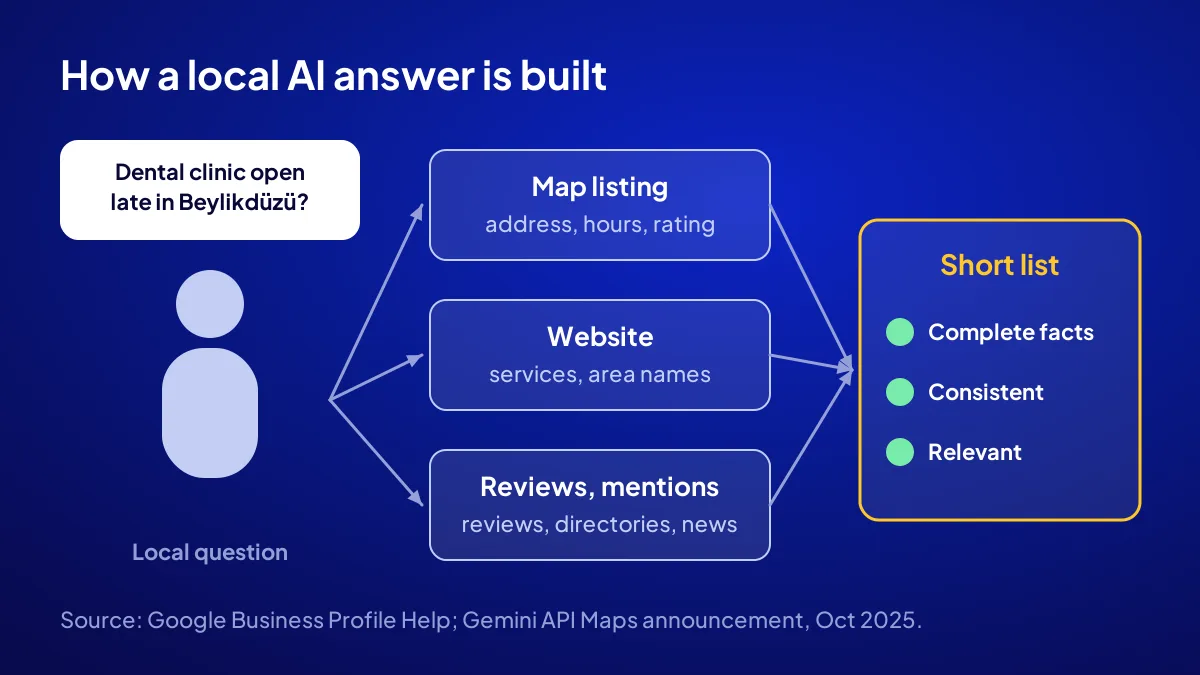
When AI makes local business recommendations, it looks at three things: where the question is asked, what trusted sources say about a business, and whether those facts agree. When someone asks Gemini for “a dental clinic open late in Beylikdüzü”, the answer is built from map listings, websites and reviews. If your name is not clear, consistent and relevant to the question in those sources, it does not make the list.
The good news: apart from distance, most of the work is in your hands. Google names three local ranking factors, relevance, distance and prominence, and much of the road to AI answers runs through the same data. Below is what you can fix at neighbourhood level in Istanbul, in order.
How does AI answer “a good dental clinic in Beylikdüzü”?
The assistant first splits the question into place and service: Beylikdüzü and dental clinic. Then it looks for records carrying both and compares checkable facts such as opening hours, reviews and address. Usually a handful of businesses make the answer. The ones that do have the most complete and consistent information, not the biggest shop sign.
Why map data comes first
According to Google’s October 2025 announcement, the Gemini API can ground its answers in Google Maps data. The feature reaches the address, hours and user ratings of more than 250 million places. On Google’s side, the backbone of a local answer is Business Profile data.
Which 3 factors drive Google’s local answer?
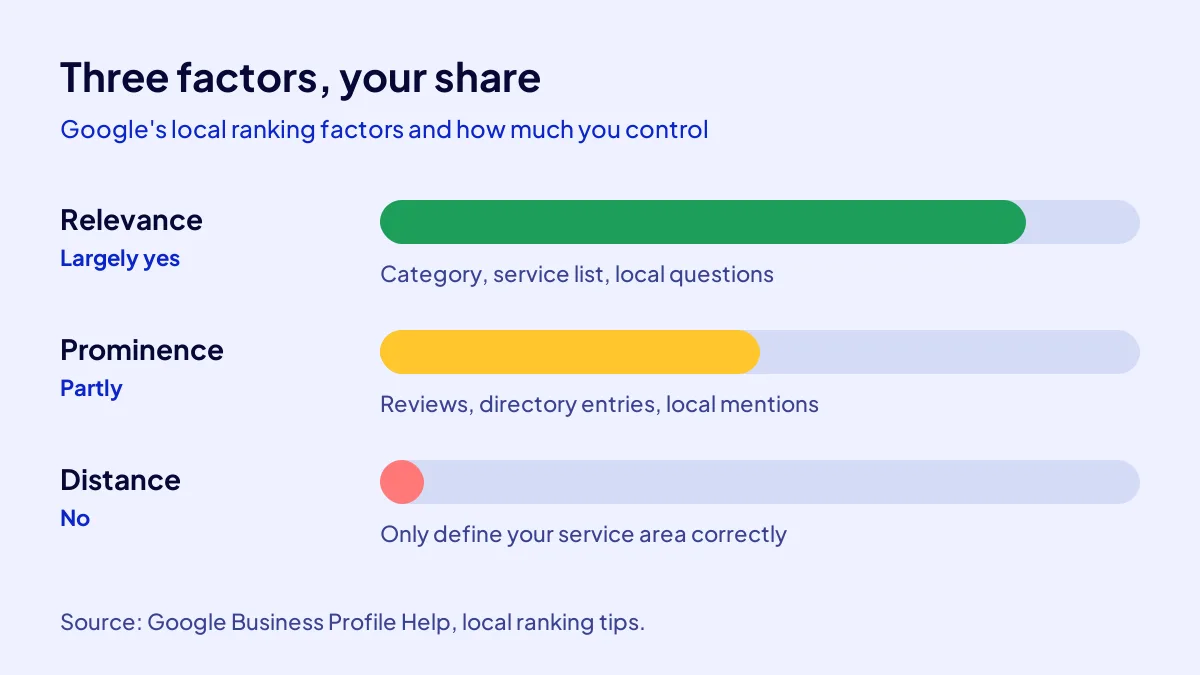
Google’s Business Profile help page ties local results to three factors: relevance, distance and prominence. Relevance is how well a profile matches the search, and distance is how far the business is from the searcher. Prominence is how well known the business is; review count and links to your site affect it. Missing or wrong information can keep you out of relevant searches.
Prominence: being the craftsman the street knows
Everyone on the street knows the good craftsman, but the internet only learns it from traces. Reviews, local news, directory entries and sites that mention you leave those traces. They make word-of-mouth reputation visible.
Distance is not yours to change; what is?
You cannot change distance without moving the shop. But almost everything that builds relevance and prominence is under your control. The table shows what you can change for each factor and how soon it becomes tangible. The timing column is not a fixed schedule but an order that comes from the work itself; finish the quick fixes first, then keep at the slow ones.
| Factor | In your hands? | What you do | When it settles |
|---|---|---|---|
| Relevance | Largely yes | Category, service list, neighbourhood pages, Q&A blocks | Fixed at once, read over time |
| Prominence | Partly | Asking for and answering reviews, directory entries, local mentions | Builds over months |
| Distance | No | Defining your service area correctly | Only changes with your address |
Draw your service area honestly
If a boiler repair service in Beylikdüzü also covers Esenyurt and Büyükçekmece, it says so on the profile and the site. Listing districts it does not serve turns customers away at the door and comes back as bad reviews.
One address, one spelling
Writing your name, address and phone the same everywhere is called NAP consistency. A short or long form of a neighbourhood name rarely causes trouble; an old phone number or address forgotten in one directory does.
Why should the neighbourhood name be on your page in Istanbul?
Istanbul has 39 districts and, per TÜİK’s end-2025 figures, 15.75 million residents. At that size, “dental clinic in Istanbul” has no meaningful answer; a meaningful one is built at neighbourhood level. If your site never names the neighbourhood, an assistant has no sentence to match you with it. The sign hangs on the street, but online you exist only as far as you are written.
Telling machines your address with structured data
Address, hours and service area are also marked up with structured data. This makes it harder for AI to confuse you with a business of the same name. See examples in why AI confuses you without structured data.
Presenting your business as an entity
AI recognises your business from the sum of facts about it, not from single pages. That sum is called an entity; we explain it in what is an entity.
Which 6 signals should a local business fix, in order?
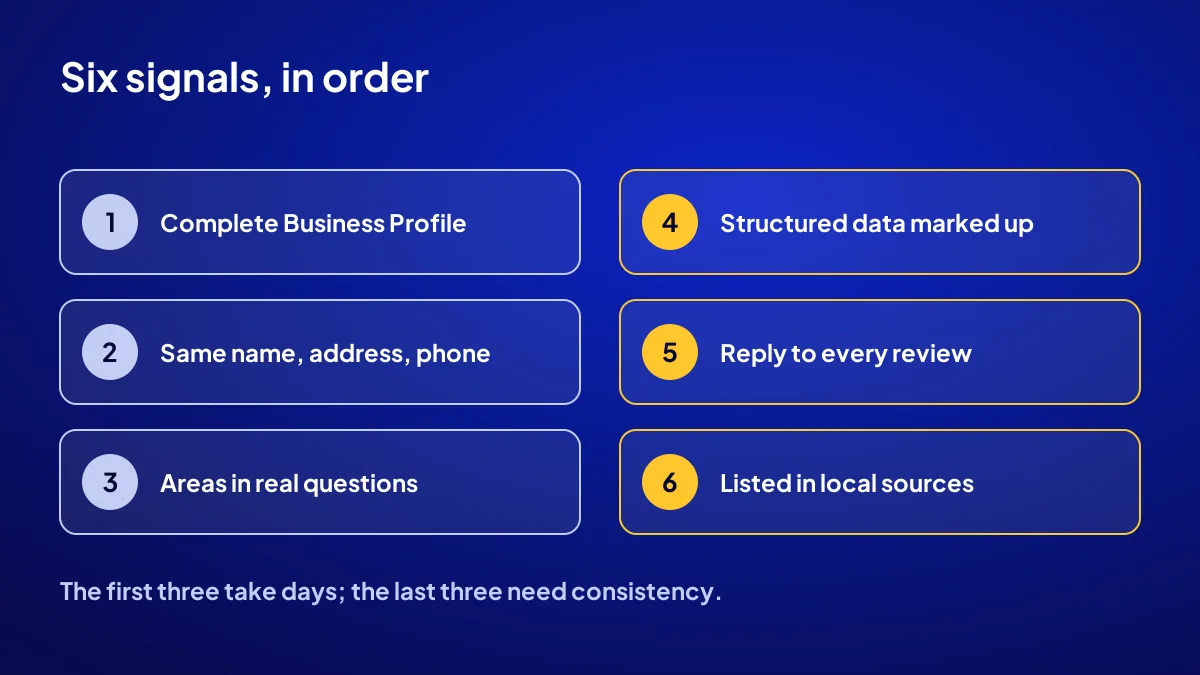
Order matters, because each signal builds on the one before. First the core listing, then the site, last the mentions and reviews. The six steps below are a sequence a small business can run between customers, with the shutters open. The first three take a few days; the last three need consistency.
- Business Profile: Complete category, services, hours and photos; add public holiday hours too.
- NAP consistency: Same name, address and phone on site, profile and directories.
- Neighbourhood language: The areas you serve appear on the site in real questions.
- Structured data: Address, hours and service area are marked up.
- Reviews: Ask every customer, and answer every review, bad ones included, briefly and calmly.
- Local mentions: Appear with correct details in trade associations, local news and sector directories.
Common mistake: Chasing review count while leaving the profile half empty. Plenty of reviews with no service list, and the assistant still cannot match you to an “implant” question.
How assistants pick brands
For non-local questions, we collected why assistants recommend certain brands in how to get recommended by assistants.
Measure before you fix
Before you start, ask three assistants the same neighbourhood question and note the answers. Ask again a month later. If the till is not ringing, you look for the reason in that note, not in guesswork.
Can a recommendation be guaranteed, and what does the campaign set up?
No one can guarantee an AI recommendation; the assistant builds the answer and its sources can change. Adapte’s AI SEO campaign gives no guarantee either. What it does is build the groundwork for a business to be readable and recognisable, and measure it with opening and closing diagnosis cards. For a local business, that covers most of the six signals above.
What in the package matters locally
Brand profiles and directory signals, entity setup, structured data, Q&A blocks on existing pages and 108 articles across 6 question groups. On measurement: AI traffic in GA4, plus Search Console and Bing Webmaster Tools setup.
Price, timing and places
TRY 36,000 + VAT, fixed; at 20 percent VAT that is TRY 43,200, but check the current rate on your invoice. Delivery takes 30 days, 12 businesses per period, with a 10 percent coupon. The full package is in AI SEO with 108 articles, and you apply on the AI SEO campaign page.
Quick Summary
- A local answer is built by reading map listings, websites and reviews together.
- Google’s three factors are relevance, distance and prominence; all but distance sit largely with you.
- At Istanbul’s scale, meaningful answers form at neighbourhood level, so name it on your site.
- Name, address and phone should read the same everywhere.
- Six signals, in order: profile, NAP, neighbourhood language, structured data, reviews, mentions.
- There is no recommendation guarantee; groundwork is built and measured.
Short Glossary
Prominence: Prominence is a local ranking factor used to describe how well known a business is through reviews, links and mentions.
NAP consistency: NAP consistency is the term used for writing a business’s name, address and phone the same in every source.
Service area: Service area is a profile field used to define the districts a business travels to or serves customers from.
Next Step
To see why your name is missing in your neighbourhood, you need a diagnosis first. Apply to the AI SEO campaign, share your site and target questions, and get your diagnosis card.
Frequently Asked Questions
Source: Google Business Profile Help — Tips to improve your local ranking on Google
Sık Sorulan Sorular
ChatGPT and Perplexity also draw on web results and data sources of their own choosing, without fully disclosing which source carries what weight. So rather than leaning on one platform, the safer path is having your name written the same way in several trusted places.
If “dental clinic” is your category but “implants” or “children’s dentist” appear nowhere, relevance stays weak for those questions. Your service list, description and site pages should speak the same language.
Copy pages for every district do not work and tell the reader nothing. The stronger path is answering real questions in the areas you truly serve: “How do I reach the clinic from Yakuplu by public transport?” or “Do you make home visits in Gürpınar?”
No. No recommendation guarantee is given. The AI SEO campaign builds readability and recognisability groundwork and measures the result with opening and closing diagnosis cards.
Brand profiles and directory signals, entity setup, structured data, Q&A blocks on existing pages and 108 articles across 6 question groups. Delivery takes 30 days.
AI-referred traffic is measured separately in GA4, and Search Console and Bing Webmaster Tools are set up. Opening and closing diagnosis cards are compared on the same yardstick.
Updated: October 2026